
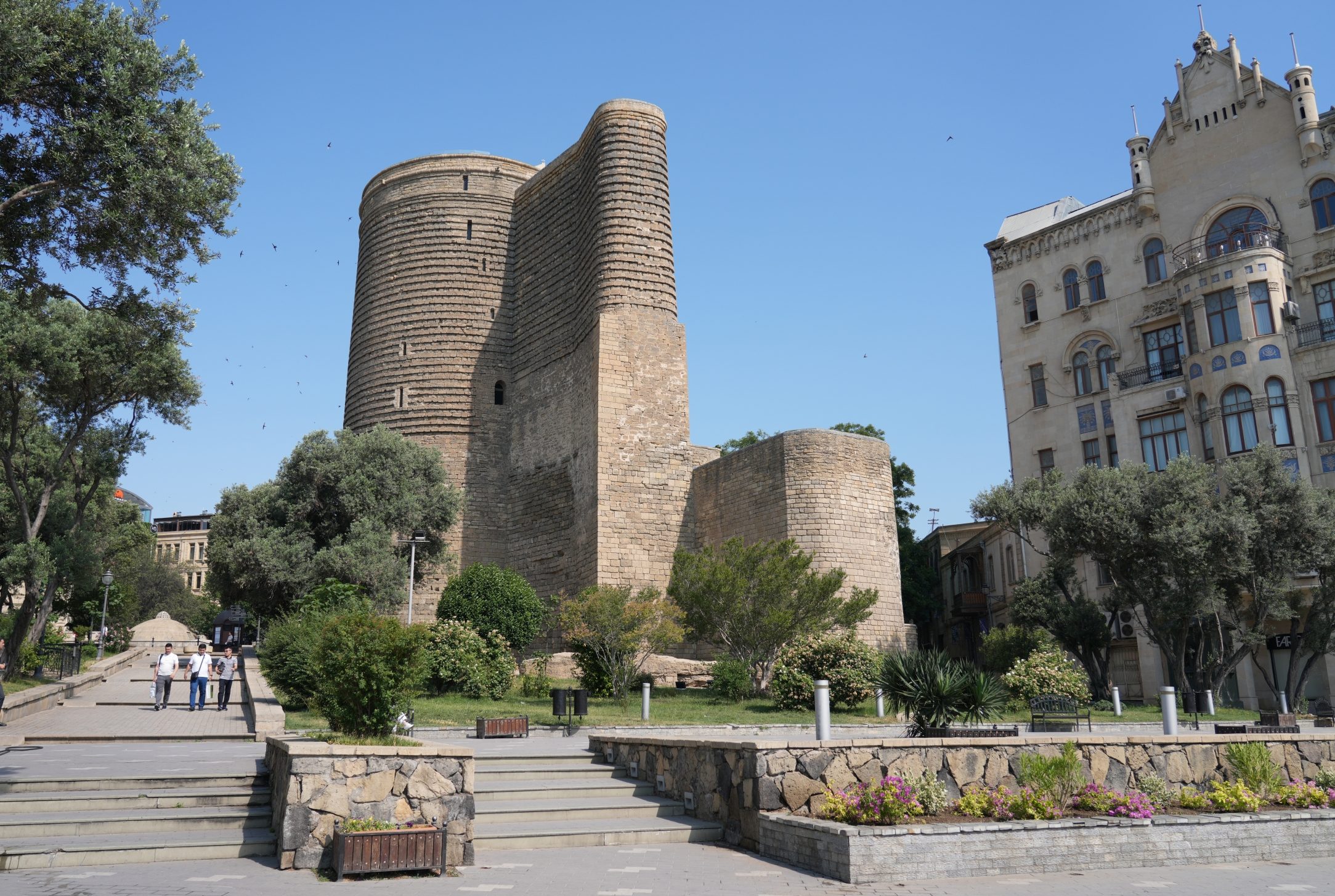
Baku is a wonderful, eclectic city filled with such a wide array of architectural styles it will make your head spin. On paper, it seems as if the Old City’s stone buildings, the European Rococo properties and the tall modern skyscrapers wouldn’t blend well. In fact, it is this contrast of styles that gives the city so much character. Each of these neighbourhoods contains a treasure trove of sites that are fun to discover.
We’ll begin by taking you through Baku’s Old City. In the next post, we’ll explore the modern faces of Baku.
A Little History
This area has been inhabited since Paleolithic humans, but it was in the first century AD that a fortified port city was established. It changed hands a few times before it came under the Shirvanshahs Dynasty in the 11th and 12th centuries. The Shirvanshahs ruled parts of Azerbaijan, called Shrivani, from 861 until 1538. Their capital was in the town of Shemakhy, over 350 km away. In the 12th century, an earthquake destroyed it, forcing their capital to be moved to Baku. In addition to destroying the buildings, the earthquake resulted in the deaths of many, including the wife and children of the ruling Shah.
It was the Shirvanshahs that brought Baku to its full potential. Under their rule, the port on the Caspian Sea prospered and the city soon filled with palaces, caravanserais, bathhouses and mosques. They remained in charge until the 1500s when they were defeated by a Persian Dynasty. Control of the city then went back and forth between the Ottoman and Persian Empires. In the early 1800s, it became a protectorate of the Russian Empire and then fell under the control of the Soviet Union until 1991.
Old City (Icheri Sheher)
Today Baku has a wonderful Old City and is where you should begin your visit. Much of what we see today in the historic quarter is from the Shirvanshahs Dynasty.
City Wall and Gates
The Shirvanshahs built a city wall to protect their new capital from frequent attacks. The 12th century wall may have originally been a double wall, but today, only the original one remains. One of our favourite activities was walking around the wall and admiring the gates. The wall is in very good condition and still protects three sides of the city so, on those sides, these gates are the only ways in.


Once you have explored the city wall, it’s time to see what’s hidden inside. The medieval buildings were built from local limestone, giving it a monotonal appearance. But it is far from bland, in fact, the Old City is quite magical.
Here are some if the key spots to see in Icheri Sheher:
Shirvanshah’s Palace
The most notable building in the Old City is the Shirvanshahs’ Palace Complex. The 15th century palace was built both as the royal residence and for State business. It suffered damage from the many battles it saw, and after the Shirvanshas left, it was only used intermittently by various rulers. The palace was eventually abandoned. Today, some of the buildings have been partially restored, and the palace is open as a museum.
The complex was built on a hill, so the 9 remaining buildings are on three separate levels, each with its own courtyard. The first courtyard is in front of the palace residence and offers views of the modern city beyond the ramparts.

The original residence building had 52 rooms, but today’s version has far fewer. Those that have been restored are sparsely decorated and have very little furniture, so the building doesn’t have the typical opulent feel of a palace The most elaborate is the Throne Room, where we found a few details carved into the walls.


Behind the residence is the Divankhana building. The modest stone pavilion has a large courtyard surrounded by a colonnade. There used to be 8 small rotundas in the yard, but they were not rebuilt. It was likely a courthouse and reception hall.
As you move further down the palace tiers, you will find two mausoleums, both from the 15th century. The most interesting one architecturally is the pointy-roofed Dervish Mausoleum. Adding to its look are the ruins of Keyqubad Mosque in front. The mausoleum was the burial site of prominent local Sufi scientist and philosopher Seyid Yakhya Bakuvi. On the lowest level, you’ll find Shirvanshahs’ Mausoleum. When we compare it to some of the mausoleums we’ve seen in the Islamic world, this one is quite unremarkable. The mausoleum was built for the mother and son of the leader, but other family members were also buried there.


Across a large courtyard from Shirvanshahs’ Mausoleum is the Palace Mosque. Inside, there is a large prayer room for the men and a separate, dark prayer room for the women. You can also see the ruins of baths from this courtyard.

Overall, this UNESCO Heritage Site is interesting, but it is not as highly decorated as you would expect for a palace.
Entry fee is 15AZN. You can buy a multi pass for 3 sites. The Palace, Maidens Tower and Treasury. Hours – 10 am – 6 pm
Maiden Tower
Despite its height and unique shape, not much is known about the origins of Maiden Tower (Giz Galasi/ Qız Qalası). At 31 m tall, it has 5 m thick walls on the first floor, but the walls become thinner as they stretch up the building. Its lower levels date to the 6th century and its upper floors to the 12th. Some claim the tower dates as far back as the fire-worshipping Zoroastrian people from pre-history. Others say it was built by Caucus Albanians in the Middle Ages and used for defense. Both may be true since there is evidence of a 7th century BCE construction below the tower. We’ll talk more about Zoroastrians below.
The uniquely shaped building is a UNESCO World Heritage Site.

Inside the tower you’ll find a basic museum. Entry fee is 15 AZN. Hours 10 – 5 pm
Mohamed and Juma Mosques
Not far away from the Maiden Tower are two heritage mosques. The 11th century Mohamed Mosque (also called Siniqqala) is the oldest mosque in Azerbaijan. Only a block away is the 12th century Juma Mosque which was built on the grounds of a Zoroastrian temple. You can see in the pictures that many newer buildings in the old town are squeezing in on both.


Caravansaries and Baths
Located on the shore of the Caspian Sea meant that Baku was a stop on medieval Silk Trade routes. They traded local minerals, fossil fuels and carpets in exchange for precious gems. You can see this part of their history in the old caravansaries, or inns, in the historic centre. Most that are still standing today are used as restaurants or shops. You can also visit the ruins of Bukhara Caravansarai, located behind Maiden Tower.


There were also several baths in the old city. Their domed roofs are interesting features.


Balconies
Almost all the buildings in Baku’s Old City were constructed using limestone from nearby quarries. Even though they are quite monochromatic, they are not plain. What makes them even more special are their overhanging balconies that served as a status symbol for wealthy merchants. Today, they are one of the best features of the historic centre and make a good reason to wander these streets with your head up.
There are also buildings from later centuries that don’t hold much interest, but the narrow, winding lanes still follow their centuries-old routes, giving the old town a nice atmosphere.


Ateshgah Temple (Fire Temple)
There are a few sites outside the Old City that are connected to the area’s history. Before converting to Islam, most people living in Azerbaijan were Zoroastrians. In this region, natural gas has never been far from the surface. This phenomenon resulted in a prevalence of fires that burned directly on the ground. Some burned for thousands of years before dying out and were called eternal flames. They are the reason Azerbaijan is nicknamed ‘The Land of Fire’. Knowing this unique detail makes it easy to envision how this fire-worshipping religion began. Zoroastrians believed that fire was a manifestation of their divinity, which is why they worshipped it. The religion likely took hold in the 2nd millennium BCE, and yet, some of these ancient beliefs are still followed in parts of Azerbaijan today. We first learned about Zoroastrians in Wakhan, Tajikistan, where it has also integrated with Islamic beliefs. You can read that story here.
North of Baku, in the village of Surakhany, is a site that is important to both Zoroastrians and Hindus. The eternal flame on this site was originally an ancient site of prayer for Zoroastrians. During the Silk Trade days, fire-worshipping Hindus would stop at this spot to worship and built Ateshgah Temple over the eternal flame. The original temple is no longer here but, you can still visit the complex that was built on the same spot in the 17-18th centuries.


The temple is surrounded by a tall wall with a dozen or more cells that were once used by those on pilgrimages. The fire stopped burning naturally, so it is no longer a pilgrimage site, but rather a tourist attraction. An artificial fire burns every day in the temple located in the centre of the complex. The old pilgrimage rooms are used to display artifacts from the area.

If you have extra time, it is an interesting part of the country’s history, but the site itself doesn’t have a lot to see.
Entrance – 9 AZN; Hours – 10am-7 pm
Getting to Ateshgah Temple
Located on the edge of Baku, it is possible, but not easy, to reach Ateshgah Temple by public transit. We took Yango there and back for only a few dollars. It is also included on some day tours from Baku.
Mardakan Fortress and Round Tower
This perfect medieval castle stands out like a sore thumb in this modest residential community in Baku. The 12th century Mardakan Fortress and nearby Round Tower were built to provide lookouts for the Shirvanshahs Dynasty. Unfortunately both are being restored so we couldn’t go inside. Once the restoration is complete, they will likely be interesting sites, but in 2025, all you can see are their outer walls.
Our taxi driver didn’t know about these old buildings so took a selfie of himself and sent to his friends as he drove us back to the centre of town.


Getting to Markakan Fortress and Round Tower
We used Yango to reach the two sites and unless you have your own car, that is likely the only way to reach them. Once the renovations are complete, it may be easier to reach.
Tips for Visiting Baku & Azerbaijan
How to get to Baku

Currently you can not enter Azerbaijan through its land borders. You can exit to Georgia, Russia and Iran by land, but the borders are closed for entry. The easiest way to reach Baku then, is by flying into Baku’s Heydar Aliyev International Airport. Depending on your home country, you may need a visa to enter. Getting one online is the easiest way and takes approximately a week to process. You can find them here.
Getting around Azerbaijan
It’s quite easy to get between cities using public transit, but finding information online is more difficult. The app BILETIM.AZ has most bus routes and you can purchase tickets on the app. It does not have information or tickets for marshutkas that travel between smaller centres.
Getting around Baku
Walking is the best way to get around the Old City. In fact, many sites can only be accessed by foot. It is also only a short walk to Nizami Pedestrian Street. For sites further out, you can take the metro. Reloadable cards can be purchased for 2 AZN and then loaded with enough for your trips (40-50 gapik (cents)/ride). Metro cards can be shared.
Another option are the ride-share apps Yango and Bolt. We used both and found Yango had shorter wait times and cheaper fees, but we had more hiccups with them. Also remember that traffic is very bad during rush hour. The population of Baku is 2.5 million but it seems like there are 4.5 million cars. So, sometimes it is faster to take the Metro than a taxi.
A funny thing that we’ve never seen before occurred with the ride-share apps in Baku. You may find that there is more than one driver on a Yango or Bolt account. This means that your driver may not have the same license plate number that the app tells you because there is more than one driver and car using the same account. They will show you their phone with your ride on it so you know it is legitimate.
Where to stay in Baku
There are many choices for every budget in Baku. Since most of the sites in Baku are in or near the Old City, that is typically the best part of the city to stay. That means staying within walking distance of Shirvanshahs’ Palace or Maiden Tower. The other option is to stay near Nizami Street. Here you will find a lively atmosphere and be close to many local and international restaurants.
Where to eat in Baku
The streets in and around Nizami Street have a large concentration of restaurants. It is always a busy part of town, but there seemed to be more Azerbaijanis than foreigners. Our favourite restaurant was Nergiz. They offer very tasty dishes with perfectly seasoned meats and vegetables.
Food – The Azerbaijani diet is heavily meat based with lamb, beef and chicken dishes that are roasted, skewered or barbecued. For vegetarians, local restaurants also usually offer excellent soups and vegetable dishes with similar seasonings. The flavours seem to blend the tastes of Turkey, China and the Arabic world. Alcohol is not usually available.
– Breakfast was our favourite meal of the day. We had our choice between 3 or 4 types of eggs, meats, cheese, olives and phyllo pastry filled with spinach or cheese. It is a tea culture, though. You can find coffee shops with espresso and cappuccino, but in hotels, it is usually instant or a weak drip coffee.
Language – They speak Azerbaijani which is a Turkic language. If you remember any Turkish words from trips there, you will recognize a few here. The younger generation speaks broken English and the older generation speaks Russian. Richard learned Russian in school and it helped a lot to get around in some places. They don’t seem to mind, in fact some told him they thought the country was better off when it was in the Soviet Union.
Also, they use a modified Roman alphabet so it’s not too difficult to read signs.
What to wear – Even though Azerbaijan is a Muslim country, it is not nearly as conservative as others. Local women mostly cover their legs, but short sleeve tops are common and their hair is not covered. Some tourists wear shorts or knee-length skirts and it seems to be fine. When visiting religious sites, though, you must dress conservatively, which means covering your arms and legs.
ATM – Businesses use a mix of cash and cards. Not all ATMs service international bank cards. We had success with The Premium (there’s one on arrivals level at the airport), Bank of Baku and YapiBank. Rates were approximately the same in each.
Safety – Azerbaijan is a very safe and honest country. We walked everywhere, through many neighbourhoods, and didn’t once feel unsafe. We met a couple who said the most dangerous thing in the country are the sheep dogs. If you come across them when hiking, be sure to keep your distance as they are very aggressive.


This article is now featured on GPSmyCity. To download this article for offline reading or create a self-guided walking tour to visit the attractions highlighted in this article, go to Walking Tours and Articles in Baku.
To read more of our adventures in Azerbaijan click here.
Coming Next – Explore The Modern Architecture of Baku
For pictures from other blogs go to Gallery at monkeystale.ca
To read about more of our adventures go to Destinations.
If you like what you read, please comment or share (with credit) using the links below.






We'd love to hear from you, please leave a comment.