
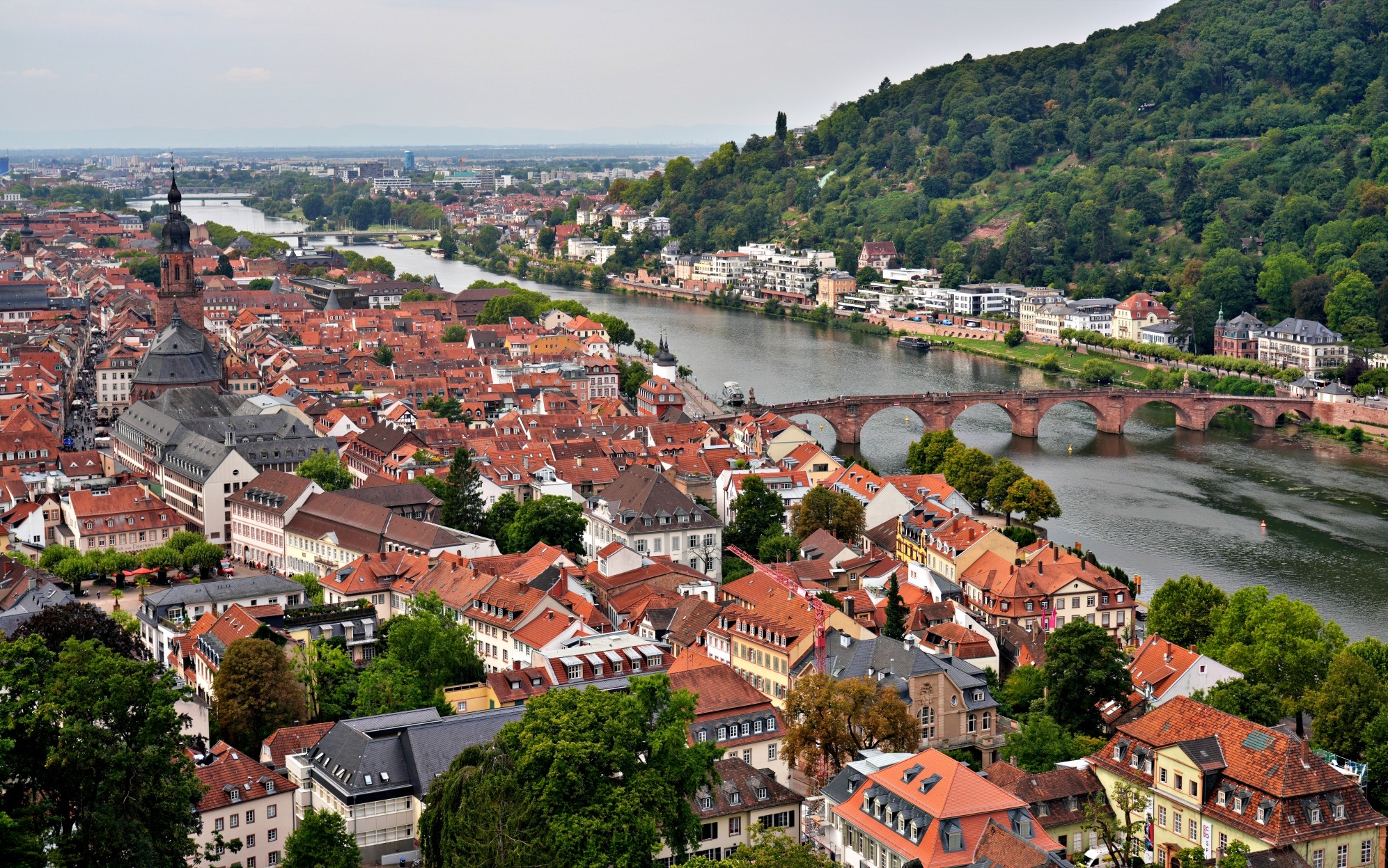
Heidelberg’s compact Old Town fills in the land between its castle on a hill and the Neckar River. Unlike Frankfurt, almost every building in the centre is authentically historic because the city escaped damage during WWII. This detail endows the vibrant university town with a timeless charm, making it a joy to visit. Join us as we step back in time and explore the many things to see in Heidelberg’s enchanting Old Town.
With so much to see, Heidelberg is said to be one of the most visited cities in Europe. While we did notice that there were quite a few groups at the castle, the rest of the enchanting old centre didn’t feel too busy. Having said that, there is a reason why the castle is busy; it is a wonderful medieval castle, and that is where you should begin your visit.
Heidelberg Castle
Standing on a hill above the city’s Old Town, Heidelberg Castle has an imposing position. Adding to its impenetrable appearance are sturdy ramparts above a deep moat. Its look, however, is softened a little by the surrounding verdant forest.
Seeing the castle from below will undoubtedly make you want to get a closer look. One way to reach it is on foot by following the cobbled path from the base of the hill to the edge of those tall, stone walls. On the way, the views of Heidelberg below get better and better.


After passing through several stone gates with elbow corners, you’ll reach a large balcony. This open spot allows you to look down upon the Neckar River and the red rooftops of the city below.


Even though the view of the river is lovely, once you turn around, your attention will be diverted from that scene. The wall behind the balcony boasts a stunning display of carvings of lions, flowers and other motifs. This is the rear of a building called Friedrich’s Wing, and it gives you a small hint of what you’ll see when you pass through the last castle gate.

Although a castle has stood on this hill since the 1200s, it wasn’t until the 1400s that the designs we see today were added. At that time, Germany was a part of the Holy Roman Empire and was ruled by Prince-Electors. The elaborate details on some castle buildings are the result of several successive Prince Electors who wanted to flaunt their success with more impressive palaces. Collectively, they turned the stoic castle into one of the most beautiful in the Empire.
Friedrich’s Wing
We were surprised by the outer wall of Friedrich’s Wing, but once we went through the final gate and saw it from the front, our jaws dropped. Its façade is adorned with dozens of statues of knights and kings from the royal family, making it the most elaborate of the Elector Prince buildings. This elegant wall was almost destroyed by a lightning strike in 1769, but was thankfully rebuilt in 1895. Seeing Friedrich’s Wing is reason enough to visit Heidelberg Castle.


The lower level of Frederick’s Wing has an unusual artifact. The 16th century Big Barrel holds 130,000 litres of wine. You can appreciate its size by seeing the people standing below it in our picture.

Ottheinrich’s Wing
Unfortunately, Heidelberg Castle was damaged in the Thirty Years’ War and also by several lightning strikes. It was only partially restored in the 19th century; as a result, you’ll see many ruins interspersed between the wow-factor buildings. Those ruins, though, only seem to add to its allure.
One of those ruins is Ottheinrich’s Wing (Ottheinrichsbau). Built by Prince Elector Ottheinrich, it was the first to begin converting the complex into a piece of Renaissance art. It is almost as stunning as Frederich’s, but it sustained significant damage and wasn’t rebuilt. In the picture below, you can see that not much remains of the building’s interior beyond its front wall.

Between the two is the less ornate Glass Hall (Gläserner Saalbau). It was used as a banquet hall and was not preserved after being damaged by lightning. Its best feature is the sundial that is supposed to be one of the most accurate clocks in the city.


Apothecary
An interesting part of the castle is the German Apothecary Museum held in the lower level of the Ottheinrichsbau building. It takes you through the history of pharmacies, showing their progression through the Middle Ages.


Ruprecht’s and Ludwig’s Wings
Prince Electors Ruprecht and Ludwig built the most functional, but less glamorous, buildings in the castle. They were home to several necessary shops and services such as a bakery, butcher shop and tailor. These buildings weren’t restored.

Gate Tower
We didn’t realize it, but by walking up from Old Town, we entered the castle from the rear. If you drive or take the funicular, though, your main entrance is through Gate Tower. Its 40 m tall clock tower once had a dungeon in the basement, but it was mostly used as a defence tower and guards’ room.
If you do enter through the main gate, before you leave the castle, make sure you walk to the balcony behind Friedrich’s Wing for the wonderful views of Old Town and the Neckar River.


Englisher Bau
Built by Elector Friedrich V and his English wife, Princess Elisabeth Stuart, the English Bau was the last building added to the castle. Built atop the old Thick Tower, Friedrich converted the tower’s ground floor into a dining room. It is mostly in ruins today and is best seen from outside the castle.
Schefelterrasse
Once you’ve seen the castle, don’t forget to walk around the outside of its walls to admire its features. The best views of the castle are from Schefelterrasse on the next ridge. A paved walking path travels from the castle to the terrace, making it easy to visit this viewpoint.
Schefelterrasse is outside the castle and has no entry fee.


How to get to Heidelberg Castle
There are several ways to reach the castle. The most popular ways are either to drive or take the funicular up to the castle’s Tower Gate. The other option is to walk from Old Town. If you do walk, partway up, the trail splits into two. One way is to take the stairs to Tower Gate; the other is a pathway that slowly climbs up to the castle grounds, where you eventually reach the balcony behind Friedrich’s Wing. We walked up one way and down the other and found both to be enjoyable and scenic walks.
Entrance fee – €11 Euro; Opening Hours – 9am-6pm except holidays. Guided tours are also available and take you into some areas that are otherwise closed.


Old Town Heidelberg
After seeing the views of Old Town from the castle, you’ll want to visit these wonderful streets in person. Even though it was not damaged during WWII, the city was badly damaged during the 17th century’s War of Succession, so most of Old Town dates from the rebuilding done after this war.
Haupstrasse
Begin your exploration of Old Town Heidelberg’s many charming sites on its long pedestrian street, Haupstrasse. Here, the pastel coloured buildings seem to go on forever, and as you walk, you will think that each building is prettier than the last.
One to look out for is the Ritter House. It was one of the few buildings that remained unscathed during the War of Succession. Other features we enjoyed seeing were the many quirky statues that sporadically decorate the buildings.


As you walk, don’t forget to wander up and down the many side streets, lined by even more heritage buildings. Heidelberg seems like a never-ending wonderland of pretty scenes.


Church of Holy Spirit
Along the side of Haupstrasse is the gigantic Church of the Holy Spirit. The Gothic building is unique in design, sporting a tall mansard roof above red stone walls. At its front is a tall tower where you can usually climb to its top, but it was closed when we visited.
Inside, stained glass windows provide the only colour to the space.


Market Square
Dwarfed by the massive cathedral, Market Square is bordered by lovely heritage buildings, including the pink City Hall. At its centre is Hercules Fountain. Some say it was built to commemorate the Herculean effort needed to rebuild the city after the war.
Today, it is a vibrant spot where patios spill out onto the cobbled square, but in medieval times, the square had a more sinister role. It was the site for witch trials and public burnings at the stake.


Corn Market Square
Only a block away is Corn Market Square (Kornmarkt). If you haven’t seen the castle yet, this is where you can get your first view of the imposing structure. Even though the castle looms above, the square is very quaint with potted plants hanging from many of the half-timbered buildings. As its name alludes to, Corn Market Square was originally a vegetable market.


Heidelberg University
Founded in 1386, Heidelberg University has buildings scattered throughout the Old Town, including its library. As the oldest university library in Germany, it may also be one of the most beautiful. Decorating its exterior walls is a gorgeous mix of Renaissance and Art Nouveau ornamentations, which makes it a work of art, rather than just a building. Unfortunately, in autumn 2025, scaffolding covered most of the library, but we could see its decorated upper floors and rooftop.


In front of the old library is University Square with a lion fountain that was once a major water source for the town.

Other University buildings are Heidelberger Marstall and Hay Barn, which are leftovers from the city’s defence system. Heidelberger Marstall was a medieval armoury and horse stable. Today, it’s being put to good use as a university building and cafeteria. Hay Barn was constructed of rubble masonry and originally was used as a watchtower, but in the 1800s, it was used to store hay, which gave it this more recent name.
A few blocks away is the former student prison. It was used to penalize students who committed transgressions. We were surprised to learn that it was in operation until 1914.


Old Bridge
Its location on the Neckar River adds a lot of charm to Heidelberg. Nowhere is that more obvious than the Old Bridge and its Bridge Gate (Brückentor). Two thick, white pillars joined by a gate guard the entrance to the pedestrian bridge. It must have been a good spot for bridges since there have been eight on this same site. The first was a Roman Bridge built in the 1st century.


From the bridge, you have a great view of the castle above Old Town. Looking the other way, across the river is Philosopher’s Walk, where you can see Heidelberg from a different perspective.


Sitting beside the white pillars is the strange-looking Bridge Monkey. To us, it looks more like a male orangutan than a monkey. It was placed there to remind citizens that when they cross the bridge, they should look over their shoulder as a reminder of where they came from and to remain humble.
A brass monkey has been on this spot since the 15th century. The current one was crafted in 1979 by artist Gernot Rumpf. Apparently, if you rub the monkey, you will be granted good luck. We saw another of Rumpf’s bronze statues in Mainz. You can read about it in our post Mainz: The Perfect Day Trip From Frankfurt.

We visited Heidelberg on a day trip from Frankfurt, but it is such a nice city that you may want to stay overnight.
To read about the historic centres in Frankfurt and Mainz, visit our posts Explore Frankfurt’s Old Town, and Mainz – The Perfect Day Trip From Frankfurt.
Getting to Heidelberg
It is very easy to visit Heidelberg on a day trip from Frankfurt. DB Trains run from Frankfurt Hbf station, or the airport, arriving at Heidelberg Hbf. Several trains depart throughout the day, but some require connections. Once you reach Heidelberg Hbf, you can walk to Old Town. If not, it is a short taxi ride, or you can catch bus 20 or 33 to the Rathaus-Bergbahn stop. It is usually cheaper to buy a return ticket.

This article is also featured on GPSmyCity. To download this article for offline reading or create a self-guided walking tour to visit the attractions highlighted in this article, go to Walking Tours and Articles in Heidelberg.

To read more of our adventures in Germany, click here.
Coming Next – Mainz – The Perfect Day Trip From Frankfurt
For pictures from other blogs go to Gallery at monkeystale.ca.
To read about more of our adventures go to Destinations.
If you like what you read, please comment or share (with credit) using the links below.




We’d love to hear from you, please leave a comment.