
There are many wonderful sites to select from within a short drive of Yerevan. They are so close, in fact, that you can often see several in one day. From historic monasteries to natural features, there seems to be something for everyone. We joined a tour that is dubbed ‘From Paganism to Christianity’ because it combines the pagan Garni Temple with the early Christian Khor Virap and Geghard Monasteries. Since they are in the area, we also stopped briefly at Arat Reservoir, Symphony of Stones and the Arch of Charents. We think that this combination of sites makes a great day trip from Yerevan.
Have a look at them below and see if they interest you too.
Click on the link to go directly to Garni Temple or Geghard Monastery.
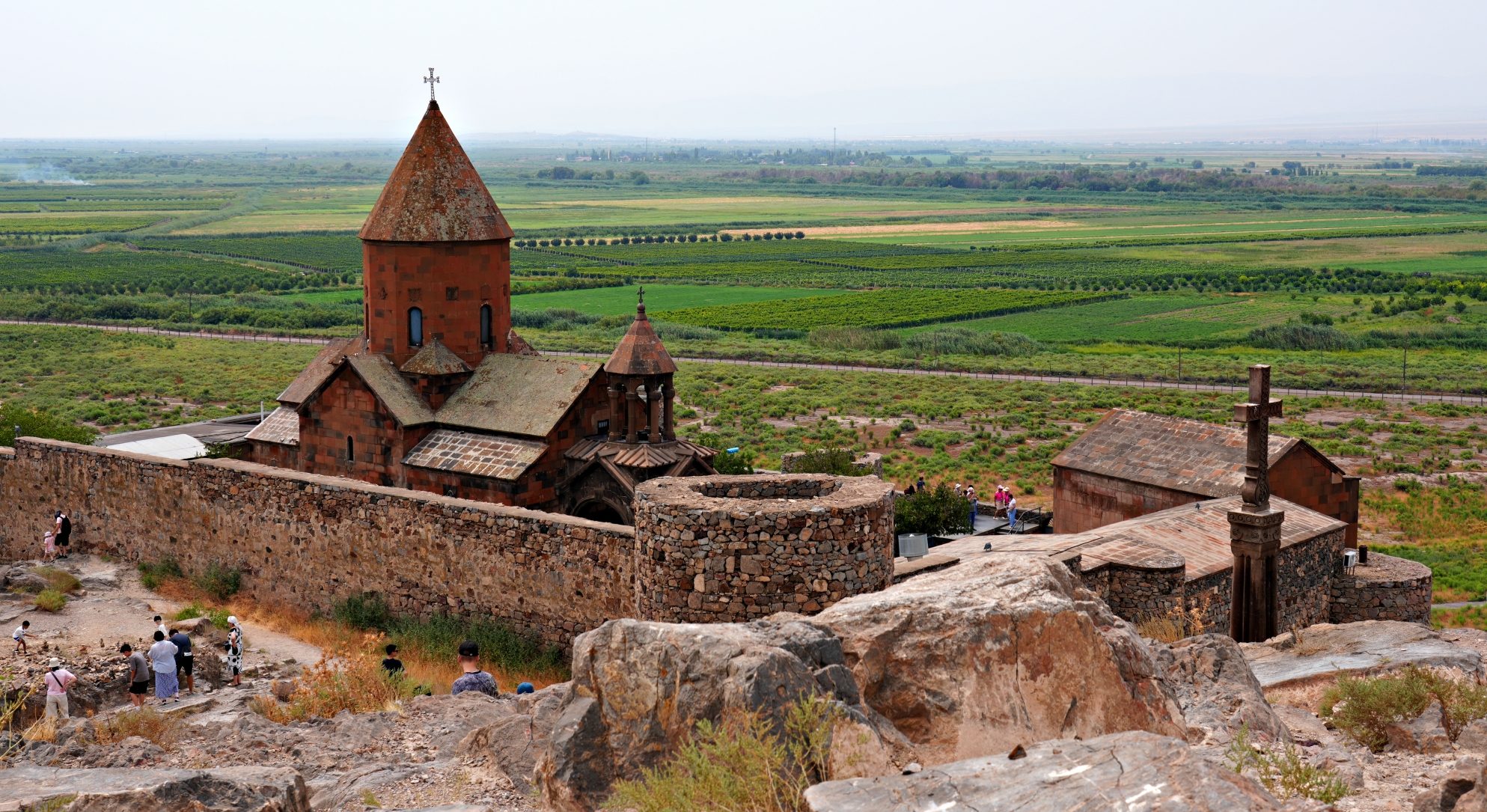
Khor Virap Monastery
The closer we drove to Khor Vrap Monastery, the better the views of Mt. Ararat. Set in the shadow of the mountain, the monastery has a picture-perfect setting and is the archetypal image of Armenia. Unfortunately, though, a persistent heat haze prevented us from getting a clear view of the mountain.
Located in Armenian territory for generations, Mt. Ararat is strongly tied to the country’s legends, history and identity. In 1923, though, the border between Armenia and Turkey was redrawn, and Mt. Ararat (5,137m/16,853 ft) ended up on the Turkish side. Seeing it from Khor Vrap Monastery made it even more obvious how close the mountain is to Armenia. Today, the monastery is only 100 m from the Turkish border.


On the long walk up to the monastery, you’ll pass an old cemetery and then several replica khachkars. These stone stelae are engraved with a cross and other decorative elements. Khachkars were erected as memorials to celebrate a new church or to commemorate victories in battles. You’ll see them throughout the country.


The monastery was built atop the ancient city of Artashat, which was the site of an important event in Armenia’s Christian history. Its name, Khor Virap, means the Pit, which hints at its legend. Late in the 3rd century, King Tiridates III held St. Gregory the Illuminator captive for 13 years for preaching Christianity. At the time, Gregory was a preacher, not yet a saint.
The prison cell in Artashat was a pit, dug deep underground, and infested with venomous snakes and scorpions. After Gregory spent 13 years in the hole, King Tiridates III became gravely ill. His sister had already converted to Christianity and convinced the king that Gregory would be the only one able to cure him. The king eventually agreed, so Gregory was thrown a rope and climbed out of the pit. When on safe land, he prayed for the king’s health, and soon after, the king became miraculously cured. After this, the king converted and became such a strong believer that he declared that the entire country would be Christian. As a result, Gregory became St. Gregory the Illuminator.
You can read more about St. Gregory in our post about Etchmiadzin Cathedral.

A chapel was built over the prison in the 7th century, and, although that building was replaced, the old pit is still there. Today, visitors are allowed to climb down into the pit, and thankfully, there are no longer snakes or scorpions. Getting into it is not an easy feat, though. Access is down a narrow shaft on a rusty, old ladder. It was stiflingly hot in the chapel above, and we weren’t sure we wanted to go down into a suffocating hole. Eventually though, we decided we should. Our hands were slippery with sweat as we slowly descended. Finally, we landed in the small, damp stone room. The pit is a barren space, except for the engraved crosses and an altar carved into the walls. It would have been an awful place to spend an hour, never mind 13 years.
There is a second, even smaller pit under the chapel, but its entrance is so tight that you have to squeeze through it feet first to reach its ladder. We decided we didn’t need to visit this one.


In addition to this old chapel, there are a few other buildings on the monastery grounds. There is a second chapel, cells for the monks and the main church, St. Astvatsatsin. Other than the stone altar, the church’s interior is sparsely decorated. Its dark basalt walls only hold a few paintings of Jesus and Mary.
For us, the best part of visiting the monastery is seeing its location below Mt. Ararat.


Entrance is free; Opening Hours – 9am-7pm, daily, except holidays.
Azat Reservoir
On the way to our next stop, Garni Temple, we stopped at Azat Reservoir. Its blue water provides a nice contrast to the surrounding arid mountains. Located at 1,050m (3,500ft) elevation, we had another hazy view of Mt. Ararat in the distance.


Entrance is free. Apparently you can SUP and paddle on the reservoir but we didn’t see anyone or any rental shops. If you have a car and plan to drive to the reservoir, it is at the end of a rough 10km gravel road. Conditions vary throughout the year, so you may need a 4WD.
Garni Temple
One of the most unique sites in the area is a temple that looks like it belongs in ancient Greece or Rome rather than Armenia. Balancing on the edge of a steep gorge is the stunning Garni Temple. In the 1st century AD, King Tiridates I built a citadel with this temple at its centre.


Once you climb the stairs and reach the wrap-around balcony, you can have a good look at the columns. There are twenty-four of them to represent 24 hours of the day. The best part of getting so close to them is seeing the intricate leaves, lions and curls that decorate their tops.
Beyond the columns is a wonderfully sculpted ceiling. Try to pick out the images of walnut, pomegranate and grape leaves. These carvings of commonly found vegetation indicated to researchers that local artisans were involved in their designs.


Inside the temple is an altar to the pagan Sun God Mithra. It was placed under a hole in the ceiling so that the sun would shine on the altar. The pagan temple was the target of many invasions, especially after Armenia converted to Christianity. Remarkably, the wonderful building withstood them all. It didn’t collapse until a 17th century earthquake rattled its foundation. The temple was reconstructed in the 1970s using stones found on the site, so what we see is mostly original. During the rebuilding, it was determined that there was no mortar between the stones, and they were instead connected by metal rivets and held in place by molten lead.
Scattered throughout the complex are many large rocks engraved with ancient text. The most important one had Greek writing describing how King Tiridates I of Armenia built both the temple and fortress for his wife in 77 AD. Other details at the site suggest that Roman Emperor Nero donated funds for the temple. The king had ties to the Roman emperor, explaining both the design and the generous donation.
There are also partial remains from the citadel, some of which date back to the 3rd century BCE. You can walk between the ruins of a palace, the 7th-century St. Sion Church, a wine press and other citadel buildings.
Of these ruins, the most interesting is the 3rd century AD, Royal Baths. The building’s foundation is still intact, allowing researchers to understand its clever thermodynamics. Water was heated by fire at one end and filtered under an elevated floor, while the smoke heated the walls. The result was a different temperature in each of the four connected rooms, ranging from hot to cold baths.
Garni was apparently mostly used as the king’s summer residence. It was difficult for us to imagine the need for heated baths in this part of Armenia in the summer because it was in the 40s°C when we visited in August.

At the end of the baths are the remains of a dressing room with a gorgeous mosaic floor. Depictions of Oceanus and Tethys decorate the floor and is the only mosaic of its kind in Armenia.


With the rebuilt temple and the bathhouse, it’s easy to understand why Garni is on the UNESCO Tentative List.
Entrance – 1500AMD (€3.40); Opening Hours – 9am-10pm, daily
Symphony of Stones
Immediately below Garni Temple is a unique, natural phenomenon known as columnar jointing. The bizarre canyon is composed of collapsed basalt, volcanic rocks that appear to be streaming down from above. The best view is from the bottom of Garni Gorge, where you can look up at the 50 m high features. Because of its pipe organ appearance, it is called the Symphony of Stones.


From the end of the canyon, you can see Garni Temple on the edge of the cliffs above.

Entrance – 300AMD (€.70); Opening Hours – 9am-6pm.
Geghard Monastery
Standing above the Azat River Gorge is the UNESCO World Heritage Site, Geghard Monastery. It is a great place to visit, not only for its historical importance, but also because of its canyon setting. First established in the early 4th century by St. Gregory the Illuminator, its original name, Airivank, translates to Monastery in the Cave. The name comes from the number of cave cells located in the mountain wall above, as well as the one inside the main church that has a sacred spring.

You can still explore some of the old cave cells and chapels. Some are natural caves, while others are hand-carved. In most, their dark interior walls are sculpted with crosses, niches and other details. These caves were necessary to help protect the monks and royals during the countless invasions by Arabs and Seljuks


One of them has a very small entrance that leads to a long hallway decorated with engravings. This path takes you deep into the mountain and opens up into a large mausoleum for the royal family. It’s even more impressive when you remember it was all hand-carved out of the rock.


The monastery’s name today is Geghardavank, which translates in English to The Monastery of Spear. According to legend, St. Thaddaeus brought a sacred spear to the caves. It was the spear used by a Roman to pierce the heart of Jesus. This legend makes Geghard a very important pilgrimage site.
A replica of the spear is on display in the church. The original now resides in Armenia’s first capital, Etchmiadzin, although there are many others around the world that also make that claim.

Below the caves is the main church. Its outer walls are made from granite blocks, but the interior ones are basalt stones and have crosses carved into their surface. In addition to these typical symbols, this church features a decoration we hadn’t seen yet in Armenia. Persian-style muqarnas adorn the ceiling and cornices.
A wedding was taking place in the main sanctuary when we were there. Doesn’t that setting make wonderful wedding pictures?


On the side of this room is the entrance to a cave chapel. Inside, you’ll find the spring that first brought St. Gregory to this spot. It was difficult for us to get close to the spring, though, because there were so many parishioners dipping their hands or feet in the holy water. While we waited for the crowd to dipserse, we looked around the cave to see many details carved into the cave walls and ceiling. With so much ornamentation, it would be easy to forget that we were inside a cave.


In addition to the caves and church, there are several replica khachkars on the monastery grounds.

Entrance is free; Opening Hours – Summer 20am-9pm, Winter – 10am-5pm.
Charents Arch
The arch was built in 1957 and isn’t much to see on its own, but from it, you have a nice panorama of the countryside. If you’re lucky, you may have a clear view of Mt. Ararat. We must have worn out our luck by seeing the mountain twice already that day, because all we saw was clouds. The arch is etched with lines from the Armenian writer Ydghishe Charents’ poem My Sweet Armenia.


How To Visit These Sites
If you don’t have your own car, getting to these sites by public transit is possible, but is very arduous. Each involves a combination of a marshrutka and a taxi. As well, most of the villages are very small, so there are only a few taxis available. The more common option is to take a tour. On the streets in the centre of Yerevan, you can’t miss the dozens of vans that advertise their tours. Each agency has several combinations of sites to choose from. These are often only transportation and do not include a guide. We used Arman Tours and were pleased with the service.
To find out more about Yerevan, go to our post Yerevan Top Sites To Visit In Yerevan.
Garni and Geghard can be found in the middle of the map below, the other sites are not far from them. Click on the map to be directed to interactive map.
Other great day trips to consider from Yerevan are: Etchmiadzin, Amberd Fortress, Lake Sevan, Wine Tasting in Areni, and Tatev Monastery. Click on the links to read our posts from each area.

Click on the link to read our Travel Tips For Armenia.
To read more of our adventures in Armenia, click here.
Coming Next – Day Trips From Yerevan: Amberd Fortress And Mt. Aragats
For pictures from other blogs go to Gallery at monkeystale.ca.
To read about more of our adventures go to Destinations.
If you like what you read, please comment or share (with credit) using the links below.




We’d love to hear from you, please leave a comment.