
Super Soakers squirted us with water as we walked down the sidewalk. Then, we saw other unsuspecting people getting doused with buckets of water thrown from balconies or fountains. In neighbourhoods, passersby were being sprayed with garden hoses. Our first day in Yerevan, Armenia happened to coincide with Vardavar, Water Festival. Yerevan gave us quite the welcome, and we hadn’t even begun to see its many sites.
Click on the arrow to see our Vardavar pictures. (On phones, slide to see next picture)


Of course, this isn’t a typical day in the city, so once the fun and games were over, we explored Yerevan and found many top sites that we’ll share with you.
To go directly to tips on where to stay, eat and how to get to Yerevan click here.
About Yerevan
First settled by the ancient Uartu Kingdom, Yerevan is one of the oldest, continuously inhabited cities in the world. Times weren’t necessarily good to them, though, as the Armenians suffered through many wars, invasions and unwelcome rulers. We’ll discuss some of this in more detail below.
When the Soviets took over, Yerevan was a war-torn, derelict town and was considered unfit to be a Regional Soviet capital. That’s where Russian-born architect Alexander Tamanian entered the scene in 1924. His job was to transform Yerevan into a respectable Soviet capital. He was also involved in the design of the city of Gyumri. You can read about this lovely city in our post Things To See In Gyumri.
Tamanian laid out a plan for the city, with Republic Square at its centre, but it was called Lenin Square at the time. So, let’s begin our discovery of Yerevan’s top sites in this central square.
Republic Square
Built in the Neoclassical style, the pink volcanic tuff stone buildings in Republic Square gave Yerevan the nickname, the Pink City. The first one built is known, logically, as First Government Building. It was constructed in stages and set the architectural design for the rest of the square. Work began in 1926, but most of the buildings we see today weren’t built until the 1950s.

In addition to First Government Building, there is also Second Government Building, another is now Marriott Hotel and the HayPost Office. (Hay translates to Post Office in English). We heard the post office was very grand inside. Maybe it once was, but it looks a little tired nowadays. Only the marble columns and chandeliers hint to its former glamorous life.


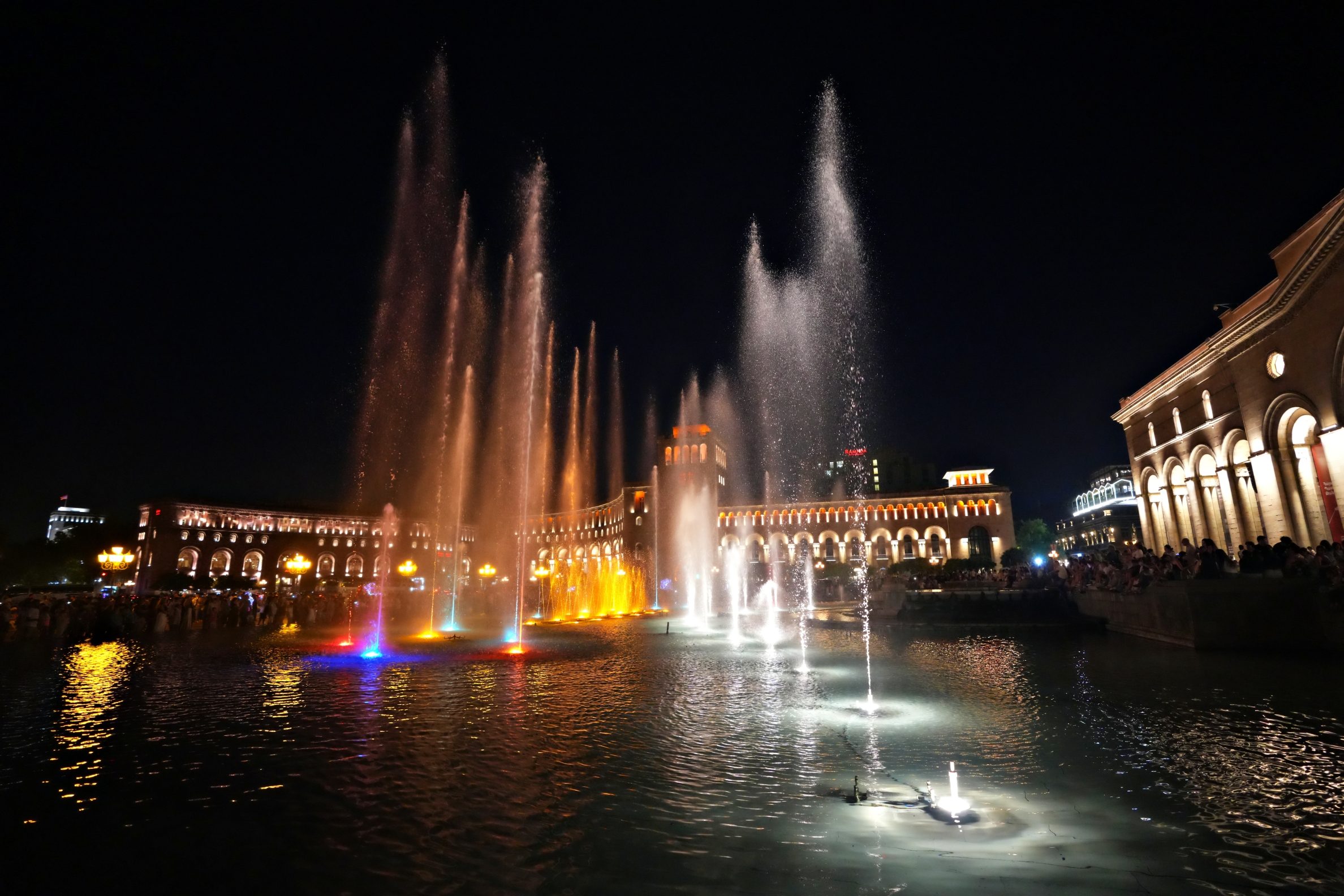
Republic Square is popular with locals who commonly call it Hraparak, meaning The Square, in English. It is especially busy in the evening when everyone comes to see the fountains come alive. Music and lights accompany The Dancing Fountains Show to create family-friendly entertainment. We were quite impressed with the show, and think you’d like it too.


Tip – The internet lists many different start times for the show, so it is confusing. In July 2025, the show began at 9 pm. It is typically held every day except Mondays. As you can imagine, when we visited the fountains on the night of Vardavar, they were almost completely void of water, and therefore there was no show.
History Museum of Armenia
Also on the square is one of the most important sites in the city, the History Museum of Armenia. It shares the youngest building on Republic Square with the National Gallery of Armenia. The museum features a large collection of Armenian artifacts that dates as far back as the Bronze Age. The ones we found the most interesting came from places we visited in the country, including the world’s oldest shoe from Areni, a beautifully carved door from Lake Sevan, a four-sided stela from Harichavank Monastery, and a stone with the oldest known inscription of the Armenian language. Click on the links above to go to our post from each artifact.
Tip – Don’t confuse this museum with the Yerevan History Museum. We didn’t visit it, but were told it wasn’t as well done.


Northern Avenue
Between Republic Square and the Opera and Ballet House is a long pedestrian walkway. Northern Avenue is bordered mostly by red tuff Soviet-era buildings that have been repurposed into designer clothing stores and coffee shops. It was often busy, but especially at night, when temperatures cooled down, making a walk much more pleasant. Although we found the long pedestrian walkway was a good way to get between the two ends of the historic centre, we didn’t find much reason to stay for long.

Armenian National Opera and Ballet Theatre
Yerevan’s main architect, Tamanian, also designed this large, prominent building at the end of Northern Avenue. We weren’t able to get inside the Opera and Ballet Theatre, but it is said to have excellent acoustics, so it would have been nice to go to an Opera performance.

Erebuni Fortress
Overlooking the city from its position atop Arin-Berd hill are the ruins of the ancient Erebuni Fortress. Built by the Uartu Dynasty in the 8th century BCE, the fortress marks Yerevan’s beginnings. The dynasty once ruled a vast area in Armenia and Eastern Turkey as early as the 9th century BCE, but it only lasted for two centuries. We were already familiar with Uartu’s fortresses, having visited one in Van, Turkey. You can read about that here.
Not much remains of the fortress today, except for its long rampart. When you get closer, you can see the large blocks of red tufa and basalt used in its construction. The blocks were piled on top of each other without mortar, and they covered the wall with clay, making it waterproof. Inside, only remnants of the mud walls of a few buildings remain.


The ancient Uarutu had a written language. Remarkably, cuneiform inscriptions made by King Argishti in 782 BC, were found in the fortress foundation. In the inscription the king names the fortress as Erebuni and himself as king. You can see it at the History Museum of Armenia.

Entrance to the fortress is free, but the nearby museum charges 1500 AMD (€3.40). Opening Hours for both is 10:30am-4:30pm, Tuesday to Saturday.
Armenian Genocide Monument and Museum
Armenia is located in a tenuous spot, being a Christian nation sharing borders with Turkey, Iran and Azerbaijan. As a result, they have suffered many battles and invasions over their history. The worst, by far, was in the 20th century when the Ottoman Empire decimated the Armenian population living in what is now Eastern Turkey.
It began after the Turks suffered a humiliating defeat at the hands of the Europeans in the First Balkan War (1913). WWI resulted in more embarrassing losses and was the impetus to begin their killing spree. In 1915, the Ottomans started with the mass deportation of Armenians from the Ottoman-controlled Armenian Highlands (Eastern Turkey). Most men were subsequently conscripted into the Ottoman army, followed by the arrests of Armenian intellectuals and elites. At the same time, they exiled women, children and the elderly to Syria. The Armenians were mostly housed in concentration and work camps. If they didn’t die on the long walks to these camps, they died inside them as a result of starvation, torture or mass murder. This genocide continued until 1919. In total, an estimated 1.5 million Armenians were killed. Turkey denies that there was a mass government-led extermination.
On a hill above the city, the Armenian Genocide Monument and Museum was built to remind everyone of these atrocities. The museum is difficult to visit because it takes you through the details of this history, including personal stories and images. Like similar museums around the world, though, it is important to keep these times in people’s memories.
Outside the museum, a 12-sided monument surrounds an eternal flame. Beside it is a small forest of evergreens donated by world leaders.


Entrance is free; Opening Hours – 10am-5pm, Tues to Sunday.
Saint Gregory the Illuminator Cathedral
Armenia was the first country in the world to adopt Christianity in 301 AD, beating Georgia by 25 years. Saint Gregory the Illuminator Cathedral was built in 2001 to commemorate their 1700 years of Christianity. The church is on a hill above the city and has a long staircase that takes worshippers up to its front door and two accompanying chapels.
We’ll explain more about the Armenian Apostolic Church in our next post about Etchmiadzin Cathedral.


With such a long history as a Christian country, you would be right in thinking there must be a lot of churches and monasteries throughout the country. Here are a few of those we found in Yerevan.


The Matenadaran
The Armenian Alphabet was created in 405 AD by linguist and theologian Mesrop Mashtots. He did so because he wanted to transcribe the Bible into Armenian. After studying other alphabets of the time (Greek, Assyrian, Aramaic and Persian), he realized that none of them contained all the phonetics used in the Armenian language, so he decided to create one. It ended up being 36 letters, which was expanded by 3 more in the 12th century. For this, he was venerated as a saint by the Armenian Apostolic and Catholic Churches.
A statue of Mashtots and his alphabet stands outside the museum.

We had hoped this library would provide us with some of this history, but it did not. Instead, it displays manuscripts, scrolls, books, and documents from Armenia, Georgia, Persia, Syria, Greece, and other countries. Some date as far back as the 5th century, but most are from medieval times. It was interesting, but not what we had expected, so we left a little disappointed.

Its official name is Mesrop Mashtots Institute of Ancient Manuscripts.
Down the street from the museum is a nice art installation of the Armenian Alphabet, called the Eternal Alphabet. We’ll take you to an other monument dedicated to the alphabet located outside the city, soon.

The Armenian language was difficult for us to learn. At the top of the difficult words is shnorhakalut’yun (thank you). Thankfully, many Armenians use ‘Merci’ instead. This comes from their relationship with the beloved crooner Charles Aznavour. The French singer has Armenian roots and is loved throughout the country, and he has performed there often. At the end of his concerts, he would say ‘Merci’ to the crowds. It caught on as a frequent way of saying thanks.
A statue of him can be found in a small Yerevan park.

The Cascades and Cafesjian Center for the Arts
This monument of steps and fountains was a part of Alexander Tamanian’s 1924 urban plan for Yerevan. Construction didn’t begin until the 1970s, though, and was only partially completed when an earthquake in 1988 halted progress. Then, it was abandoned with the fall of communism in 1990. In the mid-2000s, Armenian-American Gerard Leon Cafesjian set out to complete the monument, but it remains unfinished.
At the base is a sculpture garden including works by Colombian artist Botero and other international artists. We already saw some of Botero’s work in Cartagena, Colombia and instantly recognized his rotund bodies on display here. At first, we thought Laughing Man was one of his, but it is the work of a Chinese artist.


Today, The Cascade has retained its Brutalist style with 572 steps climbing the hill between the Opera House and Victory Park on top. The strange Soviet style cement staircase has five terraces, each with a display of fountains in typical Soviet geometric designs. The only things to break up its drab appearance are the green hedges at each level.
At the top is a tall monument celebrating the 50th Anniversary of the October Revolution (Soviet Armenia); a celebration of their freedom from Ottoman rule. The site is still unfinished, though. Between The Cascade and the monument is a construction site that has been ongoing since 2009.


If you don’t want to walk up the 572 steps, you can take the indoor escalators and step out at each level to see the fountains. The escalators display art from Castejan’s personal collection, and galleries off to the side showcase a variety of artists’ work. Honestly, we enjoyed the sculpture garden at the base the most.
Entrance is free but there are often separate art exhibits that charge a fee. Opening Hours – The Cascade is open 24/7, the Cafesjian Center for the Arts is open 10am-6pm, Tues to Sunday.
Victory Park and Mother Armenia
Across the road from the 50th Anniversary Monument is the large, treed Victory Park and the Mother Armenia statue. Originally, a statue of Stalin stood on this spot, but it was dismantled in 1967 and replaced by the 22 m tall copper Mother Armenia. By carrying a sword and a shield, she signifies power and the unbreakable will of Armenian women. A military museum is housed in its base.


It was often very hazy in Yerevan, so we could rarely see far outside the city. When we visited Mother Armenia, we were surprised to have a view of Mt. Ararat, far away in Turkey. Located on the Armenian Highlands, the mountain was once in Armenian territory, but the lines were redrawn after the Turks signed the Treaty of Kars with the Soviet Republic.
Ararat translates to Holy Land, or High Land, depending on your source. We’ll take you for a closer look at the mountain in the coming days.

Entrance is free; Opening Hours – 11am-11pm, daily. The park and statue are open daily, but the museum is closed on Mondays.
Street Art The Streets of Yerevan
Outside of these main sites, most of Yerevan is in rough shape, with many of its Soviet buildings falling into disrepair. However, we saw wonderful examples of street art throughout the city, showing us that people are trying to improve the city’s appearance.


Blue Mosque
As the only functioning mosque in Yerevan, the tall, blue-tiled dome of the Blue Mosque contrasts with the red tufa in the old town. The dome is one of the most colourful we’ve ever seen. Inside its main gate, you’ll find a matching tiled minaret, as well as the former madrasa and a manicured garden.


Entrance is free, appropriate dress is required.
Khachkar Park
Not far from Republic Square is a nice park with flower beds, trees and a manicured lawn. The main focus of the park, though, is not nature; it is the 13 khachkars that are on display. The park was established to commemorate the 100th anniversary of the Armenian Genocide, and the khachkars on display are copies of those destroyed during the genocide.
A khachkar is an upright stone monument with a hand-carved cross and other decorative elements. Each one has a unique design. The use of khachkars began in the 800s and can be found throughout the country. They were often placed on the grounds of new churches or when converting pagan sites to churches, but were also used to commemorate victories in battles or as grave markers. We’ll show you many more as we travel across Armenia.


At the far end of Khachkar Park is Vernissage Market. The art market has a few nice stalls, but it mostly sells touristy stuff.

Kond Neighbourhood
The Kond neighbourhood is the oldest part of the city and was left untouched by Soviet architects. The hodgepodge of homes are unlike the rest of Yerevan, but does look somewhat similar to small towns and villages we visited throughout the country. If you’re not exploring other parts of Armenia, you may enjoy a walk through this neighbourhood.


Ararat Brandy Company
Armenia has a history of wine and brandy making since ancient times, so we knew we wanted to do tastings while in the country. The oldest brandy distiller in Armenia, Ararat Brandy Company, is located in Yerevan, across the river from the historical centre. We went on a tour of their museum, which, most importantly, included brandy tasting.


They use 6 grape varieties, all from Armenia’s wine regions. After warming the brandy with our hand and swirling it in the glass to observe the tears, we said ‘Genats’ (cheers) and took a sip. We tasted three brandies and our favourite was their smooth 7 year old Ani Brandy. Overall, the brandy was good, and we preferred it to most Armenian wines.
We thought about buying a bottle of their best, until we saw the price tag of 2.1 million AMD (€4,790).


How to get to Yerevan
The capital city is well connected. To reach it by air, you will fly into the large Zvartnots International Airport. It receives flights from many European cities, as well as Georgia, Russia, and Arab countries. To get between cities within the country, the most economical option is by marshrutka. There are many marshrutka stations throughout the city, though, so know which one your ride will depart from. Marshrutkas don’t often travel between the smaller towns, though, so you may have to return to Yerevan to reach another destination. Like most marshrutkas, they typically leave when full.
There is also a limited railway, between Gyumri and Yerevan. The train schedule is online here.
You can find Yerevan near the centre of the map below. It is an interactive map, so you can zoom and click on any markers.
Getting around Yerevan
The historic downtown is quite walkable, but for sites further out you can take the metro, or one of the ride-share apps, Yango or GG.
Where to stay in Yerevan
As the capital of Armenia, there is a large variety of hotels and apartments for rent in the city. Expect prices to be higher than in smaller regions in the country. Try to find one within walking distance to Republic Square. Many are listed on Booking.com.
Where to eat in Yerevan
Almost every block in Yerevan’s downtown has a long string of patio restaurants. Some are inside small parks, while others take over sidewalks. It will not be difficult to find a restaurant in Yerevan. A nice option is the tree-lined Sayan Street, which has many cafes to choose from. You can also find quite a few restaurants across from the Opera House and in Freedom Park.


This article is now featured on GPSmyCity. To download this article for offline reading or create a self-guided walking tour to visit the attractions highlighted in this article, go to Walking Tours and Articles in Yerevan.

Click on the link to read our Travel Tips For Armenia.
To read more of our adventures in Armenia, click here.
Coming Next – How To Visit Etchmiadzin and Zvartnots Cathedrals
For pictures from other blogs go to Gallery at monkeystale.ca.
To read about more of our adventures go to Destinations.
If you like what you read, please comment or share (with credit) using the links below.
While in Yerevan, you may want to do one of these great day trips: Etchmiadzin, Garni/Khor Virap/Geghard, Amberd Fortress, Lake Sevan, Wine Tasting in Areni, and Tatev Monastery. Click on the links to read our posts from each area.




We’d love to hear from you, please leave a comment.