
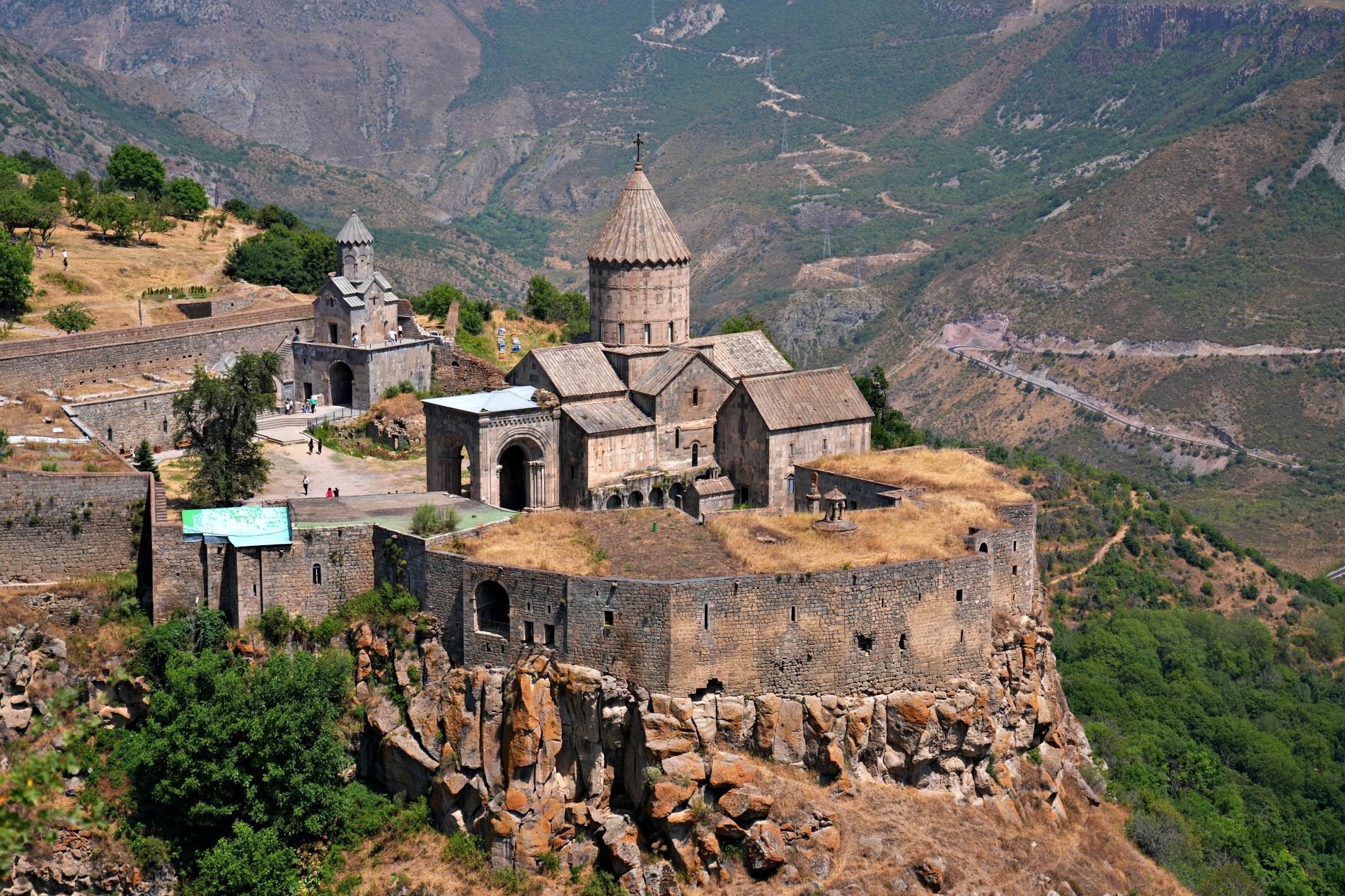
Built on the edge of the deep Vorotan Canyon, Tatev Monastery is a must-see in Armenia. Not only does it have a spectacular location, but the monastery also showcases some of Armenia’s most impressive medieval architecture, making it one of Armenia’s true treasures. Let us introduce you to this important and picturesque monastery.
Tatev Monastery
The fortified monastery was founded in the 9th century, and by the 11th, Tatev had expanded into a large educational centre. As many as 1,000 monks resided and studied at the monastery, and it was considered the leading school for manuscript copying in the region. In the 14th century, it was home to one of the most important universities in Armenia. With such a prestigious history, we knew we wanted to visit Tatev.

The monastery’s location in an earthquake zone near present-day Iran and Turkey resulted in extensive damage to the buildings from both earthquakes and invasions. The most recent earthquakes occurred in the 1930s and 1960s. After each disaster, it was rebuilt. The latest work began in the 1960s and continued into the 2000s, so that today, much of what we see was restored or rebuilt.
Our first view of the monastery was from across the deep gorge, where we could see its precipitous location on the edge of the cliff. This view made us excited to explore it further.


Once you enter through the main gate, you’ll be transported back in time to a medieval Armenian monastery.

There are still many buildings inside the monastery walls. Let’s explore each of them together.
St. Gregory the Illuminator Church
The first church to be built was St. Gregory. That 9th century building no longer stands. In fact, it needed to be replaced twice, in 1048 and again in 1295, before recent restorative work began. It’s a simple stone building, but once you are closer, you can see old engravings on the church wall. A decorated tomb at its front entrance adds to its timeworn appearance.


Saints Peter and Paul Church
The main church in Tatev Monastery, Saints Peter and Paul, was built at the beginning of the 10th century. Its front entrance is protected by a unique portico, bordered by large arches. Another detail that is not common in Armenia is the umbrella roof. The only other place in Armenia we saw these was the monasteries near Mt. Aragats. You can read about Hovhannavank Monastery here, Gyumri Cathedral here, or Harichavank and Marmashen Monasteries, here.


The church’s interior walls were originally decorated in frescoes. It would have been nice to see it painted instead of the dark, stone walls we see today. On the side is the tomb of St. Gregory of Tatev, an abbot of the monastery in the 14th century.

Gavazan Column
In the centre of the complex is one of its treasures, the striking Gavazan Column. First built in the 900s, it was dedicated to the Holy Trinity. The column was built using ingenious technology, especially for its time. Most notably, its movable upper section was designed to withstand earthquakes. Remarkably, the 8 m (26 ft) tall structure has never collapsed, even though the surrounding churches have several times.


St. Astvatsatsin Church
Above the main gate is the 11th-century St. Astvatsatsin Church. On first glance, it may not seem that interesting, but there are a few details that make this church worth exploring. First, it is called a mausoleum-church due to its location atop monastic tombs. This lofty spot also put it above the ramparts, so it acted as a watchtower, in addition to being a place of worship. Adding to its rare location, its 8-sided dome is uncommon in Armenia.
Once we climbed the exposed staircase, we saw the final unique detail. Covering its outer walls are centuries-old inscriptions.


Monastic Buildings
There are several monastic buildings around the edge of the complex, including a winery. Most date to the 7th century and haven’t been restored, but you can still wander through their old rooms. One of our favourites is the restored monastic residences. Their perfect barrel roofs and dark stone walls give them a unique and mysterious feel. Today, these buildings are used to display a collection of khachkars and artifacts found in the monastery.


Oil Press
In the 17th century, an oil press was built outside Tatev Monastery’s walls. Monks made vegetable oil from linseed, sesame and hemp. Its location outside the walls allowed villagers to buy the oil without disturbing the monastery.


Vorotan Canyon
Not only is Tatev Monastery an architectural gem, but its location in the picturesque Vorotan Canyon makes it even better. From the edge of the monastery, you can see the deep walls of the rugged canyon that cuts its way between the small clusters of mountains. Seeing the landscape around Tatev Monastery is a nice bonus to your visit.


Getting to Tatev
Most visit Tatev on day tours from Yerevan, but you can see it along with other sites if you base yourself in Goris for a few days. We read online that there are several marshrutkas that run between Goris and Tatev, but there is actually only one, and it is at 10 am. An alternative is to hire a Bolt/taxi from Goris, but be sure to ask them to wait for you because no taxis are waiting at the monastery.
Instead of taking a taxi directly to the monastery, you could also have them drop you off at the base of the Wings of Tatev Cable Car. It’s the longest gondola in the world (5.7km/3 ½ mi). Again, make sure you ask the driver to wait for you at the monastery.
Our interesting taxi experience
We learnt these lessons about the transportation shortcomings the hard way. When travelling independently, sometimes you have to go with the flow. We arrived at Tatev with the ride-share Bolt, but didn’t ask the driver to wait, which was our first mistake. After we finished visiting the monastery, we struggled to find a taxi, and there were no Bolt drivers in the area. Eventually, a man pulled up in his beat-up Lada and offered us a ride, but there was a catch. He needed to get his other car because he didn’t think the Lada would make it to Goris. With no other offers, we hopped in the Lada and went with him to his home, a kilometre or so away. He also wanted to wash up before he went into the ‘city’, so we sat on chairs outside his home to wait. He felt bad for making us wait and offered coffee, but it was in the high 40s°C, so we didn’t want one. Still wanting to show us Armenian hospitality, he went into his large garden and returned with two cucumbers for us! This is yet another example of the warm welcome Armenians give to their guests.
Shamb Reservoir
If you visit both the monastery and Zorats Karer (below), we recommend driving the back highways between the two. It takes you through the tree-covered mountains that rise from tight, deep gorges, and it is much more scenic than the main highway. On the way, you’ll pass a few monasteries and Shamb Reservoir, whose blue water adds a splash of colour.
The turnoff is on the main highway, a couple of kilometres west of Zorats Karer.


Zorats Karer
On top of a small hill, above a steep rocky canyon, is an unexpected ancient site. The monoliths of Zorats Karer (also referred to as Karahunj) make it a one-of-a-kind place in Armenia. Over 200 tall, basalt, monolithic standing stones and boulders, dating from the 18th to 4th century BCE, were placed in straight lines and circles in a large field. For this reason it is dubbed the ‘Stone Henge of Armenia’.
Local legends say that it was a cemetery for military leaders and soldiers. The myth reveals that soldiers were buried vertically under the tall standing stones and laid horizontally under the boulders. Archeologists have confirmed that it is a cemetery, but not the position of the bodies.


A 350m long wall from the 7th century BCE protects one side of the Stone Age city, while a deep ravine protects the other.

Eighty of the huge boulders have holes bored into them. After years of controversy between researchers, it is generally believed that these holes were used to observe and track the movement of stars.


While not an extensive site, it is quite fascinating and we’re glad we stopped by.
Getting to Zorats Karer
Located 38 km from Goris, you will need a car or Bolt/taxi to reach the remote site. We visited on our trip to Tatev Monastery since both are located on the west side of Goris.
Entrance Fee – 500 AMD (€3.40); Opening Hours – 9am-7pm, closed Sundays.
Getting to Goris
You can take a marshrutka between Goris and Yerevan, but they are often full. We flagged one down as it was passing us on the highway in Areni. We didn’t realize at the time, but we were very lucky to get seats. You can not prebook seats on most marshrutkas, but you can for these, and it is wise to do so. They only leave twice a day, at 9 am and 4 pm, from both Goris and Yerevan. There is an office in downtown Goris and in Yerevan at the Intertown Bus Station.
Goris is located in the lower right side of the map below. Both sites in this post are not far from Goris. It is an interactive map, so you can zoom-in or click on a marker.

Click on the link to read our Travel Tips For Armenia.
To read more of our adventures in Armenia, click here.
Coming Next – Sites To Visit Around Lake Sevan
For pictures from other blogs go to Gallery at monkeystale.ca.
To read about more of our adventures go to Destinations.
If you like what you read, please comment or share (with credit) using the links below.



We'd love to hear from you, please leave a comment.