
As we drove over the pass between Lake Sevan and Dilijan, the land transformed from arid, brown hills to ones covered in lush forests. Set inside those forests are historical monasteries that whisper stories from their past. A visit to Haghartsin and Goshavank Monasteries makes a perfect day trip to this remote part of Armenia, so let’s go see them together now.
Located a short drive from the town of Dilijan, you can easily visit the two historic monasteries of Haghartsin and Goshavank on a day trip from Dilijan.
Click on the link to go directly to Goshavank Monastery.
Haghartsin Monastery
Surrounded by a verdant beech tree forest, the white monastery is one of the prettiest we’ve seen. Built from locally sourced travertine, the churches are tightly packed in the complex, and each adds its own unique style and beauty.


The monastery was built under the order of the Bagratid Dynasty, which we first learned about at Sevanavank. It was likely part of the summer residence for two rulers of this dynasty, and that detail may be part of the reason for its elegance.
Haghartsin suffered extensive damage from the many earthquakes and invasions it experienced over its lifetime, but was beautifully restored in 2011 by a Sheikh from the UAE. That restoration means that today, we can see how lovely this monastery once was.

The largest church in the complex is St. Astvatsatsin Church (Holy Mother of God). In front are the ruins of its large travertine gavit (foyer). This room wasn’t restored, but from the thick columns topped with arches, you can imagine how pretty it would have been. When standing in the gavit, look up to see the unique sixteen blind arches that decorate the church’s dome.
A gavit is a foyer outside the main nave in Armenian churches. They are used as meeting halls or as an overflow area for parishioners who couldn’t get inside the nave.


The travertine continues inside and surrounds a large, open nave. Its walls are bare, but the beautiful white stone adds a sophistication that makes it appear decorated.

Beside it, St Gregory the Illuminator Church (10th century), is the oldest in the complex. Even though its foyer was restored, its old stone walls still look their age. Unusual design features in the church are the steps and the small door in front that lead to the sanctuary.

The smallest church in Haghartsin Monastery is St. Katoghike, which was built very close to St. Stephanos. You can see in the pictures below how tight these buildings are to each other. In fact, the easiest way to see St. Stephanos is from its side.


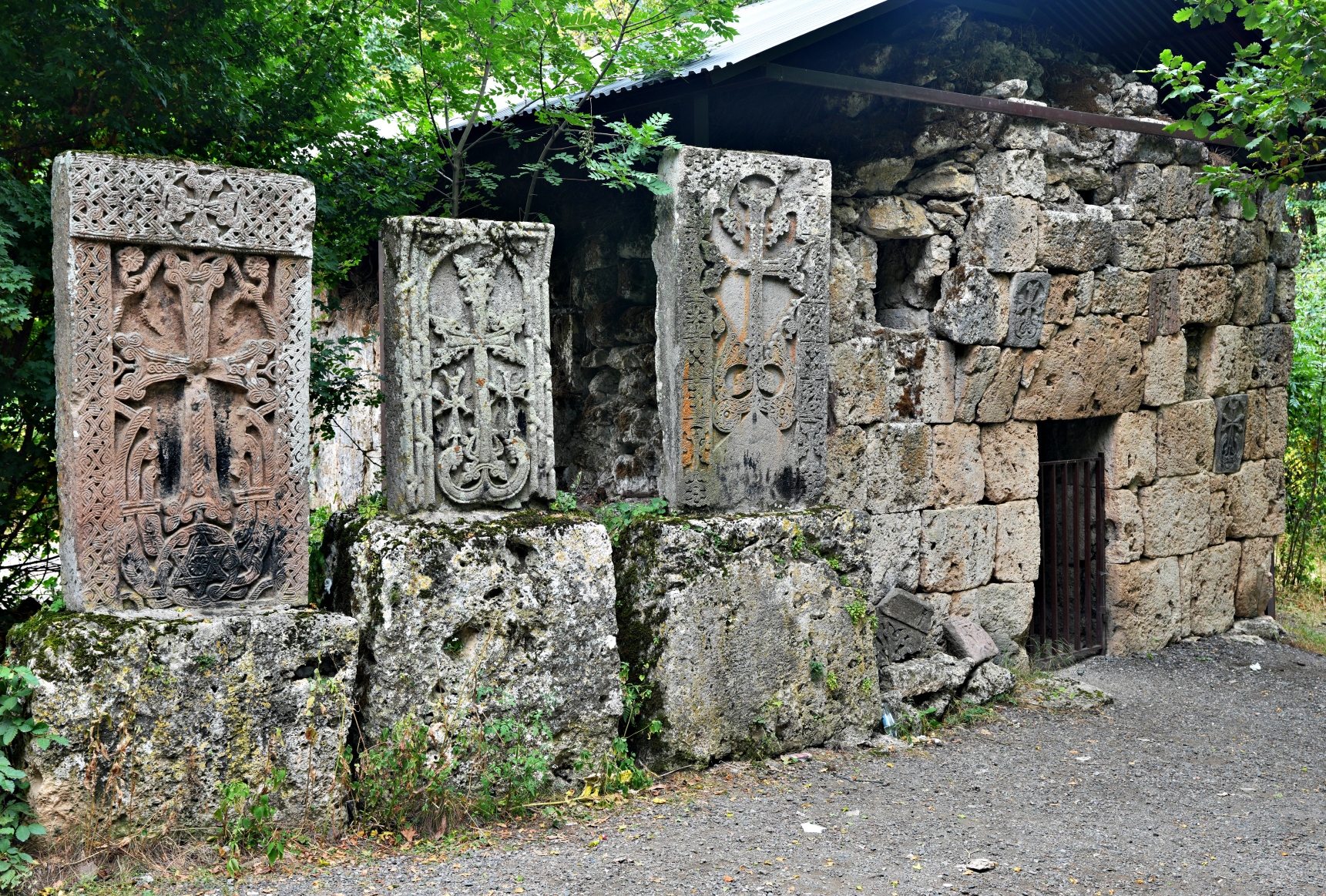
Behind the monastery are a few old and new khachkars, but not far down the road, we found a few more that we liked better. These old khachkars are bursting with character in their position beside a small old chapel.

A small café at the base of the monastery has a lovely tranquil setting. It would be a nice place to take a break if you have time.
Goshavank Monastery
This twelfth-century monastery has a serene, rural location in the village of Gosh. From its hilltop perch, you can look out to see the neighbouring hills, blanketed in healthy, green forests. In addition, its yard is filled with flower beds, and even though we were late in the season, many were still in bloom.


When you enter the main church, St. Astvatsatsin, you’ll notice a sacred aura in its gavit (foyer). The uneven floors and multiple arches look to have many stories to tell.


Attached to the main church is the smaller St. Gregory Church, whose lace-like tympanum hints at the designs inside. One you enter the small church, you will be stunned by the dozens of original, intricately carved designs that adorn its walls.


At the back of the monastery, St. Gregory the Illuminator Church is not remarkable in itself, but it has wonderful old khachkars outside its door.


The monastery’s name comes from its founder, Armenian scholar and priest, Mkhitar Gosh. He developed the monastery into a centre for education, culture and lawmaking. During its height, one of the most unique buildings would have been the bell tower/ library, which once housed over 15,000 religious books and manuscripts. Today, unfortunately, it is mostly an empty space, with no remains of the library.
Goshavank is on the UNESCO tentative list.
How to visit Haghartsin and Goshavank Monasteries
Unless you have a car or are on a tour, you will need to hire a local taxi in Dilijan to take you to these two monasteries. We hired a taxi for 10,000AMD (€22) for the 55km round trip. We did not see them offered on any tours in Yerevan. Reaching Goshavank by public transit from Dilijan is possible, but not Haghartsin.
Dilijan
The town of Dilijan is promoted as having a lovely historic centre. While its restored heritage buildings are nice, it’s not the Old Dilijan we were expecting. It was a good thing that we had other sites on our itinerary.
During the Russian occupation, Dilijan was a favourite weekend mountain retreat for well-to-do Russians. The city was home to weekend villas, quaint shops and hotels. After it lost its favour, the city fell into disrepair. Today, the main site in Dilijan is Sharambeyan Street, home to restored 19th and early 20th century heritage buildings, left over from Russian times. They house workshops and craft stores. It is a nice street, but it is very small and it won’t take you long to walk up and down.


Outside of this one street, the buildings of Dilijan are a little worse for wear, and old Ladas roam the streets. It seems that they are trying to spruce it up with statues and an outdoor concert venue, but it’s not a destination town yet.


Drunken Forest Hike
There are a few hiking trails in the surrounding hills. We did the Drunken Forest hike. From its name, we thought we’d find oddly bent trees similar to those we’d seen in other countries. We were able to find a few with crooked trunks, but it was hardly the highlight of the hike. The trail mostly travels through a dense forest, but offers one nice view of the hilly town below. In general, there are not many viewpoints.
You can find it and other hikes on AllTrails.


If you’re feeling adventurous, you could play laser tag or try out a zipline when in Dilijan.
Getting to Dilijan
Marshrutkas travel between Yerevan and Dilijan, as well as to/from Sevan and Vanadzor. The bus stop is located on the main intersection near the Mimino Statue (above), but you have to flag down the marshrutka, because they will not automatically stop. We ended up hiring a taxi from Sevan to get to Dilijan and then another to travel to Vanadzor. This wasn’t very expensive for the convenience.
You can find Dilijan above Lake Sevan in the centre of the map below. It is an interactive map, so you can zoom in or click on a marker.
Where to stay and eat in Dilijan
There are a remarkable number of hotels and guesthouses in this small town, but remember, it is very hilly. Unless you have a car, it is better to stay closer to downtown, otherwise you’ll have to walk up and down hills. Most of the restaurants are located across from Sharambeyan Street.
Since we tried the popular Gata sweet bread in Sevan, we thought we should try it in Dilijan. It has a thick pastry filled with a sweet walnut paste, which was denser than the one in Sevan. It was tasty, but we won’t crave it.


Click on the link to read our Travel Tips For Armenia.
To read more of our adventures in Armenia, click here.
Coming Next – Debed Canyon Monasteries: Sanahin, Haghpat and Akhtala
For pictures from other blogs go to Gallery at monkeystale.ca.
To read about more of our adventures go to Destinations.
If you like what you read, please comment or share (with credit) using the links below.






We'd love to hear from you, please leave a comment.