
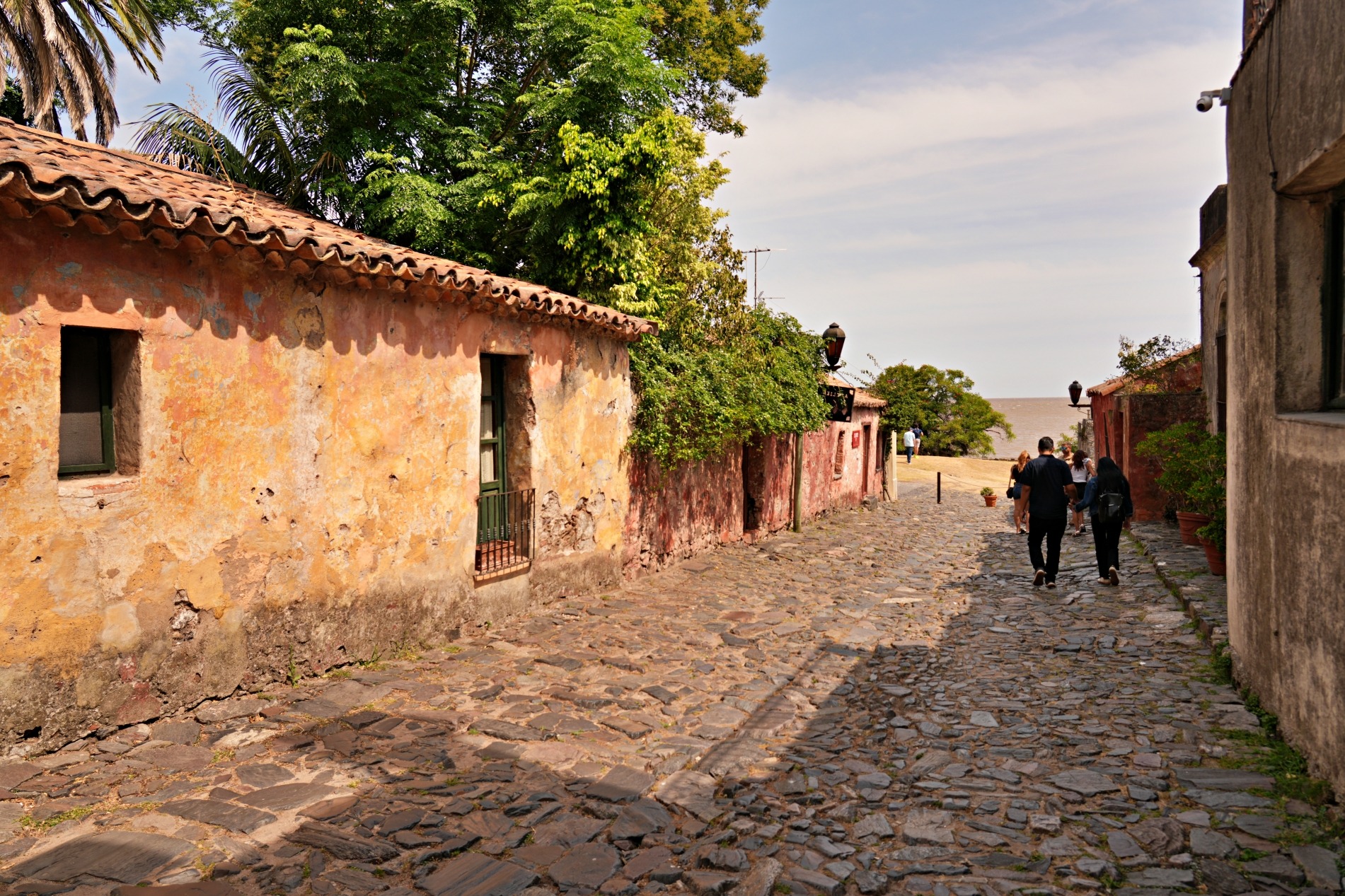
Once surrounded by a tall rampart, Colonia del Sacramento’s centuries-old buildings decorate its cobblestone streets to make it Uruguay’s prettiest city. As you wander through the historic quarter, you can’t help but be enchanted by the rustic grace these Portuguese and Spanish heritage buildings possess.
Situated on the edge of Rio de la Plata, Colonia del Sacramento had a coveted location that made it attractive to both Spanish and Portuguese conquistadors. It was first settled by the Portuguese in 1860, but many battles over it ensued, and ownership went back and forth between the two. As a result, its historic quarter boasts styles from both countries. In some areas you can see a definite difference, while in others, they blend seamlessly from one to the other. When exploring the streets of Colonia’s historic quarter, you will be transported back to those early days.
We arrived in Colonia, as it is commonly called, from Buenos Aires by ferry. Seeing its low-rise homes and uneven shore from the ferry made us excited to explore it further.


Old Port
The deep port on the Rio de la Plata is why the town was first established here. Instead of 17th century ships docked at its piers, today the Old Port (Puerto Viejo) is used by sailboats and fishing boats. You can still get a sense of its age, though, from the old warehouses on the banks nearby.
Ferries arrive a little further down shore, allowing this area to retain its historic feel.


Bastion of Carmen
Standing in front of the old port, the Bastion of Carmen (Bastión del Carmen) was originally built as an artillery platform during the battles between Portugal and Spain. Once at peace, the bastion was transformed into a warehouse and a tall, picturesque chimney was added. Today, the bastion has been reinvigorated again into a cultural centre and small art gallery.

Historic Streets
Not far from the old port is the historic quarter (barrio histórico). The contrast between Portuguese and Spanish is evident in this area from the layout of the streets. The oldest is the Portuguese section. It is quite small, but its old streets seem to have been built as needed, without any planning or forethought. As a result, they are not organized in a grid pattern like those in the Spanish-built parts. Instead, they are a little haphazard, which only adds to their charm.


As you wander between the Portuguese and Spanish sections, you’ll stop noticing the streets and be intoxicated by the time-worn homes that make this area so endearing. Some are brick, others have painted plaster, but most are imperfect and give the centre a lot of character.


Some specific streets to watch for are the following three:
Calle de los Suspiros
Street of Sighs (Calle de los Suspiros) is the most photographed street in Colonia, and for good reason. History seems to hang in the air on this street of worn and faded plaster homes standing beside an uneven cobblestone lane. While not pretty in the traditional sense, we have no doubt this rustic lane will captivate you.
Some say its name, Street of Sighs, comes from the brothels that were once located in these buildings and frequented by sailors.


Calles de Solis and de la Playa
The next street over, Calle de Solis, is another not to be missed. Bougainvillea drapes from its stone walls, and the only other decorations are the old street lights.
Calle de la Playa’s cobblestone is a little rougher, as are its stone buildings, but it is still as appealing as the others. In fact, all three streets are a photographer’s dream.


Plaza Mayor
Not only are the streets non-uniform, but the Portuguese plazas also come in a variety of shapes. Plaza Mayor was the main square during the Portuguese era. Low-roofed heritage buildings wrap around its uneven edge, allowing you to imagine life during those times.


Colonia del Sacramento Lighthouse
Also on the edge of Plaza Mayor is the old lighthouse. It was built in 1857 atop the ruins of the 1690 Convento de San Francisco Javier, giving it a unique look. The lighthouse stretches high above the single-story homes, so can be seen from many parts of old town.
You can climb up to its top for a view of the town. It is a very popular activity, though, so go early in the morning or late in the afternoon, before or after the day trippers, otherwise, there will be a very long lineup.


Plaza de Armas
Another irregularly shaped square, Plaza de Armas, was once home to the Portuguese Governor’s House. Today, the house sits in ruins in the middle of the park, but the sides of the square still showcase charming heritage buildings. Most of them have been restored and put to good use as cafes and artisan shops.


Basilica of the Holy Sacrament
One side of the square is home to the Basilica of the Holy Sacrament (Basilica del Santisimo Sacramento). You may not notice it immediately due to its rather stoic-looking exterior. Once you get closer, though, you’ll realize that its front door has a lot of character with its exposed brick and stone.
Its matching bell and clock tower are difficult to see from the tight plaza, but you can easily see them a block or two away as it soars above the roofs of Old Town.


In addition to the buildings, there are several vintage cars in Colonia. You’ll find them in random spots, and many are decorated with planters or stuffed animals. The one pictured below is on a street leading to Plaza de Armas.

Fortified Wall
Parts of the old Portuguese wall are still standing on the edge of Old Town. One of its best features is Portón de Campo (Field Gate) complete with the old chains from its days as a drawbridge. Above the gate are a few old cannons that still stand in place as if in anticipation of another attack.
Outside the gate is a large park with flowering trees, some of which were new to us, such as the Cockspur Coral Tree.


After spending time exploring the oldest part of the centre, walk beside the river to see it from a different perspective. There are a few interesting sites here, too.
Punta de San Pedro
San Pedro Point (Punta de San Pedro) marks the line between the protected cove of the old port and the rough waters in the more open river. This was once the location of the Bastion of San Pedro, a part of the old rampart.

Santa Rita Bastion
The tall stone tower of Santa Rita Bastion (Bastión de Santa Rita) lets you know it was once a formidable structure. Today, though, the flowering trees and restaurants at its base soften its look.
You can walk down to the rocky shore below it to find a few hidden beaches.


Outside the Ramparts
The streets in the Spanish-built part of the old city are organized in a grid pattern, as we see in many colonial Spanish towns. Most are lined by tall sycamore trees whose branches form an arch over the street, providing much needed shade. The buildings in this area are a mix of Spanish colonial and newer ones, but they are no less pleasant to explore.


Colonia Train Station
The first train arrived in Colonia from Montevideo in 1901. Its station was operational until 1985, when the route, along with many others in the country, was cancelled.
When you visit the old station, you will find a few other remains in the yard from the old days. There is an old train turntable and a water tank used to fill the steam engines.


The Rambla
Colonia del Sacramento has a larger waterfront than we saw in the historic quarter. The Rambla is a pedestrian path that partially follows the coast in the newer part of the city. At its side are several beaches, which is another reason the city is a tourist hotspot. Rowing Beach (Playa del Rowing) is the closest one to the historic quarter.


After showing you these adorable historic streets, you can easily see why Colonia del Sacramento’s historic centre was declared a UNESCO World Heritage Site.
Tips to explore Colonia
The city is a popular one-day excursion from Buenos Aires. As a result, there are quite a few tourists, but they arrive in waves. Many take walking tours, and they all seem to visit the same sites and seemingly in the same order. If there is one tour group at a site, there are likely 5 or 6 more. When planning your visit, you should check the ferry arrival times and try to catch the sweet spot in between. It also means that it is quiet in the morning before 10am and in the afternoon after 4pm, when the city empties out.
Where to stay in Colonia
While it is possible to visit Colonia on a day trip from Buenos Aires, we believe this city deserves more time. Stay in one of the many small, locally run hotels in or near the heritage centre. Staying in one of these allows you to slowly enjoy the city, both before and after the crowds.
Where to eat in Colonia
There are oodles of restaurants in the historic centre, but most are only open for lunch, closing at 4 or 5pm. Many are located along the sides of the two main squares, or at the base of Santa Rita Bastion. Other options for dinner can be found on General Flores Street. Keep in mind that restaurants are very expensive in Colonia, and the price doesn’t often match the quality. Expect to pay $30 to $50 USD per dish, and sides, such as a salad or fries, are extra. One thing we encountered in Uruguay is that pasta and sauces are priced separately. Do not assume your pasta dish comes with a sauce.


How to get to Colonia
The most common way to reach Colonia is by ferry from Buenos Aires. The 50 km (39 mi) trip takes 1 ½ hours. There are two ferry companies, Colonia Express and Buquebus.
If you are already in Uruguay, Colonia is connected by bus to Montevideo, Punta del Este/Piriapolis, and Carmelo, as well as smaller, local towns. You can find bus schedules for longer routes online, but shorter routes are usually only listed at the bus stations.
You can find Colonia on the left side of the map, across from Buenos Aires. It is an interactive map, so you can zoom-in or click on a marker to find a link to our post from that region.

This article is also featured on GPSmyCity. To download this article for offline reading or create a self-guided walking tour to visit the attractions highlighted in this article, go to Walking Tours and Articles in Colonia del Sacramento.

To read more of our adventures in Uruguay, click here.
Coming Next – A Guide To The Top Sites In Buenos Aires
For pictures from other blogs go to Gallery at monkeystale.ca.
To read about more of our adventures go to Destinations.
If you like what you read, please comment or share (with credit) using the links below.




We’d love to hear from you, please leave a comment.