
As you wander through Buenos Aires’ historic quarter, it will seem as though there is an endless supply of extravagant buildings. From the famous Casa Rosada and Congress Palace to the unknown, but equally elegant properties, you could spend your days aimlessly exploring its streets and admiring the architecture. While that is an option, we wouldn’t want you to miss out on some of the main attractions, so we’ve compiled a guide to the top sites in historic Buenos Aires.

First a little history of Buenos Aires
Even though it is an important port city today, Buenos Aires didn’t have it easy in its early years. Attacks by the indigenous Querandí people led to a failed attempt at establishing the city, Ciudad de Nuestra Señora Santa María del Buen Aire, in 1536. Fifty years later, the Spanish finally succeeded in building a port city, which they called Ciudad de Trinidad (Trinity City). At that time, Spain’s South American capital was Lima, so governance, including decisions about exports to Spain, took place in Peru. Located on the Rio de la Plata on the opposite side of the continent, Buenos Aires was very far from the government and was considered to be more of a backwater town. Eventually, its underused port was taken over by smugglers, and the city began to grow.


By the end of the 17th century, the fertile land surrounding the city supported a strong agricultural industry. Not thought of as the typical smuggling goods, exports such as grains, salted meats, leather, and wool were shipped around the globe. By the late 18th century, the Spanish government realized its importance and made Buenos Aires the capital of its new region, the Rio de la Plata, and the city flourished. Europeans were moving to the city in droves, bringing with them their sense of style. In fact, by the early 20th century, Buenos Aires was considered the wealthiest and most luxurious city in the world.
This success meant that a strong independence movement was also emerging. On May 25, 1810, Argentina’s first independent government, the Primera Junta (First Assembly), was formed, and the May Revolution began. Argentina declared independence on July 9, 1816, even though Spain didn’t agree yet, and the war of independence didn’t formally end until 1818.
Today, both are celebrated in Argentina; Día de la Revolución de Mayo (May Revolution Day) on May 25th and Día de la Independencia (Independence Day) on July 9th.
Buenos Aires is located in the centre-right side of the map. It is an interactive map, so you can zoom-in or click on a marker to find a link to our post from that region.
As a result of its European immigration surge, the city centre is home to prestigious and elegant 19th and 20th century buildings, just waiting for your visit. There is so much to see in Buenos Aires, though, that we will explore it with you over two posts. In this post, we’ll show you the most famous ones in the city centre, and in the next, we’ll take you to its eclectic neighbourhoods, which are also not to be missed. You can read more in our post Discover the Eclectic Neighbourhoods of Buenos Aires.
Here are the stunning points of interest in Buenos Aires’ centre:
Plaza de Mayo
Named for the revolution that began on May 25, 1810, Plaza de Mayo is home to three of the city’s most important buildings: Casa Rosada, Cabildo, and the Cathedral. Sharing the square are monuments to the revolution; May Pyramid, which celebrates this history, and the Monument to General Manuel Belgrano, one of the leaders of the May Revolution.
The park is one of the most visited parts of the city, but it never felt crowded or cramped. Buskers and tango dancers keep the atmosphere upbeat rather than hurried.


Casa Rosada
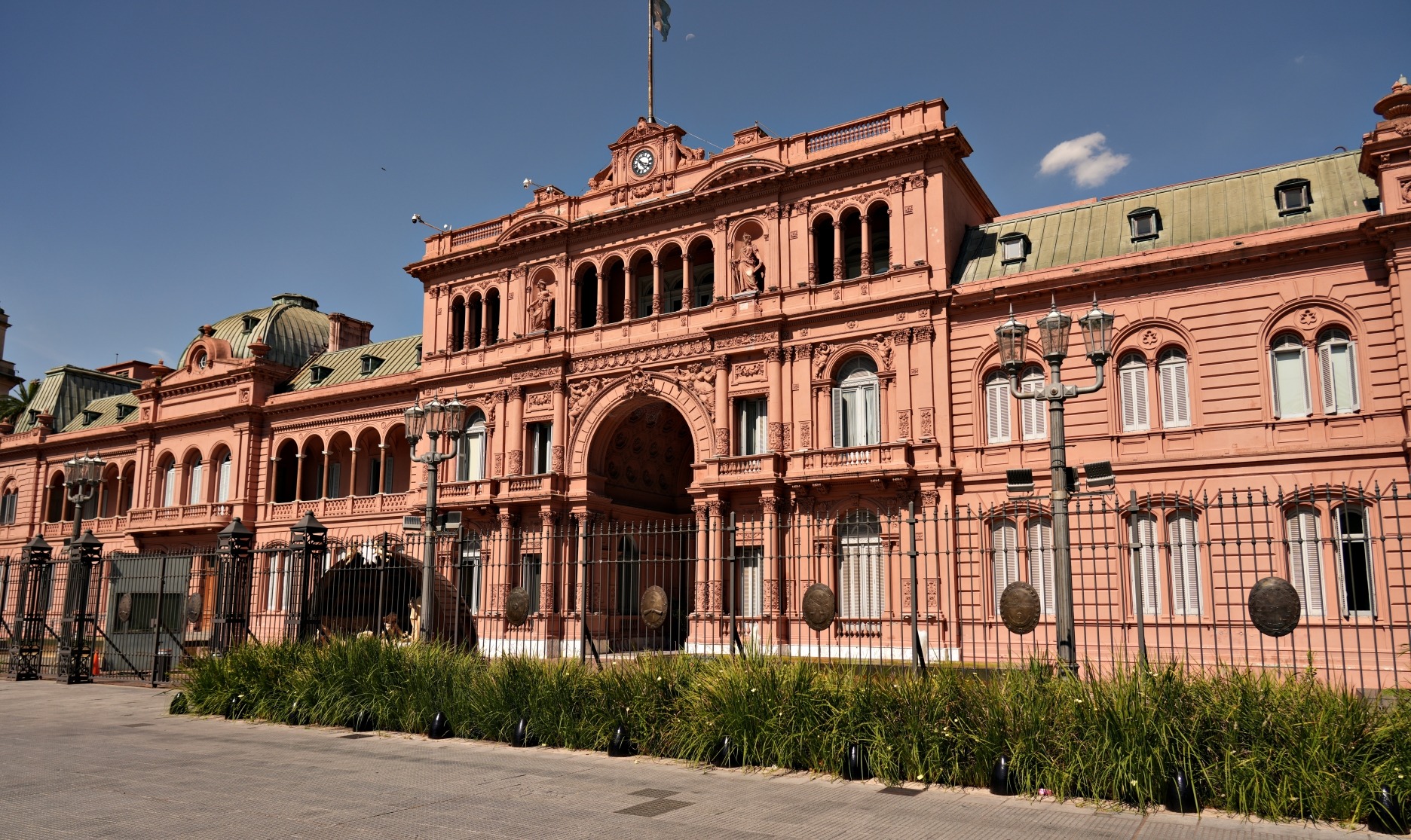
The main reason to visit Plaza de Mayo is to see the elegant, pink Casa Rosada. If this building looks familiar to you, it is probably because you saw the movie Evita starring Madonna. The balcony above the central arch is where Eva Perón (Evita) gave her inspiring speeches to the people of Argentina, and where Madonna sang ‘Don’t Cry For Me, Argentina’. Evita’s husband, Juan Perón, was the Argentine President, but it was Evita who stole the hearts of the people.
Casa Rosada serves as the seat of the national government, and the balcony continues to have a starring role, being used by presidents to address the public.

Built on the site of Spain’s 16th century fort, Casa Rosada’s long history is as convoluted as the city’s. Once the fort was demolished, two buildings were built on the site. They were used by Spanish viceroys and then by the leaders of the independence movement. In the late 1800s, the two buildings were joined, and it slowly evolved into the building we see today.
It was painted pink in the late 1800s; some say it is to show that the two main political parties, Colorado (Red) and Blanco (White), must cooperate to build a successful country. Others say it is because it was painted with cow’s blood, a common practice at the time, because blood is more durable than paint in humid environments.
It is best to visit in the afternoon when the sun makes it glow.

Bicentenary Museum is an on-site museum located behind Casa Rosada. It has limited hours and was closed when we tried to visit. Entrance is Free; Opening Hours – 10am to 5 pm, Wed to Sunday.
Metropolitan Cathedral
From the outside, the Metropolitan Cathedral (Catedral Metropolitana de Buenos Aires) looks more like a theatre than a church. Its interior, however, reminds you of its esteemed place in Argentina’s history. Two distinguished Argentines are connected to the church. One is Jorge Mario Bergoglio. More commonly known as Pope Francis, he was the Archbishop of the church before being selected as Pope.


The second important connection is that it contains the tomb of The Liberator, José de San Martín. He was a military leader who helped bring independence to Argentina. Guards dressed in military costume stand at the entrance to the tomb. We’ll take you to many monuments dedicated to San Martín during our travels through Argentina.

Cabildo
The oldest building on the square is the Cabildo. Although there has been a City Hall on this spot since 1589, the one we see today is from 1764. It is a typical modest Spanish colonial structure that stands out against the European styles around the square.

There isn’t a lot to see inside, but the reason to enter is to enjoy the views from its balcony, where you look across to Casa Rosada and the Cathedral.


Entry is free; Opening Hours – 10:30am – 6pm, closed Mondays and Tuesdays.
Mothers of Plaza de Mayo
In the 1970s and 80s, Argentina was under the reign of ruthless dictator General Jorge Rafael Videla. During this time, many Buenos Aires residents were vocal in their opposition to the government. Most of those dissidents were detained, disappeared, tortured and killed. Mothers of these missing people frequently gathered for non-violent protests to raise awareness of their lost children. They wore white headscarves, which became a symbol of their cause.
These women still gather for marches in Plaza de Mayo to ensure their children are never forgotten, and they are honoured in the square with plaques decorated in white scarves. We saw similar monuments in other cities in the country, too.

Central Post and Telegraph House
Just a block off the plaza is the beautiful old Central Post and Telegraph House. Now operating as the Kirchner Cultural Center, it was built in 1928 in the Neoclassical Beaux-Arts style and must have been one of the most beautiful post office and telegraph offices in the country.

After visiting Plaza de Mayo, take time to explore the surrounding streets and see if you can find your favourite building. The mix of Beaux-Art, Art Nouveau, and neoclassical styles is a reminder of the past, when Europeans arrived en masse, filling the city with their extravagance.


Avenida de Mayo
Connecting the two main squares in the historic centre, Avenida de Mayo (May Avenue) has its own collection of notable buildings. Despite its busyness and popularity among tourists, there is so much to see in a few blocks that it is worth it to walk between Plaza de Mayo and Congress Square.
Some of the things you can see on your way are:
Café Tortoni
The iconic café was built in 1858 by a French immigrant who named it after one in Paris. We visited the famous Café Tortoni on our first visit to Buenos Aires over 20 years ago and thought we would stop by again. This time, however, it has become so famous that there was an hour-long line up to get inside. We didn’t bother to wait, so were unable to recreate this portion of our trip, but we can share an old picture with you.


Palacio Barolo
A couple of blocks away from Congress Square is the eclectic Barolo Palace. The office building was completed in 1923 with designs inspired by Dante’s Divine Comedy. At that time, its 22 floors made it the tallest building in South America. After completing this building, Italian architect Mario Palanti designed Montevideo’s iconic building, Palacio Salvo. You can see a few similarities in the buildings, especially their top-heavy towers.
Tours are available, but prices begin at a whopping $60 USD. The interior is said to continue the theme of Dante’s epic poem.

Beside it is another distinctive structure, the Immobiliaria Building. These two buildings are so tall, and the streets so narrow, that it is difficult to see one without the other.


In addition to these famous buildings, there are many more gorgeous ones to admire as you stroll down Avenida de Mayo.


Congress Square
Avenida de Mayo ends at the large Congress Square (Plaza del Congreso), home to the stunning Palace of the Argentine National Congress (Palacio del Congreso). Taking almost 40 years to build, the neoclassical building features many details, including a tall central dome and Corinthian columns. When it was built, there were statues at the front door sculpted by Argentine artist Lola Mora, but the nudes were considered scandalous at the time and were removed. The ones we see today are replicas and were only installed in 2014.


You can take a free guided tour to see the interior of the Congress Palace. English tours are held at 12:30pm and Spanish ones at 5:00pm, weekdays.
Monument of the Two Congresses
The ornate fountain in front of the palace, Monumento a los Dos Congresos (Monument of the Two Congresses), represents the two congresses that declared independence from Spain. When we visited Buenos Aires 20 years ago, the fountain was covered in spray paint. Today, there is a tall fence and an obvious police presence, ensuring the fountain appears pristine.


As we saw in most of the downtown parks, there were a lot of homeless lying in the shade. It didn’t seem unsafe though.
Confiteria de Molino
The Congress Palace is such an impressive building that you almost fail to notice the striking one at its side. The Art Nouveau, Confiteria de Molino, was once home to a popular early 20th century coffee house.

Mariano Moreno Square
Connected to Congress Square is Mariano Moreno Square, making it feel like one large park. Named after the leader of the first Junta that deposed Spanish rulers, the park is filled with statues. One of them is an original cast of Rodin’s The Thinker (El Penser). Surprisingly, a small fence is all that protects this magnificent piece of art.


Plaza Lavalle
Colon Theatre
Built at the start of the 1900s, the Colon Theatre (Teatro Colón) combines Renaissance, Baroque and Classical styles. The large building takes up an entire city block on the side of Plaza Lavalle and boasts small balconies, large gargoyles and elaborate windows.
Tours are available to see the theatre’s interior. They are very popular, so during busy season, you may need to book in advance.


It is hard work for the theatre to outshine its neighbours on the square, though. On the opposite side of Plaza Lavalle, the Palace of Justice, commonly called the courthouse, is a stately, eye-catching building.
Beside the theatre is Escuela President Roca, one of the most beautiful schools we’ve ever seen. This Greco-Roman influenced facility was built at a time when schools were thought of as temples of knowledge, but it must be distracting to be a student in such a gorgeous building. As well, there are many other heritage buildings on the surrounding streets, so don’t forget to look around.


Avenida 9 de Julio
During your time in Buenos Aires, you will undoubtedly find yourself walking or driving on July 9th Avenue (Avenida 9 de Julio), the largest Avenue in the world. Named after Argentina’s independence day, the busy avenue travels the length of the city.
Even though there are many statues and memorials along the street, two stand out. Located only a block away from the theatre, in the middle of a busy intersection, is a tall Obelisk from 1936. It was built to commemorate the 400th anniversary of the first attempt at founding Buenos Aires. A few blocks away, at the intersection of Avenida de Mayo and Avenida 9 de Julio, is a statue of Don Quixote. It was a gift from Spain to commemorate the 400th anniversary of the city’s 2nd founding.
As in most parks, several homeless were lying in the shade on the pedestrian street between the Obelisk and the theatre.


Filling in the sides of this intersection are stunning old buildings that are a reminder of the city’s past wealth. One of the nicest is home to a McDonald’s, which must make it one of the prettiest locations for the restaurant in the world.


After exploring the most famous attractions in Buenos Aires, there is still much more to see. We’ll take you to more of this wonderful city in our next post, Discover the Eclectic Neighbourhoods of Buenos Aires.
Tips for visiting Buenos Aires
Getting to Buenos Aires
As the capital of Argentina, Buenos Aires is very easy to reach. International flights arrive at Ministro Pistarini International Airport, Ezeiza (EZE), located 32 km (20 mi) from city centre. Domestic flights and those to nearby South American cities use Jorge Newbery Airport, known as Aeroparque (AEP). It is in the neighbourhood of Palermo, so is not far from downtown.
Bus travel is also easy using the station Terminal de Omnibus de Retiro. Distances are far in Argentina, though, so if you take a bus, expect very long travel days.
Finally, if you are in Uruguay, a great way to arrive at the city is by ferry from Colonia del Sacramento or Montevideo.

Where to stay in Buenos Aires
The city is very large but is very well connected by an extensive metro system. Where you stay, then, will depend on what type of accommodation you are looking for.
Palermo Soho and Hollywood have quiet, safe, tree-lined streets, giving them a neighbourhood feel. There are several good restaurants, and it is connected to the rest of the city by metro. There are not many hotels in Palermo, but you can find a large selection of apartment rentals. We stayed in Palermo Soho and are glad we did.
San Telmo is a short walk away from Plaza de Mayo and is filled with pretty pastel row houses. There are many restaurants and bars, which makes it a little noisy at night. It also has a reputation for petty crime, so may not appeal to everyone.
Recoleta is another quiet choice and is not far from the main sites. You’ll find mostly upscale hotels in Recoleta, but not many budget options.
Puerto Madero has modern luxury hotels along the waterfront and a vibrant nightlife. It is only a couple of blocks away from Plaza de Mayo.
Centro will put you in the heart of the city, likely in a heritage building. If you only have a few days in the city, this will put you closest to the main sites. It is not as safe at night as some of the neighbourhoods listed above.
Where to eat in Buenos Aires
Similar to accommodations, there are many choices for dining so where you eat will probably depend on what part of the city you are in at mealtime. Remember, though, siestas are strictly adhered to, so most restaurants close between 1:00pm and 8pm, and many do not open on Sundays. In the tourist areas, you should be able to find restaurants that open at 5 or 6pm, and in Puerto Madero, most are open from noon until midnight. While there are many parrillas (grills) and Italian restaurants, there are also many international choices throughout the city. It is also fairly easy to find vegetarian options.
Palermo – You can find a large selection of patios in Plaza Serrano and the surrounding streets.
San Telmo – The main street, Calle Defensa, is a great place to find a variety of pubs and restaurants in beautiful heritage buildings.
Puerto Madero – The old warehouses along the waterfront are filled with excellent restaurants, each with outdoor patios looking out to the water. We noticed that the other side of the waterway also has a number of restaurants, but we didn’t venture over the bridge.
Coffee Shops – The coffee shops listed in the next post are also great choices for a small meal, snack or dessert.
Getting around in Buenos Aires
Uber, Cabify and taxis are widely available, but the city also has an extensive metro system. SUBE cards are reloadable cards available at some metro stations, 25 Hour convenience stores and at other kiosks. They can also be reloaded at these spots, but the convenience stores charge a fee, roughly $1USD. Metro stations do not charge a fee. At all metro stations and on many buses, you can use your credit card. There is a fee to use your credit card, but it is only pennies per ride. If you are only using it a few times, it is cheaper than loading the cards at a convenience store. If you plan to visit Mendoza, Bariloche, or San Salvador de Jujuy, keep your SUBE card because you can also use it on their public transit.
When to visit Buenos Aires
Spring (October/November) and autumn (March/April) are the best times to visit the city because the weather is mild and there are fewer tourists. Summer (December to February) is often hot and crowded, but this is when we visited, and we didn’t find it too busy.
Money
Getting cash is more complicated in Argentina than in most countries. Most ATMs charge very high withdrawal fees, $10USD and more per transaction, and the withdrawal limit is $80USD. Argentine banks also charge an extremely high fee for credit card purchases, as much as 10% per transaction. Those fees are charged by Argentine banks and are in addition to what your bank may charge. Argentina has high inflation, and there are two conversion rates. One is the official rate, and one is the blue rate. Most places offer an exchange rate between these two. This is true for the entire country.
The most cost-effective way to get cash is to send yourself money via Western Union. We were charged just over 2% per transaction. The drawback is that not all branches have enough cash on hand, so try to use a Western Union in a large store such as Carrefour.
Language
Argentina is a Spanish-speaking country. Even if you only know a little Spanish, the pronunciation throughout Argentina will confuse you. The most noticeable ones are that ll and y are pronounced sh or zh. For example, pollo is posho, and playa is pronounced plasha.
Note – Prices are listed in USD because the rate of inflation in Argentina is so high that as of 2026, any fees listed in pesos would be inaccurate within a few months. Many restaurants don’t list prices on their menus, or if they do, they have been written over many times as the value of the peso drops. Apart from hotels, most business will only accept payment in Argentine pesos.


This article is also featured on GPSmyCity. To download this article for offline reading or create a self-guided walking tour to visit the attractions highlighted in this article, go to Walking Tours and Articles in Buenos Aires.
Click on the link to read our Travel Tips For Argentina.

Coming Next – Discover the Eclectic Neighbourhoods of Buenos Aires
For pictures from other blogs go to Gallery at monkeystale.ca.
To read about more of our adventures go to Destinations.
If you like what you read, please comment or share (with credit) using the links below.




We’d love to hear from you, please leave a comment.