
From the time its first ancestors landed on Anakena Beach to the establishment of the new Birdman Cult, Rapa Nui has had a fascinating story to tell. We’ll explore them and more when we take you to Anakena Beach, Orongo, the Lava Tube and other spots on the island.
There’s so much to see on this island that we are presenting it in three posts. In this, we’ll take you to Orongo and Anakena Beach, among other sites. In previous posts we showed you the famous Ahu Tongariki and Rano Raraku Quarry, and some of the things you can see for free from the island’s only town, Hanga Roa.
A little background on Rapa Nui
Although the exact dates vary based on your source, Rapa Nui was first settled over a thousand years ago. The first king, Hotu Matu’a, sent an exploratory crew of seven to find a new home for his people. They were likely from the Marquesas Islands in Polynesia, 3,700 km (2,300 mi) away.
The king’s holy priest had a dream about an island with freshwater, rain, fertile soil, trees and other vegetation. His dream pointed the seven canoers to Rapa Nui. They navigated across the vast ocean using only the southern cross and the Orion Belt as guides. When the crew returned to tell the king of their news, he immediately set off with his pregnant wife and 100 settlers. They packed their canoes with chickens, pigs, vegetables, Polynesian rats, and set off for Rapa Nui. Others followed and established settlements on various parts of the island.
Anakena Beach
Legends say that when King Hotu Matu’a first arrived, he landed on Anakena Beach. Although other evidence suggests it was elsewhere, we like the idea of this group landing on this pretty cove with a rugged, rocky shore and a white-sand beach. After a long ocean passage, they would have thought they had landed in paradise.
As the only sandy beach on Rapa Nui, it was busy on a cloudy Sunday afternoon. Many of the sunbathers were locals, but there were also quite a few tourists. We couldn’t imagine coming all the way to Rapa Nui to spend a day lying on the sand.

Ahu Nau Nau
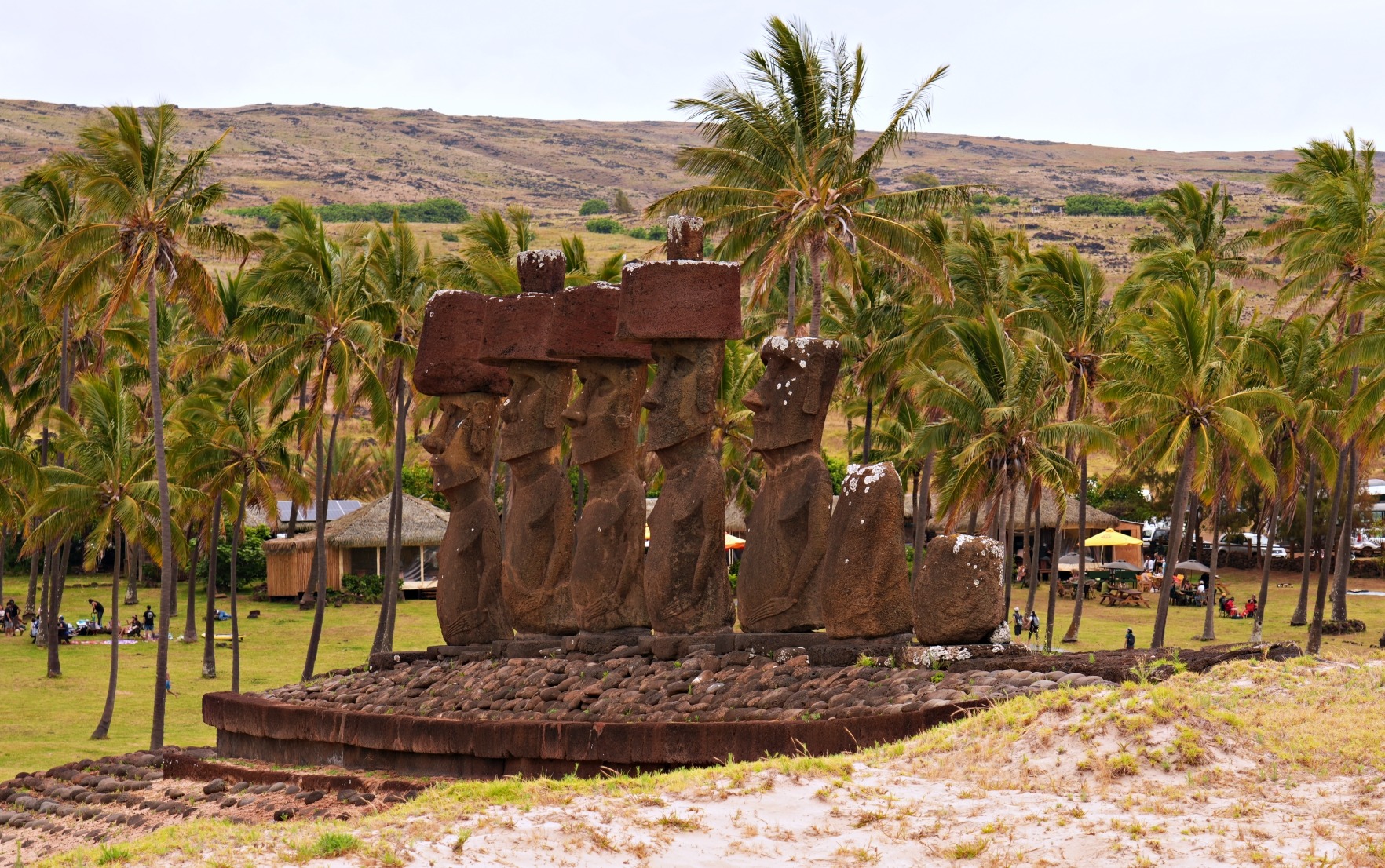
Since we didn’t come to the beach to sunbathe, you know there must be something else to see. Originally, more platforms were located at Anakena Beach, but today only two remain. One is Ahu Nau Nau. Of its original 9 moai, only 7 have been restored, and only 4 of those have hats, called pukao. With palm trees at their backs and red hats on their head, Ahu Nau Nau is one of the prettiest platforms.


Don’t forget to walk around to see them from behind. The final part of the moai’s creation was to carve designs on their backs. These engravings represented tattoos worn by the king. Unfortunately, most have worn away from exposure to wind and rain. Since these moai at Anakena Beach were covered in sand for centuries, their carved backs were protected, and so today, we can see a little of these wonderful designs. One is supposedly a lizard, but it is difficult to distinguish specific animals or symbols.

One of the best parts of visiting this platform is seeing the pukaos on the statues. These hats weren’t added until the 15th century, so not every moai had one. Of those that did have hats, many were damaged when the moais were knocked over, so seeing these is a real treat. Most believe that the hats represented the king’s hair, worn in a bun on the top of their head. They are made of scoria stone and were placed on the statues once they reached their platform.
As well as the pukaos, coral eyes were also added once the statues arrived at their platforms. The first eye was found on Anakena Beach, but it was badly damaged. Since then, fragments from over 50 eyes have been discovered on the island, but no complete eye has been found. You can see a moai with new coral eyes at Ahu Tahai Complex, near the town of Hanga Roa.

Ahu Ature Huki
Another platform near the beach is Ahu Ature Huki. It has only one lone moai, who has no hat and is a bit fatter than the others. This was the first moai raised after being toppled during the civil war.

Life on Rapa Nui was patriarchal, so almost all kings, and therefore moai, were male. The only female moai known to be made was found near the beach. It was moved to the museum in town, which, unfortunately, has been closed since June 2024, with no re-opening date scheduled.
Entry – The beach and both Ahus are free; you do not need a park pass to visit.
To learn more about how these mysterious statues were built, read our post Rapa Nui’s Famous Sites: Ahu Tongariki and Rano Raraku Quarry.
The following sites require a guide and a park pass to visit:
Puna Pau Quarry
There isn’t a lot to see at Puna Pau Quarry, but since it was where the pukao (hats) were made, it is worth a visit. Most of the rock is covered in soil and grass today, but you can still find a few hats or pukao scattered on the ground. The crater’s scoria stone has a high iron oxide content, giving the rock a red colour.
You won’t see the pukaos on many of the moai because they were not added to them until the 15th century. As well, of those that were made, many were damaged during the civil war.


Ahu Akivi
Not far from the quarry is an ahu with an unknown origin. This is the only group of moai to face the sea, instead of having their backs to it. This detail and the fact that there are seven moai, led people to believe that they represented the first seven canoers sent by the king to find Rapa Nui. The problem with the theory is that they were built hundreds of years later, so it is no longer thought to be true.
They do have an interesting link to astronomy, though. The statues are aligned so that they look toward the rising sun on the spring equinox. You can see a few carvings on their backs as well, but they are not as defined as those on Ahu Nao Nao.


Orongo
Located on the crater rim of Rano Kau Volcano lies an important ceremonial site from Rapa Nui’s Birdman Cult days. Unfortunately, not long before our visit, on November 4, 2025, part of the cliff collapsed, so the site was closed. There is no word on when it may re-open. We were able to see it from afar, which still helped us understand the Birdman Cult story.
Although homes were already built on the crater rim, Orongo rose to prominence during the time of the Tangata Manu Cult, also called the Birdman Cult. In the 1700s, beliefs changed, so as the Ancestor Cult died off, the Birdman Cult emerged. Their god, MakeMake, was the creator god who brought migratory birds every spring. The cult believed birds, especially the tern manutara, had special powers, because they were connected to the sky, land and sea.


One of their most important activities was the daring Birdman competition. One warrior was selected per tribe to compete in the perilous race. The game began and ended in the ceremonial village of Orongo. The night before, a big feast brought the islanders together, and the competitors were decorated in body paint. The next morning, the young warriors scaled down the other side of the precipitous 150 m cliff that we could see in the distance.

After reaching the ocean, they swam 1.6 km to Motu Islet using a flotation device made from tortora reed in the Crater Lake. Then, they had to climb up the rocky islet and search for a tern egg. They then placed the egg in a bandana on their head and raced back to the finish line in Orongo. The winner was awarded his choice of virgin, and his tribe’s chief would be the island’s king for the year.
With such prestigious rewards, the competition was not a gentleman’s game. Many were injured or even killed by their own negligence or by a vicious competitor. It was an annual competition and some years there were no winners, but in others there were repeat winners. The egg was kept by the winning tribe, and once it hatched, the bird was released.

You can find symbols of the new king and the Birdman etched into nearby rocks.

The Birdman competition began in the 1760s but only lasted until 1878. Shortly before this, Catholic missionaries arrived, and for a large variety of reasons, the islanders were quite quick to convert to Christianity.
Before leaving Orongo, take a second to look around at the view from this high point on the island. It allows you to see up and down the long coast.


Ana Te Pahu Lava Tube
Created during a volcanic eruption thousands of years ago, Ana Te Pau Lava Tube is an unusual site. In total, seven kilometres of interconnected tunnels travel underground. Lava tubes are formed when the slower-moving surface layer of lava cools and hardens while a central flow of hot lava continues to flow, creating a tunnel.

The tube was used as a bunker during the island’s tribal war. At that time, an entire village of 400 lived in the tunnel for around 50 years. They survived by planting gardens in cave openings, including banana and avocado trees. In another opening, they collected fresh water, and further inside, they raised chickens. The tube is close enough to the coast to go fishing, and natural holes in the roof acted as chimneys for cooking. Its nickname is Banana Cave for the banana tree forest at one of the cave entrances.
There’s not much to see inside, but it is the size of the tunnel that is so impressive.


Near the lava tunnel are the remains of a village. There aren’t many places where you can still see their construction methods, but this village provided a few good examples. Most of what’s left are long rows of stones that shaped the building’s foundations. Holes were carved into the rocks to support wooden beams used to make walls. The biggest house was 22m long.

For tips for visiting Rapa Nui, as well as how to get to the island and where to stay, visit our post What To See in Hanga Roa.
Interested in reading more about Rapa Nui? Click on the links to read our posts from Hanga Roa and Ahu Tongariki and Rano Raraku Quarry.

Click on the link to read our Travel Tips For Chile.
To read more of our adventures in Chile, click here.
Coming Next – Our Favourite Places to Visit in Chile
For pictures from other blogs go to Gallery at monkeystale.ca.
To read about more of our adventures go to Destinations.
If you like what you read, please comment or share (with credit) using the links below.




We’d love to hear from you, please leave a comment.