
As one of the world’s most isolated islands, Rapa Nui is famous for its enigmatic moai statues. Also known as Easter Island, visiting Ahu Tongariki and Rano Raraku Quarry allows you to delve deeper into the history of the iconic statues and the people who created them. Come with us as we explore one of the most fascinating places on earth.
There’s so much to see on this island that we are presenting it in three posts. In this, we’ll take you to the famous Ahu Tongariki and Rano Raraku Quarry, as well as a few smaller spots nearby. In the next, we’ll explore Orongo and Anakena Beach, among other sites. In the first post, we showed you some of the things you can see for free from the island’s only town, Hanga Roa.
A little background on Rapa Nui
Although the exact dates vary based on your source, Rapa Nui was first settled over a thousand years ago. The first inhabitants likely came from the Marquesas Islands in Polynesia, 3,700 km (2,300 mi) away. Seeking the perfect island, the king, his pregnant wife and 100 settlers packed their canoes and set off across the Pacific Ocean for Rapa Nui. Others followed and established settlements on various parts of the island.
At its height, there were 3,900 inhabitants in 18 different tribes, each with its own leader. Having so many chiefs and competing tribes played a significant role in what we see on the island today, both in the number of statues and also in how this ritual ended.

The Moais
What made Rapa Nui famous are its awkward and mysterious statues, called Moai. The first people of Rapa Nui, like many Polynesians, belonged to an ancestor cult where they worshipped their ancestral kings. Central to their beliefs was the idea that tribal leaders possessed a spiritual energy, called mana. After the king’s death, this energy protected those left behind.
Tribes built shrines to the kings, which consisted of moai and ahus. Moai are monolithic statues that represent the deceased chiefs or kings, and they stand on platforms called ahu. Each tribe or village built one platform (ahu) and added a new moai after the death of each king.


How and Why were the Moai Destroyed?
The islanders faced numerous difficulties over the centuries, which ultimately led to tribal fighting in the 1700s and 1800s. One theory is that the moai were toppled during these civil wars. Tribes likely destroyed their enemy’s moai to remove their mana (spiritual energy). Another theory is that they were damaged when beliefs changed from an Ancestor Cult to the new Birdman Cult. Regardless of the reason, by the mid 1800s, every moai had been toppled.
Only a few of the almost 300 platforms around the island have been restored. We visited many of those and we’ll show you them now.
The following sites require a guide and a park pass to visit:
Ahu Tongariki
Standing on the edge of the island’s east coast is one of the most recognizable sites on Rapa Nui, Ahu Tongariki. This platform is the largest, with 15 moai standing in a line. During the summer equinox, on December 21, the sun rises in its middle, so many try to visit the island at that time.
Thirteen ceremonial platforms (ahu) were built along the eastern coast of Easter Island, but only Tongariki has been restored.


The platforms are more than just stands; they are also tombs for the kings. In fact, the entire space is a cemetery. The king’s remains are inside the platform, and the land in front is a graveyard for everyone else in the village, including the queen.

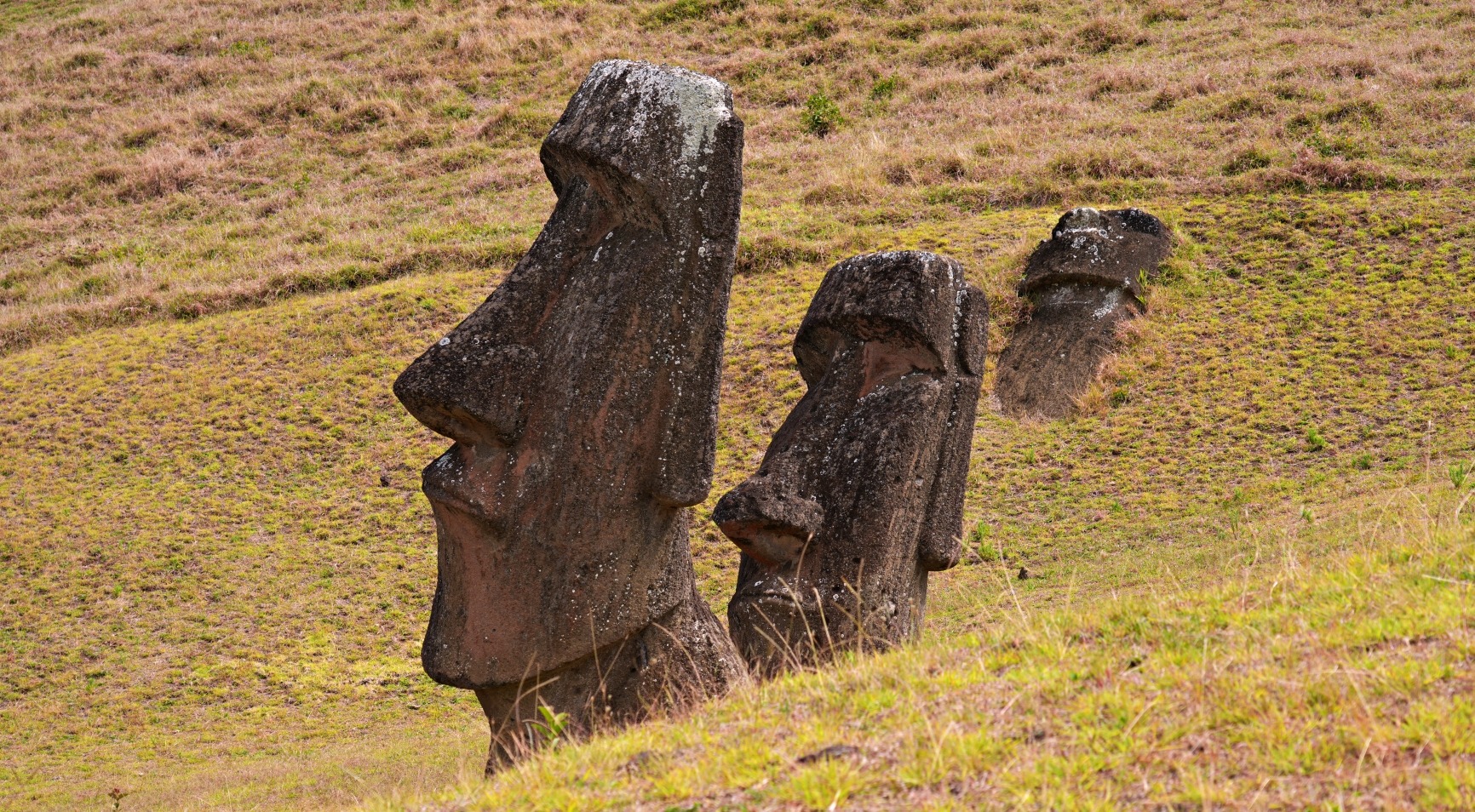
An interesting detail is that every moai is unique because they are the king’s living face, called aringa. While they may not be completely accurate representations, if you look closely, you can see a difference in the heads. For example, they have different nose lengths and shapes, as well as unique mouths and ears. You can see this more easily in a side view.


You may also notice that many of the moai have long earlobes. Some think the royals wore heavy earrings to elongate their earlobes. From behind, we could also see carvings on some ears, which may represent the king’s tatoos or sacred markings.

Standing near the entrance to Ahu Tongariki is a lone statue called the Travelling Moai. It was originally on a platform down the coast, but a tsunami in the 1960s swept it into the hills high above. The Japanese Government restored it for an expo in the 1980s, and later returned it to Rapa Nui.


You can see more evidence of the destruction left by this tsunami by examining the grounds around the platform. Parts of heads and pukaos (red hats) lie scattered around. When the water retreated, it brought many stones from higher areas to this platform, located on lower ground. It also washed many into the sea. Divers located and retrieved a few, which are now also displayed at this site.


Rano Raraku Quarry
Are you wondering where and how these moai were made? A visit to Rano Raraku Quarry will help you understand them a little more. Above Ahu Tongariki, you can see Rano Raraku’s yellow-brown cliffs. Of the three major and 108 small volcanoes on the island, Rano Raraku crater was the preferred quarry and is the site where the majority of the moai were crafted. When we read about visiting a rock quarry, we weren’t very interested, but it ended up being our favourite site on the entire island.


As we walked up to the cliff, we passed dozens of moai randomly scattered on the hills. There are a few broken pieces, but the most impressive part is seeing the random heads sticking out of the ground. You have likely seen famous pictures of this quarry and assumed the statues were just heads. Surprisingly, underneath those heads are tall bodies that have been covered by soil and grass as the landscape changed over time.


Over the years, several archeological teams have dug beside the moai and discovered very tall bodies. Piro Piro Moai was one of those. Under its 4 metre head, they found an 11 metre (33ft) tall body. Apparently, its back was unfinished, so they covered it with soil and left it in place. Some of the statues they uncovered had carved backs, and many of those were taken to museums around the world. In fact, all moai originally had carvings on their bodies, but the artwork has worn away from exposure to wind and rain. Like the ears we saw in Ahu Tongariki, the carvings were also reproductions of the king’s tattoos.
The other interesting detail researchers discovered was that the bodies are yellow. This makes sense because the moai were made from yellow-coloured volcanic tuff. What we see above ground has blackened from exposure to the elements.

A unique one to watch out for is Tukuturi Moai, the only kneeling moai. It dates to the late 10th or early 11th century, but no one knows why it is not standing.

A fascinating part of the quarry was seeing the wall where the moai originated. There are several carvings in various states of completion at the base of the cliff, allowing you to see the stages of their creation. First, their shape was carved horizontally into the wall. When this stage was complete, the statues were brought off the cliff and laid on their backs, where sculptors brought out the king’s likeness. Once a moai’s face was completed, they were stood up, so the back could be shaped.
It is difficult to imagine the skill required to carve these massive monoliths using only crude blades made from obsidian and basalt. The final step at the quarry was to polish them with pumice stone.


The average height of a moai is 4.5m (16 1/2 ft). The tallest found at a ceremonial platform is 10 m (33ft). The largest known moai ever carved is called Te Tokanga, the Giant. It is 21 m (69ft) long, but was never raised to a standing position. Today, most of its body is covered by the earth, but from the size of its head, you can appreciate its enormity.


There are 900 to 1,000 moai on the island, and more continue to be discovered. This number includes the 400 to 500 at the quarry that were either completed and not yet delivered, or left unfinished when the tribal fighting began.
You may notice that none have coral eyes or hats. That’s because those features were added once the moai arrived at the ceremonial sites. We’ll talk more about them later.
Did the Moai Walk?
Once completed, the moai were taken to their platforms at various places around the island. The remarkable detail is that the island is almost 22 km long (14 mi) and 11 km (7 mi) wide, and the moai weigh around 13 metric tons (14 tons).
There are many theories on how the statues arrived at their platforms, many kilometres away. The latest, most believable theory is that they walked. Well, not exactly, but ropes were wrapped around a moai’s neck and pulled by people on the ground. Like a well-coordinated dance, they were able to rock the statue back and forth, while rotating one way and then the other. These long walks took as long as 100 days. You can see a re-creation of that in this YouTube video.
The details on the creation and delivery of the moai make Rapa Nui even more compelling.
An alternate theory is that the statues were carried on wooden sleds or rollers. While it would explain the lack of trees on the island, the sled theory is not as widely believed as the walking method.
Rapa Nui was apparently highly forested when the first settlers arrived in the 1200s. Its deforestation is the result of other reasons than sleds and rollers. The Polynesian rats that were brought over on the first boats were part of the problem. They were very prolific, and with no predators, their population grew. Their favourite foods, tree nuts and seeds, were in good supply, but by eating those, they ensured no new trees. At the same time, many trees were being cleared to make vegetable gardens, and others were used to build fishing boats. Together, these resulted in a mostly treeless island. Efforts are ongoing to repopulate forests, but it is a slow process.
Not far from these two main sites are several other small ones that are worth seeing. Let’s look at them now.
Ahu Vinapu Complex and the Inca Wall of Ahu Tahira
The Ahu Vinapu Complex consisted of three different platforms. Unfortunately, most were destroyed, but there are still a few important details that make it worth a visit.
One of them is Ahu Tahira. Rather than visiting this site to see the moai, it is the platform itself that is interesting. While most ahus are crudely made, this one was built with precisely cut stones, perfectly fitting seams and was polished by coral. This is the only example of this technique in Polynesia, leading some to believe there was contact with the Incas in Peru, giving it the name the Inca Wall.

Ahu Huri A Urenga
Not far from the Inca Wall is a site on private land. The interesting detail on this moai is that it has four hands and twenty fingers. One theory is that it shows inbreeding. Others believe the moai was damaged, and a second pair of hands was carved.

Ahu Akahanga
What was likely an important gravesite is now only a pile of debris. Ahu Akahnga was the platform for the first king, Hotu Matu’a. Unfortunately, during tribal fighting, it was damaged beyond repair.
From it we could see another damaged platform and village along the coast.


Te Pito Kura Magnetic Stone
When you visit the first king’s platform, you’ll likely also visit Te Pito Kura. Here, a circle of stones surrounds a smooth rock. Some say the one in the middle is a meteor. It has a high iron content, which makes it absorb more sunlight, so it is warmer than the others around it. Some say the round stone can alter compass readings, making them display the wrong coordinates. Our guide demonstrated this, but it seemed a bit suspect.


It is sometimes difficult to put these dates into perspective. We thought this poster from Egypt, would help to understand it’s place in history better.

There’s still more to see on the island; stay tuned for our post from Orongo and Anakena Beach.
For tips for visiting Rapa Nui, as well as how to get to the island and where to stay, visit our post What To See in Hanga Roa.
Interested in reading more about Rapa Nui? Click on the links to read our posts from Hanga Roa and Orongo and Anakena Beach.

Click on the link to read our Travel Tips For Chile.
To read more of our adventures in Chile, click here.
Coming Next – Rapa Nui: Orongo, Anakena Beach and Lava Tubes
For pictures from other blogs go to Gallery at monkeystale.ca.
To read about more of our adventures go to Destinations.
If you like what you read, please comment or share (with credit) using the links below.



We’d love to hear from you, please leave a comment.