In Chile’s remote north is a pristine wonderland, waiting to be explored. Lauca National Park has so many picture-perfect scenes of volcanoes, mineral lakes, and unique wildlife that you will quickly fill your camera’s memory card. Let’s take a look at this special park in northern Chile.

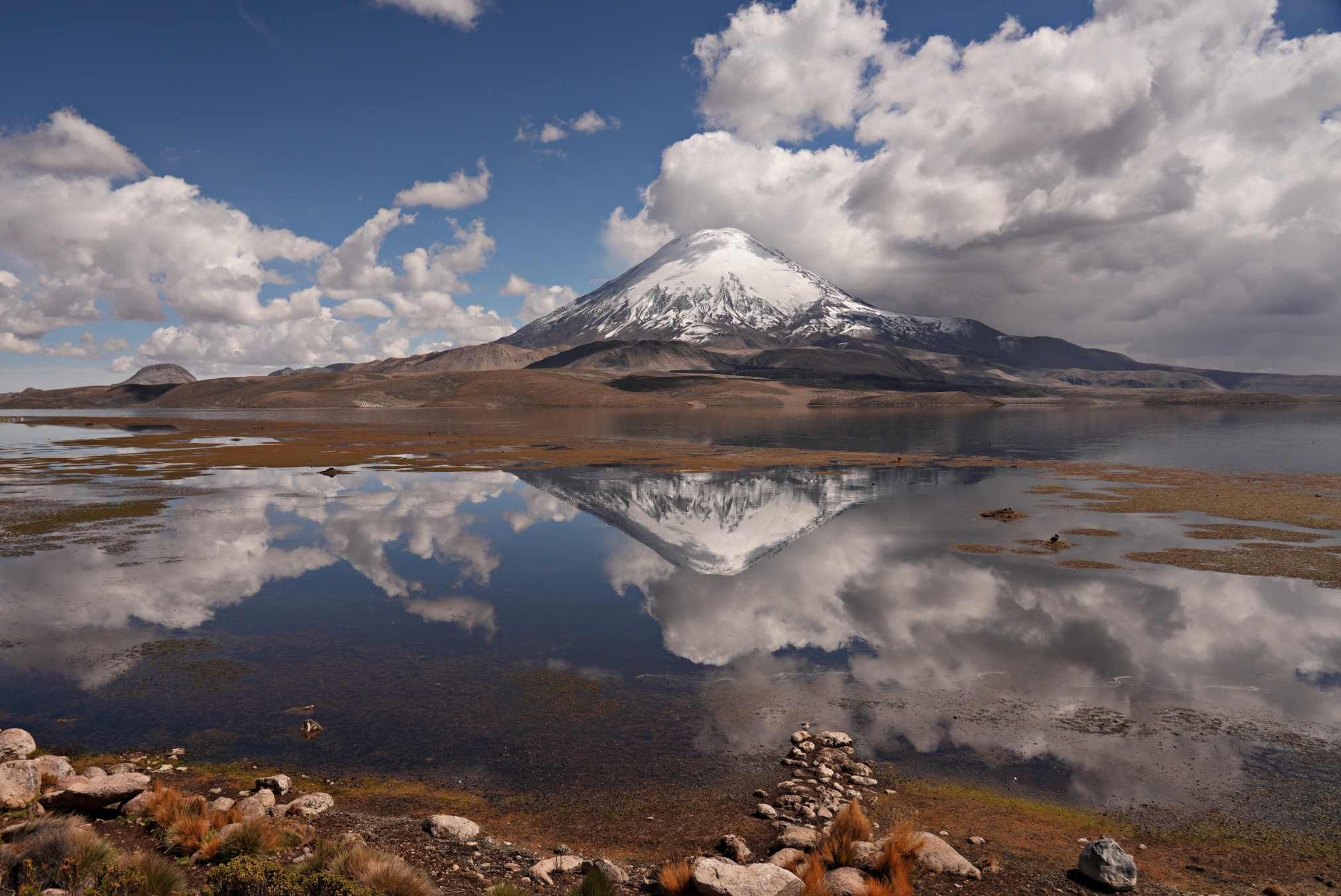
The twin volcanoes, Parinacota and Pomerape, are the park’s main features, but as we found, there is so much more to see. Lauca National Park is located on the Altiplano, a high alpine plateau that stretches between northern Chile, most of Bolivia and southern Peru. Located near Chile’s tri-border with Bolivia and Peru, these lands are not often seen by foreigners, which makes them even more special.

Once we climbed above the hills near Putre, we reached a flat plain at 4,385m (14,400ft). It welcomed us with sweeping views of the colourful mountains on one side and the twin volcanoes on the other. The valley around Putre is like a desert, but on the Altiplano, there is more vegetation, a sign that it receives more precipitation, especially in the summer.

Our first stop was at the Bofedal Wetlands. Since we visited before the rainy season, it was fairly dry, and we could walk between the rocks to explore this strange land. As we did, the twin volcanoes, Parinacota and Pomerape, kept a watchful eye over our shoulder.

We had seen these volcanoes from the other side in Bolivia’s Sajama National Park a couple of years ago. Now seeing them from the Chilean side, we noticed a much different landscape at their base.

You can read about Sajama in our post Llamas, Alpacas and Volcanoes in Sajama.

The mineral lake in the centre of the wetlands fills with water from December to February, so our visit in November meant the water level was very low. This worked to our advantage because it was the perfect depth for Andean and Chilean Flamingos.

Not only were there flamingos, but we saw dozens of viscachas scampering between the rocks. These rodents look a little like rabbits, but are more closely related to chinchillas. The ones in Lauca are mountain viscachas, which only live above 4,000 m (13,100 ft).

One of the best viewpoints of Parinacota Volcano is from Chungará Lake on its other side. As we looked up at the dusting of snow on the volcanoes, we were told that it had snowed the day before. Two days earlier, the volcanoes were brown, so we felt very fortunate to have them glistening with snow.

In the mornings, Chungará Lake is often flat, allowing it and the other volcanoes to perfectly reflect off its surface. Between the new snow and the mirror lake, it is a breathtaking scene.

In addition to being treated to these gorgeous views, the high-altitude lake is also home to a variety of waterbirds such as Andean Geese, Puna Teal and Flamingos. We wondered how they could survive at 4,517 m (14,800 ft).

The most interesting birds were the Giant Coots. Their laughing call, horned beak and island nests made it exciting to see them.

We should have also been able to see Nevado Sajama in the distance, but unfortunately, it was covered in clouds. We saw the volcano in Bolivia, a couple of years earlier. The second picture below is from Bolivia’s Sajama National Park. You’ll notice that the skies were much nicer when we visited Sajama, but it was in August, so it was very cold.

One of the cutest animals in the park is the vicuña. We have seen them many times, but it is always a treat. They are the oldest and smallest of the camelids in South America, and like the viscachas, they only live above 4,000 m.

Not far away from Chungará Lake is another wetland. Its four separate lagoons are connected by channels. The undulating ground was formed when volcanic eruptions left dozens of islands in the lagoons. In addition to admiring the view, we also noticed a few interesting plants near the lagoons.

Named after the caves (cuevas) in the cliffs, a short walk takes you through another wetlands region of the park. Some of the caves have evidence of pre-Hispanic occupation, but the best reason to visit is to see more adorable viscachas.

The final stop that most make in the park is to Puebla Parincota. It’s almost a ghost town now, with a population of two, but it was once a busy place. During the Spanish rule, the puebla was on the road between the silver mines of Potosi and the port in Arica. As a result, it saw a lot of traffic and acquired a lot of wealth. Today, however, almost all that remains of the community is its church.

The local Aymara people built a small church after they converted to Christianity, but as the trade route became busier, the Spanish moved in, and so a larger church was required. Most of the building supplies were locally sourced. For example, the roof and pillars were made from queuña trees, while the buttresses are volcanic rock. As well, the roof is covered in tussock grass and tortora reeds from the lakes.

The church is a little unusual because it blends Aymara traditions with Christian beliefs. For instance, the bell tower represents the male phallic symbol, and the church entrance symbolizes women.

Although not many live in the village, there are several llama farms in the area. Unlike vicuñas and guanacos, llamas do not live in the wild. Llamas are descended from the wild guanacos and are mostly raised for their wool, but sadly, also for their meat.

Unless you have a car, the only way to visit Lauca is on a tour. There are very few visitors to this area, so most will be private tours. Our guide Pablo Lopez from Aventura Putre York was excellent, and we highly recommend them.

  • When to visit – The warmest weather is from late January until mid March, but the highest chance of rain is in January and February. Winter will be cold and many of the mountain roads will be snow covered.
  • Elevation – Putre is located at 3,500 m (11,500 ft), and Lauca National Park is above 4,000 m (13,125 ft). These high elevations mean you need to acclimatize. Either do this by visiting other places, such as San Pedro de Atacama first, or plan to spend your first few days in Putre. To help prevent altitude sickness, stay hydrated by drinking a lot of water; many recommend 3 litres a day. The elevation also means that nights will be chilly, but the sun is intense during the day.
  • Money – There is no ATM in Putre, but businesses operate in cash, so bring enough to last the duration of your stay.

For information on where to stay and how to get to Putre, please visit our post Putre In Chile’s Remote North.

Click on the link to read our Travel Tips For Chile.

Read from another device.

To read more of our adventures in Chile, click here.

Fediverse reactions

82 responses to “Lauca National Park – A Pristine Wonderland”

  1. The landscape, along with the wildlife, do look very primal. I can’t help but grin about the viscachas–they look like rabbits with attitude.

  2. ⬻𓂀☆♡ ‌ ‌ 🎀 ‌ 𝐵𝑒𝑎𝑢𝑡𝑖𝑓𝑢𝑙 ‌ 🎀 ‌ ‌ ♡☆𓂀⤖

      1. ✨🙏🙇‍♂️

  3. You introduce me to so many places I am unfamiliar with! Never heard of this park, but it looks like a beaut.

    1. It is unbelievably gorgeous! Happy to introduce you to it. Thanks Lex

  4. wow, that landscape is so dynamic everywhere you look. I love how it changes and seems to connect to the sky. Also the groups of llamas are just adorable

    1. Thanks Meg, the animals and the landscapes make this a wonderfully unique part of the world.

  5. Fabulous scenery

  6. Wow, just wow Maggie. That first shot is spectacular and the rest are merely perfect. The viscachas are adorable. Our kids are bunking with us right now with their 3 bunnies, as their house is being renovated. At one time, they had a chinchilla that lived to the age of 23. Cheers. ALlan

    1. Thanks so much Allan, well they should add a viscacha to their family. 😊

  7. Great pictures of the visachas in particular but it seems that you had lots of opportunities to see and photograph many other species of wildlife too. Wonderful.

    1. Thanks Lynette, the viscachas were so fun to see. We couldn’t believe how many there were!

  8. Wow, what incredible landscapes 😮 Your opening shot is a stunner but the others are amazing too! In parts it looks other-worldly. I love the cute visachas too – the last one in your series of photo s of them is especially adorable!

    1. Isn’t that last one great! Looks like he’s had too many burgers 😊 The landscape really is stunning and we timed it perfectly without knowing. Thanks Sarah

  9. Beautiful! And it’s great that you showed us your brilliant pictures, so we don’t need to travel there
    The Fab Four of Cley
    🙂 🙂 🙂 🙂

    1. Thanks, glad you enjoyed Chile with us. 😊

  10. Absolutely stunning. I am guessing it’s a place that is impossible to forget.

    1. That’s true, not many places like it.

  11. Incredible landscapes, Maggie.

  12. Great photos of the area and those visachas!

    1. Aren’t they cute?! Thanks June

  13. Oh, this absolutely magnificent. We will need to try to get there one day. Thanks for the virtual visit. (Suzanne)

    1. Thanks Suzanne, it is absolutely stunning.

  14. Wow, it is certainly an area of incredible pristine views and the local habitat look fun to capture. Well done on the hike that would’ve been challenging.

    1. Thanks Suzanne, it really is a beautiful park.

  15. You two have seen it all, haven’t you? Never even heard of a Viscacha. Absolutely stunning photos again xx

    1. Thanks Jo, Viscachas only live in South America, so not many know of them. I was happy to see so many.

  16. Wow, just look at those otherworldly landscapes, dear Maggie – they are so beautiful, and you captured so many fantastic photos, especially all the bird and wildlife ones. Thanks for sharing, and have a good day 🙂 Aiva xx

    1. Thanks Aiva, Chile just keeps on giving. 😊

  17. Beautiful wildlife and scenery.

  18. Breathtaking views. It’s such a contrast to your previous post of the brown earth of Chili’s remote north. 🙂

    1. It’s such a different landscape isn’t it? And this park is located above Putre, not far away, but completely different. Thanks Nancy

  19. Fabulous landscapes and lots of wildlife as well – what a great place to visit. I love the flamingos.

    1. Thanks Carol, we really loved Lauca

  20. I’m not even sure what to say other than wow! Those volcanoes. The lakes. The reflections you captured in those photos. Absolutely stunning! Also, the viscachas kind of look like tiny kangaroos.

    1. Haha, they do look a little like kangaroos! So many amazing things to see in Lauca. Thanks Diana!

  21. A great opportunity to spot the wildlife. We saw most of these in Peru, except for flamingos which were elsewhere at that time LOL The reflection of the volcano is fantastic, it’s a timeless moment..

    1. South America has some of the best wildlife dont they? Thanks Christie

  22. You proved the picture perfect, that’s for sure. Great shots of the birds and viscacha, too.

    1. Thanks Karen, so many amazing things to see in this one park. 😊

  23. The reflections in the water are stunning – but actually everything is just wow! Your first photo of the cloud-covered Parinacota and Pomerape Volcanoes is incredibly beautiful. And to see such a variety of wildlife – what a treat!

    1. Thanks, Chile delivers yet another fascinating landscape.

  24. The landscape is breathtaking. Looks like a good spot to see some wildlife too. Those visachas are so adorable.

    1. The viscachas were so fun, and we could get quite close before they’d run away. Thanks Linda

  25. thetravelingtaylorsofficial Avatar
    thetravelingtaylorsofficial

    Those viscachas completely stole the show for me — rabbits with chinchilla attitude! And catching Parinacota dusted with fresh snow mirrored in Chungará is the kind of timing you can’t plan for. Altitude is always the great equalizer when we travel as a family; 4,000m would have all of us reaching for the water bottle. Such a remote, special corner of Chile.

    1. The viscachas were so fun to see, and aren’t as skittish as some so we could get quite close. We had been at altitude for a while when we were in Lauca so it didn’t bother us, but you definitely have to get acclimatized. Thanks for your comment, Maggie

  26. Wonderful wildlife photos, particularly the goose in flight. The terrain is ruggedly beautiful. Wonderful post, Maggie.

    1. Thanks Tricia, there was so much to see in this one small park. Richard outdid himself with the flying goose picture. 😊

      1. He certainly did; phenomenal photo!

  27. Wow, what a place! It’s so incredibly beautiful. I love the shots of Parinacota Volcano and Chungará Lake in particular.

  28. It looks absolutely beautiful Maggie. Thanks for introducing me to these wonderful places.

    1. Thanks Marion, there is so much beauty in Chile’s north. Maggie

  29. The barren landscape is stunning in its own way. Interestingly, you label it pristine, a word we can rarely award a location.

    1. Being so remote has its benefits, being able to stay in pristine condition os one of them. Thanks Mary

  30. What a breathtaking landscape! The fact that not many tourists go to this far corner of Chile is probably a good thing as it helps to keep the pristine state of the national park. Now I’m really intrigued by viscachas. They look really cute with the rabbit-like ears and squirrel-like tail. I love your shot of the two Andean geese with the reflection of the snow-capped volcano!

    1. We were very lucky to have a mostly sunny sky and snow capped volcanoes. The viscachas are adorable. We have seen them before, but not so many! And they didn’t run away when we got close. Thanks Bama, I foresee a Chile or Argentina trip for you 😊

  31. Magnificent scenery, charming architecture, and captivating wildlife. What’s not to like? Well maybe the altitude and the weather are a downside. Great post, Maggie and Richard.

    1. Yes the attitude makes it tougher, but we really lucked out with the sky. Thanks Cheryl

  32. This post reminded me how gorgeous and diverse Chile is and the Parinacota & Pomerape are my favourite. You guys certainly covered lots of ground while there. Did Richard have his new camera for these photos?

    1. Yes he did have his new camera and as you can see, he put it to good use 😊

  33. What a treat to see so many wild animals as well as beautiful view of the volcanic mountains.

    1. It is a special part of the country. Thanks Mallee

  34. Fantastic cover picture Maggie 😁

    1. Thanks Jim, it is a gorgeous landscape.

  35. Wow, Maggie, what a beautiful place! The landscapes are stunning, and the photos are breathtaking. Loved every capture!

    1. Lauca was unexpectedly beautiful. Thanks again Jyothi

  36. Stunning pictures throughout! Thank you for introducing me to this national park.

    1. Thanks Annie, it is really a gorgeous part of Chile

  37. We were very happy that you chose to take the tour with us, and we hope to see you again on a future opportunity. You are all warmly invited to discover this wonderful destination: Parque Nacional Lauca.

    1. Thanks for a great day Pablo, we loved seeing Lauca with you. Maggie and Richard

  38. Love the viscachas – I’d never heard of those. The twin volcanos are also incredibly striking. A town of two people. That brings to mind all sorts of questions. Do they live together or separately? If separately, are they on good terms? Do they run into each other daily? Do they smile and nod? Do they borrow a cup of sugar from one another? I could go on…

    1. Haha, I think they’re married. 😊

  39. WOW!!!! Just gorgeous! Great shots.

    1. Thanks Jeanne! Lauca is quite spectacular.😊

      1. It looks like it. 🙂

  40. Fabulous photos. Love all your wildlife shots, especially the guanacos and the vizcachas. Parinacota church looks just the same as it did 24 years ago!! I have an enlarged photo on my wall of it.

    1. It is the cutest church isn’t it?! I love that it is on your wall!

      1. It is a fabulous church. So much personality!

We'd love to hear from you, please leave a comment.

Destinations

Discover more from Monkey's Tale

Subscribe now to keep reading and get access to the full archive.

Continue reading