
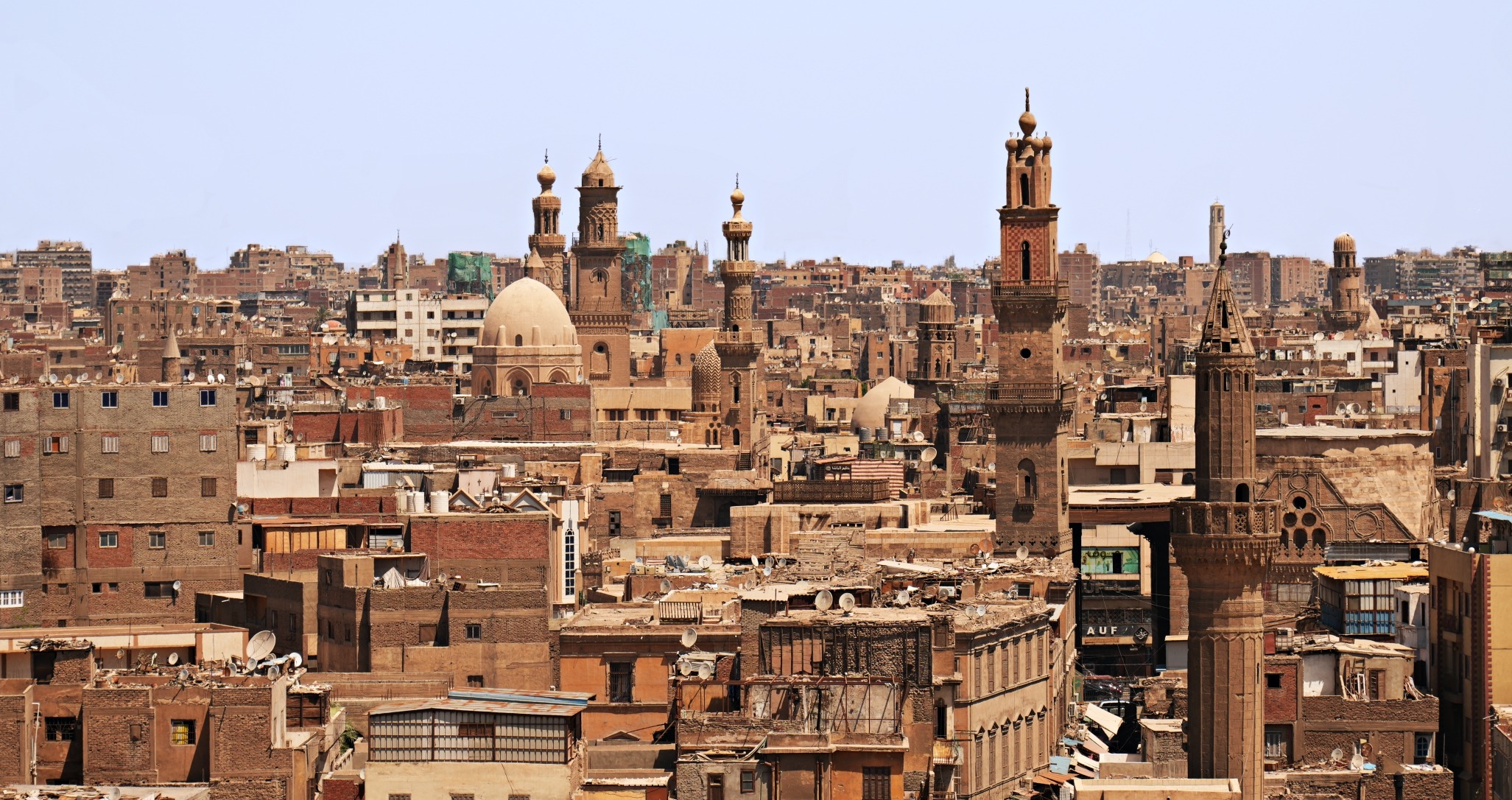
While we tend to think of Egypt as the land of pharaohs, its medieval history has also left us with wonderful architecture to enjoy. In the centre of Cairo is an area so special it has been deemed a UNESCO World Heritage Site. Referred to as Islamic Cairo, it is filled with over 600 stunning medieval buildings. Some of its finest can be found on Al-Mu’izz Street.
Note – Al-Mu’izz Street is also called El Moez or Muizz.
The History of Islamic Cairo
After the Egyptian Pharaohs, the Hellenistic Dynasties and the Roman Empire came and went, Arab Muslim rulers conquered Egypt to mark the beginning of the Islamic era. These initial Arab Dynasties didn’t settle in Cairo, though. It wasn’t until the 10th century that the Fatimid Dynasty from Yemen and Syria founded Cairo. In the ensuing centuries, they were followed by other Muslim dynasties, including the Ayyubids and Mamluks. Islamic Cairo is the heart of the city and is a treasure trove of medieval architecture from these pre-Ottoman times.
This part of Old Cairo is what you imagine a medieval town to be: narrow lanes lined by old, stone buildings used for centuries by craftsmen, food markets, and inns. Towering above are medieval minarets, mosques, madrasas, and towers. We love exploring cities on foot, and by doing just that in Islamic Cairo, we could absorb the energy of this brilliant, chaotic part of the city.

Islamic Cairo itself is massive, so first we’ll take you down Al- Mu’izz Street in the heart of Old Cairo. In the next post, we’ll explore the other parts of the city’s history in the Citadel and its medieval mosques. You can read about it in Saladin Citadel and Medieval Mosques.
Al- Mu’izz Street
As one of Cairo’s oldest streets, you can only imagine the stories it has witnessed. Buzzing with activity from one end to the other, Al-Mu’izz Street is a key place in your exploration of Islamic Cairo. Formally, Al-Mu’izz li-Din Allah al-Fatimi Street, most call it Al-Mu’izz Street or even Moez or Muizz, and it is the perfect place to begin your day.
Bab Zuwayla
Not long after establishing the city, the Fatimid Dynasty surrounded its precious Cairo with a wall. The original mud wall was rebuilt in stone in the 11th century, which is when Bab Zuwayla was added. (Bab means Gate in Arabic)
Over the next couple hundred years, they expanded the wall, but only three babs (gates) and a few small sections of this old wall remain. From the outside, you can see that Bab Zuwayla was not just for decoration. It looks formidable with tall castle-like towers topped by 14th century minarets. It must have been an imposing entry to the old city. While it looks tall to us today, it actually descends 3 m below street level due to changes in the city over hundreds of years.

The minarets on top were a later addition and belong to the 15th century Sultan al Muyyad Shayk Mosque, down the street. Their three story design is typical Mamluk style.
We climbed to the top of the towers to peer down into Al-Mu’izz Street. Once at the top, we were astounded by the number of minarets we could see within just a few blocks. Cairo is often called the City of a Thousand Minarets, and from this vantage point, we understood the nickname. From this high, we could also look into the courtyard of the nearby Sultan al Muyyad Shayk Mosque.
Unfortunately, it was also quite depressing to see the number of shabby buildings and the garbage covering their crumbling roofs.


Looking the other way, we saw the Mohammed Ali Mosque and Saladin Citadel, both prominently placed on a hill.

Entry to the minaret – 100 EGP ($1.90 USD); Opening Hours – 9am to 5pm, daily.
Once we passed through Zuwayla Gate, our feet followed the dusty, 10th century Al-Mu’izz Street, just as others have done for hundreds of years. The narrow road was packed with busy shops, tuk tuks, bikes and pedestrians, all going about a regular day.
Take your time on this street and soak in its history and atmosphere. This side of Al-Mu’izz Street feels its age, so enjoy it because the second half is much more touristy.


Sultan al Muyyad Shayk Mosque
The solid stone walls of the mosque form part of the old city wall. That and its unadorned exterior makes it look a little like a castle. There wasn’t always a mosque on this site. Before becoming sultan, al Muyyad was imprisoned in a jail at this location. He prayed to God, saying that if he were released, he would build a mosque on the site of the jail, which is the one we see today.
Once inside, you can see a small mausoleum near the entry that holds the sultan’s tomb. From there, the bare hallways lead you to the open courtyard we had just seen from the top of the minaret.


The mosque is rather plain until you reach the prayer room. Its carved wood and ivory ceiling and doors accentuate the colourful stone qibla wall, making it anything but plain.
The qibla wall faces Mecca in all mosques.

Back on the street, you’ll pass Wakala of Nafisa al-Bayda, an old caravansary from the 1700s. Not far away is Sabil-Kuttab of Mohammed Ali. These buildings are a combination of fountain (sabil), to provide clean water, and Qur’anic school (Kuttab). This one was built in the 1800s, in honour of Mohammed Ali’s deceased son. We’ll tell you more about Mohammed Ali when we visit the Citadel.


UNESCO Sites
Once you cross the busy Kobri Al Azhar Street, you will reach the other half of Al-Mu’izz Street. This section of the street is packed with seven UNESCO World Heritage Sites. It is much cleaner, but also much more touristy on this side.
We weren’t bothered by touts on the other half of the street at all. In fact, we may have been the only tourists. But here, the touts are quite relentless. They make it difficult to ignore them, so you’ll have to continuously say ‘La Shukran’, meaning ‘No Thank You,’ and keep walking. If you don’t, they will continue to follow you.

You can walk along the street for free, but to get inside any of the UNESCO sites, you need to buy a ticket. One ticket allows you entry into the following seven sites that are all closely located on the historic street:
Entry – 220 EGP ($4.20 USD) to all sites on the street, so it is very reasonable.; Opening Hours – 9 am to 5 pm, daily.
Note – Women must cover their shoulders, arms, legs and hair when entering the mosques and madrasas on the street. Men must cover their legs. Everyone must remove their shoes.
1. Qalawun Complex
The largest site on the street is Qalawun Complex. It is so large, in fact, that it takes over one full block on the narrow street. Built in 1285 by Sultan Qalawun, it was the first multi-use complex of its kind in Egypt. It included a madrasa, mausoleum, mosque, and hospital.
From the outside, its sandy coloured outer walls have a few decorations other than the minaret and large dome. This exterior makes the interior a surprise.

The first room you will enter is the mausoleum for the Mamluk sultan and his sons. Painted in gold and cream, the carved wooden ceiling and decorated arches are stunning. Add to that the colourful stained glass and elaborate mihrab, it is a spectacular room.
In the centre, a delicately carved wooden screen separates the tombs from the main room.


One of the interior entrances to the mausoleum has delicately sculpted designs on the white marble arch. The softness of this entrance is quite the contrast to the dark brown of the mausoleum.

The complex also includes a madrasa with a prayer room, but they are not nearly as decorated as the mausoleum. The hospital area is no longer standing, but we were surprised to learn that it was functional from the 13th century until the 19th century. It was very forward-thinking of the Sultan of the time to include a hospital.
2. Madrasa Mausoleum of Sultan al Salih Nagm al Din Ayyub
Located across the street is the Madrasa Mausoleum of Sultan al Salih Nagm al Din Ayyub. Built in 1240, it is considered one of the most important buildings from the Ayyubid Dynasty. This is because it was the first to teach Sunni Islam, rather than Shia, which was the sect followed by the previous dynasty.
The main room is an 800-year-old mausoleum for the sultan, decorated with lanterns, large stained glass muqarnas, and friezes of scripture and prayers around the edge.

3. Madrasa Sultan al Nasir Muhammed ibn Qalawun
Completed during the reign of the Qalawan Complex Sultan’s son, the open-roofed madrasa sustained significant damage over the centuries. As a result, the main rooms to see are the are two iwans (rooms) at either end. Large lanterns hanging down from the high ceilings make them very picturesque.
It is difficult to see many of these buildings from the street because it is so narrow. From inside the madrasa’s prayer room, though, we can see its two mismatched minarets.

The qibla wall has delicate stucco designs. We were interested in seeing it because this was the last mosque to have stucco work in Cairo. Later mosques used carved marble and stone instead.

You can see the small mausoleum for his mother and son, but he was buried in his father’s tomb, Qalawun, down the street. We will show you another mosque built by this sultan in the Citadel.
4. Madrasa and Khanqa of Sultan Barquq
This madrasa begins with a castle-like elbow entrance that eventually takes you to a beautiful open courtyard. The best feature in the madrasa, and actually on the entire street, is the mosque. The stripped qibla wall and mihrab combine Mamluk and Fatimid designs. Lanterns hang from the golden ceiling, while the mihrab has colourfully detailed designs in the wood, marble, metal and stucco. All of this is inlaid with stained glass. It served as a Sufi Lodge for many years and was our favourite building on the street.


5. Madrasa al-Kamil Ayyub and 6. Sulayman Agha al-Silahdar Mosque
These two sites were closed when we visited.
7. Hammam Sultan Inalquite
We weren’t very impressed with this former public hammam. It is very plain inside compared to other buildings we saw on the street.
This end of Al-Mu’izz Street is much more touristy with restaurants and shops, but there are so many fabulous sites that make up for this annoyance.


In addition to these UNESCO sites, there are other great buildings on the street.


Haret al Darb al Asfar Street
On the side of Al-Mu’izz is the narrow Haret al Darb al Asfar Street. Its overhanging balconies come so close that across the street neighbours could pass food back and forth. In Mexico, they would say the neighbours could kiss, but that’s not proper in a Muslim country.
Located on this street is Bayt al Suhaymi Museum. It is said to be a good representation of 17th century Ottoman houses. It is a UNESCO World Heritage Site, but it is on a separate entrance ticket. Tickets are sold on Al- Mu’izz Street.

Khan el-Khalili Souq
Located on the edge of Al- Mu’izz Street is Khan el-Khalili Souq. We were told it is an authentic market, but it is actually a tourist market, not a traditional Egyptian souq. We quickly walked through, but it didn’t appeal to us as much as the many authentic ones we saw while walking around the city.

Bab al-Futuh
At the opposite end of Al-Mu’izz Street from Bab Zuwayla is another gate from the same age. Today it is on the side of a busy street, but it would have been on the edge of the Fatimid city. Bab al-Futuh has two bastion towers and is one of three remaining city gates. Its name translates to Conquest Gate because military campaigns would exit through the gate on their way to battle. First built in the 10th century, it was rebuilt in the 11th to be the shape we see today.

Bab El Nasr
Only a block away is another gate. It looks a little different because it has square towers. Its name translates to Gate of Victory. Inside the towers were living quarters for the guards.
Between the two gates, you can see some of the old crenellated wall.


Al-Azhar Mosque
This massive complex immediately grabs your attention with its double-topped minarets, large dome and decorated entrance. It lies between the two sides of Al Mu’izz Street so you could stop to visit before crossing between them. The mosque was built by the Fatimid Dynasty to celebrate their new city, making it one of the oldest in Cairo.
Al-Azhar Mosque was originally Shia, under the Fatimids, and then suffered neglect when their reign ended, and the country transitioned to follow Sunni Islam. The Mamluks restored and rebuilt a lot of the building in the 1400 and 1500s, including adding the interesting twin-tipped minaret.


Entry – Free; Dress Code – Women must wear a long skirt, sleeves and have their hair covered. Note that long pants are not allowed. I was told it was because pants are pajamas. Men must cover their legs.
Zeinab Khatoon
Located behind Al-Azhar Mosque, this historic house has a plain front, so we wouldn’t take much notice of the building if we weren’t going inside. Once you enter, you realize that its rooms are kept hidden behind corners, walls and up staircases. This was a common design in the Mamluk Dynasty, and this house is said to be an excellent example of their architecture. Zeinab Khatoon was a former staff of the Mamluk Dynasty, and she built this house when she was released from their service.
While you can see wooden balconies and one grand room, most of the house has been poorly rebuilt with plain stone and cement walls, so it didn’t seem like an excellent example to us. The best reason to visit is to see the rooftop view of the minarets of Al Azhar Mosque.


Entry – 40 EGP (76 cents); Opening Hours – 9am to 5pm, daily.
Wikala of al-Ghawri
There were a few caravansaries in this part of Cairo. All we could see of Qaytbay Caravansary was its wonderful entryway. A few streets away, Wikala of al-Ghawri (or Ghuri) now operates as a museum. Built in the early 14th century, the old Mamluk-era Caravansary (Wikala) is in pretty good shape, although all you can see today is its main courtyard and 4 stories of balconies.
Rooms on the upper floors have wooden shutters and were used as lodging for merchants and traders travelling across the country. The ground floor was warehouses. Originally, there was an attached mosque and madrasa.


Beside it, Hawd al-Sultan Qaytbay is likely the most beauiful animal trough we’ve ever seen.

Time Needed – Visiting both sides of Al-Mu’zz Street and Al-Azhar Mosque will take a full day.
With so much history concentrated in one area, almost all of historic Cairo is a UNESCO World Heritage Site, including Al-Mu’izz Street, the Citadel, Mosque of Ibn Tulun, Coptic Cairo and the City of the Dead.
Museum of Islamic Art in Cairo
On our walk from Tahrir Square and the Musem of Islamic Art, we passed a few intereting shrines and mosques.


The Museum of Islamic Art is set in a beautiful buildng and displays a selection of Islamic Art over the ages from the Islamic Dynasties that ruled Egypt. It begins with the Umayyad, Abbasid, Tulinid, and then continues with the Fatimid, Ayyubid, Mamluk and Ottoman including Mohammod Ali. It’s a nice museum if you have time, but it is not a must see.


Entry – 340 EGP ($6.50 USD); Opening Hours – 9am to 5pm, daily.
Our tour of Islamic Cairo continues when we take you to the Citadel, the City of the Dead, and the Mosques of Ibn Tulin, Sultan Hasan and al Rifai.
For tips when visiting Cairo, including where to stay and avoiding common scams, visit our Tips For Vising Cairo.

This article is also featured on GPSmyCity. To download this article for offline reading or create a self-guided walking tour to visit the attractions highlighted in this article, go to Walking Tours and Articles in Cairo.
Click on the link to read our Travel Tips For Egypt.

To read more of our adventures in Egypt, click here.
Coming Next – Saladin Citadel and Medieval Mosques in Islamic Cairo
For pictures from other blogs go to Gallery at monkeystale.ca.
To read about more of our adventures go to Destinations.
If you like what you read, please comment or share (with credit) using the links below.



We'd love to hear from you, please leave a comment.