

Cairo is a city with two personalities. It’s chaotic, crowded, and dirty. Touts seem to be everywhere and hound you relentlessly. But its historic streets are also full of life and its landmarks carry an amazing array of stories. Cairo’s unruly reputation keeps many away, but if you can get past the noise, the litter and the touts, you will be exposed to its many charms.
With a population of over 23 million, Cairo can be overwhelming. Those who do visit come to see the Pyramids of Giza and don’t give the city much time. We spent seven days in Cairo, and many were filled from morning to night with varied and uniquely Egyptian landmarks that had nothing to do with the pyramids. In our Cairo posts, we’ll take you to its many corners; some you have heard of, but likely many more you haven’t. We’ll have to do it over several posts because there is that much to see.
In this post, we’ll show you the common sites around the city’s historic centre, to ease you into Cairo. Later, we’ll explore Al-Mu’izz Street and the Citadel in Islamic Cairo, Coptic Cairo, and finally take you to the showstoppers, the Tombs and Pyramid of Saqqara, and end in the Pyramids of Giza.
Click on the link to skip to the bottom for our Travel Tips For Cairo.
A Short Bit on Cairo’s History
Let’s begin with a brief overview of Cairo’s long history. Although there were settlements in this region as much as 6,000 years ago, it wasn’t until the 10th century that the city was founded. It was the Fatimid Dynasty from Yemen and Syria who, after defeating the ruling Arabs to gain control of Egypt, decided to settle in Cairo. In the ensuing centuries, they were followed by other Muslim dynasties, including the Ayyubids and Mamluks, until the Ottoman Empire gained control and ruled for almost 400 years.
In the 1800s, the Ottoman Pasha Mohammed Ali attempted to bring Egypt into the modern era, but since he was also rigid to Ottoman customs, his dreams were never fully realized. By the end of the 1800s, Ottoman Pasha Khedive Ismail aspired for Cairo to become more European; a ‘Paris of the Nile’. Egypt was prospering from the newly built Suez Canal, and the Pasha invested a lot of this money to turn the city’s downtown into a mini Europe. As a result, in parts of Cairo’s historic centre today, you can find Belle Époque, Baroque, Nouveau Riche and other European architectural styles. Unfortunately, the Pasha’s big dreams cost the country dearly, and as a result, Egypt couldn’t pay its debts. This is when the British entered as a protectorate.
Note – Pasha was similar to a governor in the Ottoman Empire.
The Brits didn’t control the country for long, though, because in 1923, Egypt became a constitutional monarchy. Sultan Fuad of the Mohammed Ali Dynasty became King Fuad I. The British army did stay on for 30 more years, but only to control the Suez Canal. Once Egypt rid itself of the monarchy in the 1950s, the country became an autocratic republic, called the Arab Republic of Egypt. Unfortunately, it is not fully democratic, and the current government is suspected of corruption. As a result, Egypt still hasn’t gotten back on its feet.
But enough of their history, let’s see all the great landmarks in Cairo, beginning in its historic downtown.
Tahrir Square
Placed a block from the Nile, the large space was initially named Ismailia Square, for the 19th-century ruler Khedive Ismail. In the 1950s it was renamed Tahrir Square, which translates to Liberation Square. This name is fitting since it is the scene of many protests, including the Arab Spring Uprisings in 2011 and again in 2013. Many protesters were killed in those demonstrations, so it is also known as Martyr Square.
Omar Makram Mosque
On the edge of the square is Omar Makram Mosque, which serves as a venue for state funerals. In front is a statue of the national hero Omar Makram, celebrated for his resistance against Napoleon I’s invasion of Egypt.


Ramses II Obelisk and Sphinxes
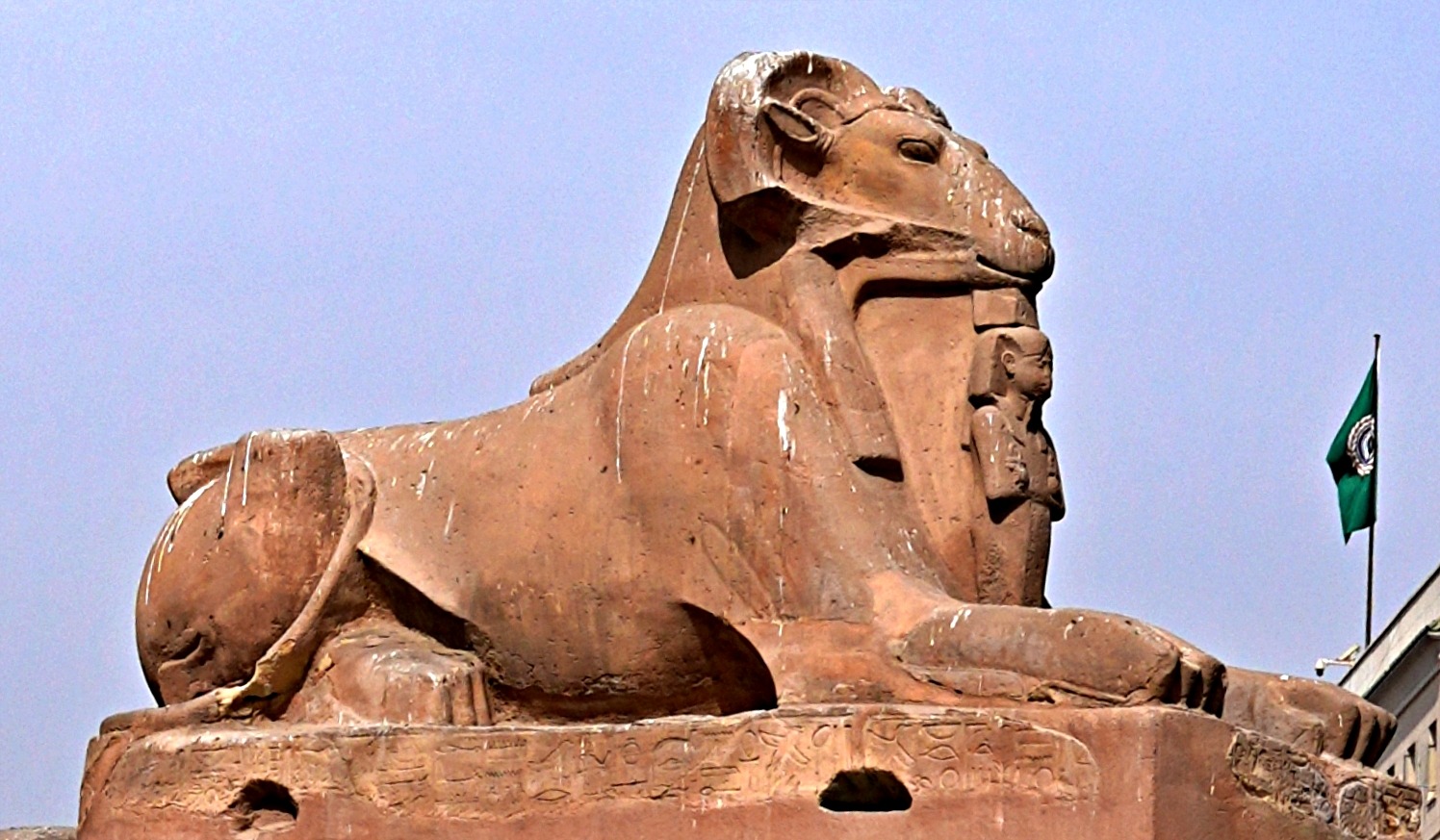
In the centre of a busy roundabout, directly in front of the square, you’ll be surprised to see an ancient obelisk. Built in approximately 1250 BCE under Pharaoh Ramses II, the obelisk stands above four ram-headed sphinxes from the same era. The sphinxes have been restored so you can see details in the small statues of Ramses II between their paws. We’ll talk more about these sphinxes when we take you to Luxor.
The juxtaposition of these ancient relics beside the rush of traffic speaks to what Cairo is all about. Steeped in history, the modern, hectic city today is just trying to survive.


Tahrir Square also has an area called the Garden, but in reality, it is a bunch of olive trees in wooden planters set on cement. They were installed in 2020, with the obelisk, to revitalize the city’s downtown, but the garden didn’t seem overly inviting to us.
Egyptian Museum
Located on the edge of the square is the Egyptian Museum. It has fewer artifacts than it used to, partly because some were transferred to the new Grand Egyptian Museum (GEM) near Giza. Another reason is that the museum was ransacked during the Arab Spring uprisings. Even with the fewer items on display, we still found many things to see and are glad we visited.

Here are a few of the things we saw, but we’ll bring you more as we visit the archeological sites.


You can find the latest opening hours and prices for this and all of the museums and archeological sites in Egypt here.
European Buildings
Around the square, you’ll notice several examples of the Parisian-style buildings erected to fulfill the Ottoman Pasha’s dream. The restored buildings, add a distinguished look to the busy streets.


Talaat Harb Square
A few blocks away from Tahrir is Talaat Harb Square, another landmark from the Ismail era. Rather than being a peaceful park, though, it is a busy intersection that is called a square. Years ago, it was probably lovely, but today most of the buildings are in much need of restoration. In the centre is the square’s namesake, Talaat Harb, an entrepreneur and founder of the large Banque Misr.


Streets of Old Cairo
As you walk along the streets between the two squares, you can find more of these European-style buildings. Some are in decent condition, but unfortunately, much of their Belle Epoque finesse has been lost over time.


As you stroll in this area, you will be inundated with the smells and sounds of Cairo. From the constant barrage of car horns and touts calling out, to aromas of horse-carts and shwarma stalls, it is like being dropped into the middle of a sensory overload chamber.


Amidst this chaos, we were greeted warmly by the locals. Many smiled and said hello, even slowing down in their cars or motorcycles to do so. About half were genuinely friendly, wanting to know where we’re from and hoping we’d enjoy their country. The other half, though, begins in the same manner, but their motive is different. These people have something to sell, or even just want to get paid for telling you information or pointing out a site, even when you didn’t ask. It’s unfortunate, but you don’t know who is just being kind and who wants something, so you tend to treat everyone as if they are a tout.
As we wandered, we found a few local markets selling everything from phone chargers and blenders to incense, shisha pipes and underwear. All around them, cars, tuk-tuks and delivery carts crowd onto the road, leaving little room to safely walk. But the smiles and shouts of welcome continue. Vendors call out telling you what they sell, but there’s no hassling here because everyone, except us, is local.


Abdeen Palace
A little further outside of downtown is the Abdeen Palace. Built in 1863, it replaced the nearby Cairo Citadel as the residence for Egypt’s Royal Family. It also served as the government’s seat of power from 1874 until the July Revolution in 1952. Built when the city was attempting to become more European, it was intended to show the wealth and influence of the Mohammed Ali Dynasty.
Today, the lower floors house the Abdeen Palace Museum, but the living quarters on the upper level can only be seen on a private tour.

Abdeen Garden
In front of the palace is Abdeen Garden, which is like a quiet retreat in this busy city. There’s a small entrance fee of 5 EGP (10 cents), but for a few minutes of peace, it is worth it.

The Nile and its Islands
Cutting through the centre of Cairo is the famous Nile River (pronounced Neel in Arabic). This part of Egypt is referred to as Lower Egypt because it is closer to the Nile’s mouth, where it empties into the Mediterranean. We were excited to see this famous river, but unfortunately, Cairo doesn’t make very good use of its riverfront. There are a few luxury hotels and riverboat casinos on its edge, but there isn’t a lot of space to stroll along the historic river.


Tip – You can take river cruises in downtown Cairo, but if you’re planning to visit Aswan, we recommend that you wait to take a cruise there. The Nile is much more picturesque in Aswan. We’ll show it to you in a few weeks.
In the middle of the wide river are several islands that are worth visiting.
Zamalek Island and Cairo Tower
Walk across the Kasr El Nile Bridge from Tahrir Square to reach Zamalek Island. Its main draw is the tall Cairo Tower. You can go up to its top for views of the city.
We had read that the island is a quiet escape, but found it to be just as busy as the city centre.

Rawda Island
The other main island in the Nile is Rawda, which has several sites that tell a different side to the city’s history.


Rawda Island Nilometer
Throughout history, the Nile flooded every summer. In ancient Egypt, it was both a curse and a gift. Floods created fertile grounds, but overflooding resulted in disasters. An ingenious design helped Egyptian leaders understand the river’s changing water levels. Built in 861 AD by Uzbek scientist Ahmad al-Farghani, the Nilometer consists of a 10 m (22 ft) tall marble column set upright in a deep hole on the edge of the island. Water entered through three different doors, depending on the river’s height. The column was a measuring stick with etchings to indicate depth. Steps on the side allowed someone to read the water level on the column and note the changes.
The Nilometer helped leaders understand how much the Nile was rising and when it had peaked by measuring the water levels. This information was useful to both prepare the dykes and canals for flood mitigation and to set taxation levels based on expected agricultural crop yields.
This simple, yet revolutionary design was copied in other parts of the country. We’ll take you to some as we travel across Egypt. The annual flooding of the Nile ended in 1970 once the Aswan Dam was completed, so the Nilometers were no longer needed.


Entrance – 120 EGP ($2.40USD); Opening Hours – 9am – 3:45pm, daily.
Manasterly Palace
Beside the Nilometer is a palace built in Ottoman-Baroque style. It is from the 1850s and was erected over the ruins of an Ayyubid palace. It is currently closed for renovation, but we poked our heads through the door to see a beautiful entry hall. Once completed, it will be a nice building to visit.

Prince Mohamed Ali Palace
At the other end of Rawda Island is the ornate Prince Muhammed Ali Palace, also called Manial Palace. We first saw its tall tower from the other side of the Nile and were curious to see inside.

Once you enter through the palace gates you’ll see a tall clock tower /minaret and a small mosque from the 1930s. From there, a walkway takes you beside a tree-filled garden to see the palace.


Prince Mohammed Ali Tewfik was a member of the Mohammed Ali Dynasty and was the presumptive future king of Egypt. His hopes were dashed however, when King Farouk had a son and ended his claim. The primary building on the grounds is his main residence. The Saray is decorated with over-the-top tiles using a mixture of Persian, Mamulak, Syrian, Moroccan, and Andalusian styles.
The jaw-dropping display begins in the main foyer, called Fountain Hall. This room is covered floor to ceiling in tiles with horseshoe gates and a wrap-around balcony above. Off to its side are equally decorated rooms.


Beside the residence is an ornate Throne Room. The long room has plush seating and portraits of the Mohammad Ali family and important Pashas from Egypt.

The most ornate room is on the upper floor. Golden Hall lives up to its name. The room is overloaded with golden Rococo-style accents that make you wonder what the designer was thinking.

To reach Manial Palace, you can take a taxi from downtown or take the metro. The nearest metro station is Elsayeda Zeinab Station.
Entry – 220 EGP ($4.30 USD); Opening hours – 9am-5pm, daily
Cairo Aqueduct
If you visit Rawda Island, take a quick stop to look at Cairo’s Aqueduct right across the river. Built in the 12th century, waterwheels brought water from the Nile up to the aqueduct, which was then carried 3 km (1.9 mi) across the city to the foot of the Citadel. From there, another series of water wheels carried the water up to the citadel on a hill. It was a remarkable structure for the time.

Rawda Island is accross the Nile from the churches in Coptic Cairo, so you could visit both in the same day. We’ll show you Coptic Cairo soon.
Pigeon Lofts
One interesting thing we saw in many parts of Cairo was wooden pigeon lofts. There are thousands of these raised platforms in Cairo. Raising pigeons is both a hobby and an income source. Some sell their pigeons for food in local markets, many raise them for pleasure, and others train them to compete.
Hobbyists, called Pigeon Fanciers, take joy in sending their pigeons out for a guided flight. The birds follow a series of whistles or flag signals that direct their route before returning to the loft. Some pigeon fanciers enter their birds in competitions where pigeons race for speed, ability to follow commands and even the art of stealing from another roost. It is an unusual part of life in Cairo.
In the first picture below, the man is using a flag to instruct his pigeons where to fly next. In the second, you can see dozens of them scattered across the community.


Tips For Visiting Cairo
Crossing the street – This is an acquired skill that requires bravery, especially for the first few times. Traffic continuously flows, but unlike Vietnam, where you have a slow, uniform pace across the street, in Cairo, you must step out into busy, fast moving traffic. When there’s a break, pedestrians cross one lane at a time and wait to cross the next lane. Traffic doesn’t go at the same pace, nor are they in organized lanes. Often, you’ll find yourself standing in the middle of two passing cars, waiting for an opening, while still keeping a watchful eye for the quicker, more nimble motorcycles.
For the first few times, until you understand the process, it is easier to go beside an experienced local. The good news is that drivers are not malicious, unlike in Paraguay, where they speed up when a pedestrian crosses. It seems as if pedestrians are just another user of the road. Cars will swerve out of your way, but they rarely stop or even slow down to let you cross.
Scams – Although the people are friendly and welcoming, and thievery isn’t in their nature, the art of the scam seems to be woven into the genes of many. This is the behaviour that makes visiting Cairo, and in fact a lot of Egypt, so tiring and has given the city a bad reputation. The most common scam is to act as a helpful stranger, but have an ulterior motive. Try to remember that nothing is free. If someone offers something, they usually expect to be paid. You can either ignore them, say La Shukran (No Thank-you), or tell them ‘we went yesterday’. Other scams are overcharging. Make sure you are willing to haggle or expect to over-pay for almost anything.
Getting Around Cairo – There are Uber and Careem ride-share apps, but they don’t appear to work very well. After receiving a quote from these apps, the driver often sent us a message to say he would only come for a higher fee. Instead, we used these apps initially to understand the pricing, so we could be informed hagglers with taxis and tuk-tuks. Also, keep in mind that in cities, tuk-tuks are not as practical because they are not allowed on major streets, so they may not be able to take you over longer distances. They are more intended for short trips within a neighbourhood.
Taxi Tips – Before taking a taxi, be very clear on the important details agreed to with your driver. Confirm: the price quoted is for your entire group, and not per person; where they will drop you off; if the price is for one way or return; and how long you want them to wait. If you are not clear, they will look for a way to charge you more at the end of the trip. There are many scams where they will say the agreed-upon price was only for one person.
Another taxi scam is that they tell you that you have arrived at your destination when you are 2 km away from it, so it’s best to follow your route on Google Maps. Stay aware of a scam that is common throughout the world, where they tell you that a restaurant, hotel or site is closed, so they can take you somewhere else.
Where to stay in Cairo
Cairo has a wide range of accommodation options. From the luxury chain hotels along the Nile to apartment rentals or hostels in Old Cairo, and everything in between. Many of the locally run, mid-range hotels operate out of one or two floors of old, European-style buildings. Some appear unwelcoming from the entrance but are actually nicely renovated inside. Others, though, are very unclean inside and yet charge the same rate as the nicer ones. If you book one of these mid-range hotels, be sure to carefully read the online hotel reviews. There is no street view on Google Maps, so it is difficult to see what they look like in advance.
After a night in an awful one, we did a lot of searching and ended up staying in two very nice, locally-run hotels. One is Eileen Hotel, which is run more like a guesthouse. They have nicely decorated rooms and a delicious buffet breakfast. The other is Sawa Hotel. It is a newly renovated and offers an Egyptian-plated breakfast. You can use their locations as guides, if you like, or at least try to find a hotel not far from Tahrir and Talaat Harb Squares. Also, look for ones on smaller streets, because the larger streets have constant traffic, 24/7 and are very noisy.
Where to eat in Cairo
There are surprisingly few restaurants in Old Cairo. We found two in front of the Museum, but most of the city’s cafes are coffee and tea houses and have very little food on their menus. There are also only a few street vendors. Here are a few restaurants we found:
Riche Café – Cairo is home to many heritage coffee shops that reminded us a little of Buenos Aires. One of the best is located on the edge of Talaat Harb Square. Riche Café has an authentic décor and waiters dressed in old-style uniforms. Entering the café feels like a step back in time. Not only did we enjoy excellent Turkish coffee, but we also had delicious meals at Riche.

Abou Tarek Koshary – The national dish, koshary, is a hearty vegetarian meal made with rice, vermicelli, lentils, chickpeas and a vinegary tomato sauce, topped with crispy tomatoes. Abou Tarek is touted as having the best koshary in the city, and it is the only dish on their menu. Koshary is filling and very cheap, costing only $2 each, but we found it quite bland and didn’t seek it out again.

Zamalek Island – There are a few trendy restaurants in B’s Cairo, located on Zamalek Island, not far from the Kasr Al Nile Bridge. They serve mostly Western food, but are popular with young Cairo residents. There are also several boat casinos on its edge which serve meals.
Getting to Cairo
Air – Most will arrive in Egypt through Cairo International Airport. It receives flights from all over the world. You can also fly domestically to/from Luxor, Aswan, Sharm el Sheikh, Alexandria, Abu Simbel and Hurghada. To reach the city, take an official taxi, located on the arrivals level. They charge $25USD to take you downtown.
Bus – If you are already in Egypt, you can reach Cairo by bus from many Egyptian cities. GoBus travels north to Alexandria (3 hours), south to Luxor (10 hours), and East to Sharm el Sheikh (7 hours). To reach Siwa, WestBus (10 hours) is the best option. The Cairo GoBus station is not far from Tahrir Square, called Abd El-Moneim Riad, and another is in Giza. WestBus uses this station near Tahrir Square.
Train – Another option is the train, but they are very expensive for tourists and are notoriously late. We looked into taking a train from Luxor to Cairo and were quoted $150 USD for a second-class ticket. A local man said Egyptians pay the equivalent of $10 USD for the same trip. It seems as if they do not want tourists riding their trains.
Cairo is located near the top of the map below. It is an interactive map, so you can zoom-in, and click on a marker to read our posts from that location.
There’s a lot more from Cairo coming up, stay tuned for posts on Al-Mu’izz Street and the Citadel in Islamic Cairo, Coptic Cairo, Saqaara and Giza Pyramids.

This article is also featured on GPSmyCity. To download this article for offline reading or create a self-guided walking tour to visit the attractions highlighted in this article, go to Walking Tours and Articles in Cairo.

Click on the link to read our Travel Tips For Egypt.
To read more of our adventures in Egypt, click here.
Coming Next – Al-Mu’izz Street – The Heart of Islamic Cairo
For pictures from other blogs go to Gallery at monkeystale.ca.
To read about more of our adventures go to Destinations.
If you like what you read, please comment or share (with credit) using the links below.



We'd love to hear from you, please leave a comment.