
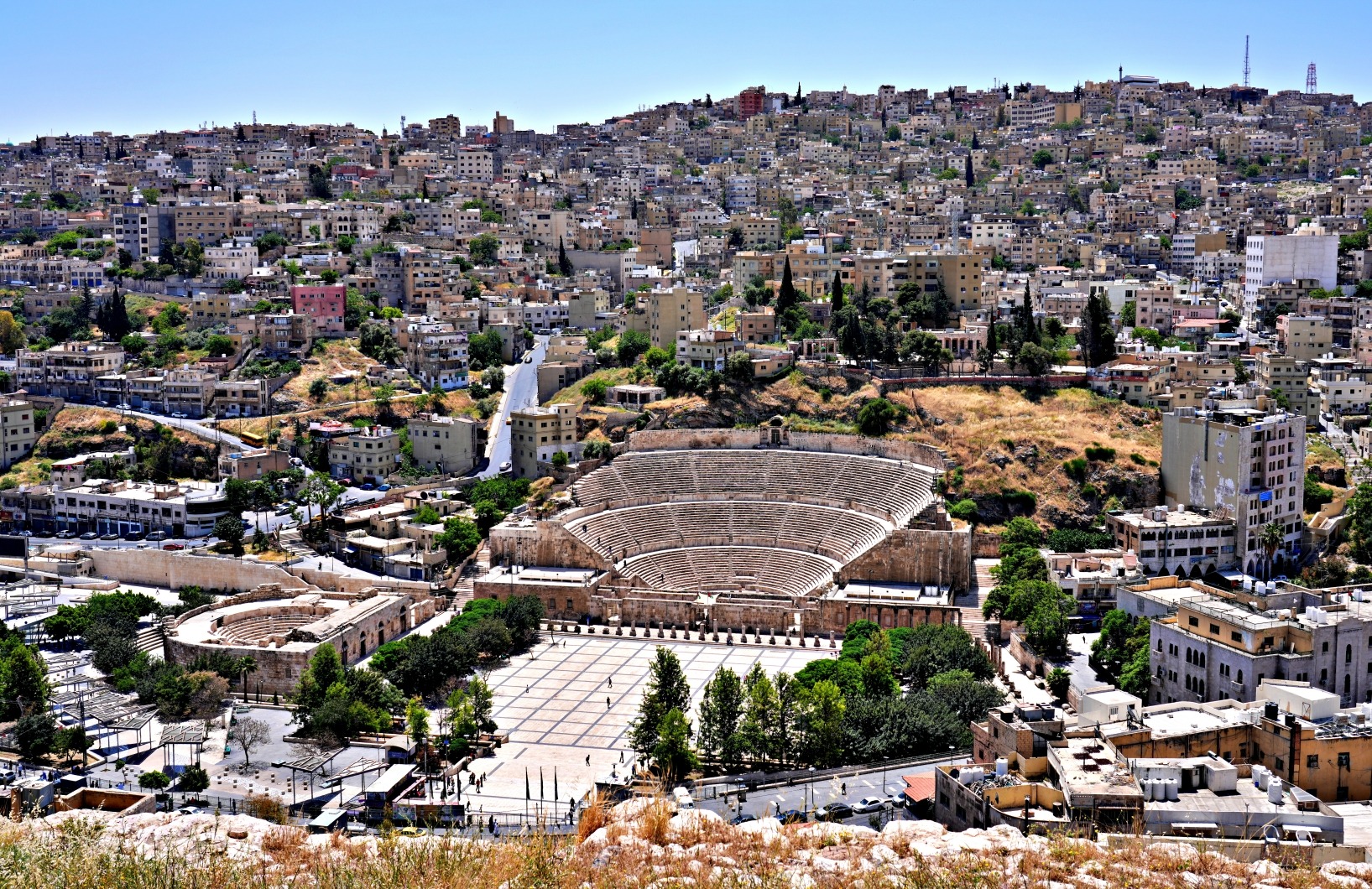
From the moment we saw the limestone homes that blanket Amman’s many hills, we were captivated by the city’s distinct beauty. That initial feeling only grew as we explored Jordan’s capital and discovered a city rich in history. Come with us as we take you to Amman, Jordan.
To see where Amman is located, please click on the link to view our interactive map of Jordan.
A Little of Amman’s History
Not only is the city pretty, but as you delve deeper, you’ll find it also has a comprehensive history. Its location within the ancient region of the Levant means that this land has been inhabited since the Stone Age. It has had several names, but its current one comes from the Iron Age tribes called the Ammonites.
Some of its lengthy story is due to its position on the King’s Highway. This major trade route ran through Jordan, connecting Saudi Arabia with Syria as early as the Iron Age. At that time, the borders we have today did not exist, and dynasties’ reigns often extended from the Mediterranean across the Middle East, Western Asia and North Africa, including the land we now call Jordan.
Because of this, Jordan experienced a variety of ruling dynasties over the centuries, until eventually the Ottoman Empire reigned for almost 400 years. After WWI, things changed. This part of the Middle East became a British Protectorate. The land east of the Jordan River was named Transjordan, and the land west of it, Palestine. After WWII, Transjordan proclaimed independence, becoming the Kingdom of Transjordan; later, the Hashemite Kingdom of Jordan. The many wars in the region, including the Arab-Israeli War, caused many difficulties for Jordan. Living in such a hotbed of political strife, since the mid 1990s, Jordan has chosen to become a mediator rather than an aggressor on either side. As a result, it maintains a relative calm amidst a sea of turmoil.
After that long history, let’s explore the wonderful city of Amman. While it doesn’t have as much to see as nearby Cairo, there are enough sites in Amman to keep you busy for a couple of days.
Old Amman
We’ll begin by exploring the hills in Amman’s centre. White limestone buildings follow the rise and fall of the city’s many hills, giving Amman a soft, almost fairytale-like appearance. Wandering these hilly streets gave us a chance to see this pretty city from many angles, so we could appreciate its unique setting.


Colourfully decorated stairways connect these hills with the valleys below. make the walk more fun.


Al-Balad is the oldest part of town and is where you can experience the hustle and bustle of the busy shops and markets that line the streets. The main one, King Faysal Street, is a great place to see what Old Amman is really about. We enjoyed watching life happen on the streets while enjoying a Turkish coffee on one of the many overhanging balcony cafes.


Amman Citadel
Standing above the historic centre is an even older settlement. The city’s highest peak, Jebel Al Qala (Fortress Mount), has been inhabited since Neolithic times, making it one of the oldest communities in the region. In the Iron Age, it was home to the Ammonite people, but only a few stones remain from their time on the hill.
The main structure on Jebel Al Qala today is the historic Amman Citadel. Portions of its fortified wall still surround the old complex, but the modern city has built right up to its edge.

The citadel was home to many different empires until it was abandoned in the 8th century. Called Philadelphia under the Hellenistic Ptolemaic Dynasty, it went on to become one of the Decapolis cities under the Romans. A few of those structures can be seen today, but mostly, the Decapolis city lies in ruins.
Temple of Hercules
Seen from many points on the hill as well as from the city below are the tall columns of the Roman’s Temple of Hercules. Construction began in the second century, but it was never completed. In addition, an ancient earthquake damaged the sections that were built.
Even the 12 metre (39 ft) tall statue of Hercules crumbled in the quake. In the bottom two pictures below, you can see a few fingers from one hand and a part of an elbow. They are all that remains of the giant statue of Hercules.


Byzantine Basilica
Other things to see on the citadel are the remains of the Byzantine Basilica. Many of the stone blocks used in building this church were taken from the Temple of Hercules. Today, only a few Corinthian columns and a very small section of mosaic floor remain.
In other parts of the citadel, you can see ruins of Byzantine villas and their portion of the fortress wall.

Reception Hall
The most complete building in the Citadel is the Reception Hall in the Umayyad Complex. Although the blue dome is new, the hall’s old walls show fine details that indicate it was built to impress. Inside, the layers of horseshoe decorations and grand arches are reminiscent of Persian designs seen around the Islamic world.
In addition to these Persian influences, you can also see vestiges of the old Roman Temple of Tyche. In fact, as with the Byzantine Basilica, many of the limestone blocks used to make the palace came from previous Roman structures.


The yard surrounding the palace once held a large urban complex. Today, you can walk between the ruins of the many homes, workshops, public baths and colonnaded market. The mix of Roman and Umayyad styles in this area reminds you that one dynasty often used building materials left behind by their predecessors.
Across from the palace complex are stone walls from the Umayyad mosque.


Jordan Museum of Archeology
Also on site, you’ll find the Jordan Museum of Archaeology. It was built in the 1950s and looks like it hasn’t been updated since. Its collection of local artifacts is extensive, though, so you can forgive the retro look of the building. It includes artifacts from the Paleolithic Age up to the Islamic Age, including pottery, statues and clay anthropoid coffins.


The most interesting artifacts are from the nearby Neolithic settlement of Ain Ghazal (7250–5000 BC). Although they were from the pre-pottery period, the people had a surprising amount of ingenuity. They developed a lime plaster and used it to make statues of people and mythical creatures, including many with two heads. These are believed to be some of the world’s oldest statues made in the human form. A few are on display in this museum, as well as in the Jordan Museum.

Citadel Entry Fee – Included on the Jordan Pass, otherwise 3JD ($4.25 USD). Opening Hours – 8 am to 6:30 pm daily (closes at 4pm in the winter).
Roman Amphitheatre
Across from the citadel is another hill, Jabal Al-Joufah, with the Roman Amphitheatre at its base. We first enjoyed a view of the theatre and the large open Hashemite Plaza from the citadel. There are a few trees on the edge of the plaza for shade, but it is mostly a wide-open area. Although it was described as a lively place for locals to congregate, it was always quiet when we passed by.

Once inside the 2nd century amphitheatre, you’ll notice the stage and orchestra pit still show off some of the original decorations. Our favourite part, though, was climbing to the top row of the 6,000 seat theatre. It is very steep, so even the top row has a great view of the stage. From there, you can also see Hercules Temple on the hill across.
The theatre is still used for performances today.


At the side of the theatre is the Museum of Popular Traditions with a display of costumes and jewelry throughout Jordan’s history.
Entry fee – is included on the Jordan Pass, otherwise it is 2 JD ($2.80 USD); Opening Hours – 8 am to 6:30 pm, daily (closes at 4pm in the winter).
Odeon
On the side of Hashemite Plaza, you may miss the intimate Odeon Theatre if you don’t look for it. Built during the same era as the much larger Roman Theatre, the semicircular audience seats only 500. Its stage, though, is more complete, giving you a better idea of its original look.

Nympheum
Another Roman artifact is on the side of one of a nearby street. Originally, a stream ran beside the 2nd century Nympheum making it both a source of fresh water and a leisure centre. When we stopped by in 2026, it was closed for restoration, but we could still see it from the street.


Jordan Museum
The small museum displays artifacts found in the region over the millennia, including pottery, tools and weapons. Like the Archaeology Museum in the citadel, this one also has Ain Ghazal double-headed statues.


Other fascinating objects were the spooky-looking plastered skulls from 9,000 years ago. They were found in the city of Jericho, on the west bank of the Jordan River. Researchers believe these people followed an ancestor cult because making them involved using the deceased’s skull and face. First, they applied plaster to the skull. Later, they moulded the deceased’s face onto the plaster and used shells in place of eyes.

The most exceptional items on display were the Dead Sea Scrolls. Dating from 0 to 100 AD, the scrolls were discovered in caves in the nearby Dead Sea and are the oldest known copies of the Bible. The papyrus and leather scrolls are in poor condition, but researchers were still able to read the Hebrew, Aramaic and Greek writings. The museum only has small pieces of the scrolls on display, but it is still fascinating to see these ancient written documents.
In addition to these, ancient copper scrolls were also found in caves beside the Dead Sea. These ones did not contain religious writings, but rather hinted to a hidden treasure.
Unfortunately, photography is not allowed of any of the scrolls. Other than the Dead Sea Scrolls, if you visited the Archaeology Musuem in the citadel, there is no reason to visit this museum.
Entry – 5JD ($7 USD), it is not on Jordan Pass; Opening Hours – 9 am to 5 pm, Closed Tuesdays and Friday mornings.
Grand Husseini Mosque
The Grand Husseini Mosque dates to the 7th century and it was built on top of an older Byzantine church. King Abdullah I rebuilt that first mosque in 1932, and its long history makes it Amman’s oldest mosque. Its prayer room is very large, with space for up to 1,500 worshipers, and is often full during Dhuhr (noon) prayer.
Compared to other mosques we’ve visited, we found it very under-decorated. The women’s prayer room is very small and has even fewer decorations.


Entry is free; Open daily, but non-Muslims are not allowed during prayers. Dress code – women must cover their hair, wear long sleeves and long skirt or pants and are only allowed in the women’s prayer room. Men must wear long pants.
Duke’s Diwan
Duke’s Diwan claims to be the oldest building in downtown Amman. Diwan is an Arabic term for a welcoming room. It first opened as a post office, and then operated as a hotel. Today, it is a small museum with only three rooms, an atrium and a large balcony that looks out to the shopping streets below.
Old photos and artwork from the region cover the walls, while the furniture lets you know how the rooms may have looked. Although not very large, Duke’s Diwan is a good way to see inside one of these old buildings.


Entry is by donation, Open – Saturday to Thus: 10 am – 5 pm.
King Abdullah I Mosque
Outside the historic centre, you’ll find the modern city with shopping malls, luxury hotels and apartment buildings. Between these is King Adullah I Mosque. Often called the Blue Mosque, its large blue dome can be seen from blocks away. King Hussein bin Talal had the moque built in 1989 to honour his grandfather, King Abdullah I. He was Jordan’s first king and was assassinated by a Palestinian group after conflicts in the 1950s.
The prayer room doors are small, but they take you into a large open prayer room with an oversized chandelier. Marble with lace-like engravings decorates the lower half of the room, and wooden shutters cover the windows. Generally, though, it is quite plain. If you have visited other mosques, you will probably find it more interesting to see it from the outside than the inside.


Entry – 2 JD ($2.80 USD). The entrance is through a gift shop, where women are given a robe and head covering to wear. Opening Hours – 8 am to 2 pm, closed to non-Muslims on Fridays.
There are other religious buildings in the area too. Across the street is the Catholic Orthodox Patriarchate, and a Greek Orthodox Church is a block away.

Getting to Amman and Jordan
Fly – Most will reach Jordan by air, arriving at the modern Queen Alia International Airport. It is 35 km from downtown, and a taxi charges around $40 USD. An alternative is the Sariyah Airport Express Shuttle for 3.40 JD ($4.80 USD) per person. Tickets are purchased from a kiosk outside the terminal.
Bus/Minibus – Within Jordan, Jett Bus travels between larger cities, but to travel to/from smaller communities, you either need to travel by collectivo (shared minibus) or taxi. Amman has three bus stations. For Irbid, Jerash and cities north of Amman use the Northern Bus Station (Tabarbour). For Madaba, Wadi Musa and other cities south, use Al-Wehdat Jett Station (South). Jett Bus also has a stop in the city centre called Seventh Circle.
If you are in Egypt, you can also travel between the two countries by land. Take a bus from Cairo or Sharm el-Sheikh to Nuweiba and then a ferry to Aqaba. This was our backup plan if the war in Iran made Jordan unsafe.
Getting Around Amman
Even though it is very hilly, the city is very walkable. If you don’t like climbing up and down multiple stairs, there are many taxis, as well as Uber/Careem ride shares.
Where to stay in Amman
The area surrounding Rainbow Street on Jabal Amman has many boutique hotels and guesthouses. Since it’s close to the restaurants, though, it can get noisy at night. A quieter area is the more residential Jabal Al Weibdeh, near Paris Square. We stayed in an apartment hotel and enjoyed the quiet evenings. It requires walking down and up more hills than if you stay on Rainbow Stteet, but we enjoyed the neighbourhood.
Where to eat in Amman
Not far from Paris Square on Jabal Al Weibdeh, you can find several trendy local restaurants. Another option is Rainbow Street. This vibrant part of the city has a few cafes and outdoor patios, decorated in fun colours. On Rainbow Street we recommend Fatari for excellent local food.


There are also several restaurants near Duke’s Diwan on King Faysal Street. For coffee, we recommend Amoun Cafe – Balat AlRasheed. We only had Turkish coffee, but it has Jordanian food and there are many others on the street. You could also try knafeh, a traditional Middle Eastern pastry at Habibah Hashem Restaurant.

Jordan Pass
We’ll mention the Jordan Pass in most of our posts in the country. This is one of the best tourist passes we’ve ever used. It includes entry to over 40 tourist sites in the country, and unlike other passes we’ve seen, it includes the country’s top places of interest. One of its best features is that it includes the tourist entry visa on all levels of the pass. Because of this, you are strongly encouraged to purchase your pass online before arriving in Jordan. We gave ourselves a week to make sure there were no problems, but we received the pass within a few hours.
The pass is available in three options. Other than the price, the main difference between the passes is that you will have one, two or three consecutive days in Petra. Even if you only plan to visit Petra, the Jordan Pass is still a worthwhile investment, but access to so many other sites lets you explore more without concern for the entry fees. You will receive the pass by email, but you should also make a paper copy since not every site has the appropriate scanners.
You can find more information on the Jordan Pass, including site hours, entry fees, etc, on their website.
Please note, we visited Jordan in the spring of 2026. At that time, there was a ceasefire in the Iran War due to the signing of the Memorandum of Understanding. Since conditions are changing frequently, please read current news on the area before planning your trip.

Here’s a link where you can read more of our adventures in Jordan, and a link to our interactive map of Jordan.
Coming Next – As-Salt and Quseir Amara – Day Trips From Amman
For pictures from other blogs go to Gallery at monkeystale.ca.
To read about more of our adventures go to Destinations.
If you like what you read, please comment or share (with credit) using the links below.





We'd love to hear from you, please leave a comment.