
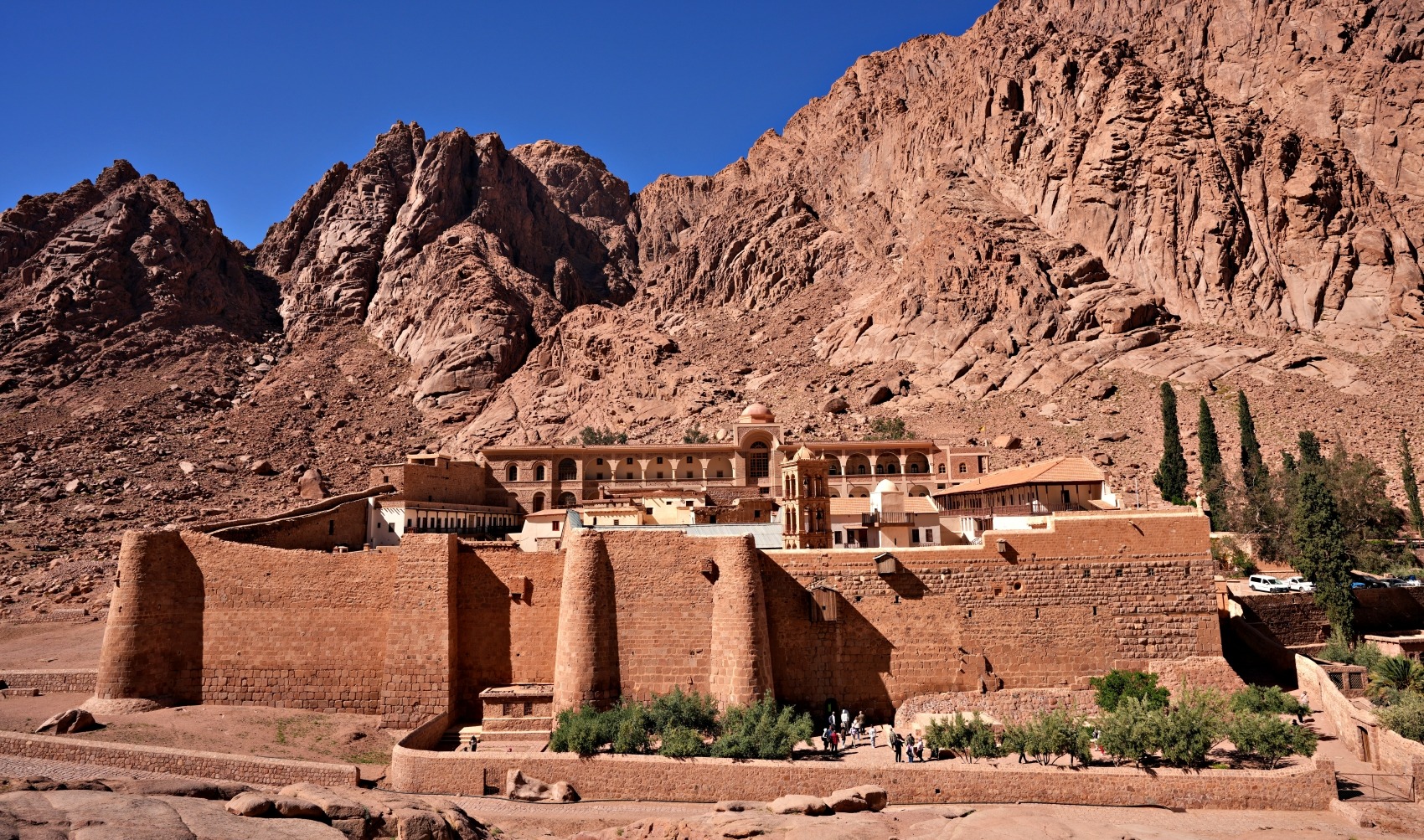
Egypt’s history isn’t limited to ancient pharaohs, pyramids and tomb art; it also served as the setting for several Biblical stories. Many of those took place on the Sinai Peninsula. The most well-known occurred on Mount Horeb, where Moses received the 10 Commandments from God. That mountain is widely believed to be Mount Sinai, and a popular activity is to hike to its summit. Combining the hike with a visit to the historic St. Catherine’s Monastery at its base makes a full day trip from Sharm el-Sheikh.
While diving in the Red Sea, we found ourselves not far from Mount Sinai, so we decided to include a visit to it on our itinerary. Since the mountain is over 200 km from Sharm el-Sheikh, the easiest way to hike and visit the monastery is to take a tour, which is what we did. On this tour, we learned a few things we wish we had known before going, and we’ll share those with you as we tell you our story.
You can read about our diving adventures in our post, Sharm el-Sheikh: Diving in the Red Sea.
First, we’ll take you on the hike to the mountain’s summit, then we’ll show you a few scenes from St. Catherine’s Monastery. Together, they are UNESCO World Heritage Sites.
Hike to Mount Sinai Summit
Distance – 6.8 km (4 ¼ mi) one way; Elevation Gain – 745m (2,444 ft), Max Elevation – 2,285 m (7,496 ft).
Access – The hike to the top of Mount Sinai begins in front of St. Catherine’s Monastery at 1,540 m (5,203 ft), which is a 3 hour drive from Sharm el-Sheikh.
Note: Mount Sinai is also called Moses Mountain or Jabal Musa in Arabic.
After being picked up in the evening in Sharm and driving through the night, we arrived at the monastery’s parking lot in the dark. It was close to midnight, and we were one of the first groups to arrive. Lights from St. Catherine’s Monastery shone on the arid mountain, but once we passed this area, the only light came from the moon and our headlamps.
We met our Bedouin hiking guide at the trailhead, and with our headlamps turned on, we began our ascent of Mount Sinai. Since most people try to reach the summit in time for sunrise, you will also be hiking in the dark and therefore have no idea what scenery surrounds you.


There are two trails to the summit: the Camel Trail and Steps of Repentance. Most people go up the Camel Trail (Siket El Bashalt) and down the other, or use the Camel Trail for both directions. It is mostly a good trail that slowly ascends switchbacks up the side of Mount Sinai, scaling 500 m over 5 km (1,6406 ft over 3.1 mi). If you take the more direct route, called Steps of Repentance (Siket Sayidna Musa), you can cut off a couple of kilometres, but it is much steeper. Because of that, most use it for the descent, not the ascent.
As you make your way up, you’ll pass several tea houses. The first is at the 3 km (1.9 mi) mark, and then they are placed every kilometre or so. Since most people on the trail are not hikers and many are unfit, groups will stop at each teahouse for 10 to 20 minutes.
At least one camel herder follows each group and constantly asks if anyone wants to ride a camel instead of walking. Our group of 13 mostly ignored them for a while. Things changed, however, after the first teahouse. Here, the slope became a little steeper, and our guide quickened his pace. Sure enough, as if it were pre-planned, one person in our group said it was too difficult for her and asked for a camel ride. This behaviour was consistent among the groups we spoke with, so we’re quite sure the guides are in cahoots with the camel herders.
After approximately 5 km, the Camel Trail ends and the tougher ascent begins. Instead of a trail, the route now travels up 750 granite steps to reach the mountain’s top. After 650 steps, you’ll reach a small plateau called Elijah’s Basin, with 5 teahouses. These are the highest teahouses on the mountain. By the time you reach this plateau, you’ll have walked 6.2 km (3¾ mi) and gained 740m (2,430 ft). It takes roughly 3 hours to reach the plateau, and most groups stop here for 30-45 minutes. If you’re planning to hire a camel, be aware that they do not climb these stairs.
As you can see in our picture below, our group was the first to arrive, but within the next hour, the tea house was bursting with hikers.

From Elijah’s Basin, there are only 100 steps (approximately 60 m/200 ft) to the summit at 2,285m (7,496 ft). At this moderately high elevation, it is very cold on the summit before sunrise. Making it worse, the winds are usually very strong, so it feels even colder. Knowing this, we weren’t very happy to arrive at Elijah’s Basin so early.
With at least a half-hour rest in one of the teahouses, it’s a good place to have your morning coffee or tea. In fact, you are expected to buy something if you wait in a warm teahouse. That would be fine if it weren’t the only thing you’re pressured into buying. While you’re drinking your coffee, the Bedouin guides stress how cold it will be on the summit. They all put a lot of pressure on everyone to rent blankets (200 EGP) and mattresses (200 EGP). But that’s not the only problem. They then try to convince you that you must leave the teahouse by 3:30 or 4 am to find the best sunrise spot. Most of our group went up when he suggested and sat in the dark on the cold and windy mountaintop until sunrise.
Richard and I waited until 5 am, knowing we didn’t need to be there in advance. As the sky began to brighten, we climbed up the last hundred steps to the rugged mountaintop. Instead of finding it to be a revered and holy place as expected, it was crowded with a hundred or more hikers, all crammed together, trying to keep warm.

As the sun rose, it awakened the surrounding peaks of the Sinai Range, offering us our first view of these rugged mountains. Our view included Mount St. Catherine’s. At 2,646 m (8,625 ft), it is the tallest mountain in Egypt.


As far back as the 200s AD, hermit monks believed Mount Sinai was Mount Horeb, the location where Moses received the 10 Commandments from God. Since the story of Moses is important to Christians, Jews and Muslims, we were surprised that, other than a couple of buildings, there wasn’t much on the summit to commemorate this religious site.
The summit used to be home to several churches, including one built by Byzantine Emperor Justinian. Today, they are all in ruins, but the one that remains standing was built with stones from these previous buildings. Chapel of the Holy Trinity (Chapel of Prophet Elias) was erected in 1934 by Greek Orthodox monks. It is said to enclose the rock believed to have been the source of the Ten Commandments tablets. Even though it would be impossible to verify, it would have been interesting to see the rock. Unfortunately, the chapel is closed to visitors, and there is no sign to indicate the rock inside.
Beside the chapel is a cleft under a massive boulder, said to be where Moses stayed while waiting to receive the Commandments. As with the rest of the summit, nothing marks this spot. You can see it in the lower-left corner of the picture below.

There is also an 11th century Fatimid Dynasty mosque on the summit. It is open to everyone, but you must be properly dressed. This includes removing your shoes at the door and covering your hair. Since it is so cold, it is unlikely your arms or legs will be exposed, but if they are, you will need to cover them as well.


As the sun continued to rise, the entire mountain top and the surrounding Sinai Mountains came to life. These early morning views are what made the hike worthwhile.


By 6:45, it was time to leave. We retraced our route and walked down to St. Catherine’s Monastery at the base of the mountain. After you climb down the 750 granite stairs, you can either take the Camel Trail or the Steps of Repentance. They criss-cross each other, so you could also do a combination of both.
In the daylight, we could see the various teahouses and parts of the trail we passed on the way up, including several camels.


Partway down, we had a view of the Chapel of the Holy Trinity above and a good view of Mount Sinai. Then, in the distance, we saw the controversial Great Transfiguration Project. This new resort and housing complex will accommodate tourists visiting Mount Sinai and the monastery. Local Bedouins and monks are not pleased that a large tourist centre is being built so close to this religious site and their homes.


There were also surprising sights hidden in small openings in the sheer mountain walls. In these seemingly uninhabitable spots, we saw Bedouin farms with homes, sheds and small gardens.

The sunrise itself was nice, but not spectacular, and since there was nothing to commemorate the Biblical story, the entire experience was a little disappointing. It seems most people come to this legendary place to see the sunrise, not to learn about the mountain’s prestigious place in the Bible.
St. Catherine’s Monastery
In the 3rd or 4th century, local monks claimed to have found the Burning Bush, mentioned in the Bible. In 337 AD, Byzantine Empress Helena, mother of Constantine, commissioned a chapel to accompany the legendary plant. Later, Emperor Justinian added to the complex by surrounding it with fortress-like walls. The current monastery incorporated parts of that original chapel built by Empress Helena, but it is not open to visitors.

The monastery is named for St. Catherine. While living in Alexandria, Egypt in 305 AD, she was martyred by the Romans because they feared she would attempt to convert Egyptians to Christianity. Legend says that monks discovered her finger in the 9th century on the top of the nearby St. Catherine’s Mountain. After its discovery, they brought the finger to this monastery, where it remains today. Only Orthodox Christians are allowed to see the finger.
Today, St. Catherine’s Monastery still looks like a fortress strategically placed between the Transfiguration, Sinai and St. Catherine’s Mountains. Included in this look are wooden baskets hanging from medieval hoists once used to haul food and supplies into the monastery. From the outside, it doesn’t look like a monastery at all.


We were surprised to see a large vegetable garden as well as olive and almond trees within the complex grounds. The terraced garden was first built by Emperor Justinian in the 7th century and helps the monastery be self-sufficient.


Inside the complex, visitors are only allowed to enter a few places, and most come to see the Burning Bush. Even though it would be thousands of years old, many claim that this bush is the original. In the story, Moses saw an enigma of a bush that was burning but was not being consumed. God spoke to him from this enigma and told him to save the Israelites from slavery in Egypt.
You can buy leaves from the famous Burning Bush in the monastery’s gift shop.

Moses is also an important prophet in Islam. Therefore, in the 600s, Prophet Mohammed visited St. Catherine’s and pledged protection for the priests and the monastery. This allowed the Christian monastery to continue, even when Egypt was under Muslim rule. As a result, it is the world’s oldest continuously functioning Christian monastery. The monastic library has a copy of Mohammed’s pledge, but the original is in a museum in Istanbul.
Not far from the Burning Bush is a 12th century mosque. Its location within a monastery is very uncommon. You can see the mosque’s dome behind the tall 19th century bell tower, but we weren’t allowed inside. There are a few more points of interest in this part of the monastery. For one, the bells in the tower were donated by Russian Tsar Alexander II the Great. Another is the pieces of paper tucked into cracks in the wall below the tower. We learned that pilgrims write their prayers on paper and place them into holes in the wall.

The Transfiguration Church is the final space that we visited. Its nave is stunning, with hundreds of lanterns hanging down from a vaulted ceiling. The nave walls display a few paintings of saints, but it is not overly decorated, leaving it with a more solemn and spiritual feel. Pictures are not allowed, so you’ll have to visit yourself to see.
In addition to what we saw, the monastery has 9 chapels, including a chapel of bones (ossuary) and a library with a collection of rare books and manuscripts. These areas, though, are closed to visitors.
Entry is free, but most visit on a guided tour. Opening Hours – 9am to 11:30 am, Monday to Thursday and Saturday. If you hike, you will likely arrive before opening, and can wait in the monastery’s cafe.
Getting to Mt. Sinai and St. Catherine’s Monastery
Located 200 km (125 mi) from Sharm el-Sheikh, and 130 km/ 80 mi from Dahab, you can not reach Mount Sinai or the monastery by public transit. If you don’t have a car, the easiest way to reach it is by a tour. If you drive yourself, the highway is in good condition, but take note of the opening days listed above.
On the drive back to Sharm, we were able to see the rustic Bedouin villages and arid mountains that we passed on the way in.


Tips for hiking to Mount Sinai summit and visiting St. Catherine’s Monastery
- We found the sunrise view to be very overrated, so don’t think it is a must-see event. Some people were hiking up as we were walking down. It would make a more pleasant experience on the summit, but they may not have had enough time to visit the monastery after the hike.
- There are several tours offered in Sharm. We found out too late that an important question to ask before selecting one is what time they leave, and what time they begin hiking. Our tour picked us up at 9pm, and we began hiking at midnight. This was far too early since we arrived just below the summit one and a half hours too early.
- Confirm that guiding fees for both the hike and monastery are included in your tour package. Even if they are, you should bring extra cash for a camel ride, snacks and tips.
- If you have your own transportation, you still have to hire a local Bedouin guide to take you to the summit. The cost is roughly $30 USD/group, and you can arrange this once you arrive.
- Non-Orthodox are not allowed to enter many areas of the monastery. In fact, since it is an active monastery, very little of it is open to the public.
- If you go at opening, the monastery will be very crowded. There were a couple hundred people on the mountain, and almost all visited the monastery, so, to say the least, it was not a peaceful visit. It empties around 10 am, but is only open until 11:30 am.
- Bring your passport because you must show it at the security checkpoint at the entrance to the complex.
- You may want to bring snacks and water although there are several teahouses on the mountain and a café at the monastery.
- Bring warm layers including a hat and mitts/gloves for the hike, especially if you are going for sunrise. As well, good hiking shoes and poles are recommended. When visiting the monastery, wear modest attire. Even if you don’t hike, the monastery is located at 1,540 m (5,203 ft), so temperatures will be cool.
- Even though most of the Sinai Peninsula is not in the ‘not recommended zone for travel’ by governments, Mount Sinai is found in the safe zone.
Where to stay and eat
Until the Great Transfiguration Project is complete, you will either need to stay in Sharm or Dahab. Please visit our post from Sharm el-Sheikh to see information on where to stay and eat.

Click on the link to read our Travel Tips For Egypt.
To read more of our adventures in Egypt, click here.
Coming Next – Top Places to Visit in Egypt
For pictures from other blogs go to Gallery at monkeystale.ca.
To read about more of our adventures go to Destinations.
If you like what you read, please comment or share (with credit) using the links below.




We’d love to hear from you, please leave a comment.