
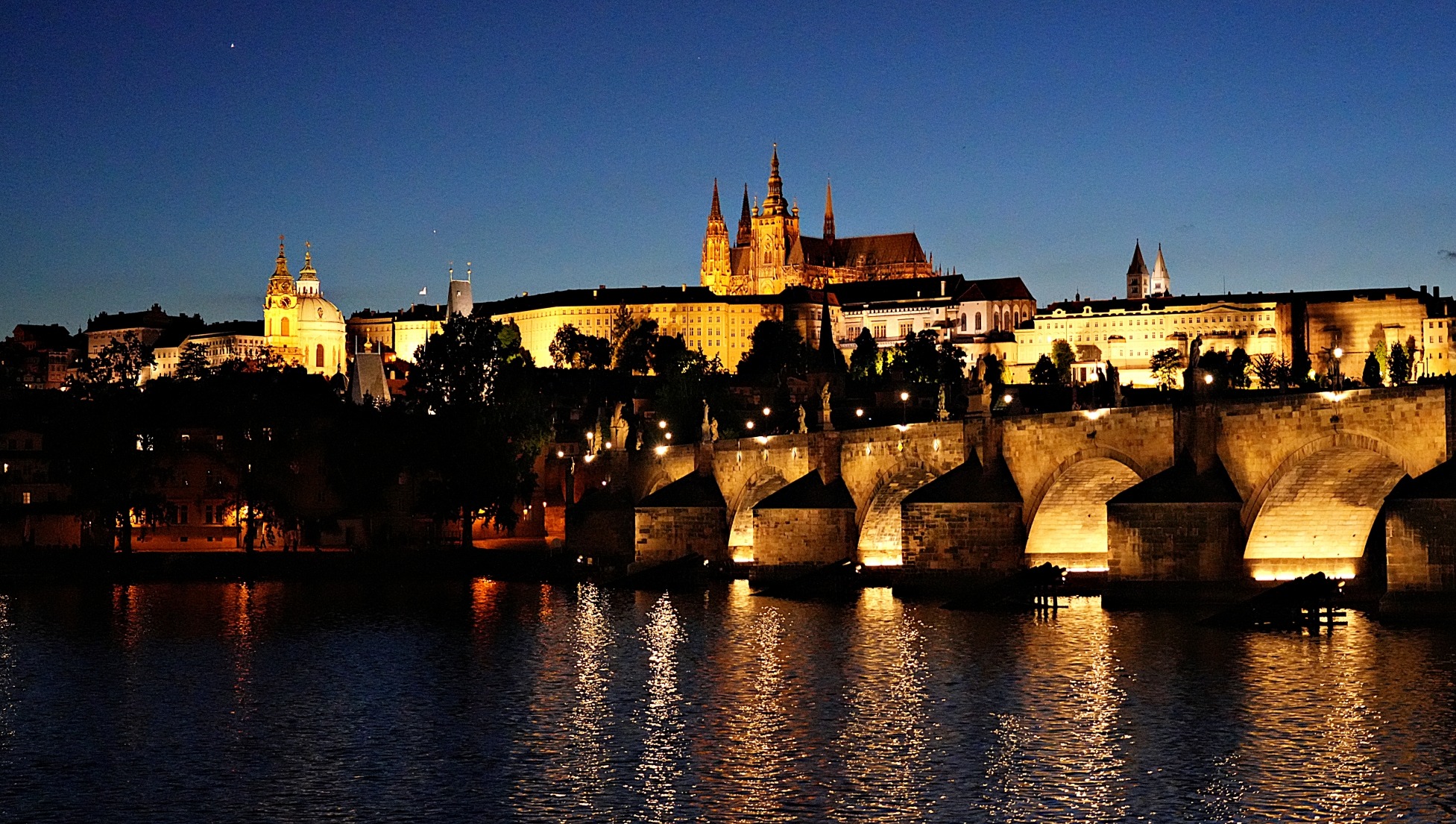
When you look across the Vltava River, you will be in awe of the perfectly placed castle, high above Lesser Town. This view is what enticed us to get a closer look at Prague Castle. As the largest castle complex in the world, it is much more than a castle. The large complex includes elaborate churches, palaces, and even a small village contained within the fortified wall. In fact, the Prague Castle complex takes over the entire hilltop above the old city.
To find where Prague is located, please visit our interactive map of Czechia.


Note – Prague is the world’s largest castle complex, and Malbork Castle in Poland is the largest by land area. We’ll show you Malbork soon.
Visiting Prague Castle is at the top of the list for most visitors to the city, and for good reason. But because it is so large and busy, being organized will help you make the most of your visit. Below, we’ll take you to the castle’s top attractions and give you tips on how to see them yourself.
How to get to Prague Castle
Located on the other side of the Vltava River from Prague’s Old Town, you have several bridges to choose from. We think Charles Bridge is the best way to cross the river because it combines history and scenery.
You can read about Prague in our post What to See in Prague’s Old Town.
Charles Bridge
Of all the structures built by King Charles IV, Charles Bridge may be the most famous. Built in 1357, it replaced Judith Bridge after it sustained flood damage. Although it is named after the king today, it was called Stone Bridge or Prague Bridge at the time; it wasn’t named Charles Bridge until the 1800s. In addition to the name change, its famous statues were added long after King Charles IV’s reign. The 30 statues of saints that line its balustrade were slowly added between the 1600s and 1800s.

Elaborate towers guard either end of the bridge. At one end, Old Town Tower provides a grand entrance to this wonderful bridge. This tower would be interesting to see during summer solstice. At that time, the setting sun shines on the nave of St. Vitus Cathedral from Old Town Tower.

The bridge was part of Prague’s Royal Route. This procession of royals travelled from Powder Tower, through Old Town Square, up Karlova Street, over Charles Bridge, up Mostecká Street, ending at Prague Castle. As you cross the river, take your time to soak in this history. In addition to its towers and statues, the bridge also offers beautiful views of the river and the buildings that line its edge.


At the other end of the bridge, you’ll reach Lesser Town Bridge Tower, which is actually two towers connected by a gate. Their different architectural styles, Renaissance and Gothic, give it a unique appearance. The reason for the difference is that the smaller one was part of the original Judith Bridge, while the taller is 300 years older.
As you near the end of the bridge, don’t forget to look over the edge to see Čertovka (Devil’s Canal) and its old mill in Lesser Town.


Once you’ve crossed the bridge, you can choose between a few different routes to reach the castle. We suggest taking a different route up and down, so you can see more of this wonderful area. Also, remember, the walk is part of the experience, so take your time.
We’ll describe our favourite, which takes Mostecká Street. Another option is to walk up to Na Opyši Gate, near the Golden Lane entrance. We’ll show you this route on the way down.
Lesser Town Square
After crossing the bridge, stop at Lesser Town Square (Malostranské náměstí) to see the magnificent Baroque St. Nicholas Church in Malá Strana. Built in the 1700s, the church’s tall green dome and bell tower makes it one of the most important Baroque buildings in Prague.
From the square, continue to walk up the hill on Mostecká Street. It still shows off its best days, with well-kept heritage buildings making it one of the prettiest in Lesser Prague.


Near the top of Mostecká Street, you can either take Radnické Schody (Town Hall Stairs) or Zámecké Schody (Castle Stairs). The Town Hall Stairs are a bit longer, but also a little quieter.

Hradčanské Square
Once at the top, take a look around Hradčanské Square. Surrounded by residences of nobles and elites such as the Archbishop’s Palace, Schwarzenberg Palace and Thun Palace, the square has an aura of grace. Also on the square, the Marian Plague Column commemorates victims of the plague epidemic of 1713–1714.


One last stop before entering the castle is the Balcony of Hradčanské Square. From it, you are treated to sweeping views over Lesser Town’s red rooftops and across the Vltava River to Old Town.
Another way to reach this same point is by walking up the Old Castle Staircase to the viewpoint called Vyhlídka Na Opyši on Google Maps.

Prague Castle’s History
The castle’s first buildings date back to 880 under Prince Bořivoj of the Přemyslid Dynasty. By the 10th century, the castle achieved head-of-state status and began to grow. This old stone and wooden fortress was expanded, damaged, left vacant and restored many times. Over these thousand-plus years, the castle has seen many style preferences and phases, giving it a unique look that combines this illustrious past.
One of those was under King Wenceslas, from the Christmas Carol. He laid the groundwork for the rotunda of St. Vitus Church in 925. Today, portions of it still lie in the crypts below the church. When King Charles IV became ruler of the Holy Roman Empire in the 1300s, he made Prague Castle his residence and greatly expanded the Old Palace. At the same time, he began building St. Vitus Cathedral. The castle regained prominence in the 16th century, when the Jagiellonian Dynasty and then the Habsburgs ruled from it. The next main expansion came when it became the seat of the head of state of the newly formed Czechoslovakia. Today, the castle is still the official seat of the President.
Gate of Giants and Matthias Gate
On the side of Hradčanské Square, the castle’s Gate of the Giants and Matthias Gate make a great first impression. This used to be the main entrance, but now the entrance is on the left, and this is an exit.
Gate of the Giants is also the location for the Changing of the Guard, which happens daily at noon. It is typically very popular, so if you want to see it, you should plan to arrive early. Between these two gates is the castle’s First Courtyard, which you can visit on your way out.

Now, you are ready to visit the castle. Much of the castle grounds are free to enter without a ticket. That means you can return to the castle at any time if you want to see it in a different light. Entry into most of the buildings, though, requires a ticket.
Second Courtyard
After passing through the entrance, you’ll reach the Second Courtyard. Surrounded by solemn-looking Renaissance and Baroque buildings, there isn’t much for visitors to see, though, other than the 17th-century Kohl’s Fountain.

Third Courtyard
Continue walking to reach the Third Courtyard, home to the imposing St. Vitus Cathedral. The large church takes up most of the courtyard and all of your attention.
St. Vitus Cathedral
Having seen its tall spires from across the river, you will undoubtedly be in awe when standing in front of St. Vitus Cathedral. As the country’s largest church, the building we see today is the third church on this spot and it has been more than 1,100 years since King Wenceslas built the first St. Vitus Rotunda.
That church was replaced by the current building, but its construction took 585 years, from 1344 until 1929. As you can imagine, architectural styles and technology changed over those years, so the building’s design is multi-layered. Today, its Romanesque, Gothic, Renaissance and Baroque spires, towers, and flying buttresses combine to make a magnificent building.

Before going inside, make sure to have a good look at its many features from the outside, including the front, back and sides. As the light changes, different features are more prominent.


Hymnal songs flowed from the organ giving the room a sacred aura as we walked into the imposing church. Although its walls are grey stone, it would be difficult to say this church is undecorated. Colour is easily found in the many large stained-glass windows. More decoration comes from the elaborate bronze and golden statues and tombs. Placed high above, the two-tiered organ has very different designs. The Baroque organ on top dates to the 1700s, while the Renaissance-style one beneath dates to the 1500s.


A large statue in the centre caught our attention. St. Vojtech (Adalbert) is lying, supported by Saints Radim Gaudentius and Radla. Called Adalbert in German and English, you will read more about St. Vojtech when we visit Poland, where he is called Wojciech. The saint adopted the name Adalbert during this Confirmation and often went by this name during his life.

A ticket is required to enter the Cathedral and can be purchased online or at one of three ticket offices on the castle grounds.
Cathedral Tower
The 280 steps to the top of the cathedral’s Great South Tower are worth the effort. After climbing them all, your reward is the 360° panorama of Prague as well as the many spires and roosters on the rooftop.


From here, it is obvious what makes Prague so different from other European cities. Since it was not damaged during WWIII, the Old Town extends far from the main square. Instead of a re-created block or two, the original historic centre extends for many blocks.


The tower requires an extra ticket. You can buy a ticket online, or at one of the ticket offices on the castle grounds.
Old Royal Palace
Across from St. Vitus Cathedral is the Old Royal Palace. Your visit includes walking through a series of halls, Judicial Courts and a Land Rolls repository. One of the most unique was a chamber with the Coat of Arms of distinguished landowners and officials on the ceiling and walls.


St. George Basilica
The second church built on the castle grounds, and the oldest surviving, is St. George Basilica. It is set in a courtyard with several nice buildings, but other than the Starbucks, most are not open to the public. The building suffered damage from fires as well as from additions that changed the look of that original church.

The interior of St. George Church is very austere when compared to St. Vitus. A split staircase at the front allows you to see old frescoes on the ceiling. Along the side walls, artifacts from 9th century Přemyslid Dynasty crypts are on display. They were discovered during reconstruction work on the castle grounds in the 1950s.

Golden Lane
One of the most popular attractions on the castle grounds is this street of basic homes where craftsmen, including goldsmiths, once lived. Today, Golden Lane is filled with tourist shops and small museums, but they still show the different types of village homes that once occupied the castle streets. Many of the houses were lived in until the 1950s. Even Kafka lived here for a while.


In addition to the homes, you can visit an armoury, torture chamber and alchemist’s workshop in the White Tower. Just before the exit, don’t miss Daliborki Tower. It served as a prison and has a gruesome display of torture techniques.


Golden Lane requires a ticket. You can buy them online or at one of the ticket offices on the castle grounds.
We suggest you exit through the Golden Lane gates so you can stop at the South Garden and Na Opyši Gate for another great view of the city if you didn’t arrive this way. From there, take the Old Castle Stairs down to Wallenstein Palace.

Other things to see in the castle if you have time, they require extra tickets:
- Permanent exhibitions on the history of the castle are held in Rosenberg Palace
- Stroll through the Royal Gardens
- Visit the privately owned Lobkowicz Palace
Buying Tickets
Tickets can be purchased ahead of time online, but there are many tour companies offering tickets for a higher price. Be sure to use http://www.hrad.cz, or buy your tickets at one of the three ticket offices located in the 2nd and 3rd courtyards, and before Golden Lane. We were told to arrive before the ticket office opens because there will be a long line, but we didn’t find that when we visited in June.
For current prices and hours, visit the official castle website. The castle grounds open daily from 6 am to 10 pm, and the museum buildings are open from 9 am to 5 pm (4 pm in winter). The cathedral doesn’t open until noon on Sundays.
Getting to the castle by public transit
We think the best way to reach the castle is to walk, but if that’s not possible for you, it can also be reached by public transit. Take tram 22 to Pražský Hrad stop. (Note this line is under construction until 2026.) You could also take Metro Line A to Malostranská Station and walk up the Old Castle Stairs and enter through the Golden Lane entrance.
Lesser Prague
Since you’re already on this side of the river, plan to spend a while roaming the streets in Lesser Prague. In addition to Mostecká Street, there are many other historic streets that make this area worth exploring. It is also quieter than Old Town, so it would be a nice area to stay.
Although its name is deceiving, Lesser Town, located at the base of Prague Castle, was home to Nobles and aristocrats. Before this, however, it was settled by peasant Slavic farmers and traders. In the 1250s, the king founded it as a royal city, and the peasants were forced out. King Charles expanded it even more and built a wall around the community. Several fires damaged the original buildings, and in the 16th century, a fire ripped through the community, destroying many. Those were replaced with the Baroque ones we see today.

Wallenstein Palace
One building to include in your walk is Wallenstein Palace, also spelled Waldstein. Nobleman Albrecht Wallenstein built this immaculate 17th-century Baroque palace as his personal residence. Thankfully, he loved green spaces because the main reason to visit is the gorgeous Wallenstein Garden. In addition to the hedges, fountains and statues, an unusual feature is the grotto wall. This purpose-built wall is dripping with calcified water to mimic cave walls.
You can’t visit much of the building because it the offiicial seat of the Federal Senate. Small sections of the interior may be open to the public on weekends or on guided tours.


Entry to the gardens is free. Opening Hours – although hours vary, it is generally open from 7:30 am to 7pm in the summer. (Open 10am on weekends). It may be closed at any time for Senate functions.
Lennon Wall
We had high hopes for Lennon Wall. It is touted as a place for street art and political protest messages. Instead, we found it covered in tag graffiti. As it stands, don’t plan on spending much time here.

Where to eat in Lesser Town
Before rushing back to the other side of the river, you’ll find many options for lunch on either side of Charles Bridge; some have seating along the canal. One has an unusual entrance at the bottom of the world’s narrowest street.
For information on where to stay, please vist our post, What to See in Prague’s Old Town.

Here’s a link to read more of our adventures in Czechia, and a link to our interactive map of Czechia.
Coming Next – Day Trips From Prague: Kutna Hora and Karlstein
For pictures from other blogs go to Gallery at monkeystale.ca.
To read about more of our adventures go to Destinations.
If you like what you read, please comment or share (with credit) using the links below




We’d love to hear from you, please leave a comment.