
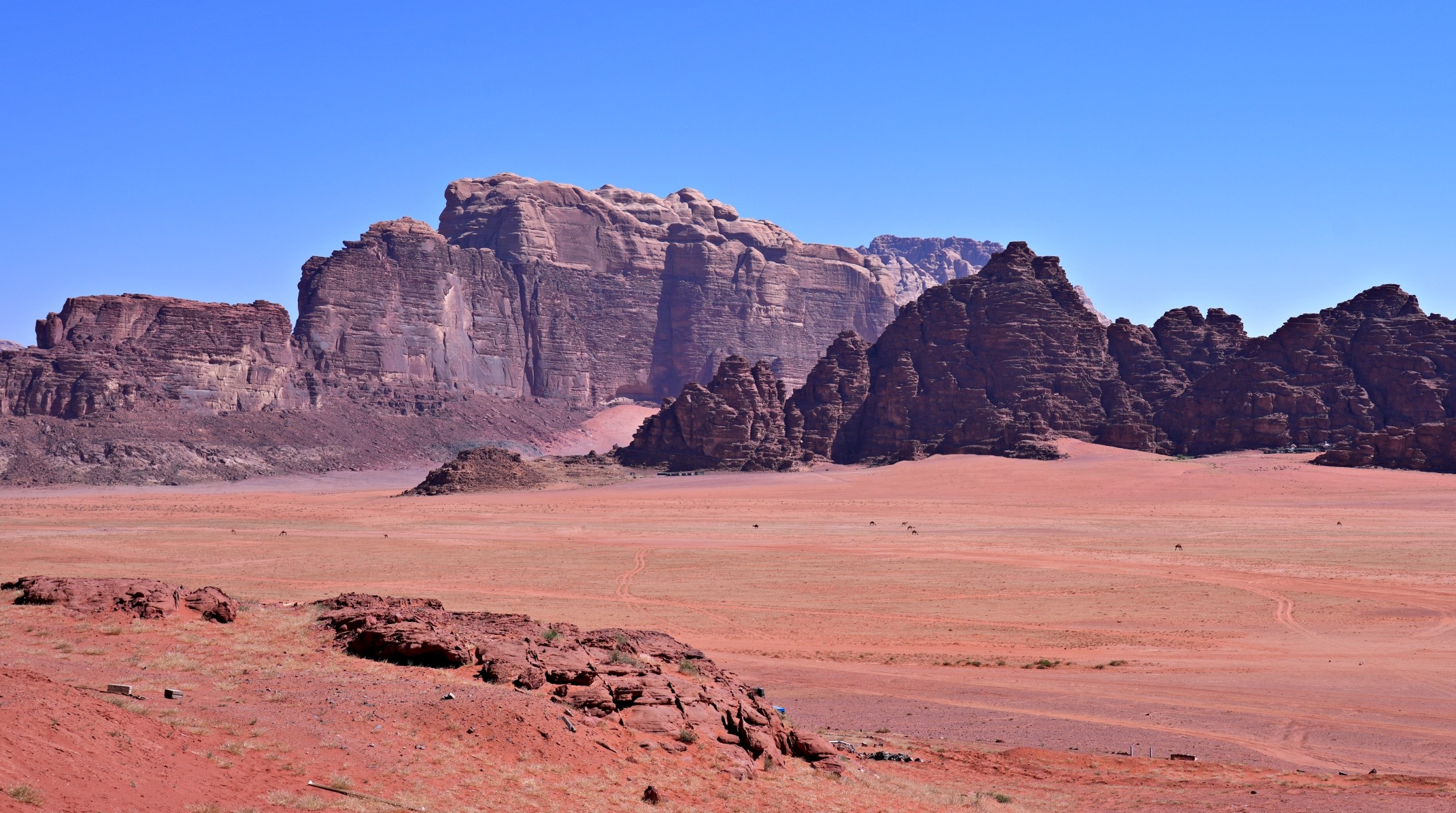
With sheer mountain walls towering above the red desert floor, Wadi Rum differs from the traditional desert scene where golden sand dunes stretch into the distance. But touring between these giants showed us that traditional isn’t necessarily more beautiful. Taking us through these mountains was a local Bedouin, and as we learned, visiting Wadi Rum is about more than seeing the landscape; it is also about learning from the Zalabieh Bedouins and their way of life.
To see where Wadi Rum is located, please click on the link to view our interactive map of Jordan.
Wadi Rum’s rugged landscape formed millions of years ago when the frequent shifting of tectonic plates forced tall mountains to rise high above the flat ground. Then, high winds whipped the sand against them, sculpting the rocks into many shapes. Seasonal floods then softened these rough edges. Together, these natural forces created a scene that looks like it’s out of this world.

Wadi means a dry or seasonal river valley, which means that it only rains a few days in the winter, for a total of 50 mm (2 in). They were lucky to have received quite a bit of rain the previous winter; therefore, on our visit in May, the open plain had pockets of greenery. In extreme conditions, this rain arrives at once in a violent thunderstorm, causing flash floods. Those floods are part of what shaped this landscape.
Wadi Rum’s History and Legends
Neolithic people first inhabited the deserts of Wadi Rum, and its location on trade routes to Saudi Arabia and the Red Sea made it an important spot for centuries. Although it was a transit route throughout the reign of many of Jordan’s rulers, it was the nomadic Bedouins who knew how to survive in this desert landscape. These camel and sheep herders lived in camel hair tents, moving to greener pastures as needed.
The legend of how they came to Wadi Rum is an unusual one. Around 600 years ago, a Saudi man was found guilty of murder. The custom at the time was for the victim’s family to determine the punishment, choosing between death or banishment of the killer. In this instance, they chose banishment, and so the man left Saudi Arabia and eventually ended up in Wadi Rum. He fell in love with the mountainous desert because it reminded him of his home, so he settled down and started a family. The story says that everyone in the town of Wadi Rum today is a descendant of that man; all 2,000 of them.
Some still live like their nomadic ancestors, but most live in the nearby town of Wadi Rum. Today, almost all men are involved in the tourism industry.

How To Visit Wadi Rum
While you are allowed to drive your own 4×4 in the desert park, there are many restrictions to protect the environment that make this more difficult. As well, it wouldn’t be easy to navigate since there are no real roads or maps. Most visitors therefore take 3 to 5-hour or full-day tours offered by the local Bedouins. Most tours take you to the same sites; the difference is how many different places you will see.
In addition to the standard tours, you can go camel or horseback riding, hiking and desert wilderness camping. We did a full-day tour, including an overnight in a Bedouin camp, and visited nine sites in the desert. These spots are not overly special on their own, but travelling between them allowed us to get a good look at this phenomenal land that makes a trip to Wadi Rum a UNESCO World Heritage Site.
The entry fee to Wadi Rum is included in the Jordan Pass; otherwise, it is 7 JD ($10 USD).

As we drove through the Mars-like land, our guide, Khalaf, navigated his way along the grooves in the sand, left by the many 4x4s that travel these routes. He knows every feature on every mountain, and they are his navigation tools. At night, if he gets lost, he shines a light on the mountain and then knows where he is and which way to go.

The tours generally include a combination of the following places, depending on how long of a tour you book:
Khazali Canyon
The stately Mount Khazali, in the centre of Wadi Rum, is more than just something to admire from a distance; it also carries messages from past civilizations. A natural canyon in the tall, red mountain has inscriptions left by others who lived and travelled in this desert. The oldest date back as far as 12,000 years ago, and depict people and animals, similar to cave drawings we’ve seen before. They include images of hunters with bows and arrows, and even one of a woman giving birth. The animals range from ibex and camels to ostriches. What really makes these walls interesting, though, is that you can see a progression from these basic images to an ancient text, showing how languages and writing progressed over time. (Included on all tours)
In another area of the desert, researchers discovered a cartouche of Egypt’s Ramses III. Many believe the Egyptian Pharaoh visited Wadi Rum during his reign.


Those travellers didn’t enter the canyon just to leave messages, though; they came for the water. This desert location receives a very small amount of rain, but luckily, many places have natural features to collect this water, including inside the canyon. During these rains, waterfalls form in the canyon and fill natural pools. These pools were often the primary water source throughout the dry summer season.

Streams created from the winter rains leave just enough water in the ground for a small garden to grow at the canyon entrance.


Khazali Dune
Across from Khazali Mountain is one of the only sand dunes in Wadi Rum; therefore, Khazali Dune is a popular stop. You can climb to the top of the red dune for views down the desert. (Included on all tours)


Rocky Bridges
There are three natural rocky bridges that are commonly visited in Wadi Rum: Little Rock, Um Frouth and Burda.
Little Rock Bridge
Also called Raqabat al Wadak, this natural arch is a popular photo op because it’s easy to climb to the top. (Included on all tours)

Um Frouth Rock Bridge
Another picturesque natural arch is Um Frouth Rock Bridge. During the busy season, a line of people forms, waiting to pose below or on top of the arch. When we were there, only one other family was at the bridge, so we didn’t have to wait. (Included on most 4 and 5 hour tours as well as the full-day tour)
In addition to seeing the bridge, you can walk to the end of the canyon for a panoramic desert view. After your visit, stop for a drink at the camel tent teahouse below the bridge.


Burdah Rock Bridge
On the edge of White Desert is another natural scene. High up on Mt. Burdah is a natural bridge connecting two sides of a crack. On a separate tour, you can hike up to it with a guide, but it is best to start early in the morning. We just saw it from below. (Only on full-day tour)

Lawrence’s House
Lawrence of Arabia (T. E. Lawrence) was a famous archaeologist and British Army officer. He fell in love with this area and assisted Bedouin armies during the Arab Revolt in WWI when they were fighting against the ruling Ottoman Empire. He spent time in Wadi Rum, working and living with the local Bedouins, and you can visit the ruins of a shelter and cave where he lived. (Included in all tours)
As well as seeing this house, don’t forget to explore the rest of the rocky outcrop, including climbing to its top, where you’ll be treated to another view of the desert. If you use your imagination, you may be able to envision camel caravans travelling across the vast desert.


Lawrence’s Spring
Another site connected to Lawrence of Arabia is a natural spring that was a popular stop for camel caravans travelling to Saudi Arabia. A large boulder at the base of the mountain has inscriptions that helped others find the water source. The spring is located under an overhang, partway up the mountain. You can see it up close by climbing the granite blocks to a patch of greenery under an overhang. (Included on all tours)


Today, modern hoses bring water down the mountain, but apparently Lawrence of Arabia helped the Bedouins set up the first pipe and build a water trough. Whether this story is true or not, we don’t know. There are apparently several places that are attached to Lawrence of Arabia, some of which he likely never saw.

Abu Khashaba Canyon
With fig trees guarding its entrance, this narrow red canyon is very pretty. Green trees and red rocks converge in the tight slot, making it a top spot in Wadi Rum. In the middle, you must climb over a rockfall blockage to reach a little garden oasis in the desert. The walk takes 20-30 minutes. (Only on the 5-hour and full-day tour)


There’s a sand hill at the end of the canyon where you can rent a broken snowboard and ride down.
Mushroom Rock
In a land of weathered rock formations, there are a few that have been sculpted into bizarre shapes. On the eastern edge, where the red desert turns white, is a lonely rock that looks like a mushroom. Some say it looks more like a chicken, but we couldn’t see that. (Only on full-day tour)

White Canyon
While most of Wadi Rum is red, a remote area in the south is quite different; it has white sand and white mountains. Since it is far from the regular tourist sites, only people on full-day trips visit, resulting in a quiet and peaceful atmosphere. There are a few hikes in the White Desert; we hiked through a small gorge called, appropriately, White Canyon. It’s not long, but it was a nice change to see the soft, white sand and tall white walls. (Only on full-day tours)


Sunset
Watching the sun set behind Wadi Rum’s mountains was the perfect end to our day. Every guide has their own favourite spot, so we didn’t have to share our view with anyone.

Life of a Bedouin
While waiting for the sun to set, our guide, Khalaf, made us tea and told us about the typical life of a Zalabieh Bedouin. Most are devout Muslims, and in their Bedouin culture, men are allowed up to four wives. Our guide came from a family whose father had 3 wives, and he grew up with forty siblings. He explained that they used to need large families to survive in this harsh land. According to our guide, the wives usually become friends, and there is rarely jealousy, but that is difficult to believe.
Today, families are much smaller, and most live in homes rather than tents, but some men still have more than one wife. The different wives either live in separate houses or on a different floor of the same house. Sometimes, after another wife is added, the first wife is left alone, and she keeps the house. This sounded more like a divorce. In other cases, the man remains involved with each wife and stays a night or two with each one.

Khalaf said that when you see a house with rebar sticking out above the roof, it is because the man is planning to have another wife, and the rebar is for her floor. We saw several of those throughout the country and giggled each time, although we’re sure most of the house expansions we saw are for other reasons.
We also talked with him about arranged marriages. He said that when he’s ready, he’ll ask his mom and sisters who he should marry. He will be considered ready when he has built his own house and has a few animals (camels and sheep). Then his family and the woman’s family will meet to see if they will allow their daughter to marry him. If everyone agrees, Khalaf and his potential bride will meet for thirty minutes, supervised by their fathers. This will likely be the first time they lay eyes on one another.
Within a week, the woman’s family will let his family know if she agrees to marry, and what the dowry is. We asked if the woman could ever ask her family to find a husband. The answer is no, and once married, she will never work outside the home.
staying in a Desert Camp
While you could visit on a day trip, we recommend staying overnight in a Bedouin Desert Camp. The camel hair tents are remarkably comfortable with marble floors, private bathrooms and in some, air conditioning.


For those who want a different experience, many camps now have bubble tents, inspired by Matt Damon’s movie, The Martian. That movie, as well as several others, including Lawrence of Arabia and two Star Wars movies, were filmed in Wadi Rum.
When you stay in a Bedouin desert camp, you will be treated to a Zarb dinner; a traditional underground barbecue. First, hot coals line the bottom of a deep pit, and then trays of food are placed on top. The trays are a mixture of chicken, lamb, goat and vegetables. The food is seasoned with lemon, garlic, salt and pepper, wrapped in tinfoil and then covered with sand and left to cook for 2 hours. The result is a flavourful meal, usually accompanied by bread, rice and salads.


Tips for visiting Wadi Rum
- Selecting a camp – You can choose from several Bedouin-run camps scattered throughout the desert, and offering a variety of prices and comfort levels. If you book an overnight stay in a camp, they expect you to take one of their tours. If you drive, you will leave your car in town, and 4x4s take you to your camp and on the tour. Usually, the pickup from town to camp is included in the tour, but each camp has its own rules. If you’re not staying overnight, you can find many day tour operators in town and online.
- When to visit – Autumn (September to November) and spring (February to May) will give you the best weather. Summers can be very hot, and winters can be cold with a chance of rain. They have had snow some years.
- Tours – The bad thing about visiting Wadi Rum is that all tours seem to go to the same places and with the same schedule; the main difference will be your accommodation.
- What to bring – No matter which tour you take, there is a lot of downtime, so bring your own entertainment, such as a book or games. There isn’t much else to do. The sun is very strong, and there is not much protection, so bring sunscreen, breathable clothing and a hat. As well, there is a lot of walking on uneven ground, so good footwear is important. Depending on the time of year, it may be chilly at night, so bring warm clothes. In some camps, you may require a headlamp/flashlight. We were well fed, but you may want to bring your own snacks. The camps have electricity, but it would be smart to bring a battery pack.
- Mobile – There is very sporadic mobile coverage in the park, and even if the camp has Wi-Fi, it will not likely be strong.
Getting to Wadi Rum
From Amman, we recommend taking the King’s Highway to Petra and then the busier Desert Highway to the Wadi Rum turn-off. While on the King’s Highway, plan to stop at some of the historical attractions along the way. From Aqaba, the Desert Highway is the best option.
If you don’t have your own car, a tourist shuttle travels between Wadi Musa (Petra) and Wadi Rum, leaving Petra between 6 and 6: 30 am. You can get the contact number from the Petra Visitor Centre and from your Wadi Camp. To get between Wadi Rum and Aqaba, you will need to hire a private driver, most likely through your desert camp.

Please note, we visited Jordan in the spring of 2026. At that time, there was a ceasefire in the Iran War due to the signing of the Memorandum of Understanding. Since conditions are changing frequently, please read current news on the area before planning your trip.
Here’s a link where you can read more of our adventures in Jordan, and a link to our interactive map of Jordan.
Coming Next – Aqaba: Diving in the Red Sea
For pictures from other blogs go to Gallery at monkeystale.ca.
To read about more of our adventures go to Destinations.
If you like what you read, please comment or share (with credit) using the links below.






We’d love to hear from you, please leave a comment.