
Set on the edge of the Gulf of Aqaba in the Red Sea, the city of Aqaba has a vastly different look and feel from the rest of Jordan. The resort city is a favourite beach destination for Jordanians, but since we loved diving in the Red Sea in Sharm el-Sheikh, Egypt, we came to Aqaba to check out Jordan’s dive sites.
To see where Aqaba is located, please click on the link to view our interactive map of Jordan.
Diving in the Red Sea
As we found in Egypt, diving in the Red Sea is different from other seas and oceans because of its high salinity. With water that is 4.1% saline, versus the ocean at 3.5%, we noticed a large difference in our buoyancy. As a result, we had to wear more weight compared to diving in the ocean. The high salinity is due to several factors. One reason is its desert location, which results in high evaporation rates and a lack of permanent freshwater sources. In addition, it is quite removed from the nearest large body of water, the Indian Ocean. Only a narrow channel connects it to the Gulf of Aidan. From there, water still needs to flow through the Arabian Sea before eventually reaching the Indian Ocean.
Although they are fairly close to each other and are both on the Red Sea, the diving in Aqaba is quite different from Sharm el Sheikh. A large difference is that the majority of dive sites in Aqaba are close to shore and don’t require boats. We did two dives from South Beach, and each offered us something different.
To read about diving in Egypt, visit our post Sharm el Sheik: Diving in the Red Sea.


Cable Canyon Dive Site
The dive is named for a collection of cables that travel on the sea floor between Aqaba and Egypt. While they weren’t natural or very picturesque, it was interesting to see large amounts of coral growing on them. There’s a lot more to see than these cables, though. Interspersed along the sandy bottom are bands of reef with healthy coral, in a variety of shapes. Some are endemic to the Red Sea.


We also saw unusual fish we weren’t familiar with, and several endemic Red Sea clownfish. The sandperch and sand lizardfish seemed to be ‘walking’ along the sandy bottom, while the clownfish loved posing for the camera.


Cedar Pride Dive Site
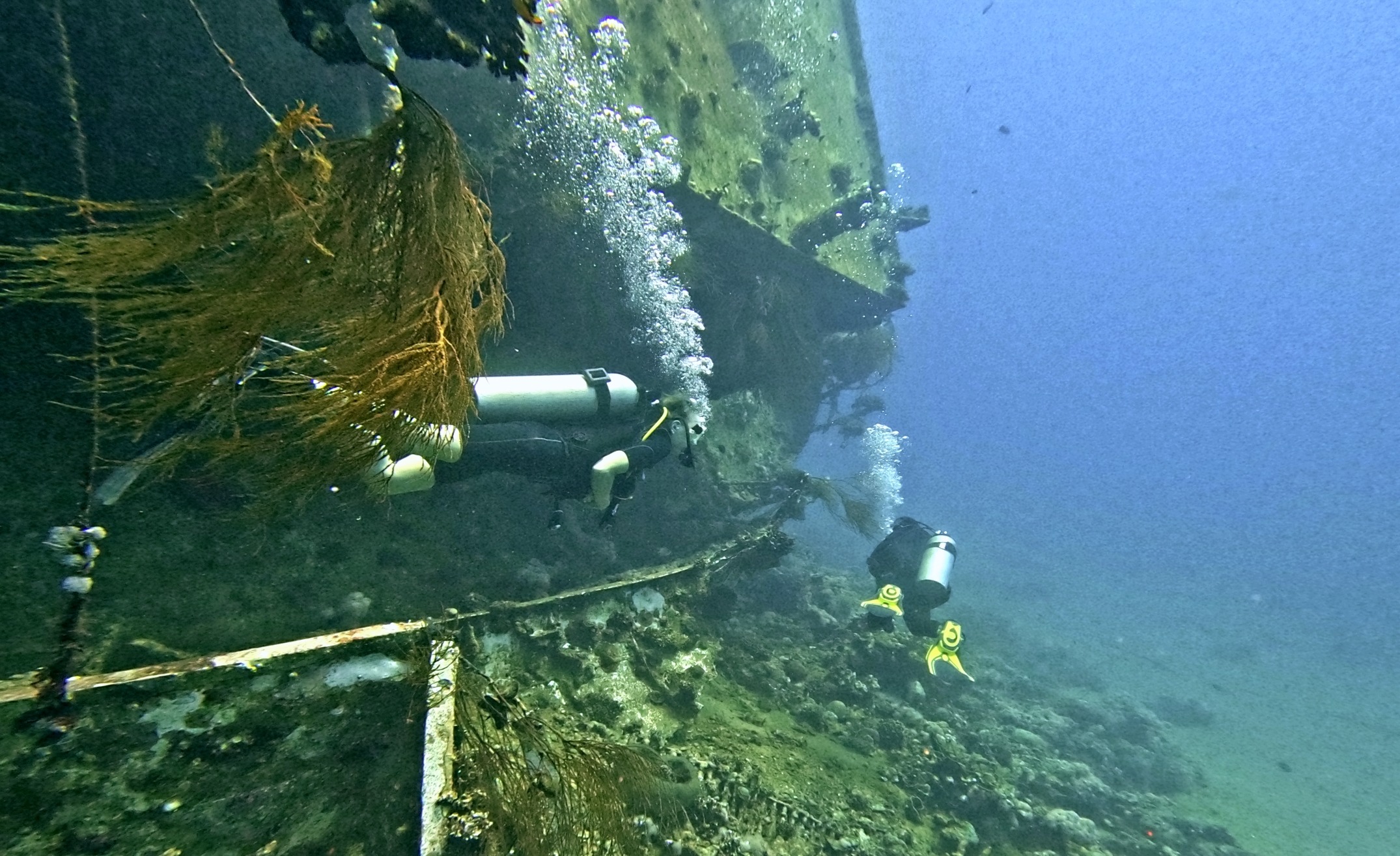
Even though we started from the same beach, the second dive was quite different. After crossing a similar reef band, we saw a large cargo ship in the distance. The Jordanian king is an avid diver, and in the 1980s, when he was still a prince, he had it purposely sunk here to create an artificial reef. In addition to the ship, Cedar Pride, there is a platform, an airplane and an army tank sunk in other places along this coast.

It was fascinating to see how much the coral and fish have become accustomed to this big piece of metal, using the ship as their home. Coral was growing on it, and small fish swam between its walls.


Similar to the other dive, we saw more unusual fish and colourful coral. Can you spot the stonefish next to the eel in the second picture?


We were there during a coral spawning event, so the water was filled with thousands of jelly-like strings of eggs and sperm. It felt as if we were swimming in jello. When we came out of the water, our wetsuits, skin and hair were covered in dried purple matter. Knowing what it was, we made sure to take long showers on the beach to get it off our bodies and gear.
Best time to dive in Aqaba
The Red Sea is a year-round diving destination, but conditions do vary. For more comfortable water temperatures and lots of marine life, April to May or September to November are good choices. During the summer months from June to August, the water is warmer, but the outdoor temperatures are in the 40s °C. Winter has exceptional visibility, but the water is much colder.
Aqaba
As with most of this region, Aqaba was inhabited since Neolithic times. These civilizations were followed by the Egyptians, Nabataeans, Romans and Byzantines. It was the Nabataeans who established it as the busy port city of Aila. They used it to ship copper extracted from mines in Wadi Araba. Its beaches, though, are the main draw for Jordanians today. Europeans also come in the winter to soak in the sun, but most stick to the resort beaches and pools rather than the ultra-conservative public beaches.
The tourists and its seaside location give Aqaba a much different look than the rest of Jordan. Palm trees line the streets, and views of the Red Sea let you forget about the arid desert behind. This makes it a very nice city.


Since you can’t spend your entire time diving, here are a few attractions to visit in the city:
Islamic city of Ayla
By 650 AD, the first Islamic settlement in the area was established, and it was one of Islam’s first planned cities. They called their new city Ayla. Although it was inhabited until the 1100s, there is not much left of it today, but you can see a few partial walls and gates. The heavy traffic on the street in front of the ruins, and the McDonald’s and Pizza Hut a block away, contrast with the ruins of this old Islamic city.

An earthquake brought a lot of damage to the city, and then, after trade routes shifted, Ayla lost its prominence. It didn’t get much notice until the Crusaders arrived in the 12th century.
Byzantine church
A few blocks from the Islamic city of Ayla are the ruins of a Byzantine church. This 3rd century building is considered the world’s first purpose-built church. Earlier churches existed, but they were converted from other structures, such as Roman Temples. Unfortunately, only short mud and stone walls are all that remain of the Byzantine church.

Aqaba Castle
The first castle built on this spot was a 12th-century Crusader castle. That building, however, was demolished by Sultan Saladin in 1187. The one we see today was built by the Mamluk Dynasty in the 16th century. Today, the castle is mostly an empty shell, but it is still worth visiting.
You can read about other Crusader Churches in our post, Karak and Shobak: Crusader Churches.


It was interesting to see how they used palm trees to help withstand earthquakes. Maybe they worked because, it wasn’t an earthquake that damaged the castle; it was the Arab Revolt.

Arab Revolt Square
Beside the castle is Arab Revolt Square with the Arab Revolt flag proudly waving in the breeze. By the early 1900s, the Ottoman Empire had been ruling Transjordan, Syria and Saudi Arabia for almost 400 years. Eventually, these countries had enough of the Ottaman’s oppressive rule, sparking the beginning of the Arab Revolt. During WWI, with assistance from the French and British militaries, their goal was to defeat the Ottomans and create a unified Arab state. They were partly successful in achieving that goal. In the end, however, the British and French governments split the area up into separate regions that would remain under their control. Jordan didn’t achieve full independence until 1946.
You may notice a similarity between Jordan’s flag and the Arab Revolt flag. The country’s flag is based on the revolt flag, as are many others in the region.

Al-Ghandour Beach
Several years later, when Jordan achieved independence, it only had a small shoreline. In 1965, King Hussein negotiated a land swap with Saudi Arabia to add 19 km of shoreline, in exchange for desert lands. That means they share the Gulf of Aqaba shore with Israel.
Today, their main city beach is Al-Ghandou. It wasn’t very appealing to us, but a few local families were enjoying the water. From it we could see the Israeli city of Eilat on the other side of the bay.


We often have unusual sightings on foreign beaches, but seeing a hookah on the beach was a new one for us. It turns out, they are very common in Jordan.

Getting to Aqaba
King Hussein International Airport receives flights from Amman, Istanbul and Cairo, but most flights from Europe are only over the winter months. If you’re already in Jordan, Jett Buses connect Aqaba with Amman’s 7th Circle Station and Petra. There is no bus to Wadi Rum, so either take a taxi or rent a car in Amman or Aqaba.
Where to eat in Aqaba
There are quite a few restaurants in the neighbourhood southwest of Princess Hiya Circle, and you can find many international chain restaurants near Ayla Circle. We had excellent coffee at Kava Coffee & More on As-Saadeh St.
Where to stay in Aqaba
If you want a beach or pool vacation, it is best to stay at an international chain hotel where women can wear a bathing suit. If that is beyond your budget, there are smaller, locally run hotels, and you can pay a day rate to access the private beaches.
For diving, you can find several apartment rentals near South Beach, but there really isn’t anything else to do there but dive. All dive shops provide free transportation, so it is probably better to stay in town. We used Coral Garden Diving Centre and found them to be very professional.

Please note, we visited Jordan in the spring of 2026. At that time, there was a ceasefire in the Iran War due to the signing of the Memorandum of Understanding. Since conditions are changing frequently, please read current news about the area before planning your trip.
Here’s a link where you can read more of our adventures in Jordan, and a link to our interactive map of Jordan.
Coming Next – Our Favourite Places to Visit in Jordan
For pictures from other blogs go to Gallery at monkeystale.ca.
To read about more of our adventures go to Destinations.
If you like what you read, please comment or share (with credit) using the links below.





We’d love to hear from you, please leave a comment.