If you’ve been wanting to have a real jungle adventure there’s no better place to find one than in Borneo. Gunung Mulu National Park is set in the middle of a dense jungle in the Malaysian state of Sarawak. It has thick forests, steep mountains, bat filled caves and meandering rivers all waiting to be explored.

Jungle Walks

Gunung Mulu National Park is a great tourist site with boardwalk trails, canopy walks, hiking trails and river trips allowing you to see the jungle from many perspectives. Over 5 days we saw many of this jungle’s interesting flora, creepy bugs, endemic butterflies and bees.

An interesting tree in the Borneo jungle is the Tajem tree. Its sap is poisonous and was once used by the indigenous Penan people. They put the sap on the tips of their blow darts, poisoning their targets. We saw a few of these large trees that had old cuts in the bark, presumably by ancient tribesmen.

The Caves

Gunung Mulu National Park was designated as a UNESCO World Heritage Area because of its many large caves. Even though Lang Cave is one of the smallest caves in this park, it is still very large. Inside, huge chambers house thousands of stalactites and stalagmites. Water drips down from the limestone ceiling continuously building these features until the stalactites and stalagmites join to form columns. In the process, these features develop interesting shapes with intricate features. The stalactites, stalagmites and columns inside Lang Cave made it the most beautiful of all of the caves in the park.

Beside Lang Cave is Deer Cave. It is one of the largest caves in the world and has a resident population of over 3 million wrinkled bats. This large number of bats have made huge mounds of bat guano inside the cave. As you approach the cave you can smell the guano, even before you can see the entrance. Inside, the smell is suffocating. At the far end of the cave is a lush garden where the roof collapsed and the jungle has taken over.

One of the biggest thrills is to be at the cave at dusk to see 3 million bats exit the cave en masse to feed on bugs. We weren’t the only ones watching these bats, however. Bat Hawks soar above the cave’s entrance anticipating the event. At dusk, groups of thousands of bats stream out of the cave. In unison they twist and turn like a tornado as they try to escape their enemy bat hawks.

If it rains, the bats don’t exit. On our first night, we heard a strange honking sound from the jungle. Our guide told us that it was the Malayan Horn Frog. Their calls indicate that rain is coming. Sure enough, 10 minutes later it began to rain and the bats didn’t exit the cave. On our third night, we finally saw the show as millions of bats swirled out of the cave. Bat Hawks swooped in and out of the swirl, trying to catch their own meal. It was an awesome display of wildlife survival.

Two other Mulu caves are Wind and Clearwater Caves. At the entrance to Wind Cave the interesting rock formations are covered in single-leaf plants. The Melinau River flows through the Clearwater cave. Rushing water over thousands of years have slowly eroded the cave walls leaving behind beautiful etchings.

The Pinnacles Hike

Our next adventure was a trek to see the famous karst formation pinnacles on Gunung Api (Mount Api). The start of the hike is in a very remote location. We took a 45 minute boat ride up the Melinau River on a wooden long-boat and then an 8 km trek along the river. The hike started easy but not long after we started walking it began to rain. It poured heavily for an hour. The rain was so intense that we were soaked after the first 2 minutes. The bigger problem was that the rain brought out leeches. By the time we arrived at camp, Richard had pulled off 8 blood filled leeches and Maggie had 6! Not a great start to this adventure.

Due to the remoteness and difficulty accessing the area most people spend two nights at Camp 4. There is a long-house with a dining room, kitchen and a few dorm style rooms. Each bed has mosquito netting. The mosquitos actually weren’t bad, but the bees were horrible. There seemed to be thousands of bees swarming around camp. One man in our group wasn’t careful when tucking in his mosquito netting allowing dozens of bees to get inside. The bees found their way in, but couldn’t get out. Eventually, he found a way to safely coax them out of his bed.

You are required to have a guide for the hike to the pinnacles. We hired a park ranger as our guide instead of going with a large tour group. At 6:30 the next morning we started the 2.4 km, 1,600 m elevation scramble. We climb and hike a lot, so didn’t think it would be too difficult, but we don’t usually climb in a rain forest. The trail is very steep. The 45⁰ – 60⁰ incline had us crawling over slippery, mossy roots, mud and sharp limestone. In places it was so rough we had to grab on to fixed ropes. Near the top, it was even more difficult. Eighteen ladders were the only way to get up the cliffs.

As the trail approached the summit, we saw several carnivorous pitcher plants. These interesting looking plants come in many sizes and colours and all have a deep basin to collect water and trap bugs.

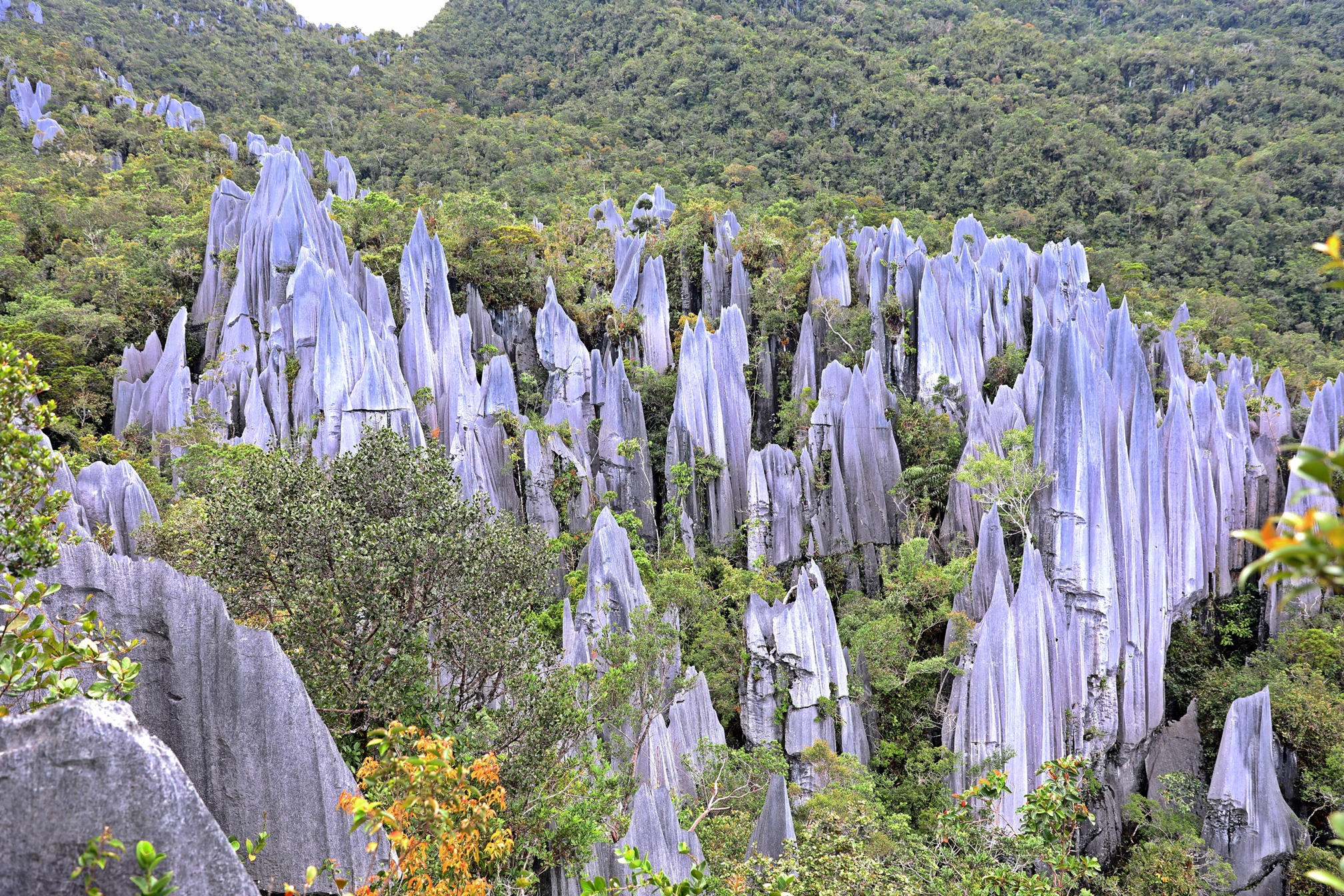
Finally, almost 3 hours later, we reached the incredible viewpoint. In front of us were dramatic, razor sharp, karst limestone pinnacles. They were formed by hundreds of years of rain water wearing down the exposed limestone into these beautiful formations. It is a stunning scene and worth the tough climb.

Getting to the summit was only half of the battle as we now had to retrace our steps down that steep, slippery trail.  After another 2 1/2 hours, we were back at our camp and welcomed a refreshing dip in the Melinau river. This is the same river than ran through Clearwater Cave. As we relaxed at camp we were joined by dozens of beautiful butterflies, including the endemic Rajah Brooke’s Birdwing. It’s a gorgeous butterfly with bright blue-green wings. They are quite large with a wingspan of 16-17 cm.

The next day we hiked the 8 km back to the boat dock. It rained overnight but not during our hike and yet Maggie had another 4 leeches and Richard had another 6!

Our Penan Village Experience

We had the opportunity to spend 2 days with a local Penan guide in the village of Long Iman. Penans are historically nomadic, indigenous people of Borneo. Their ancestors were headhunters but they stopped practicing this in late 1890. Many Penans have made permanent settlements by living in longhouses, but some still live as nomads. We stayed in one of these remote village, where we saw traditional ways of life of the Penan people.

Over the two days our guide took us hiking into the jungle. One day we visited a gorgeous private waterfall. It was so nice to swim in the clear water with no one else around. The second day we hiked to a secret cave that had been used by the Penan people centuries ago. He showed us broken pottery and human bones that were left by ancient tribes. We were only the second group of non-Penans to visit the cave. It was quite exciting.

We wrote more about this fascinating trip in Our Penan Village Adventure. The post includes information on how you could also visit this village.

Getting to Gunnung Mulu National Park – This remote park is only accessible only by plane. Maswings Airline flies into the town of Mulu from a few different cities in Borneo.

Where to eat and stay – There is a wide range of accommodation for most budgets. Outside of the park are very basic guest houses and a luxury resort. Inside the park are government-run long-houses and cabins. Before booking, check to ensure they have a generator that will run throughout the day and night. Our guesthouse’s generator didn’t run all night so the fan stopped working and our room was very hot.

There are a few basic restaurants near the park gates and a cafeteria inside the park.


Coming up next – Mulu Longhouse Village Homestay

For more pics from our blogs go to Gallery at monkeystale.ca

To read more of our adventures go to Destinations.

If you like what you read, please share it (with credit) using the links below.

Fediverse reactions

66 responses to “A Borneo Jungle Adventure – Mountains, Caves and Bats”

  1. When you get home I think you should publish all your blogs. The education you are providing here is wonderful.

  2. An excellent article well illustrated with your exquisite photos. I enjoyed every word. The explanation of the Tajem tree and its photo reminds me of nature’s resilience…and ours too. Great share. Its great to share in adventures in the best of times. In these times your gift of travel writing and taking the reader on your journeys…even more precious, now. Thank you, sincerely, my friends.❤❤

    1. Thank you so much Suzette. Nature is resilient and the primitive tribes were able to figure out how to use the tree to their advantage without destroying the trees or poisoning themselves. We could learn from them. Glad you could travel with us in these seemingly endless crazy times.😊 Maggie

      1. Yes indeed! I enjoyed each journey. And, excellent point about preserving the environment…and ourselves alongside it. Peace. Stay safe. ❤❤

  3. I love walking in lush tropical rain forests, but I hate the prospect of getting bitten by leeches. But in the end, all those tall trees, thick undergrowth and noisy birds up in the canopy always outweigh the cons. Your photos bring back some good memories of my past trips to some forests in Indonesia.

    1. Thanks Bama, we were not expecting the leeches, and they were abnormally vicious! But the canopy walks, the butterflies and listening to the jungle at night was unbeatable. Maggie

      1. What an amazing adventure this sounds. You make me want to share it with you. You are truly blessed to be able to see such fancinating parts of the world and spend so much time in the natural world ( the importance of which cannot be underestimated). Such an inspiration 🙏.

        1. Thank you, the wild jungle was a great adventure. Unlike any other place we’d been! Thanks for reading!

  4. I think I’ve read that huge areas of Borneo have been deforested by man. Like everywhere else, man is destroying the natural world.

    1. Yes a lot of Borneo’s jungles were torn down, mostly to plant palm oil plantations. It left a lot of animals without a home. Having said that we were pleasantly surprised that there still is a lot of wild jungle left in Borneo.

  5. Sounds like a great trip. Will have to add to my bucketlist

    1. We really enjoyed it. There’s a good mix of tourism comforts but still in a wild jungle.

  6. A really interesting read and an island that I have not explored! Thank you for allowing me to go there vicariously!! Happy New Year to you both! 🙂

    1. Thanks, Borneo is unlike anywhere else. Parts are surprisingly modern while others look like they haven’t been touched by anything modern.

      1. Wonderful!! Years ago, I used to make travel plans based on being somewhere before McDonalds haha

  7. Unbelievably amazing photos, just fabulous. The jungles of Borneo look well worth exploring, such a shame deforestation has affected them so badly. Looks a fascinating place to visit.

    1. Thank you, yes there has been a lot of deforestation in Borneo, but thankfully there are parks like Gunung Mulu and others to protect what’s left.

  8. Adrenaline pumping read! And gorgeous pics!

  9. This is gorgeous ! Loved the way you explained every bit ..I had a jungle safari sitting at home 😇..Thanks for sharing

  10. wonderfully written blog..I had a jungle safari experience from home 😇..Thanks for sharing !

    1. Thanks! Our forrest is covered in snow so I’d love to be back there.now!

  11. Sounds like you had an adventure like in The African Queen! Sorry about the leeches! UGH! Julia Roberts went to Borneo once to highlight orangutans and bring awareness of the problems facing them. It was made a very long time ago, but I definitely recommend it!

    1. We went to a Orangutan Sanctuary too. I’ll look for the documentary. Thanks

      1. You’re welcome!

  12. Wow!! What an amazing place. Never seen a place like this. No wonder this is UNESCO World Heritage.
    Great pictures.

    1. Thanks! It is a very unique place. So glad it is being protected.

  13. Looks wonderful!!

  14. Thank you for publishing about this part of the world that is difficult to visit. Very interesting!

    1. Thanks for reading! 😊

  15. A real and wonderful adventure, except the leeches.. I remember being a kid, someone got a few on the legs while swimming in a swamp, I was so horrified LOL I hear they are using them now for a new therapy: leech therapy.. ouch!!
    The butterflies must have been exquisite, and so big! We’ve seen few tropical butterflies last fall at a conservatory, they are so colourful❤

    1. We had leeches at our lake in Manitoba but these ones were huge and there were so many. In addition to the ones we listed we pulled off dozens more before they latched on!!! The butterflies though were so beautiful. They kept landing on my bright blue bathing suit!

  16. Wow, Lang Cave looks truly impressive! I can only imagine all the vivid sounds and sights and the obscene amount of biodiversity, when exploring the jungle. Life moves at a different pace and so too do the people. I would love the remoteness as it gives you more peace and quiet and a better chance to see wildlife, but I am not too sure about all the bugs! Thanks for sharing and have a good day. Aiva 🙂

    1. Lang Cave has some of the most elaborate structures, as if an artist created it. The jungles are so full of life, but it’s difficult to see them on your own. But it’s true there are a lot of bugs. The Penan people still do mostly live off the jungle. It’s fascinating to see how they thrive. Our best meals while in Mulu was at our Penan homestay not in the ‘modern’ town.

  17. Interesting photos of all the plants you saw
    An amazing journey

    1. Thank you, the jungle has so man different plants and animals that we’ve never heard of before.

  18. I have never heard of this fascinating park. And I’m speechless in front of such a report.
    Many thanks for you both Richard & Maggie.

    1. Thank you so much Saleh, it is a unique park in a fascinating jungle.

  19. Great adventure, reminiscent of our time in Kuala Tahan, Malaysia. beautiful flora and fauna. Not sure about the leeches though! 😁

    1. Yes, the leeches did put a damper on things! 😊 We didn’t spend much time on the mainland, good to know there are still thriving jungles there too.

  20. great adventure. I was born in Malaysia but havent been to this area before. And leeches are common in a lot of places. Great story telling

    1. Thanks Kevin, we have leeches in Canada too but these ones were relentless! 😊

  21. […] to Day 5: White Cliffs of Dover, Dover, England. Shout out to Monkey’s Tale for the correct […]

  22. I would love to go to Borneo. The caves, the frog, the bats – great pictures.

    1. We loved Borneo, but I was often thinking of lines from J Peterman’s catalogue!

      1. I hope you weren’t thinking of the Urban Sombrero. That would not work well in the jungle. Ha ha!

  23. Brings back memories of our time there. We saw alot of destruction of wildlife and vegitation due to mankind.

    1. Yes, there was a lot of forest devastation. We saw more of that in Sabah than Sarawak. It’s good that this park and a few others were designated UNESCO to save the jungles.

      1. Did you see any Orangutans while in Borneo..we loved seeing them. UNESCO does help safe our world.

        1. yes, we went to the Orangutan Sanctuary in Sandakan. It was like looking at my family )

          1. That’s where we saw them. They were so smart ..loved seeing them .

  24. So many beautiful things to see. A real feast. I love the birdwing butterflies. They’re real eye catchers!

    1. Yes, those butterflies were so gorgeous. I had a bright blue bathing suit and they kept landing on it. I didn’t want to post those photos though:)

  25. What a great adventure! I was waiting for you to mention the leeches.

    1. Haha I see you’ve been to a jungle in the rain!

  26. I have researched this so many times, but never made it to Gunung Mulu NP (or anywhere else in Borneo). For some reason, other trip always “won out”. You’ve reminded me that it should be a priority in our travels. While I’d love to see that Pinnacles view, I’m not sure Mike and I could drag our butts up that trail (or tolerate the leeches).

    1. I had no idea what to expect from Borneo. I had this idea that it would be very wild and uncivilized. It’s actually very advanced and modern compared to many places in SE Asia. And of course they have these wonderful jungle parks and animal conservation centres. There is a lot of forest devastation which is difficult to see, but they do have a few of these large parks. The hike was a tough grind but I’m sure you’d be fine with it. It was more dirty than strenuous. The leeches we awful though.

  27. […] 5: White Cliffs of Dover, Dover, England. Monkey’s Tale got the correct […]

  28. This looks amazing!

    1. It was! There’s nothing like a Borneo jungle!

  29. I’m curious, do all Tajem trees have the criss cross pattern, or are they footprints of dead and cleared away vines?
    The caves are spectacular!
    The Birdwing butterfly’s appearance reminds me of a certain Bird of Paradise. The species that cleans a spot on the forest floor to impress a lady bird.

    1. We were told that the marks on the Tajem trees were from headhunters who removed the poisonous sap to use on their arrow tips. You’re right Rajah’s Birdwing butterfly does look similar to the Bird of Paradsie with the long green/blue stripe on its wings. There are a lot of fascinating plants and animals on Borneo. 🙂

      1. Wow that’s amazing, insidious, but amazing!! So much beauty on the world!

  30. […] Coming up next: A Borneo Jungle Adventure – Mountains, Caves and Bats […]

We'd love to hear from you, please leave a comment.

Destinations

Discover more from Monkey's Tale

Subscribe now to keep reading and get access to the full archive.

Continue reading