
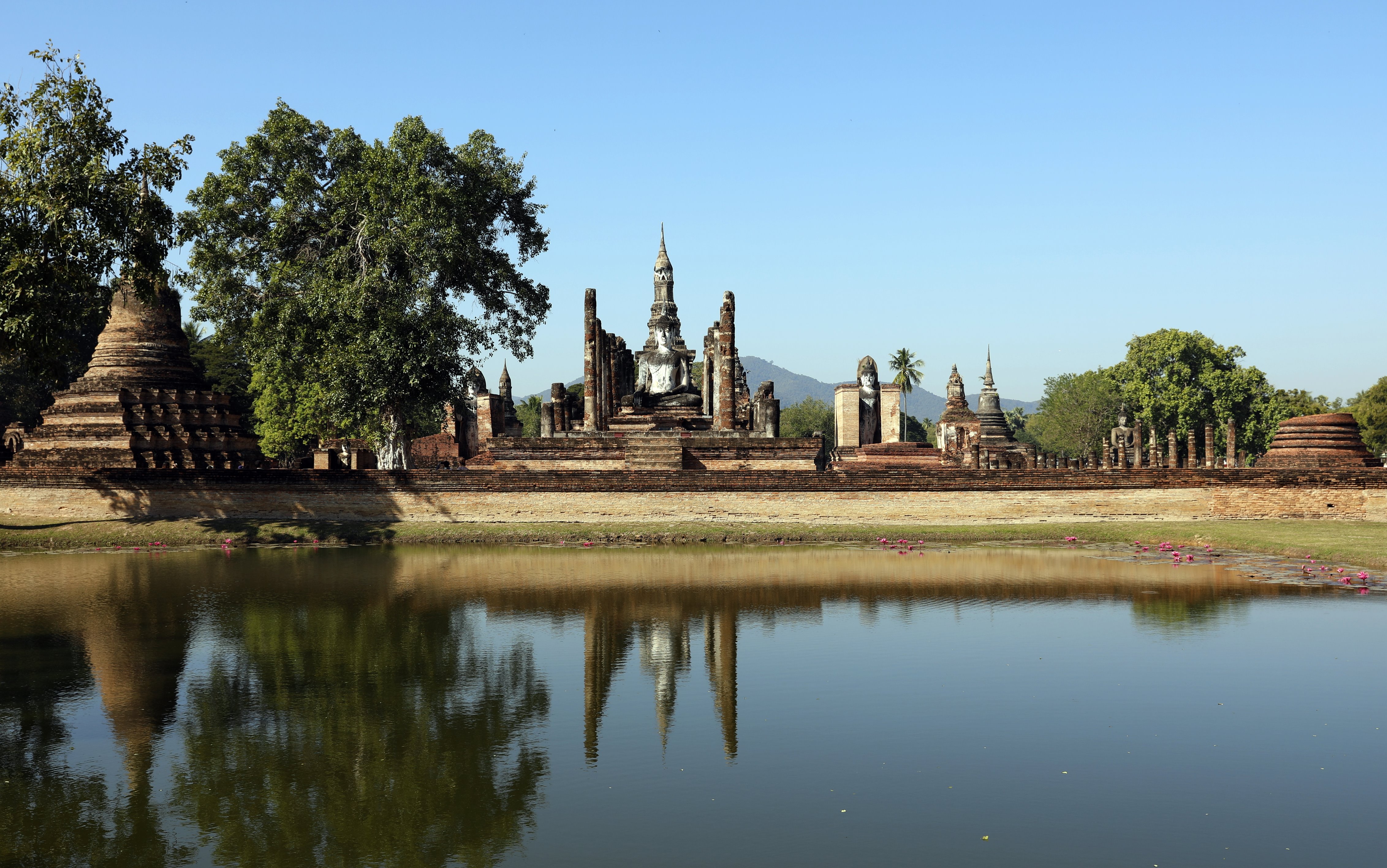
Before Bangkok was the capital, Thailand had rulers in Sukhothai and Ayutthaya. Today these historical cities are UNESCO World Heritage Sites because of the large number of important historical wats and stupas in their Old Towns.
Ayutthaya
In the mid 1300s the capital of Siam (now called Thailand) was in Ayutthaya, 80 km north of Bangkok. Ayutthaya’s Old City is located on an island at the confluence of Chao Phraya and Pa Sak Rivers. Most of the ruins are on the island, but a few are scattered along the opposite side of the Chao Pharaya River. Since it was late afternoon when we arrived we decided to take an evening long-boat cruise to see the ruins along the river. They are not a part of the Ayutthaya Historical Park but are a great introduction to what Ayutthaya has to offer. We saw the pointy tops of quite a few old stupas as we travelled up the gentle river. The boat pulled up to a small dock in front of Wat Chaiwatthanaram so we could explore it on land. It was early evening and the sun was setting which gave the old brick towers and stupas a beautiful glow.


Our boat captain made sure we returned to our boat in time to see a gorgeous sunset from the river. She navigated the boat to the perfect spot so we could see the sun setting beside the wat.

The Old City is still a functioning part of Ayutthaya. Many of the ruins are in small parks that are located beside busy streets. Most of the archeological sites are close enough to walk between and we found it a fascinating neighbourhood to explore on foot. It was interesting to see locals going about their regular day around these amazing archeological buildings, barely noticing them.
Ayutthaya was conquered by the Burmese in the mid 1500s. It eventually regained its independence, but many of the buildings were destroyed in the takeover. As a result, the ruins in Ayutthaya are not in very good condition, missing walls and pillars. Even with this damage though it was incredible to walk between the old wats and stupas and imagine how they once were.

The first site that most people visit is Wat Mahathat. It is one of the oldest temples in Ayutthaya and must have been very grand in its day. Its distinguishable prang tower can be seen from many places in the park.


Beyond this wat there are still several more sites to visit in Ayutthaya. Each has its own unique character whether it has bell shaped stupas, lion statues or delicate carvings. You can easily spend a few days exploring.


Sukhothai
Before the capital was in Ayutthaya, Sukhothai was the capital of Siam. It’s located 300 km north of Ayutthaya and dates back to the late 1100s. When the capital was moved to Ayutthaya, Sukhothai was slowly abandoned. Since it wasn’t invaded the ruins, although older, are in much better condition than in Ayutthaya. There are no roofs as those would have been made of wood, but there are partial walls and pillars still in place. We found these features made it easier to imagine the size and shape of the buildings.


The Old City of Sukhothai has been preserved in a beautifully manicured park with flowers, shrubs and ponds. It was a relaxing setting to explore the numerous old wats, stupas, and prangs. The main temple, Wat Mahatat, is set in front of a small pond and is one of the prettiest buildings in the park.


Spread around the manicured park are numerous other ancient temples, stupas and prangs. There are many statues of Buddha in various poses and a temple with large elephants around its base. Many were still in good enough condition to see the details in the intricate carvings.


Si Satchanalai
50 km north of Sukhothai is another site called Si Satchanalai. It was a city before and during the Sukhothai period so many of the ruins are older than in Sukhothai but are still in fairly good condition. The site is very rural, set in a natural forest.
We rented bicycles from a shop near the bus stop and rode to the park as well as between ruins inside this large park. Three km before Si Satchanalai Historical Park is a small site called Chaliang. The main building, Wat Phra Sri Rattana Mahathat isn’t large, but it is in good condition with pillars and a central prang. The double seated Buddha statues at this wat were something we hadn’t seen before.


The buildings have different designs than in either Sukhothai or Ayutthaya. We loved the look of Wat Chang Lom where dozens of elephant statues guard the temple’s base. Above the elephants, 29 Buddha statues are set in protected niches. Many of the elephants and Buddha statues are in disrepair, but it’s still a fascinating looking temple. Other notable buildings include Wat Chedi Chet Thaeo that has the remains of a small stone wall and Wat Suam Kheo Utthayan Noi with its original roof.


On the top of a hill in the north end of the park are a few more ruins. It’s not as frequently visited, but we saw a few fabulous temples that made the tough bike ride up hill worthwhile.


Visiting The Sites
Ayutthaya Historical Park – Each temple, whether within the park or outside, has its own entrance fee (20 and 50 Baht). Passes are available from hotels that allow you access to the 6 main temples of the park for a reduced fee. Most of the ruins are spread throughout Old Town. To get between them you can walk, bicycle, motorbike or hire a tuk-tuk.
Sukhothai Historical Park – There are five zones in Sukhothai Historical Park, each has a separate entrance fee (100 Baht). We visited the North and Central Zones. The park is quite large but is walkable or bicycles are available for rent.
Si Satchanalai Historical Park – Entrance fee to the park is 150 Baht. The ruins are spread over a very large area. In order to see the majority of them you need a bicycle, motor bike or car. Just outside of the park you can visit a few ruins in Chaliang, including Wat Phra Sri Rattana Mahathat. Entrance fee to Chaliang is 20 Baht. For this price it is worth a visit.
Getting to Ayutthaya – There are hourly minibuses that leave from Morchit Bus Terminal in Bangkok. The minibus kiosks are outside of the terminal and away from the large buses. The fare is 70 Baht and it takes about an hour and a half. Note though that they may try to make you pay for an extra seat if you have large luggage. We argued and ended up keeping our bags on our feet. You can also take one of the many daily trains from Bangkok or Chiang Mai.
Getting to Sukhothai – There are frequent buses each day to Sukhothai from the south (Ayutthaya or Bangkok) or the north (Chiang Mai). The main bus terminal is north of the central area but buses can drop you off in Old Sukhothai on their way through. Tuk tuks cost 80 Baht to get from the bus terminal to most hotels in New Sukhothai. There are frequent Songthaews going between New and Old Sukhothai (12 km). They’ll drop you off at the park entrance. This is the same spot to catch buses returning to New Sukhothai.
Getting to Si Satchanalai – Buses bound for Chiang Rai leave three times a day from Sukhothai Bus Terminal and pass through Si Satchanalai. Ask to get let off at Wat Pra Sri. At the bus stop you’ll find a shop that rents bikes and will explain how to get to the main gate of the archeological park. They will also know the current schedule for buses returning to Sukhothai. All of the locals and bus drivers know the area well so it’s easier than it may sound. It can easily be done as a day trip from Sukhothai.
Dress Code
Although these sites are temples, a strict dress code is not enforced as some active temples. However, it is advised to wear clothes that cover your shoulders and knees.
Click here for Travel Tips in Thailand.
Coming next – Thailand’s Andaman Sea
To see more pictures from Thailand click here. For more pictures from other destinations go to Gallery.
To read other stories from our travels around the world go to Destinations.
If you like what you read please share, with credit, by using the links below.




We’d love to hear from you, please leave a comment.