
To get around mountainous Kyrgyzstan you don’t use the typical methods of bus or train. Share-minibuses and share-taxis are more common. For this part of our journey we took share-taxi and it turned out to be one of the most interesting parts of the week.
Our travels in Kyrgyzstan began in the southern half of the country. After spending two days in Arslanbob we began our journey north to the capital of Bishkek. Getting between southern and northern Kyrgyzstan involves a harrowing drive, crossing over two high mountain passes in the Tian Shan mountains.
The day began as planned. Our first two share-minibuses (marshrutkas) left on time and we only had to wait 30 minutes between them. When we arrived in the town of Toshkomur we exited the marshrutka to find a taxi driver offering to take us to the Bishkek share-taxi stand. We hopped in his taxi and as soon as we started moving, the driver started blowing a whistle. His car horn was broken so his solution was to use a whistle. The problem is that it was very loud inside the small car, but not much of the noise reached the car he was angry with. Luckily it was only a 5-minute drive, or three whistle blows, until he dropped us off by the side of the highway in a seemingly random spot. We stood there hoping he knew what he was doing and had left us at the right spot. Remarkably within 10 or so minutes a share-taxi arrived and was looking for 2 more passengers.
With one of our bags tied to the roof with what looked like a car bumper, we crawled into the back row of an eight passenger SUV. The other passengers were all local Kyrgyz. The driver was a young man from the conservative town with a decoration hanging from his rearview mirror that said ‘Warning, Sexoholic’ in English. Since the Kyrgyz language uses the Russian alphabet, we’re not completely sure the driver knew what it meant. Certainly none of the Kyrgyz Muslim passengers could read it. On a different trip there was a sign that said ‘F**K’ hanging from the mirror. We’re also pretty sure that the 60-year-old driver didn’t know what it meant.
With us in the share-taxi, were two passengers I’ll call Mom and Dad, even though they weren’t traveling together. We learned much later that they didn’t even know each other. There was a seven old boy that we thought was with mom and dad but was actually traveling on his own. And finally, there was a 35 year old man who introduced himself as Ernest. At least that’s the name our English ears heard.
We began by driving through the arid hills in central Kyrgyzstan. Our driver raced along the two-lane highway, passing as many vehicles as he could when I didn’t think there was room enough to pass. Oh, and did I mention that about half of the cars in Kyrgyzstan, including the one we were in, are right hand drive but the roads are also driven on the right side. That makes passing a little trickier because the passing car has to get all the way out from behind the one in front so the driver can look for oncoming traffic. It was quite unnerving at times.
We had already travelled on two minibuses and a taxi to reach the share-taxi meeting point so we were quite tired at the start of this 7 ½ hour car ride. For the first part of our trip we didn’t communicate with the other passengers. The driver circumnavigated almost completely around a large, blue reservoir. Its turquoise colour reminded us of lakes on the high plateaus in Tibet. We talked quietly between ourselves about the beauty of the landscape. The other passengers didn’t talk to each other at all.
Kyrgyz people are not overly friendly when they don’t know you. This was very different from our experience in Uzbekistan where the people are incredibly friendly. We saw the boy or Ernest occasionally look over their shoulder, to sneak a look at these strange foreigners, but we really didn’t communicate other than smile.
To break up some of the monotony of the 7 ½ hour road trip Richard started teaching me the Russian alphabet. He learned Russian in Poland and it is still widely spoken and taught in schools in Kyrgyzstan. In fact almost all signs use the Russian alphabet so learning it would be helpful for the trip. Hearing us speak a few Russian words was the impetuous for Ernest to turn around and talk to us, or rather to Richard, in Russian. We were about to learn that once the reserved Kyrgyz people begin speaking with you, there seems to be no boundaries in the questions they ask. Once the formalities of ‘Where are you from?’; ‘Why are you in Kyrgyzstan?’; ‘Do you like Kyrgyzstan?’ questions were over, Ernest’s questions continued and got more and more personal. He asked how old we are, which is not something a Canadian would ask anyone over school-age.
Then he asked about our work and had a difficult time understanding retirement and pension. The questions continued as he asked ‘Where are you going on our trip?’ He was startled when Richard explained that we were going to visit 8 countries so he asked much money our trip will cost. Again, Canadians don’t ask others about money so these questions seemed very personal.
Ernest asked if we could show him the best photos from Canada, but the Russian word for photo (fotka) sounds like vodka. We thought it odd but replied ‘Alberta Pure’ is the best vodka in Canada’. He showed us his phone and said he wanted to see pictures, so Richard went to Google and pulled up an advertisement for Alberta Pure Vodka. Ernest was very confused and said, ‘I’m Muslim, I don’t drink alcohol.’ He then showed us pictures he had taken in Kyrgyzstan and that’s when Richard realized that Ernest wanted to see the best photos we had from Canada. Not vodka!
After a while he asked about children. Richard was good to avoid the ‘step-daughter, second marriage’ conversation that wouldn’t have gone over very well by saying that we have two children. Ernest immediately wanted to see pictures. We went to Facebook to show him a couple of pictures, but were careful not to show him their names. On another taxi ride a few days earlier, the taxi driver wanted to see pictures of our daughters. We showed him pictures from Instagram. The driver noted the Instagram page and ended up sending Richard’s daughter a picture of him and Richard in his taxi without us realizing!
After we drove a little further, the share-taxi climbed higher and higher getting closer to the mountains. Ernest turned around and asked if we could arrange a marriage for him to a Canadian woman? Richard replied that we didn’t know anyone who is single. He told us he doesn’t like Kyrgyz women and wants to marry a Canadian or French woman. After Richard again said he didn’t think we could help him, Ernest said he’d even marry a divorced woman. When this went nowhere, he asked if we have something from Canada that we could give him. It seemed quite forward and unexpected, but we told him that we only bring what we need for our trip and nothing extra. Which is the truth.
The questions continued and Ernest asked ‘who is the boss in our home?’ Richard replied ‘No one is the boss, it’s an equal partnership.’ Mom, who had been very quiet through the whole trip, had a good chuckle at that answer. Ernest couldn’t really understand. He said that in a Muslim house, the man is the boss and everyone must obey him. Richard replied that a Canadian or French woman wouldn’t stand for that, so maybe he should reconsider his marriage ideas. Ernest quickly replied, ‘I can change!’
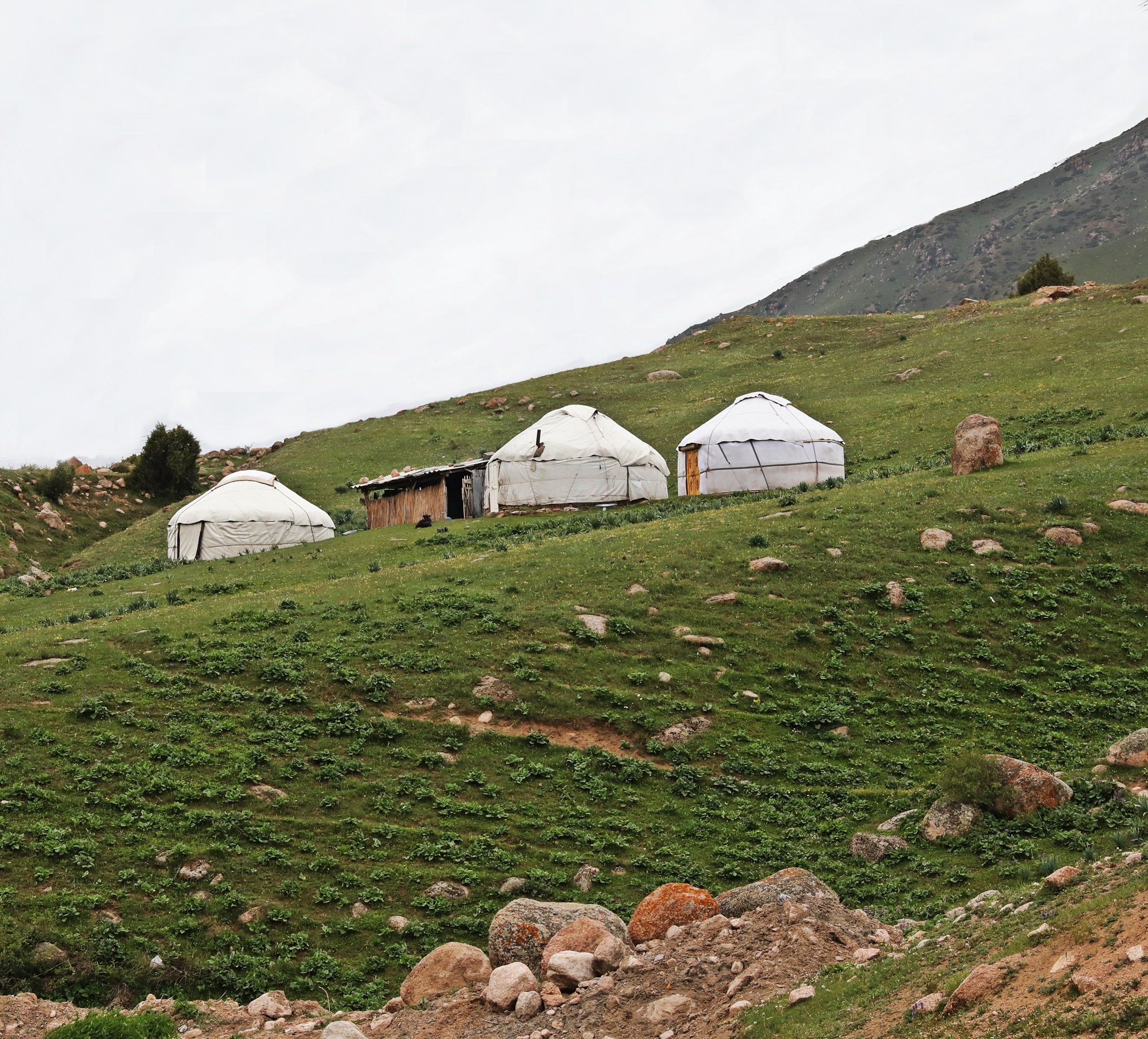
The car climbed and climbed through the arid mountains and finally we were at Tor-Ashu Pass (3,060 m); the first of two mountain passes on the drive. On the other side of the pass, the landscape changed. In front of us, the lush green Suusamyr Valley was spread out below tall, snow capped mountains. Then we started seeing yurts set up on the green meadows. It was the quintessential image of Kyrgyzstan that we had hoped actually existed and wasn’t just a marketing ploy.


In Kyrgyzstan, nomadic people bring their horses to the high alpine meadows, called jailoos, each spring and summer to feed on the grass. They stay with their animals the entire time, living in yurts. The nomads milk their horses and then sell the milk on the side of the road. It’s usually a fermented milk called kumis which is a delicacy to the Kyrgyz people, but they also sell fresh mare’s milk called Saamal. Everyone in the car, except us that is, was excited to buy a litre or two each.
We stopped at one of the roadside yurts and piled out of the SUV. The other passengers had a free sample of milk, poured out of a bucket. They offered us a taste, but seeing as non-pasteurized cow’s milk doesn’t agree with our digestive system, we didn’t think drinking horse milk from a yurt on the side of the road was a good idea. Everyone purchased their mare’s milk and we were on our way.


After feeling rejuvenated with his milk, Ernest began questioning Richard again. Ernest said he’d like to come to Canada as our guest. Richard asked if had enough money to buy the plane ticket. Ernest assured him he would have enough by then. He explained that worked as a coal miner in Tashkomar.
Very soon after this question we were all distracted as the share-taxi began speeding up the hill toward the second pass. Our driver was overtaking as many cars and trucks as he could. Often, he forced the two-lane highway into three lanes. Oncoming vehicles had to veer off on to the non-existent shoulder to prevent a collision. Remember that our driver is sitting on the wrong side of the car for these highways. It was quite stressful to be a passenger with no control.
At Ala-Bel Pass (3,600 m) there is a 3 km tunnel that is under construction. Because of the construction, the tunnel is open for 2 hours and closed for 2 hours, all day long. We arrived just before it opened to find a disorganized mess as each car tried to get to the front of the line. Finally we saw the first group exiting the tunnel. A herd of furry heads went running by our car. Hundreds of sheep and goats were the first to go through the tunnel from the other side!! Only in Kyrgyzstan.

Once we got through the narrow tunnel it was an intense drive down. Over 500 switchbacks took us down the narrow gorge carved out by Kara Balta River. The road went all the way down to 1,700 m. With a loss of 1,900 m in just a few kilometers we could smell the scent of burning brake pads and hoped they weren’t ours. Dozens of vehicles were pulled over on the other side of the road having over heated on their drive up. Our driver was again passing every available car on the tight twisty road. Our eyes were glued to the windshield, but Ernest had fallen asleep.
By the time we arrived in Bishkek, an hour or so later, he had forgotten about us. I guess he was upset that we wouldn’t find him a wife.
For Travel Tips in Kyrgyzstan go to our post on Fergana Valley.
To read more of our stories from Kyrgyzstan click here.
Coming Next – Best Day Trips From Bishkek
For pictures from other blogs go to Gallery at monkeystale.ca
To read about more of our adventures go to Destinations.
If you like what you read, please comment or share (with credit) using the links below.






We'd love to hear from you, please leave a comment.