
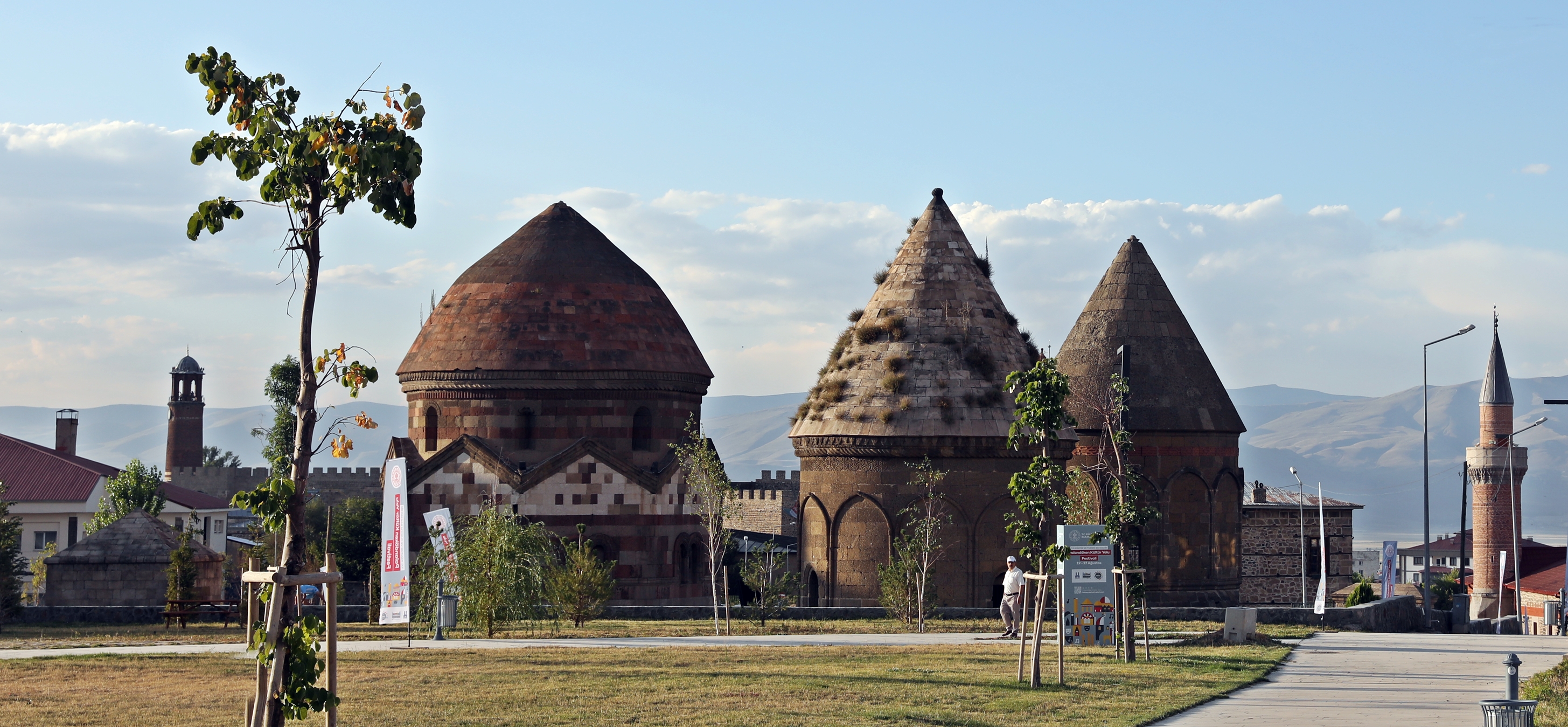
Many dynasties have ruled Eastern Anatolia over the centuries leaving behind a land filled with a diverse array of historical buildings. In the city of Erzurum, the short-lived Seljuk Dynasty left their mark with a new style that melded the architectural features of those around them. Scattered between the new buildings of downtown Erzurum, we found a few fabulous treasures from the Anatolian Seljuk and the smaller Saltukid Dynasties.
Eastern Anatolia is located on a high plateau in eastern Turkey where the Pontus and Taurus Mountains converge. Erzurum is the name of the largest province as well as the major city of this region. The city’s history dates back to at least 4,000 BCE. Since then, there have been no less than 19 different empires ruling this land. The largest of these dynasties were the Byzantine and Ottoman, but two lesser-known ones have added their own unique flare to the city. (Read our post about an Ottoman city here.)

One of these was the Anatolian Seljuks. This offshoot of the larger Seljuk Empire ruled eastern Turkey. Their beginnings are similar to that of the Ottoman. Originally the Seljuks were a collection of nomadic tribes living on the steppes of Central Asia. Forced from their lands by the Mongols, they spread to the Middle East ruling over Persia, Mesopotamia, Syria and others for 300 years from the 11th to 13th centuries.
The tribes that became the Anatolian Seljuks settled in what is now eastern Turkey where they ruled for over 200 years (1077 – 1308). As they built their cities, the Seljuks drew influences from the previous inhabitants such as Byzantines, as well as nearby Persia, Syria, Iraq and Armenia. Erzurum’s location made it an important stop on ancient trade routes which brought even more multi-cultural influences. Their architects successfully wove these different design elements into their elaborate mosques, madrasas and other buildings. The Seljuk’s capital was Konya. You can read that post here.
Another lesser-known empire called Saltukids, added their own structures to Erzurum. They had already been ruling the city for a few years when the Seljuks arrived and continued to govern it as a vassal state under the larger empire.
With decorated minarets, elaborate madrasas and picturesque tombs, we had fun exploring the Seljuk and Saltukid architecture in Erzurum.
Three Tombs of Yakutiye (Üç Kümbetler)
Huddled together in a small yard are three circular tombs with conical roofs. Set in front of Palandöken Mountains, these three stone buildings and their pointed, roofs are the iconic image of Erzurum. The shape of the roofs would make you think they are metal, but surprisingly, they are made from stone. It was a picture of these tombs that made us interested in exploring this historical city.


Not a lot is known about these tombs, but it is believed that the oldest was built in the 12th century for a Saltukid Emir. Of the three, this one has the most interesting design. Its lower half is patterned in white and red stones around an octagonal base. An elevated band around its top adds a unique flare to the tomb. The entrance is also quite pretty with a decorated stone arch.

The other two tombs are believed to be from the 14th century. They are not as elaborate as the oldest tomb but are still picturesque structures.

Entrance is free; Open 24 hours
Twin Minaret Madrasa (Çifte Minareli Medrese)
Immediately in front of the Three Tombs is another famous image of Erzurum. As you approach the madrasa you can understand why it is so beloved. Two tall minarets stand beside a beautifully sculpted entrance gate. The minarets have fluted glazed brick and colourful tiling on their tops. If you look closely you can see that the two tops are slightly different.

The Seljuks adorned their buildings with elaborate features uncommon in the area before, such as elegant entrances with intricate carvings on their stone walls. The main gate of this madrasa has lovely detailed sculpting on the walls as well as two ornamental columns with intricate engravings.
Another design feature that the Seljuks brought to the area are the stalactite-looking muqarnas. Often used as a transition between round and square walls, these fancy design features added a unique flare. Above the door of Twin Minaret Madrasa are gorgeous muqarnas that demonstrate the incredible skill of the craftsmen. We saw this same style in some of the buildings in Samarkand, but learned that the Seljuks had already been using them for centuries before the Timurids did.
This madrasa is said to be a great example of Seljuk architecture.

At the rear of the building is a cupola with a conical roof similar to those we saw on the tombs. We soon realized that we would see these medieval roofs on many of the historic buildings in Erzurum. One theory is that this architectural feature has Armenian influences. Another theory is that both the Armenians and Seljuks were influenced from a third source that is yet unknown.

Inside the madrasa you can see more details on the ceiling of a large alcove. This leads to an open courtyard with small rooms around the edge. Madrasas are schools, usually for theology, and these rooms would have been student cells when it was used as a school.


At the end of the hall is the cupola that we saw from the outside. We walked inside to find a stunning room made of marble with elaborate muqarnas above the windows.

Entrance is free; Opening hours – 9 am – 6 pm
The Castle of Erzurum
Standing on a small knoll in the middle of Old Town is the Castle of Erzurum. Its tall stone wall complete with a watchtower and turrets make it a formidable looking castle. The roofs of the stone turrets have the typical stone, pointy roofs that we’ve seen on other buildings in Erzurum.
The castle was originally built by Byzantine rulers in the 5th century but has been damaged and rebuilt several times over the centuries with each dynasty making its own contribution.


The interior of the castle is now mostly in ruins except for the 12th century mosque and clock tower. The mosque is plain with stone walls, high dome ceilings and low chandeliers. The tower was originally built as a minaret but during Ottoman rule it was modified to be a clock tower.


The best thing to do inside the castle walls is to climb to the top of the clock tower for great views of the ancient sites of Erzurum and the Palandöken Mountains behind. When the sun was low, the long shadows of the hills make it an exceptionally beautiful view.

Entrance fee – 60 TRY ($2 USD); Opening Hours – 8 am – 7 pm daily
Yakutiye Madrasa
A few short blocks away from the castle is another Seljuk built madrasa with a unique and picturesque minaret. The Anatolian Seljuks are known for making beautiful minarets. They added a new design element by styling them in decorative patterns by alternating between recessed and projected bricks. The brick work on Yakutiye Madrasa’s minaret has been arranged in wonderful geometric patterns that we haven’t seen before.

The minaret stands beside a dark stone entrance gate that has beautiful stalactite-style muqarnas above the door. There are also detailed carvings are on the stone walls on the side of the entrance gate. These elaborate decorations on the entrance and the unique minaret are what sets Seljuk architecture apart from other dynasties.


For such an elaborate exterior we thought the building’s interior would be equally stunning. Instead, it is very plain with very few embellishments. The only design elements we noticed were the details on the ceiling.


After the Mongols lay siege to the city in 1242, they also used the madrasa as their own centre of theological learning.
Entrance is free; Opening hours – 9 am – 6 pm
Lala Mustafa Paşa Mosque
In the same yard as Yakutiye Madrasa is a 16th century Ottoman mosque. Lala Mustafa Paşa Mosque was the first mosque that the Ottoman built in Erzurum. The entrance and late-comers area have pretty, multi-domed ceilings painted in white with blue and red flowery designs. The white theme continues inside with matching domes above the prayer room.
Its design is very similar to other Ottoman mosques we’ve seen around Turkey.


It is an active mosque so appropriate dress is required.
Entrance is free
Grand Mosque (Ulu Cami)
Across from the Castle of Erzurum is a large stone mosque. It consists of only one large room, but the multiple stone arches between domed ceilings gives it the appearance of having several rooms. The mosque doesn’t have a lot of decoration inside, but the shear size of the room is impressive. The mosque was built by the Saltuk Dynasty in 1179 and is one of the most plain ones that we saw in Erzurum.

Cimcime Hatun Tomb
In addition to the Three Tombs, there are a few other similar looking tombs scattered throughout Old Town. One is called Cimcime Hatun Tomb. It is a small conical building that we stumbled on in the middle of downtown. As with many cities in Turkey, there are so many artifacts that the city has just developed around them. For this tomb, a pedestrian sidewalk was built around it and cars rush along the busy street beside. Built in the 14th century, its design is similar to other ones in the city.
Old Town Erzurum is a pleasant place to walk and explore. In addition to these main sites we found a few other historic buildings that are being used as stores and restaurants.


Where to stay in Erzurum
Erzurum is not that large, but it is best to stay in or near Old Town. Find a hotel walking distance from Yakutiye Madrasa, the Castle or the Three Tombs. The entire Old Town is not that large and is very walkable.
Where to eat in Erzurum
One of our favourite restaurants on our travels throughout Turkey was in Erzurum. Not only does Old Erzurum Houses have delicious traditional Turkish food, it also has a fantastic atmosphere. The owner used eleven, 300-year old attached houses and an inn to build the large restaurant. Each room in the inter-connected heritage building is decorated in traditional Eastern Anatolian decorations including the seating. Eating here is like eating in a museum. Old Erzurum Houses added the final touch to our great stay in this historic city.


This article is now featured on GPSmyCity. To download this article for offline reading or create a self-guided walking tour to visit the attractions highlighted in this article, go to Walking Tours and Articles in Erzurum.
Click on the link to read our Travel Tips For Turkey.
To read more of our adventures in Turkey click here.
Coming Next – Picturesque Van Lake
For pictures from other blogs go to Gallery at monkeystale.ca
To read about more of our adventures go to Destinations.
If you like what you read, please comment or share (with credit) using the links below.





We'd love to hear from you, please leave a comment.