
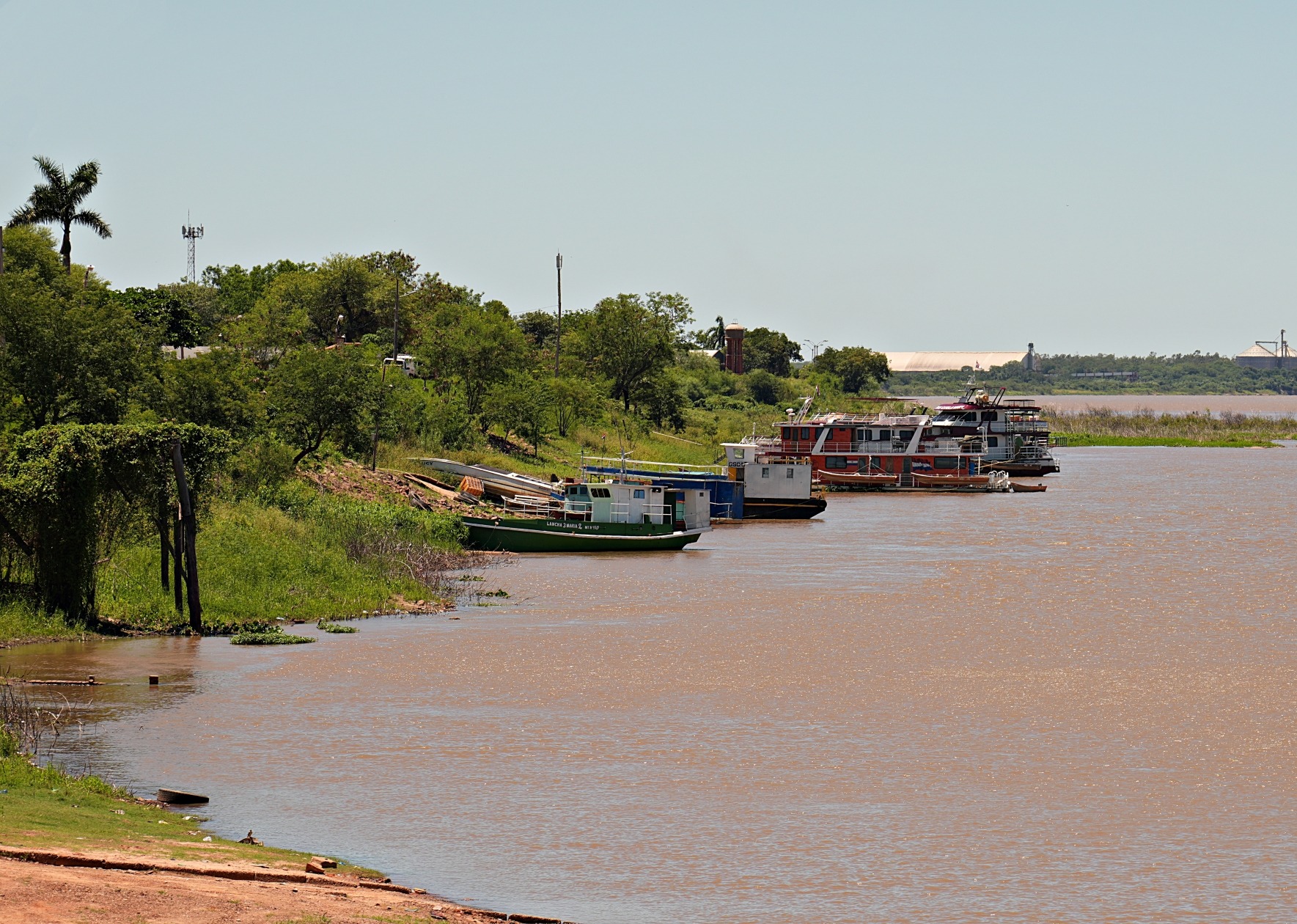
In the centre of Paraguay, not far from the Tropic of Capricorn, is the city of Concepcion. Its wealthy past as a port city on the Paraguay River has left a trail of wonderfully ornate buildings that have suffered the effects of time. These buildings give the city a lot of potential, and one day, we think Concepcion, Paraguay, will be on Paraguay’s tourist trail.
Founded by the Spanish in 1773 as Villa Real de Concepción, the port town developed into a booming city in a very short time. Unlike other Paraguayan colonial towns, this one wasn’t built on indigenous land. Due to its extensive wetlands, the northern region of the country, called Chaco, was not settled by the Guarani. The Spanish, though, liked the location for its natural port on the navigable Paraguay River, because it allowed them to connect the riches in Peru with Asuncion.
In the early 20th century, it dropped the first part of its name and was called simply Concepción. At this time, its port was even more valuable, earning the nickname La Perla del Norte (Pearl of the North). Word of the potential opportunities in Concepcion spread through Europe, and immigrants arrived from Spain and Italy to make their fortunes in the city. These newly rich left their mark on the city with grand, European-style architecture.
Colonial Mansions
We walked between the main streets and dusty, red-earth side streets in Concepcion seeking these grand old estates. Today, the town has lost its importance, and what were once beautiful mansions need a little TLC. Once home to wealthy merchants, they are no longer at their prime, but enough of their details remain to hint at their former brilliance.


Being further north than Asuncion, we expected temperatures to be much higher and weren’t sure we’d be able to walk outside for long. In fact, temperatures were about the same as the capital, but thankfully, the humidity was much lower, so it felt a lot more comfortable, even at the hottest time of day. And so, we continued to explore.
Most of the buildings we found were quite subdued, but a few, including the Regional Governor’s Office, were colourful.


As well as these mansions, closer to the port, we found the more humble-looking Guarani-Spanish colonial buildings.


One of our favourite things to see on our walk was the guira cuckoo birds with their funky hairdo.

Cathedral of Immaculate Concepcion
As in most towns in Paraguay, Concepcion has its share of churches and religious monuments. Unfortunately, the Cathedral of Immaculate Conception (Catedral Inmaculada Concepción de María) has seen better days. In the 1960s, the old building partially collapsed, and sadly, was replaced with a rather ugly façade. Due to this new design, the view of the dome on top is obscured.
Its interior is also more modern than we prefer, so this wasn’t one of our favourite buildings.


Plaza de la Libertad
This quiet park used to be the city’s Plaza de Armas, and had a prominent spot across from the cathedral. As the new city grew, this area became less frequented by locals. When we visited, the square was empty; in fact, most of the heritage centre was quiet. It’s too bad because if these buildings were restored, it could be a very nice Old Town, competing with some of the more famous colonial cities.

Monumento a María Auxiliadora
In the middle of the busy Avenida Agustin Fernando de Pinedo, is the large Monumento a María Auxiliadora (Mary, the Helper of Christians). Maria Auxiliadora is an important patron in the Paraguayan church. In the statue, she appears to be supplying the world with water.
A few blocks away is a college named for Maria Auxiliadora and a monument to Our Lady of Fatima.


San Jose Church
Across from the monument is the large yellow San Jose Church (Iglesia San José). It has a more colonial look than the cathedral, but its position on the side of the busy avenue, makes it less charming. We passed by it several times, but the church was never open.
At night, both the church and the statue are nicely lit, and the Christmas decorations in front during our visit made them look very festive.


Old Port of Concepcion
As the wealth disappeared, its port also suffered. Today, it is mostly abandoned and is only a skeleton of the busy port it once was. Although quiet, we found the Old Port (Puerto Viejo de Concepción) to be an interesting part of town. Richard suggested that its old buildings and crane could one day make a great restaurant row and market.


Nowadays, the river is used by fishing boats and small ferries, instead of cargo ships.


When Concepcion was booming, it had several factories and warehouses. The streets around the port would have been filled with flour mills, lumber yards, pulp and paper mills, gin distilleries, and others. A block from the port, these old buildings that at one time were filled with goods are now empty and falling into ruins.

Train Museum
Another indication of how wealthy this city once was can be seen in the collection of steam engines and steam excavators. You can see a few at the Train Museum (Parque Museo Tren del Norte), but calling it a museum is an overstatement. It’s more of a disorganized collection of old trains and equipment scattered around the park lawn. Another place to find old steam equipment is on the meridian in the centre of the busy Avenida Agustin Fernando de Pinedo.


Being in this small town for a few days made us appreciate how much Guarani is spoken in the country. It is the first language of many Paraguayans, especially in rural areas. Most learn Guarani at home and study Spanish in school. To our ears, the language is similar to Canada’s indigenous languages, with abrupt words, unlike the more lyrical romantic languages.
Another part of their culture that sets Paraguayans apart from their neighbours is their love of tereré. It is an iced version of mate. People drink so much, they walk around carrying coolers of iced water to pour into their mugs (guampa). We spotted this couple with their cooler hanging out at the port.

Overall, if you have time and are interested in travelling to northern Paraguay, Concepcion does have an interesting story to tell. But if you are short on time, it is a place that can be missed.
How to get to Concepcion
You can find Concepcion at the top of the map below. It is an interactive map, so you can zoom-in, or click on a marker to be directed to our post from that region.
Located 400 km from Asuncion, the only way to reach the city is by car or bus. Buses leave from the Asuncion Bus Terminal (Terminal de Ómnibus de Asunción). Even though the bus companies claim the drive takes 8 hours, prepare for it to be at least an 11 hour ride. If you drive yourself, the road is not in the best condition. There is not much of a shoulder, and there are many potholes.
Not far from Concepcion, we noticed that the farms and homes were more nicely kept than on the rest of the drive. There was less litter on the ground, lawns were freshly cut, and flower beds were well-tended. Then we passed a sign to a Mennonite colony. We learned that in the early 1900s, Mennonites migrated to this region from Maggie’s home province of Manitoba. The Mennonite community has strict values and strong religious beliefs. They were apparently feeling pressure in Manitoba to assimilate, which caused them to move to South America. They also left Canada at that time to avoid having to send their sons to WWs I and II. We wondered if the reason for the more pleasant-looking homes was the result of these religious immigrants.
Just before reaching Concepcion, we crossed the Tropic of Capricorn. It would our third time on this trip.

Click on the link to go directly to our Travel Tips for Paraguay.
To read more of our adventures in Paraguay, click here.
Coming Next – A Day In Villarica
For pictures from other blogs go to Gallery at monkeystale.ca.
To read about more of our adventures go to Destinations.
If you like what you read, please comment or share (with credit) using the links below.




We'd love to hear from you, please leave a comment.