
As one of the oldest colonial settlements in Paraguay, Villarrica had an unusual start. First established in 1570 in another location, it was called Villa Rica del Espíritu Santo (Wealthy village of the Holy Ghost). Rica, because it was believed that there were precious metals in the area, and Espiritu Santo, because it was during the Catholic festival of the Holy Ghost. As it turned out, there weren’t riches, and in fact, the town wasn’t very lucky at all. It had to be moved seven times over the next hundred years due to invasions by Portuguese soldiers from nearby Brazil. Over time, it lost Espíritu Santo from the name and added an ‘r’ to be Villarrica. By 1701, they finally settled at the current location.
In the early 20th century, a new railway passed through the city, bringing with it opportunities and potential wealth. This resulted in an influx of European immigrants, and the city became filled with extravagant homes. By the end of the 20th century, though, it lost its importance to the border cities of Ciudad del Este and Encarnacion.
Today, Villarrica is the hub of culture and education in Paraguay, with many artists hailing from the city. As a visitor, other than Ybaroty Church, there aren’t as many sites as we had hoped, but we managed to find a few during our walks around the city. Let us show you the sites in Villarrica, Paraguay.
Ybaroty Church
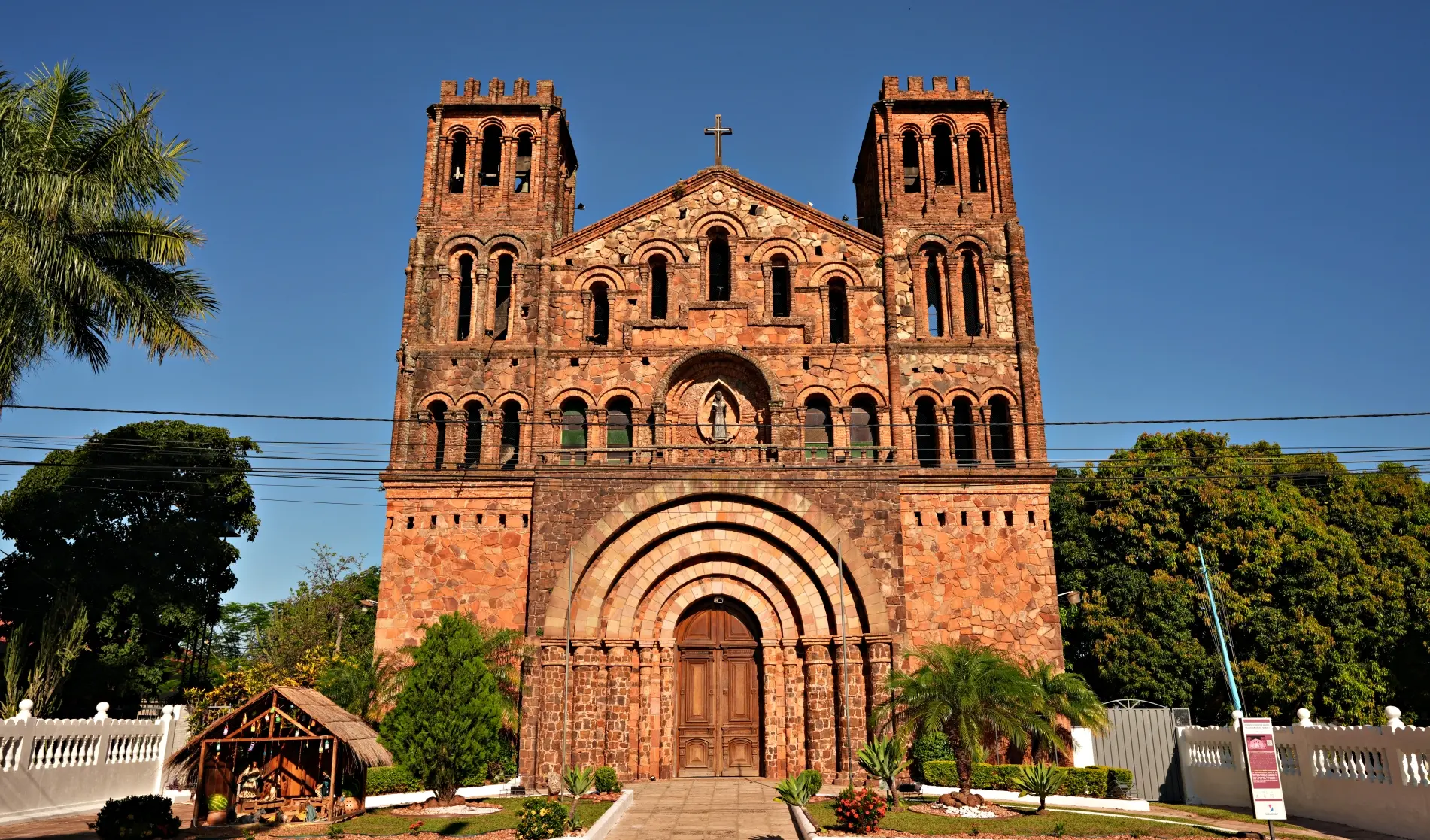
The most famous building, and what attracted us to Villarrica, is Ybaroty Church (Nuestra Señora de la Asunción de Ybaroty). Although it was built in the 1950s, it is a Paraguayan version of a medieval Romanesque-Gothic style building. The brick building’s façade, including its faux columns, is overlaid with a veneer made from local stone. Although it is only a veneer, it is this stonework that makes the building so unique and picturesque.
Completing the neo-Gothic look are flying buttresses and twin bell towers. In order to get the best pictures, visit the church in the afternoon when the sun gives a red hue to the stone.


It was close to Christmas when we were in Villarrica, and the streets felt magical, decorated in festive lights and Christmas trees. There were many vendors selling nativity scenes and other Christmas decorations along the streets and in the parks.
Some were selling an unusual-looking plant. Flor de Coco (Coconut Flower) is used to decorate the small nativity scenes, that people place in their homes. The aroma reminds everyone in Paraguay of Christmas, much like the scent of pine does at home in Canada.


Liberty Square
The heart of most South American cities is their historic squares. That doesn’t seem to be the case in Paraguay, though. In every city we visited, including Villarrica, these squares were quiet, day and night. Liberty Square (Plaza de la Libertad) has beautiful tall trees that provide shade to the many park benches, but none were in use.

Villarrica Cathedral
The main occupant of Liberty Square is the 1950s Villarrica Cathedral (Iglesia Catedral del Espíritu Santo). From our hotel, we could hear its bells ringing from the tall clock and bell tower, calling everyone to mass.


Heroes’ Square
Heroes’ Square (Plaza de los Héroes) was sparkling with Christmas lights and had a very festive look when we visited. It is only a couple of blocks away from Liberty Square, and we found it difficult to tell the two squares apart.
At its head is one of the prettiest buildings in the city, Pintura del Palacette Municipal, City Hall.


Between the two plazas, we found a few old colonial buildings, but not as many as we saw in other Paraguayan centres.


Manuel Ortiz Guerrero Park
Outside the city centre is a large park with tall trees surrounding a pond. Manuel Ortiz Guerrero Park is named in honour of Villarrica born poet and musician, Manuel Ortiz Guerrero. We read that there were capybaras in the park, but once we saw that it is located in a busy part of the city, we thought that information must be wrong. Just in case, we slowly walked around the small pond. We couldn’t believe our eyes, but on the edge of the deep bushes, we saw a capybara, cooling itself in the water. They are large, but very cute rodents found in parts of Central and South America.
There is a fence around the park to ensure the family of capybaras don’t walk out onto the busy street.


Away from the quiet city centre, Villarrica has a mix of neighbourhoods. We walked between residential streets with manicured lawns and horse-drawn carts, to hectic market streets where the goods overflow onto the sidewalks.


Getting around Villarrica
The city is quite compact, and we were able to walk between all of the sites. Walking is a little difficult in Paraguayan cities, though. Sidewalks are not built to one standard by the government; instead, they are left for the businesses and homeowners to build. The problem is that everyone creates a sidewalk that suits their needs rather than being consistent with their neighbours. Some don’t even bother to make a sidewalk at all. So, when walking on these sidewalks, be prepared to climb up and down a lot of steps when walking in front of stores or homes. We often had to go back and forth between the street and the sidewalk when people didn’t bother to make one, leaving only wild bushes in front of their property.
Getting to Villarrica
Located midway between Asuncion and Ciudad del Este, Villarrica is relatively easy to reach. The highway between the two large centres is in good condition, and many buses travel this route. You will likely have to change buses in Coronel Oviedo, but there seem to be many buses driving from there through Villarrica. Although it would make a long day, it is possible to visit Villarrica on a day trip from Asuncion or Ciudad del Este.
Villarrica is located in the middle of the map below. It is an interactive map so you can zoom-in, and click on a marker for a link to our post from that region.
Where to stay and eat in Villarrica
There are a few nice hotels in the city’s downtown. If you stay near Plaza de la Libertad or Plaza de los Héroes, you will be able to reach everything on foot, but it can get noisy at night. We stayed in Doña Emilia Hotel Boutique. It is a locally run hotel with nice rooms and a great breakfast.
The problem we encountered in Villarrica is that there are not a lot of restaurants in the downtown, so we were glad our hotel had breakfast, which meant there was one less meal to search for in the day.
There was never a problem finding Paraguay’s favourite drink, tereré, though. It is an iced version of mate. The drink is an infusion made from the dried leaves of the yerba mate plant (Ilex paraguariensis), native to Paraguay, Argentina and Brazil. The Guarani people were the first to drink mate, and the country seems to be addicted to it. In Argentina and Brazil, they drink it hot, but in Paraguay, it is drunk cold and is called tereré. Some add different herbs to the water or to the leaves, and each claims theirs is the best. In Villarrica, we saw several small vendors selling the crushed leaves in parks and along the side of the roads.


Click on the link to go directly to our Travel Tips for Paraguay.
To read more of our adventures in Paraguay, click here.
Coming Next – Jesuit Missions in Paraguay
For pictures from other blogs go to Gallery at monkeystale.ca.
To read about more of our adventures go to Destinations.
If you like what you read, please comment or share (with credit) using the links below.






We'd love to hear from you, please leave a comment.