
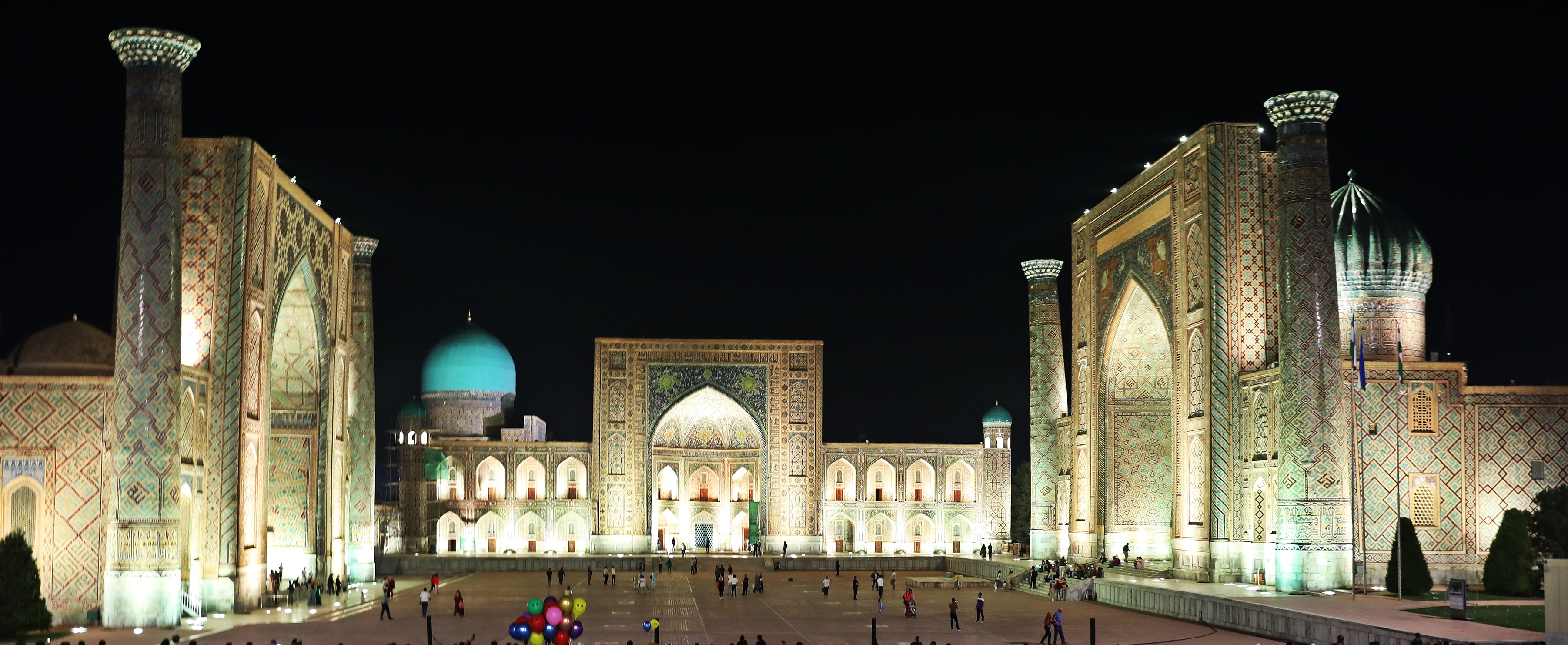
Prepare to be awed by the architecture in Samarkand, Uzbekistan where bright blue tiles and painted bricks decorate the mausoleums, madrasahs and mosques. The three historical madrasahs in Registan Square are the best place to begin your exploration of this city.
Caravans loaded with goods travelled on the Great Silk Road between China and the Mediterranean between the 2nd century BCE and the mid 15th century AD (CE). The novelty was silk which was not available in Europe, but traders also carried precious stones, glass, fabrics, spices, teas and other commodities. The Great Silk Road was actually a collection of many roads. The northern route went through the Tian Shan mountains in Uzbekistan before stopping in trading centres in Samarkand, Bukhara, Shakhrisabz and Khiva, contributing to the development of those cities.
In the 18th century the city of Bukhara became the region’s capital and Samarkand’s prominence lessened. Over the next few centuries, the amazing architecture in Samarkand suffered from earthquakes, extreme heat and neglect, and was in disrepair. Under Soviet rule many religious activities were prohibited, but they did give an order to restore Registan so that it could live up to its historical stature on the Great Silk Road. The restoration work was completed just before Uzbekistan received its freedom in 1991.
Today Samarkand stands out as a shining jewel among other Uzbekistan cites for its colourfully tiled heritage buildings. We had been wanting to visit Samarkand for a while, and the city did not disappoint. The Old Town is a UNESCO Heritage Site and it has more than earned those credentials. In fact, there is so much to see in this colourful city that we will present it in three separate posts. Click to read our posts about Amir Temur’s Mausoleum or our favourite, Avenue of Mausoleums.


Ulugh Beg Madrasah
During the days of the Spice Trade Route, this desert square was a busy trading market. Registan translates in English to ‘sandy’, giving the old square its name. In 1420 when Registan was still being used as a market, Amir Temur’s grandson, Ulugh Beg decided to have a madrasah built on the site. A madrasah is a centre for learning. Today we would call them schools, but their design and function are not exactly what we would recognize as schools. Ulugh Beg was an astronomer and scientist and wanted to educate Samarkand men. The madrasah taught math, science, astronomy, philosophy and theology.
You can read more about his grandfather, Amir Temur, in our post about Taskent.

The entrance to Ulugh Beg Madrasah is a tall rectangular wall decorated with glazed blue bricks arranged in interesting patterns. A tall, pointed arch around the door is stunning with its tiles arranged in detailed designs. Some of the tiles have painted stars to represent astronomy.
On either side of the gate are two tall minarets. There are duplicates of these at the back of the building as well. Some of the minarets are sinking giving them a Tower of Pisa lean. In fact, the entire building has sunk and is 2 m lower than the main courtyard.

Once you walk inside the gate, the view is quite overwhelming. Four similar arched gates are on each of the walls with a treed courtyard in the middle. Between each gate, two stories of smaller gates provide entrances to what would have been student cells (hudjrs). Originally this was four stories high with 55 cells in total. The tilework on these buildings is immaculate and almost too much to take in. It must have been very impressive in the 1400s.

The former mausoleum is used as a museum with information on the astronomer’s life. The two stories of cells are used by merchants who sell tourist nick-nacks including pottery, scarves and t-shirts. We climbed up the old, narrow stairway to reach the upper cells for a different view of the complex.


Sherdor Madrasah
Across from Ulugh Beg Madrasah, is Sherdor Madrasah. It was built over 200 years later in 1636 and was intended to be a mirror image of Ulugh Beg, and it almost is. One difference is that there are two blue domes with fluted tilework on either side of the entrance.


The second difference is the tilework on the tympanum; the area above the arch. On it is a depiction of 2 lions, that actually look like tigers, chasing a deer underneath a sun. The name Sherdor means ‘with lions’. It is very unusual to have animal paintings because it goes again Muslim law to have depictions of humans or animals on sacred buildings. Apparently these were allowed because they are more fantastical than real.

The inside of the madrasah is quite similar to Ulugh Beg Madrasah with a two-story cellblock surrounding the yard. The fluted domes were even more visible from inside the complex and made the entire area sparkle.


Registan was fairly busy with tourists, both Uzbeki and international. A couple stalls rented traditional dress allowing tourists to dress like a member of the Amir’s court. We had a giggle when seeing this lady, pretending to be royalty.

Tilla-Kari Madrasah
The centre building in Registan Square is the youngest, built only 24 years after Sherdor, in 1660. Tilla-Kari Madrasah was built to complement the other two. Its long rows of cells on either side of the entrance gate and single blue dome does add to the setting without distracting.


Inside the madrasah, the single storied cells made it feel a little less grand than the other two.


This feeling changed though as soon as we entered its mosque, Meremi Murra- Kapu. Brilliant gilded and blue tiles adorn every inch of the walls and ceiling and sparkle in the soft light. Golden tiles in a stalactite-like design, called muqarnas, hang above a gilded door adding more shimmer. Tilla-Kari translates in English to ‘decorated with gold’. They definitely got that title correct.


Registan square is even more magical at night. On our fist night a light show shone a myriad of colourful lights on the buildings. We actually preferred the standard lighting display though. These magnificent buildings don’t need any more flash. Accompanying the pretty display was the cacophony of bird songs, mostly the Common Myna, who gather at dusk in the nearby trees.


Entrance fee – 50,000 UZS ($4.40 USD) for all three; Hours – 8 am – 7 pm
In addition to going inside, we walked around Registan at different times of day to capture it in different light. A large garden on one side added another component to the images. It was remarkable how much of these buildings we were able to see from outside. Even the evening pictures above were taken from outside of the complex.


Note – There are many different spellings of Uzbeki cities and points of interest. Instead of listing every variation, we chose to use the most common and/or the spelling used on signage at a sites.
Getting to Samarkand
It is very easy to reach Samarkand. Aefroib (Fast trains) travel regularly between Samarkand and both Tashkent and Bukhara. The trains are clean, comfortable and very efficient; leaving and arriving exactly on time. There is also an international airport in Samarkand, but most international flights will land in Tashkent.


Getting around in Samarkand
The rideshare app Yandex is available in Samarkand and is an easy and economical way to get around. Many of the sights are within walking distance so once you get to Old Town, you may not need a taxi.
Where to stay in Samarkand
There are many options to chose from for guesthouses and hotels in Samarkand. Try to stay as close as you can to Registan Square. We stayed in the family run Fayz_Xan_Saray Guesthouse on Booking.com and can’t say enough good things about their hospitality.
Where to eat
Most of the tourist restaurants are located in the strip between Registan and Bibi-Khanym Mosque or on the street in front of Registan. We found two good restaurants near Bibi-Khanym Mosque. Zargaron has very good meals and even better are the views of the mosque. Only a few doors down we had a great coffee and an excellent dinner at Bibikanym Teahouse.
Please visit the link for our Travel Tips in Uzbekistan.
Coming Next – Samarkand – Amir Temur Mausoleum
For pictures from other blogs go to Gallery at monkeystale.ca
To read about more of our adventures go to Destinations.
If you like what you read, please comment or share (with credit) using the links below.




We’d love to hear from you, please leave a comment.