
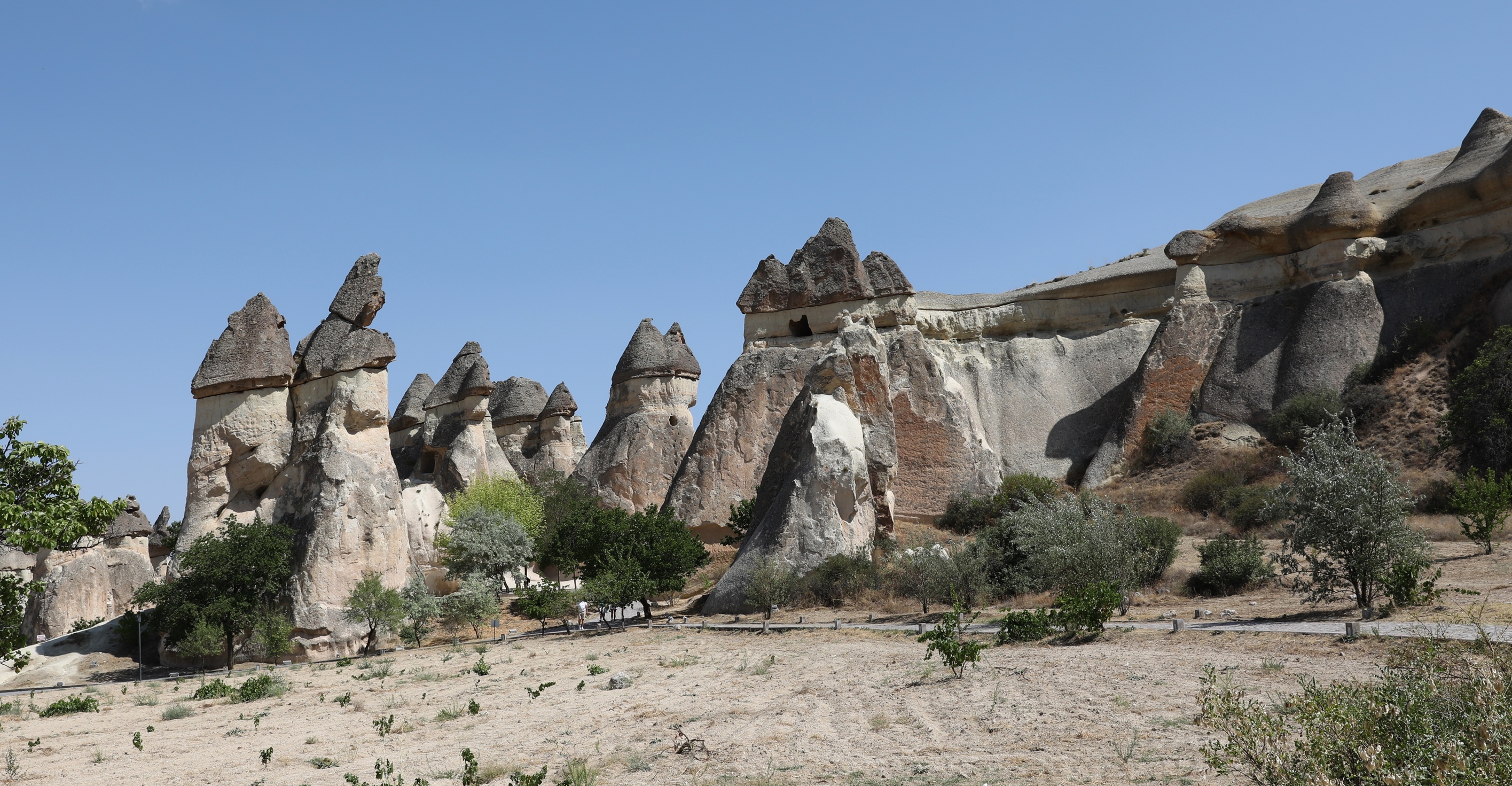
When we looked up to the top of a fairy chimney, we could see a doorway that had been chiseled out of the tuff rock. Then we noticed that most of these tall hoodoos had doors or windows at seemingly unreachable places. Cappadocia’s rock-cut monasteries are a unique combination of the wonders of nature and the creativity of people.
Millions of years ago volcanos erupted, scattering ash across the land. Eventually, this ash turned into sedimentary volcanic rock called tuff that was up to 150 m deep. These tuff rocks are very soft but were often covered by a top layer of dense, basalt stone. Eons of wind, water and earthquakes caused the soft volcanic rocks to erode. In the places where there was a layer of basalt on top, the tuff underneath was protected from these elements. Together these factors resulted in bizarrely-shaped hoodoos with oversized, mushroom-like tops. Their otherworldly appearance resulted in them often being called fairy chimneys.
As with many parts of Turkey, Cappadocia was home to a variety of civilizations beginning with the Hittites in the 1700s BCE. Christians first arrived to the area in the 1st century AD and by the 4th century, Cappadocia had become an important centre for refuge. Persecuted Christians were able to find and build many hiding places in its cliffs and rock features. This time was called the Golden Age of Cappadocia.
Paşabağ Valley
Known for having some of the tallest fairy chimneys in Cappadocia, we were delighted to see dozens of these top-heavy pinnacles even before reaching the museum in Paşabağ Valley (Paşabağ Vadisi). Tall skinny, chimneys with a rock precariously positioned on top do make you think you’ve taken a wrong turn and walked into the middle of a fairytale. Further on, large rock cones that take over the landscape are no less picturesque.


Often called Monk’s Valley, Paşabağ Valley is an enchanting site built by followers of St. Simeon. He was a 5th century monk who spent 37 years living on top of a rocky pinnacle in Syria. The monks came to this valley to live in isolation similar to him. They chiseled out their own hermitage, but their method was a little different. Instead of building a room only at the top, they hollowed out the inside of a chimney from the ground all they way up. Some of their cells were up to 15 m tall.


Many of the hoodoos in Paşabağ have two or even three tops. That’s unique, even among the surreal rock features in Cappadocia. Using the most unusual three-headed hoodoo, the monks carved out a hermitage in honour of St. Simeon.

Entrance fee is included in Zelve Open-Air Museum Ticket; Opening Hours – 8am-5pm
Getting to Paşabağ – The museum is only 2 km from Zelve Open-Air Museum so if you don’t have a car it’s an easy walk. The bus to Zelve may stop at Paşabağ if you flag it down.
Göreme Open-Air Museum
Not far from Göreme is a large Byzantine-era monastery filled with rock cut churches, chapels and cells. While many monks in Cappadocia chose to live in seclusion, the monks at this monastery determined it was better to live as a community. Today the monastic settlement can be visited in Göreme Open-Air Museum.


The monastery was used between the 4 to 13th centuries. Over this long period of time, there were many changes both in government rules and in design aesthetics. During Byzantine-iconoclasm in 8th and 9th centuries, the use of religious icons was banned. As a result, many of the churches from this time were decorated in simple, geometric motifs using red ochre as paint By the end of the 9th century this period of iconoclasm ended and Byzantine churches were allowed to use icons. Monks seemed to relish this new freedom and as a result, church walls and ceilings were adorned with colourful frescoes of saints and Bible stories.
As a result, many of the older rock-cut churches in the museum have plain, red artwork on their entrances, walls and ceilings. The 11thcentury Dark Church though, shows off the elaborate and colourful restored Byzantine frescoes of their post-iconoclasm world.


Note – There is an addition fee to enter Dark Church. Another example of the Byzantine art can be seen in Buckle Church. It is outside the museum and is free to enter but is under renovation so its difficult to see much. There will likely be a fee once the restoration is complete. Pictures are not allowed in any of these churches.
Göreme Open-Air Museum is supposed to be the main draw for visitors to Cappadocia, but for us it was a little disappointing. What ruined it were the crowds and the rules. Huge bus loads of people travelled like sheep from one church to the next. It was slow getting in and out of the buildings, especially to those churches that had stairs. The main thing that ruined our visit though, is the rule forbidding pictures inside the churches. The interiors are the most interesting part of this museum. The Open-Air Museum is quite an expensive site by Turkish standards so this ‘no photography’ rule was even more maddening.
Having said all of that, Göreme Open-Air Museum is yet another one of Cappadocia’s incredible displays of human devotion. The churches were awe-inspiring and the entire monastery was impressive. We would suggest going later in the afternoon when the tour buses are done, and don’t expect to take pictues.
Entrance Fee – 480 TRY ($22 USD); Opening Hours – 8am to 7pm
El Nazar Church (Church of the Evil Eye)
In the middle of a bunch of seemingly forgotten fairy chimneys is a fantastic little church from the late 900s AD.


We walked into the middle of the carved out hoodoo and into the central room of El Nazar church. Considering that we were actually inside a hoodoo, the artistry on the walls is surprisingly beautiful. Remnants of colourful 11th century unrestored frescoes adorn the ceiling and walls. They depict scenes from the Bible as well as portraits of the apostles and saints.


Entrance Fee – 75 TRY ($2.50 USD); Opening Hours – 9am to 5pm. You will need to ask the caretaker to open the church. His office is in the same yard.
Tips for visiting Cappadocia
Note – Prices listed are from Autumn 2023.
Where to stay in Cappadocia
Göreme is the most popular town to stay in Cappadocia. It has an abundance of hotels, restaurants and coffee shops to choose from. It is very touristy but given its setting in a fairy chimney garden, you can forgive it for the amount of tourism. There are many ‘cave hotels’ in Göreme. Most are not actual caves, but are decorated to look like caves. Staying in one does add to your experience in Cappadocia.

Uçhisar would be our second choice, but only if you face Pigeon Valley or the castle. Otherwise it’s just a small town with not a much character. There are hotels in Çavuşin, Avanos and Urgup but if you don’t have a car, they are a little more removed from the main sites.
To read about other cave towns, check out our posts from Vardzia, Georgia; Uplistsikhe, Georgia; Ajanta and Ellora, India; Goris, Armenia; and our cave hotel in Spain.
How to get to Cappadocia
Being such a popular tourist area there are plenty of options to get to Cappadocia. If you have a car Göreme is not far from the highway and the roads in Turkey are in excellent condition. There are two airports. One is in Nevşehir and the other in Kayseri. Buses travel between Göreme and many cities including Antalya, Pamukkule, and as far away as Istanbul. Travelling from other cities you may need to take a bus to Nevşehir and then a minibus from there.
How to see the sites of Cappadocia
It’s easy to visit all of the sites we’ve described on your own. The most difficult part is determining how to get there. If you don’t have a car, minibuses and public buses travel frequently between the towns in the area. At the end of each section we have described which buses to take. If you prefer to take a tour, there are many large and small tours offering a variety of combinations of sites.
When to visit Cappadocia
Cappadocia is best explored in April/May and September/October, especially if you plan to hike. During the summer months of July and August, temperatures will be quite high and there will be a lot of tourists. Due to its elevation at 1,050 m (3,445 ft) Cappadocia will experience cold and snow in the winter.

Click on the link to read our Travel Tips For Turkey.
To read more of our adventures in Turkey, click here.
Coming Next – Best Day Trips From Antalya
For pictures from other blogs go to Gallery at monkeystale.ca
To read about more of our adventures go to Destinations.
If you like what you read, please comment or share (with credit) using the links below.




We’d love to hear from you, please leave a comment.