
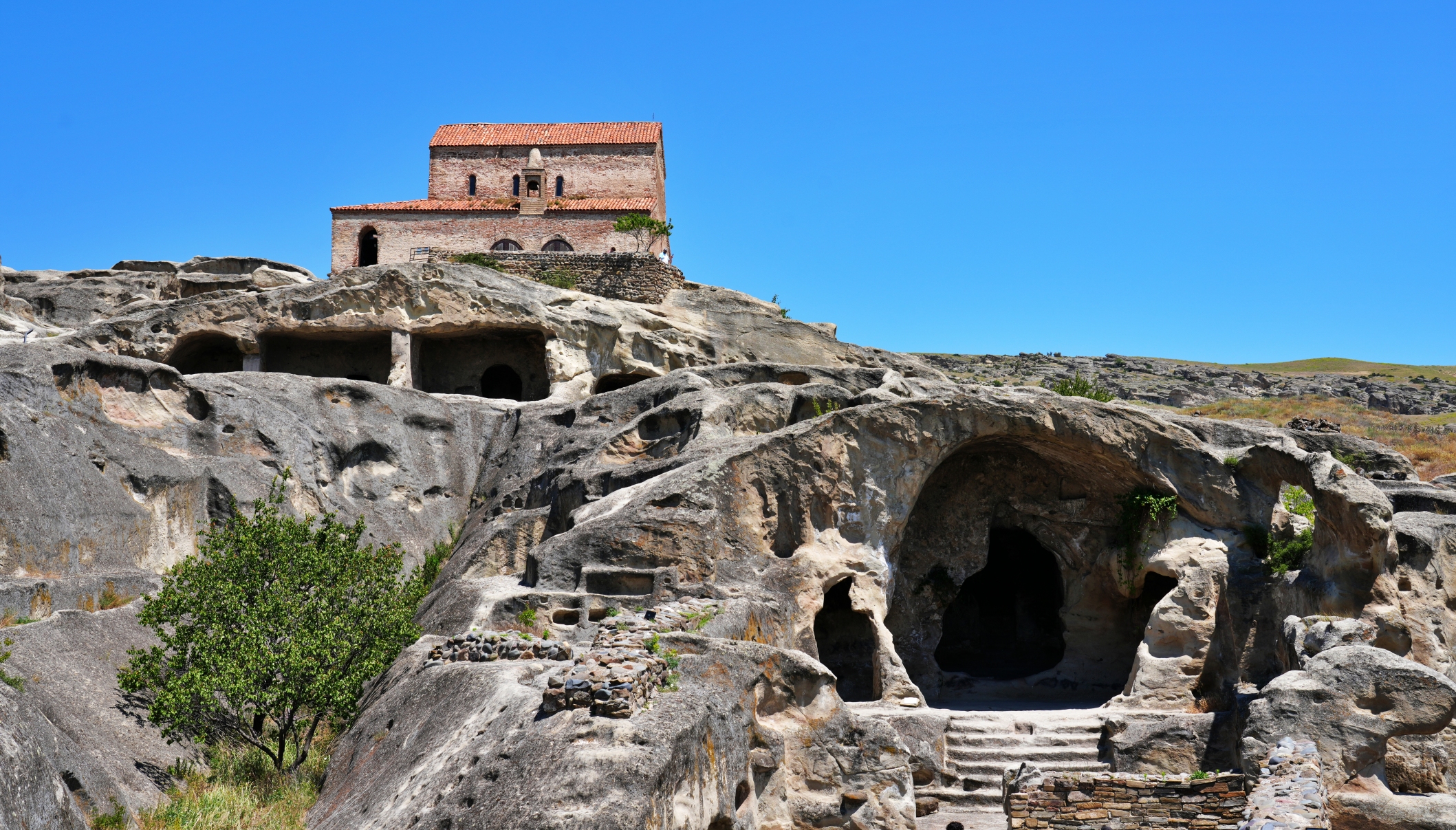
Two sites with very different histories lie close to one another in central Georgia. Not far from the city of Gori is a rocky hill that was home to an entire city of caves. These man-made caverns were lived in for hundreds of years and can still be visited today. The city of Gori has its own history, but some of it is not pleasant. Gori is the birthplace of ruthless USSR dictator, Stalin. In the city centre is a museum that glorifies his life. Visiting both when you’re in Gori gives you two sides to this region’s history.
Let’s begin by exploring a city that used nature as its foundation.
Uplistsikhe
On the southern slopes of the Kvernaki Mountain Range in central Georgia is a sandstone bluff that provided the setting for a fascinating rock-cut temple city. Instead of tall cliffs or spindly pinnacles as we’ve seen in other cave towns, these hills are topped by rounded sandstone, worn smooth with time.
Standing above the Mtkvari River (called Kura River in Turkey), the ancient cave city of Uplistsikhe became an urban centre as many as 2,600 years ago, in the 6th century BCE. They are not natural caves, but rather, were carved into the sandstone hill by hand. The difficult to pronounce name translates in English to the Lord’s Fortress. It was believed to have been the residence of various tribe leaders in its early history.

In pre-Christian times, it was a preeminent temple city. At that time, the citizens were pagans, worshipping the sun goddess. Uplistsikhe’s importance ebbed and flowed based on the political rulers of the time, but remarkably, a significant population resided here until the 11th century.
At its height, there were at least 700 caves hewn into the rock and as many as 20,000 people living in Uplistikhe. Many of the caves we see today date back to the Middle Ages, but these newer ones were often repurposed, older caves. Its location on a Silk Trade Route contributed to its sustainability. We’re not sure what’s more interesting, the fact that people lived here since prehistoric times, or that it was still a functioning cave city in the Middle Ages.

Today, the ancient city is an open-air museum, but what we see is only half of the original city. The rest was destroyed by various causes over the centuries, including a Mongol invasion in the 13th century and an earthquake in 1920.
Even at half its size, there are still plenty of caves remaining to leave you in awe of this spectacle. Adding to this sense of wonder, as you walk between the hand-made caves, you’ll be following pathways that have been worn into the rocks by thousands of years of foot traffic. You can see a defined main street, but also several smaller lanes that climb up and down the smooth rock.

As with any city, there were bakeries, wine cellars, an apothecary, stables, meeting halls and of course, many temples and churches. We found the bakeries to be quite clever. Several distinctive keyhole shaped holes were carved into the sandstone floor. They would build a fire deep in the hole, and cover it with a large stone slab. This turned it into an oven. The museum jokingly refers to them as some of the oldest ovens in the world.
Other pits were used to collect water, store food, ferment wine and some were even used during sacrifices and religious rituals.


Being located on trade routes meant that it was subject to invasions. The steep walls of the rocky massif gave it some protection, but it was also fortified with ramparts.


As you wander around these rocky hills, you’ll be stunned by the number, size and details that went into creating these caves. Important buildings, such as the temples, have decorations etched into their ceilings and niches carved into the rock walls. Arched porticos in front make the caves appear more refined than you would expect.


Here are a few specific caves to watch out for:
The Hall of Queen Tamar is the most elaborate cave in Uplistsikhe. Likely first built as a temple, the cave is not only multi-chambered, but it also has a smoke hole in its ribbed ceiling. Queen Tamar, often called king, ruled Georgia in the 12th and 13th centuries during Georgia’s Golden Era. She never lived in Uplistsikhe, but the hall is named in her honour. Some say it was because it resembles her cave in Vardzia, but we didn’t see a large resemblance.
We’ll show you the cave city of Vardzia in a few weeks.


Another group of caves worth noting are collectively referred to as the Theatre. Its main showpiece is Cassion Hall with geometric details carved into the portico’s ceiling.


A favourite view of the cave city includes a temple and three churches stacked on top of each other: Blackberry Hall, Three-Nave Basilica, and Prince’s Church. Blackberry Hall (Makvliani Hall) was originally a pre-Christian temple and is an interesting cave on its own. As we explored around it, there seemed to be an endless maze of caves, much more than we realized from above.
Taking over the ledge above Blackberry Hall, is the 6th century Three-Nave Basilica. It was originally a pagan temple cave that was converted into a church.


At the top is the most familiar looking building in Uplistsikhe, Prince’s Church. Instead of using a former cave temple as a new church, residents built an actual church. Even though it looks new, Prince’s Church dates to the 10th century. It is a bit of an eye-sore against the rock-cut caves though.
This is the only building where conservative dress is required. Shawls are available to borrow at the entrance.

There is an old legend that goes with this cave-town. It says that the ancient city was initially built by slaves. Each slave was given a pickaxe with a nugget of gold on the end. By the time their work was completed, the axe had worn down to the gold, and it served as their pay. The same legend is also associated with Vardzia, another cave-city in Georgia, so we can’t be sure which one the legend describes.
From the top of the city, you can see its strategic location above the river. On the riverbank are the ruins of the old houses where most of the commoners would have lived. Being this high above the river meant people would be exposed during water collection. A secret tunnel allowed for the safe collection of water from the river, and also an escape route if needed.


While not as interesting as other cave towns we’ve visited, including Vardzia in Georgia, Uplistsikhe is worth a visit if you’re in Tbilisi or Gori.
To read about other cave towns visit our posts from Vardzia, Georgia; Cappadocia, Turkey; Ajanta and Ellora, India; Goris, Armenia; and Spain.
Tips for visiting Uplistsikhe
There’s no shelter from the sun and it can get very hot in the summer, so bring a hat, sunscreen and water. You will also be walking on uneven ground so good footwear is recommended. There are a few restaurants near the entrance and a small museum. The site is open year round, but may be snow covered in the winter.
Entrance fee is 15 GEL (€4.75). Operating hours vary throughout the year, it always opens at 10 am but closing can be 5 , 6 or 7pm.
How to get to Uplistsikhe
The easiest way to visit the cave city is on a day trip from Tbilisi. Most tours to Uplistsikhe include Gori and Jvari Monastery. It’s only 10km from Gori so is very easy to visit in a half day on your own if you’re in the city. We used the rideshare Bolt for 10 GEL (€3.20) each way. You’ll spend at least 1 1/2-2 hours at the site and since you can order Bolt from the site, there is no need to pay to have them wait. If you prefer, taxis in Gori charge 60 GEL (€20) to drive you both ways and wait for you. You can also reach the site by public bus, but you will be dropped off on the highway and have to walk 2 km to reach the site.
Gori
The city of Gori isn’t visited as often as other cities in the country. It is definitely not overrun with sites, but along with Uplistsikhe, we found enough to do to keep us busy for a day and a half.
Gori Fortress
Standing on a ridge above town, Gori Fortress (Gori Tsikhe) must have been impressive in its day. Built in the 12th century by visionary King David IV the Builder, there is evidence of structures located up here from as long ago as the 5th-4th centuries BCE.
The Georgians in Gori battled invaders from Ossetia, Persia, Turkey and continued to use the fortress for a few generations. We can still see the tall 17th century walls on the hilltop, but unfortunately, the rest of the fortress is in ruin. It’s possible to walk up to the walls and even inside, but there isn’t much left to see.


The same earthquake that damaged Uplistkhe in 1920 badly damaged the fortress as well as much of the city.
Memorial to Georgian War Heroes
On the way up to the fortress, stop to visit the interesting Memorial to Georgian War Heroes. A circle of statues are dressed in armour, but each is missing a part of its body. They represent everything that is lost in war. You can see the memorial from above when walking up to the fortress.


Virgin Mary Cathedral and Holy Archangels Church
These two churches are located below the fortress. The 17th century Cathedral suffered under Soviet rule when it served many roles other than sanctuary. It was restored and partially rebuilt in the 1990s when it was returned to the Georgian Orthodox Church.
Across from it is the cute medieval, Holy Archangels Church surrounded by Jacob Gogebashvili Garden. In the picture below you can see the fortress poking out overtop of the church.


Old Gori
Most of Gori’s historic buildings were damaged during the 1920 earthquake, but a couple blocks in the city centre have been rebuilt in the old style. It’s a nice part of the city for locals to come and shop for clothing or visit a bakery, but it is very small.
A few blocks away are the remains of an 18th century bath once used by King Erekle II.


Joseph Stalin Museum
The Stalin Museum in Gori is a difficult place to visit. It seems as if the city is quite proud of their son. This site is less a museum and more an homage to honour his life, rather than demonstrate the atrocities he committed.
Stalin (Iosif Dzhugashvili) was born in Gori in 1878. He joined an underground revolutionary movement as a young adult, but he was too aggressive for others in that group and they kicked him out. Eventually, he joined the Bolsheviks and became a disciple of Lenin. As time went on, he climbed the ranks of the Bolsheviks and became more and more militant. After Lenin’s death, he weaselled his way to the top of the party, and his sadistic tirade began.
Stalin was the leader of the Soviet Union from 1924 to 1953. During his time as leader, he was ruthless. He killed or exiled uncooperative peasants and expanded gulags (concentration camps) where people lived in abhorrent conditions. People literally starved to death while working manual labour jobs for the party. It wasn’t just the peasants he was after. To hide his failures, company managers were forced to confess to fabricated crimes and were used as scapegoats. He ordered the execution of political rivals and those who were not subservient to him. In all, Stalin was responsible for at least 6.5 million deaths of his own citizens including, the working class, peasants and even colleagues. This puts him near the top of the list of the most heinous leaders in history.
This museum feels very odd. It is set in a park-like setting where a statue of the murderous autocrat is surrounded by beautiful roses.


Also in the park, is his childhood home. It’s a simple brick building with a wooden veranda and is protected by a marble portico. Stalin’s family was very poor. They lived in one half of the building and another family lived in the other. Likely, this house was intended to demonstrate how far he came.

The ornate building that houses the museum was designed by Stalin. It was intended to be a museum of Gori’s history, but was repurposed upon his death.

Inside, the strangeness of this museum continues. Walking through it feels like an endless string of interconnected rooms that glorify his life. Walls are covered in copies of speeches, pictures of meetings with Soviet and international leaders and other accolades. Expensive gifts given by foreign leaders are displayed in another room.
What it does not display are items or stories telling the atrocities he and his party committed.

Beside the museum is the train carriage built exclusively for Stalin. It was fully equipped with bedrooms, an office, a dining room and a kitchen.


Despite his atrocities, Stalin is fairly well regarded in Gori, and the museum feels more like a tribute to him than a reflection of his bad deeds. But don’t let this museum alter your feelings for Georgia. Most of the country does not feel this way. We met a guide who was raised in Gori. He said his father grew up worshipping Stalin, but the younger generation can see him for what he did, and Stalin is not well-regarded in the country in general.
Entrance 15 GEL; Open daily from 10 am to 6pm, In winter closing time is 5pm.
Getting to Gori
Gori is easy to access. Marshrutkas leave from the lot across from Tbilisi’s Didube Metro Station several times a day, but not all have room for luggage. We had to wait for a second marshrutka, but only waited 20 minutes. Information online says that share taxis leave from this area too, but we don’t think they operate anymore. Marshrutkas drop you off outside the Stalin Museum in Gori. Trains also travel between Tbilisi Central Railway Station and Gori. If you’re travelling to or from Kutaisi, you can also take a train, but marshrutkas leave regularly and are much faster. You can also take a marshrutka from Gori to Borjomi and Akhaltsikhe, but we were told they only leave once a day.
You’ll notice on the map below that Gori is very close to the border of South Ossetia. Ossetians are ethnic Persians who migrated to this region in the 4th century. They are mostly Orthodox Christians and were partially integrated with Georgians. When Stalin led the USSR, he divided their territory into north and south. When the Soviet Union broke up, North Ossetia remained as a Republic of Russia, while the south was included in Georgian territory. When looking at the map, you can see that South Ossetia is like a peninsula, extending into Georgia. This has led to ongoing disputes between Georgia and Ossetia over this land. Recently, South Ossetia was granted autonomous region status. Gori’s proximity to this border meant it was damaged during the Russo-Georgian War in 2008. Travel from Georgia into Ossetia is not allowed.
This isn’t the only land issue created when the Soviet Union split up. You can read about other problem areas in our posts from the Fergana Valley in Kyrgyzstan, Tajikistan and Uzbekistan. It also led to problems between nearby Nagorno-Karabakh between Azerbaijan and Armenia.
Where to Eat and Stay in Gori
Despite the fact that most visitors to Gori do so on a day trip, there are a few excellent restaurants in town. One is Shin da Gori the other is Resto-Bar Black Stars. Both serve delicious Georgian food and have large outdoor patios. There are several small hotels and guesthouses in the city’s downtown. It is best to find one near the fortress.

Click on the link to read our Travel Tips For Georgia.
To read more of our adventures in Georgia, click here.
Coming Next – Georgia’s First Capital, Mtskheta and Jvari Monastery
For pictures from other blogs go to Gallery at monkeystale.ca
To read about more of our adventures go to Destinations.
If you like what you read, please comment or share (with credit) using the links below.




We'd love to hear from you, please leave a comment.