Looking over the terracotta roofs we could see the large Lago de Suchitlán (Suchitlán Lake) far below. Between this view and the colourful heritage homes that climb up and down the streets in town, we couldn’t understand why there weren’t more foreign tourists in Suchitoto. In fact, as we explored the cobblestone streets, we realized that we were almost the only foreigners in town. It’s too bad because we think Suchitoto is the nicest city in all of El Salvador. Hopefully this post will entice more people to visit the colonial town of Suchitoto in El Salvador.

Suchitoto is in the blue box.

Click on the link to go directly to Travel Tips For El Salvador.

In the middle of the 11th century, the Pipil people migrated from central Mexico to El Salvador. The people who settled in Suchitoto harvested indigo from the Xiquilite plant that grows wild in the surrounding jungle. The Pipils used indigo to decorate their ceramics and clothing.

In the 1500s the Spanish invaded the region and established the first Spanish capital of El Salvador in Suchitoto. They called it San Salvador. They then proceeded to take over the indigo production. It became such a prized commodity for the Spanish that it was known as ‘blue gold’. As soon as an artificial indigo coloured dye was invented, natural indigo became less valuable and production ceased. A few local artisans have revived this old tradition and sell their indigo dyed clothing in town. 

Tip – These artisans also run workshops where you can learn their techniques.

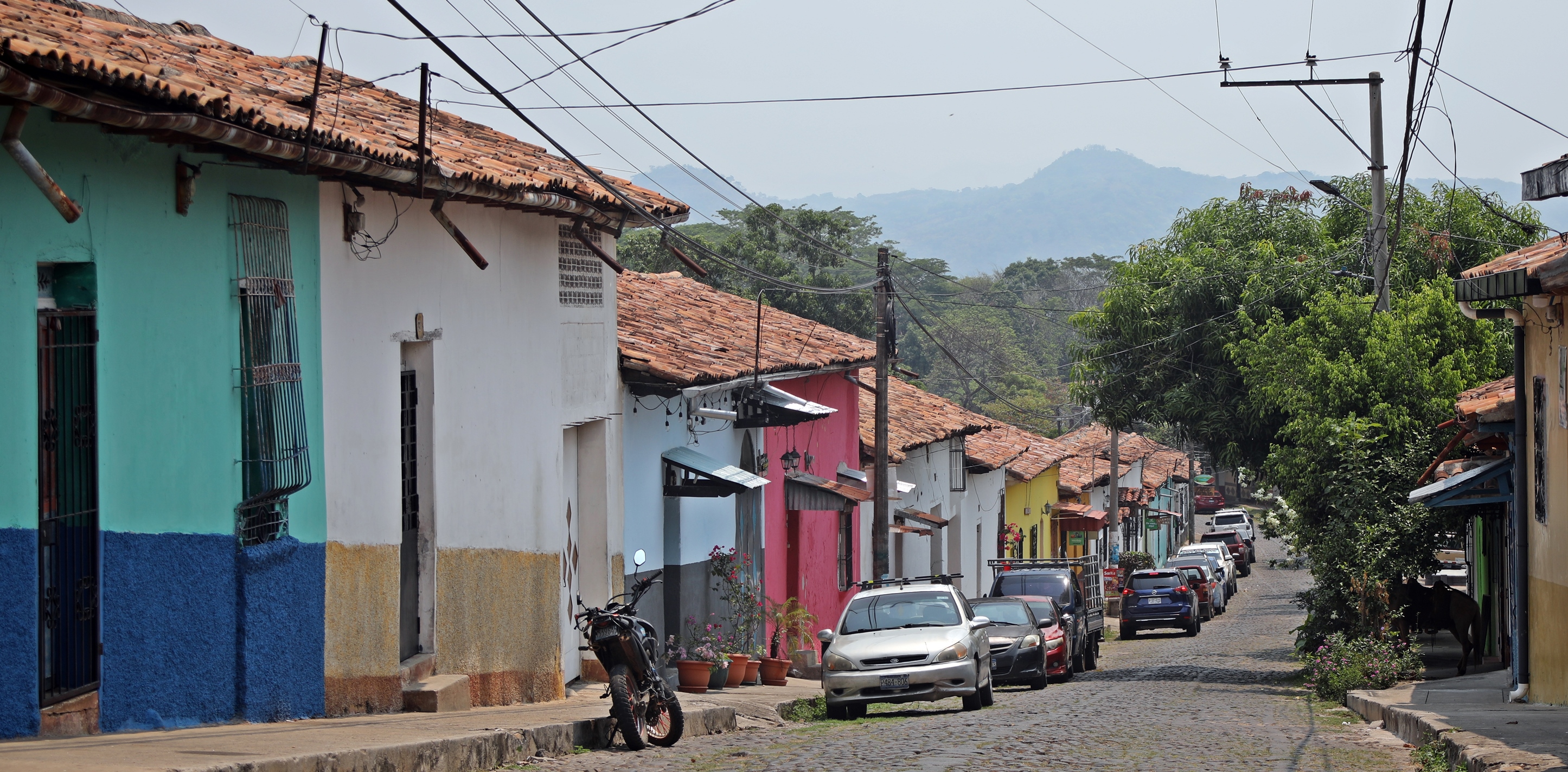
The Spanish only remained in Suchitoto for 17 years before they abandoned the city and moved the capital to San Salvador. Even though the Spanish didn’t stay long, their colonial homes remained and are lived in by the residents of this artistic community. Our favourite past-time in Suchitoto was to amble through the town and admire the many pastel-coloured homes with interesting features like wrought-iron windows and doors. As we walked, we thought about the history that has transpired behind those walls.

The cute cobbled streets are set in a grid pattern, typical in Spanish colonial towns. The only problem with them is that they are not usual cobble-stones, but were actually made from river-rock. So, although they look charming, they are very difficult to walk on.

In addition to its indigo production, this small city made a name for itself during the country’s Civil War. After several decades of suffering under ruthless dictators, tensions reached a tipping point in the 1970s. There was a large divide in the country between the wealthy elites and the poverty-stricken population. In Suchitoto specifically, the vast fertile farmlands were owned by a very small group of landowners. This wealth inequality led to many protests and uprisings by the peasant farmers. Over time, the riots becoming more and more frequent and spread throughout the country. Eventually several guerilla militant groups formed. The military did not think the government could effectively control the growing number of uprisings so they staged a coup, overthrew the government and formed a military junta. This junta leadership was even worse for the common people.

By the early 1980s El Salvador was fully immersed in a Civil War that lasted 12 years. During this time horrible acts of violence were committed by the military against their own citizens causing the different bands of guerillas to join together to form the FMLN (El Frente Farabundo Martí para la Liberación Nacional). Suchitoto’s population supported the FMLN guerrillas and so a large guerilla base was established in the mountains and jungles around the town. They remained there for the duration of the civil war.

Tip – There are tours in Suchitoto that take you hiking through the jungle to a former FMLN guerrilla camp if you’re interested.

During the war, many people escaped El Salvador and fled to United States, especially to California. Young men ended up forming or joining gangs with Mexicans and other Latin American refugees. After the civil war ended many of these gang members returned to El Salvador. Unfortunately, they brought with them their gang allegiances. The population suffered again, this time it was extreme violence from wars between gangs. Innocent people were killed. Others were robbed, kidnapped or extorted. This went on for many years making El Salvador one of the most dangerous places on earth. 

The current president pledged to put a stop to gang warfare. With their policies and actions, they successfully jailed almost 70,000 people. It appears that the gangs have been eliminated or at least under control and the country is safer for citizens of El Salvador. We can’t claim that this current government does not have its faults, but the country is enjoying a degree of stability that it hasn’t seen in decades.

Because of its proximity to the guerilla camps, many of the buildings in Suchitoto were decimated. When the war ended, the people of Suchitoto rose up to rebuild their city. They did a great job restoring it so that today Suchitoto is a safe and vibrant colonial town. In addition to the colourful homes, there are peaceful parks and gardens throughout the city.

Suchitoto is more than just pretty. The people who live in the town are also incredibly friendly. As we strolled through town, we were greeted by a welcoming ‘Buenas Dias’ from everyone we met. As we passed one humble home the man called out to us and gave us mangos from a tree in his yard. After living though such horrible times, the people are some of the most gracious and kind that we have met anywhere in the world.


After you’ve aimlessly wandered up and down the historic streets, don’t forget to check out these spots in town.

In the heart of the heritage town is a lovely park where benches are placed beneath tall shade trees. It is a very popular place for locals to congregate. This busy place is a prime location for the city’s vendors to sell a variety of items. We’re not completely sure what you are supposed to do with the gourd necklaces that were being sold by one interesting character we saw.

Along the side of the park is Santa Lucia Church. Built in 1853, it was one of the first churches built in post-colonial El Salvador and was purposely built to not look like a colonial church. Its tall, false front has a unique design with columns, a lintel and three bell towers. 

The domed roof on the side also has something truly unique. Dinner plates, wine glasses and a bleeding heart adorn its domed roof. There are two version of the story as to why there are plates and glasses on the roof. They both begin with a bride who was to be married in the church. One story says she was so happy with her wedding that she donated the plates and glasses to the church as a gift. Another version says she was left at the altar and didn’t want these wedding gifts anymore so gave them to the church. Either way, they do give a quirky design to the white church and match the personality of this artistic community.

The flaming heart is a recent addition. It is symbolic of the burning love Christ has for all of humanity. Maggie thought it was a strawberry for a long time.

Inside, the church also looks a little different with tall, wooden pillars reaching up a barrel vaulted roof and baby blue cabinets along the side. The church was used to house refugees during the civil war and has recently undergone restoration.

The town is spread out on a plateau above Lago de Suchitlá (Lake Suchitlá ). This artificial lake was created when Cerrón Grande River was dammed in the 1970s to become a major source of electricity for the country. This resulted in the flooding of thousands of people’s homes and small farms and was part of the cause of the farmers’ uprising. Even with this history, today it is a pleasant spot for locals and tourists alike.

We visited near the end of dry season, so the water levels of the lake were down. The low water exposed an undulating shore with meadows where cows grazed beside dry docked boats waiting for the next flood.

A tourist zone has been set up along the shore of of the lake. It includes Puerto San Juan where you can hire a boat to take you for trips around the lake. There are also several restaurants where you can sit and enjoy lunch or a drink with a view of the lake. The entrance fee for this area is $1 USD.

Getting to the lake – You can easily walk from town to the lake. It’s only 2 km and has a 200 m elevation loss. There is also a public bus that travels to and from the town (35¢ USD). It’s not a bad walk down but we really appreciated the bus ride back up because the temperatures were in the 40s C.

Suchitoto is an indigenous Nahuat word meaning ‘in the land of flowers and birds’. During Oct and November there is a large bird migration around the lake. We were there a bit too late for for the migration, but even without seeing these birds, it is a nice spot.

Beloved El Salvador film director, writer and photographer Alejandro Cottoz lived for many years in Suchitoto. His large house is now a museum. It has a large colonnaded walkways surrounding a lovely garden that includes mango and orange trees, a rose garden and many other flowers. Small rooms off to the side were used as bedrooms and a study, but my favourite was the heavily tiled kitchen.

The house sites in a cliff above Lago de Suchitlá and from the edge of the garden we looked down to the lake.   

A kilometer outside town is a small but interesting rock feature. During rainy season columnar basalt formations are the background to a small waterfall. When we were there Los Tercios (The Thirds) Waterfall was dry but the 10 metre high rock formations were still an interesting feature to see. Of course you must know that these odd shaped rocks have a legend attached to them. It is one of unrequited love between a young indigenous boy and the daughter of a wealthy family. When her parents kept them apart, the boy’s parents put a curse on her family’s fabric warehouse. The curse turned the family’s rolls of fabric into these stone columns.

In reality, they were likely formed from the eruption of Guazapa volcano eons ago.

The waterfall apparently has water between May and December. Entrance fee is $1 USD.


In many ways Suchitoto reminded us of Ataco, another colonial El Salvadorian town. You can read about Ataco in our post Ruta de las Flores.

Suchitoto is only 60 km from San Salvador and would be an easy drive if you have your own car. You can also reach it by public transit. Buses leave from San Salvador’s New Bus Terminal called Terminal Neuve Oriente Plaza Amanecer. Do not go to the places recommended on the internet such as Punta de Microbuses 140. As of April 2024 they only leave from the New Bus station. If travelling to or from other destinations by bus you will need to go through San Salvador.

You could visit Suchitoto on a day trip from the capital, but it such a cute town that we think you should stay for at least a night. There are many small hotels and guesthouses in town and nothing is very far from the main square. Do get air conditioning though as it is very hot. 

Dry season runs from November to April, and would be the best time to visit. But know that it will be very hot at this time, especially in April. Rainy season is in the spring and fall; May/ June and August to October.

Even though Suchitoto was the site for guerilla basecamps during the civil war, today it is one of the safest parts of El Salvador. In fact, recent changes in government crackdowns on gang violence has made the entire country a lot safer. Even with this decrease in crime, always use safe practices such as not carrying a lot of cash or expensive jewelry or walking alone at night when travelling in El Salvador.

Read from another device.

This article is now featured on GPSmyCity. To download this article for offline reading or create a self-guided walking tour to visit the attractions highlighted in this article, go to Walking Tours and Articles in Suchitoto.

To read more of our adventures in El Salvador, click here.

Fediverse reactions

88 responses to “Visit Colonial Suchitoto In El Salvador”

  1. I remember news accounts about the frequent, on-going civil unrest in El Salvador. I’m glad the situation has finally moderated.

    1. It’s much improved from those reports. Let’s hope it lasts.

  2. Wandering is one of the best ways to see a place, stopping wherever and whenever. El Salvador’s history is massively tragic; it’s wonderful to hear that this country is back on its feet again. I think there might be a wide perception that it’s still unsafe (or Suchitoto is unsafe) is still out there. Maybe that’s why you saw few tourists in that area?

    1. Its history and reputation have definitely kept most tourists away, but while we saw foreigners in the other towns and cities, there were almost none in Suchitoto. It was mostly young backpackers that we saw around the country, so I guess a cute historic town is as exciting 🙂 But if these new measures continue, it will likely come up on more people’s radars. Thanks Lynette! Maggie

  3. It’s hard to imagine all of the violence in such a charming looking area. The people sure are resilient! Glad the government has been helping curb the violence. Perhaps the gourds are on a necklace so you can easily carry them home ha.

    1. I didn’t see anyone buy a necklace so I have no idea 🙂 The people are resilient and amazingly friendly considering what they’ve lived through. Hopefully now they’ll have more comfortable lives. Thanks Lyssy! Maggie

  4. Fabulous post. I taught some El Saldadorean students some years ago and they were passionate about their homeland. I can see why.

    1. There are some fantastic communities and wonderful nature in the country. Were they refugees or immigrants that you taught? I hope they have managed to get back to El Salvador now that its safer. Maggie

      1. Immigrants who came in waves, as family here could earn enough to bring others. It’s a long time ago now and I know they had intentions of going back one day, so I hope so, too.

  5. Looks like a charming little town with some beautiful scenery. No immediate plans to go to El Salvador but if I get there I’ll be sure to spend some time in Suchitoto. Thanks for bringing it to our attention.

    1. Thanks Ken, glad to spread the word of this cute community. Hopefully they will enjoy peace for a long time 🙂 Maggie

  6. Lovely place with a very interesting history. It is amazing how people can continue to rebuild and move on. And, as in all your posts, I love the back stories and legends.

    1. Their resilience is impressive. And not only rebuild, but do it with style 🙂 I love hearing the legends when I travel so am happy to pass them on.

  7. I can absolutely see why you were so taken with this pretty town! I wonder if it’s not yet much visited because of its proximity to the former guerilla basecamps? I had to laugh at the ‘strawberry’ on the church, but I do think you have a point Maggie, it does look very like one!

    1. I’m not sure why there are no visitors in Suchitoto. There aren’t many tourists yet in the entire country, but we did see foreigners at every other stop. They were mostly young backpackers though so maybe a small, cute, historic town isn’t interesting enough for them. I still see a strawberry 🙂

  8. Loved reading about Suchitoto and learning so much more about it than what I learned when I was there.

  9. Thanks for sharing the colorful images and intriguing history of Suchitoto and El Salvatore. I agree with Maggie-the flaming heart does resemble a strawberry.

    1. Thanks Nancy, I thought it very cute, but couldn’t understand why there was a strawberry on the roof 😊

  10. It’s a lovely place with a very interesting history, which unfortunately I’ve heard little about so far.
    Thank you for sharing these colorful and fascinating photos!!!

    1. Thanks Luisa, I don’t think many people know much about El Salvador. Hopefully as it gets safer, more will visit. Maggie

      1. Thanks a lot for your lovely reply, dear Maggie 🌹

  11. A charmingly beautiful place that has known so much violence and pain. The homes fortified with wrought-iron windows and doors are a testament of those days. So glad to hear that “the country is enjoying a degree of stability that it hasn’t seen in decades.” >By the way, your post has finally appeared in my WP Reader. Yay!

    1. Yay! No more WP Games 🙂 It seems that El Salvador is coming out of its violent past so it is a safer place for the locals. It did feel very safe in many parts of the country, but I’m sure there is a long way to go. Even with their horrendous living conditions in the recent past, the people are so gracious and kind. I hope for their sake this is permanent. Thanks Rosaliene, Maggie

      1. Always a joy to join you on your travels, Maggie 🙂

  12. Looks like a strawberry to me too!

    1. Thanks for seeing it my way 😊

  13. I had no real idea what to expect of El Salvador, Maggie, but you’ve shown us some great spots. Thanks for that!

    1. We had no idea either and we’re surprised by a few of its cute towns, and remarkably friendly people. Thanks Jo!

  14. Wow! El Salvador seems like an incredible place with so much history and weight behind it. Thanks for sharing!

    1. There are a few really great spots in El Salvador. It’s still in the early stages of recovery so hopefully there will be more to see in a couple of years. Thanks for your comment Callie. Maggie

      1. Fingers crossed it keeps recovering and people get to see and experience more of it 🤞

  15. Another interesting find, Maggie. I love how beautiful the town and people are.

    1. Thanks Mary, we were pleasantly surprised by Suchitoto. It’s as cute as the pictures show and the people are incredibly friendly. Maggie

  16. Wonderful! X

    1. Thanks Anna! Maggie

  17. Lovely balance of photos and interesting text. A charming place!

    1. Thank you, Suchitoto is the cutest town that we visited in El Salvador.

  18. You’re right, it is a beautiful place. I’m sure you’ll agree, there’s something special about winding up in a town where you feel like you’re the only visitors, the only outsiders. It’s one of those special joys of travel. Also, I’m with Maggie. It’s a strawberry.

    1. Thank you!! I was so sure it was a strawberry, now it is confirmed. The waiter laughed at me when I asked why there was a strawberry on top of the church 😀 Suchitoto, and in fact El Salvador, feels very untouched; the people the cute towns, they all feel as if it was done for them and not us which was refreshing.

  19. In some ways I’m sure it was nice to have Suchitoto all to yourselves. It looks like a very vibrant and lovely city. While the waterfall was dry, the rock formations behind it are so neat.

    1. It was really nice to see a town that is so pretty and it’s just for the locals, not intended for tourists. The rock formations at the waterfall are very unusual, but it would have been nice to see the water cascading down. Thanks Linda! Maggie

  20. You have convinced me and I have added El Salvador to our long list of countries we would like to visit. Looks truly lovely. (Suzanne)

    1. It hasn’t been open for long so there aren’t a lot of sites, but what we visited were very interesting and welcoming. 😊

  21. I think this is the first time I read about Suchitoto and what an intriguing town it is! Thanks for the little history lesson as it helps me to appreciate this place even more. I can see why the current president is very popular. Peace, security, and stability sound like something El Salvadorians had not seen in a long time. So to finally be able to experience all of them, no matter how they were achieved, must have felt like a breath of fresh air for many.

    1. Yes the before and after stats on safety are staggering (next post). We won’t claim that this government is perfect by any means, but they seem to have done a few important things right for the population. Visiting these communities was very special. Because they don’t have a lot of international tourists yet, it feels as if they’ve restored and decorated them for themselves and not tourists. 😊

  22. Wow, what a heartbreaking history. I’m glad things are currently more stable. I do think I would find it interesting to visit the guerilla camp, as it’s something I know nothing about and I don’t even have any idea what it might be like.

    I can see why you thought it was a strawberry on top of the church, it does look like that from afar. The inside is lovely, as is the inside of the house with the blue tile work.

    1. It is heartbreaking, even more so because the people are genuinely kind. We didn’t have time to go to a guerilla camp. It would have been quite interesting. Thanks Diana

      1. Maybe the strawberry is another reinterpretation of Spanish conquistadores for bringing into Christianity the aztec passion for showing a heart to the Sun god before burning it …

        1. Maybe that is another meaning to the bleeding heart. Like a lot of art, I’m sure it has multiple meanings. By the way, thanks for calling it a strawberry 😊 Maggie

          1. So it is bloody as for the aztec traditions because if it was entirely Christian it should have been already fully healed 🙂

  23. Would be an incredible trip, thank you for the highlights, Maggie. Do you post while you are traveling or is something you after-the-fact?

    1. We do post while traveling and it’s difficult sometimes. I had Romania’s posts ready to go when we started this last trip so I could publish 2 a week. Then when we got to our current trip in El Salvador/Mexico/Guatemala I just post one a week. The problem is that it goes on for a long time so when we get home (soon) I may do one a week again.

      1. Thank you for the response. I’ve been curious. Safe travels.

  24. It all looks so charming. I hope the gang violence is gone for good.

  25. I love that view onto the lake (first image)! There is an enduring beauty to the whole landscape and city (Suchitoto}. Thanks for your mention of the turbulent history of the region. I think you state well the reasons why the area has not witnessed flouring tourism. In fact to be honest, I thought, until you mentioned the present peaceful state of the area, that things were still embroiled in turmoil. Thank you for that!

    I notice the beautiful but none the less bars on windows and doors. Are the wrought iron grills for style, I wonder?

    The cobble stone/rocks do look uncomfortable and probably built in the Spanish days.

    Love the Parque San Martin’s flowers and lush trees. I love the little train tour!

    I could be wrong but my (Caribbean) past understanding of culture is that the gourds (guard) are a good luck/keep away bad juju kind of token. Your photo of him a cultural icon in his dress, and gourd “chains” standing with modern ATV type vehicles behind…is the fantastic image in many ways!

    Thank you for this insightful look into  Suchitoto and for your great tips. I pray that peace continues to florish as the wonderful people of this area prospers. Safe travels as always, Maggie!

    1. There have been a few slow improvements in safety in El Salvador, but in the last 6 months or so it has significantly improved. I’m not sure to be honest if the wrought iron was for decoration or safety. Because it’s fairly elaborate and there were no crushed glass, razor wire or other security measures on the houses we think they were aesthetic.
      I wonder if it was for bad ‘juju’, that seems to go with his unique style. He definitely stood out in front of the other more typical vendors.
      Glad you enjoyed Suchitoto , we really enjoyed this colourful little town and its pretty views. Thanks so much Suzette! Maggie

      1. Thank you Maggie for the great information and for sharing your joy and the wonderful illustrated journeys. I do appreciate all the work you put into presenting this information. Safe travels! Blessings.

  26. What an absolute gem of a city- I love the colorful houses along the streets, the small beautiful details here and there, and the false front of that church. How great that they were able to move past the gang influence and create such a safe and lovely city for people to enjoy 🙂

  27. Oh wow, I don’t know what I was expecting from El Salvador but yet again a media/western perception is always so far from the reality. This town looks absolutely beautiful, and the fact people are so kind – that man with his mangos! – it’s amazing at humanity’s kindness after going through such atrocities. It’s truly amazing, and I’m not surprised you fell in love with the town.

    1. It really is a remarkable story. The people went through such horrific times and yet were so kind and they rebuilt their town to be so cute! There are likely parts of the country that look like those media files, but in general, the country is much safer and we didn’t have any problems.

  28. That is fascinating history of Suchitoto and it’s such a charming Pueblo. We are glad you covered the history of that time period that was brutal in many respects, and with the United States very much involved. Many people do not know of this history of El Salvador and the other countries in Central America. Glad to read things are much better, although they still have a ways to go. Just a note that most homes in Latin America have the wooded bars (or metal) on their houses for decoration, security and to allow safe open ventilation.

    Cheers!

    1. Thanks, they went through horrific times in El Salvador and it’s true they do have a long way to go, but we felt safer there than in many parts of Mexico. I know this current government isn’t perfect either, but the people are enjoying a period of stability they haven’t seen in many generations.
      We have seen the wrought iron in many towns in CA and SA. In some places it is less esthetic so looks more for security. In this town it was as pretty as it was protective. Maggie

  29. It looks like an absolutely lovely place to just walk around enjoying the pastel-coloured houses and beautiful parks. I was glad to read that people are friendly and kind having been through such horrible times. I hope that the government can maintain these good results regarding the reduction in gang violence. The villa of Alejandro Cottoz is a dream property.

    1. I hope the decrease in gang violence continues to improve too. It is really remarkable that they are so friendly given what they’ve lived through. Suchitoto is a very cute town and was our favourite place in El Salvador. Thanks Leighton! Maggie

  30. What a lovely town. It looks so charming. Reading of the history I’m reminded of the endless conflict in Central African Republic and Sudan – truly people must be the most self-sabotaging and angry animal on the planet. 😢
    Alison

    1. That’s so true. How can people keep doing this to each other?! What’s remarkable about El Salvador, especially Suchitoto, is that they are so kind and friendly even after the years of gang violence. Thanks Alison

  31. Suchitoto has certainly retained its romantic colonial charm. Loved the photo of the walkway at the Casa with arches on the left and a mural on the right. And the story of the dinnerware at the church. The waterfall looks like basalt columns, are they?

    1. Yes, they are basalt. Suchitoto has done a very good job of rebuilding after so many years of devastation. It was our favourite spot in the country. Thanks Ruth! Maggie

  32. It looks as though El Salvador has come a long way since the civil war and I hope it stays that way. Suchitoto looks quaint and love the colours of the town.

    I’m always amazed at how white and pristine but also how opulent the churches are in Latin America when there’s so much poverty.

    1. It’s quite shocking how opulent many of the churches are while the people are living in shacks. I hope El Salvador continues on this path too, the people deserve a better quality of life.

      1. This seems to be in many countries, regardless of the religion.
        I find it also shocking that churches are charging huge entry fees. I flatly refuse to pay to go into a church for a look.

        1. That’s so true. I will rarely pay to enter a church, although we recently did in El Salvador.

  33. Looks like a strawberry to me too. And who ever heard of a crown of thorns wrapped around a heart..? Well… probably not around a strawberry either.

    1. Thanks for the support Rob, it is a bleeding strawberry. 😊

  34. It looks like a sweet town. Thanks for sharing. I wonder how safe the jungle tours are as many of the jungle warfare has left behind un-exploded mines and other ordnance. I used to get newsletters from groups regarding Central America. They pointed out that yes there is less gang violence but there are also many innocent people among those 70,000 imprisoned, many of which are indigenous activists and farmers that fought for their land and indigenous rights. Many of the so called democratically elected leaders have stolen the elections in various ploys and killed or imprisoned anyone attempting to point out the illegitimatacy.

    I’m glad you were safe while there.

    1. The jungle tours are given by park Rangers so I don’t think there is a risk of stepping on unexplored mines, but I guess there’s always that risk. We didn’t go on one.
      I’m sure there were many innocent people who were arrested along with the gang members. It’s definitely not a perfect system and it still is Central America so is far from perfect but the people we met were mostly happy with how things have worked out.

  35. […] You can read more about the military junta and guerilla rebels in our post Visit Colonial Suchitoto. […]

  36. Suchitoto looks so lovely! Very neat and peaceful.. and it’s another proof of showing how resilient these people are, they did a great job rebuilding the city after so much unrest and troubles.

    1. The people of Suchitoto are very resilient. To have lived through what they did and then build a pretty town is very impressive. Thanks Christie! Maggie

  37. […] Coming Next – Visit Colonial Suchitoto, El Salvador […]

  38. sounds super interesting and worthwhile visiting. I like these sort of places that are very non-touristy and just opening up enjoying your series on El Salvador immensely!

    1. You’d like El Salvador then. The people are some of the friendliest of any country we’ve visited.

  39. […] few rustic but quaint colonial towns in El Salvador. You can read about them in two separate posts: Visit Colonial Suchitoto and Ruta de las […]

  40. What a great and comprehensive history of Suchitoto. You visited many places there that we didn’t have time to see. I look forward to reading more about your time in El Salvador. ~Cathy

    1. Thanks Cathy!! It would have been nice to have a local friend though, like you. 😊

We'd love to hear from you, please leave a comment.

Destinations

Discover more from Monkey's Tale

Subscribe now to keep reading and get access to the full archive.

Continue reading