The colonial city of Antigua is Guatemala’s most visited city. Not only is there a lot to do in this charming spot, but there are also a few sites that can be visited on one or two day trips from the city. Here are some ideas of what you can do near Antigua, Guatemala.

You can read about Antigua in our post Exploring Colonial Antigua.

Map of Tourist Sites in Guatemala

Dotted along Guatemala’s Pacific Coast are a few beach towns and port cities that are becoming more popular with tourists. El Paredon is one of those and since it is quickly becoming a hotspot for young beach-loving travellers, we thought we should check it out.

Once we reached the beach, all we could see in both directions was a long, black sand beach with the Pacific Ocean pounding on its shore. The sand is black because of the breakdown of basalt rocks that come from the many volcanoes in Guatemala. It was mid morning when we arrived and the black sand was already very hot to walk, even in flip flops. In addition, the temperatures were very high so not surprisingly, not many people were lying on the beach.

Similar to the black sand beach of El Salvador, the main reason people come to this laid-back beach town is for the surf. The water has consistent waves all year long. As well there are many different intensities of surf breaks for all levels of surfers. When we looked to the water, we saw why the beach looked empty; everyone was in the water. Some were grouped together, likely getting surf lessons. In other spots a few isolated surfers were riding the waves like experts. Because of the strong waves and undertow, swimming isn’t safe in many areas, and there are signs indicating locations of dangerous riptides.

A few thatched-roof beach hostels and hotels dot the shore. Most have pools, to let you cool down without going in the rough ocean. They all have a restaurant or bar facing the water, but they’re not intrusive as many beach locations. At least not yet. It seems though these are the early days for El Paredon. So far they cater to a younger crowd, but once word gets out there will likely be high end resorts towering over the black sand.

In the places where the surf brings kelp, local fishermen were casting their nets into the water. We watched for a while until they came out of the water with a successful catch in their nets.

On the side of the beach is the long, tall sand dune that gave El Paredon its name. Meaning ‘The Wall’ in English, this sand dune separates the black beach from the shore of Acomé River. This side has more of a local flare with fewer foreign tourists. Local Guatemalans were swimming in the calm river and eating in the small restaurants along the river bank.

Simple boats at the docks can be hired for mangrove tours up the river. If you’re there at the right time of year you can even take a tour to turtle feeding grounds.

The town has one paved road, but the rest are dirt and sand. Thatched roofs top most of the buildings in town adding more charm to this quiet community. Even the paved main street is quiet with only a few very casual restaurants. Nothing is very formal in El Paredon.

If you need a few days rest with nothing to do but surf, cool in your hostel’s pool or take a mangrove tour then this might just be the place for you. If you need more luxury though, El Paredon may be a little too rustic for your liking. If you still want a black beach vacation, you may want to consider Monterrico. It’s only 70 km up the coast and is much more developed.

Dry season runs from November to April so would be the best time for a beach vacation. As well, the surf is said to be better for novice surfers during dry season. It will be very hot though with temperatures in the mid 30s C. The black sand and high humidity makes it feel much hotter. Rainy season runs from May to October and the ocean is said to be very rough, which is preferred by advanced surfers.

There are quite a few hostels along the beach and within a few blocks of the sand. There are not as many hotels but we saw more being built so this may change in the near future. 

Tourist shuttles run twice a day from Antigua. We found Tropicana Hostel in Antigua to be a good source for these tickets. There are also shuttles to and from La Aurora International Airport in Guatemala City. 

On the drive from Antigua you get another look at Acatenango and Fuego Volcanoes as you pass through the towns of Alotenango or Ciudad Viejo.


The busiest and largest city in Guatemala is its capital. Due to a lack of tourist infrastructure and reported crime, Guatemala City is not on most tourist’s itinerary. We intended to spend a night or two to explore the capital but after speaking with others we decided to visit as a day trip from Antigua. It turns out that was a good decision. 

Often called Guate by locals, there are not a lot of sites in the capital city, but we were able to find a few interesting buildings in its historic downtown.

The main square, Plaza de la Constitución (also called Parque Central/ Central Park) was the location of the signing of the Act of Independence of Central America on September 15, 1821. After achieving independence the people of Guatemala suffered for many years under dictatorial leadership. Citizen protests led to the formation of guerilla rebel gangs. Soon the protests became violent and the miliary thought they should step in. They overthrew the government, forming a military junta. Of course with the military in control, violence escalated and a 36 year long civil war ensued. During that time many civilians were killed. A high percentage of those were Mayans and the civil war has since been called a genocide. Finally, in 1996 peace accords were signed and things slowly improved for the citizens. Unfortunately, though there is still a large divide between classes and as a result there is still a lot of distrust in the government and episodes of unrest.

Tributes to those who were killed during this violent history can be seen in Constitution Square. The National Library itself is rather plain and wouldn’t be of interest if it weren’t for the many sculptures around its base. They represented the tragic events in the 36 year long civil war.

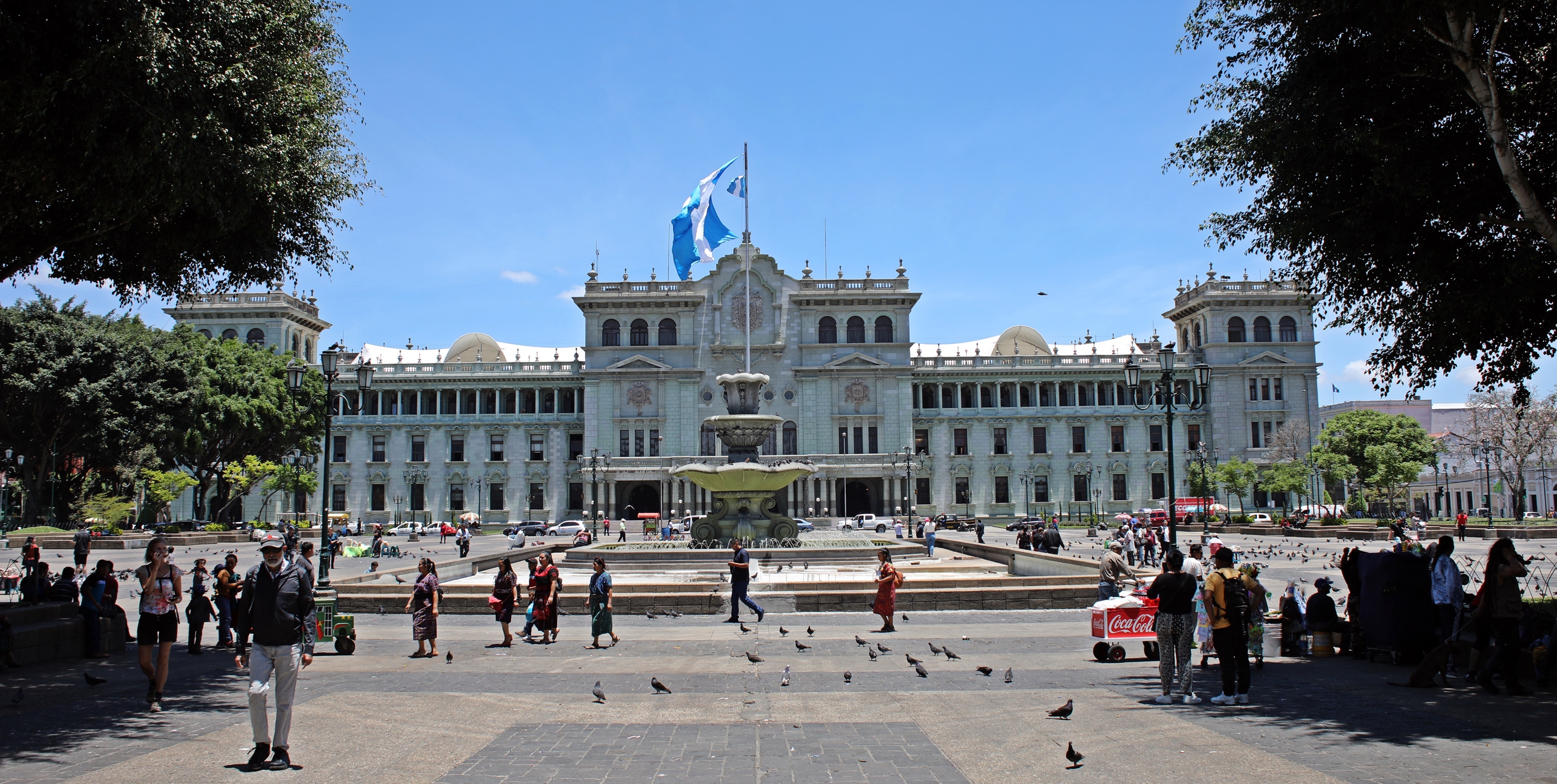
The most beautiful building in Guatemala City takes a prominent position along the edge of the square. The majestic Presidential Palace is a grand building with fine details etched into its design. It displays the elegance and grandeur expected in a palace but that contrasts the history of its construction. It was built in the 1940s under a dictatorial leader and many of the labourers were prisoners. Apparently they were treated very poorly and many died during the construction. Today it is no longer used as a palace, but instead for ceremonial and cultural events.

The other notable building in the square is Metropolitan Cathedral. Since it took 64 years to build we had expected an impressive masterpiece, but both inside and out it is rather understated.

There were quite a few people in the park when we were there. Ladies were selling corn and bird seed to feed the resident pigeons. In shady spots around the edge of the square were a few less desirables; some already or still passed out by noon, and others well on their way. During the day the square seemed fine for visitors, but we don’t think you should plan to visit at night. 

Running for a few blocks from the main square is the Paseo la Sexta (Sixth Walk). Parts of it are pedestrian-only and it is said to be the nicest street in Guate. As we walked along the street we saw a combination of heritage buildings and mid 19th century cement structures. Both were being used by international and local chain restaurants as well as clothing, electronics and convenience stores.

One of the most unique buildings is a block off this pedestrian street. Built in 1940, an arch connects the old post office (Palacio de Correos) to government offices. The arch is said to be inspired by Santa Catalina in Antigua. Today it is home to the Museum of Posts, Telegraphs, and Philately of Guatemala.

Outside of the main square and these few blocks on Paseo la Sexta, the city is not that desirable. Some areas were very poor with crumbling buildings, others didn’t look as bad but have nothing to offer visitors. On the edge of the city are a couple of new shopping malls with international brands, but they didn’t hold much interest to us.

Guate has a reputation for petty crime where tourists are the target. Although the city was nicer than we expected we did see a lot of characters in the historical district that we wouldn’t want to meet at night. During the day it did appear to be safe but you do need to take regular precautions with your money and valuables. There were quite a few police in the area during the day. 

When flying into Guatemala, most people fly into Guatemala City’s La Aurora International Airport. Shuttles leave directly from the airport for many tourist destinations including Antigua, El Paredon and Flores. Otherwise, you could take an Uber to the city’s downtown, or directly to Antigua.

Chicken buses also frequently travel between Guate and Antigua, but it is not a direct route to the capital’s historical centre. They leave every few minutes for many destinations from El Trebol in Guatemala City. It is marked on Google maps as ‘Bus Antigua’. To catch a chicken bus in Antigua their route is on the edge of town where you can flag one down or go to the central station near the market. It takes 1 1/2 to 2 hours depending on traffic.

Shuttles to Guatemala Airport can be booked from many travel agents and hostels in Antigua and in Flores. All tourist agencies charge a different amount for the ticket. We found Tropicana Hostel to have the fairest price.

Lake Atitlán – For a mix of nature and culture spend a day to two exploring Lake Atitlán. You can read more about this spot in our post Visiting the Towns of Lake Atitlán.

Hiking – There are a few hikes available from Antigua. We did the overnight hike to Acatenango & Fuego Volcanoes which you can read about here. Another popular hike is on Pacaya Volcano where you roast marshmallows on the volcano’s hot lava.

Tours -There are many day tours offered from both Antigua and Lake Atitlán to the traditional market in Chichicastenango as well as to coffee and cocoa plantations. You can find many tour agencies in Antigua and San Pedro la Laguna on Lake Atitlán.

Read from another device.
To read more of our adventures in Guatemala, click here.

Fediverse reactions

64 responses to “What To Do Near Antigua, Guatemala”

  1. The library and official buildings are the most appealing to my curiosity. I do not weather heat well, so the beach would only be a short visit.

    1. Yes the beach was too hot for us too. There are a few nice buildings in Guatemala City but it would be nice if they were able to restore more of them.

  2. A complete guide for future visitors!

    1. Thanks Indira! Maggie

  3. Some interesting side trips here. I like the laid-back vibe of El Paredon but a pool would be a must if staying there as it sounds far too hot for for me! We didn’t get there but we did take an excellent little day tour to some local villages near Antigua. We also saw a bit of Guatemala City without planning to! We had a transfer booked from Lake Atitlan to the airport for our flight up to Tikal and were so early that the driver offered to take us into the city centre. We had time to stroll around the main plaza, take some photos and visit the cathedral. From your description we don’t seem to have missed a great deal of interest despite it being such a short visit, although that library building looks rather striking!

    1. You didn’t miss much. There are a few more churches and parks but everything is very spread out and traffic is so bad in the city that it takes forever to get anywhere. It is amazing how black sand can even make the air hotter. We were surprised to see that even hostels have pools, but they have to with the heat. Thanks Sarah.

  4. Thanks for this wonderful article!

    This region is so beautiful and your photos are breathtaking

    1. Thanks you Luisa! Maggie

      1. You’re most welcome, my dear friend 💕

  5. The hostels with thatched roofs offering amenities and bordering the ocean are very appealing as compared to the City of Guatemala where you’d likely be busy looking over your shoulder. 🙂

  6. Such beautiful pictures! I’ve always wanted to learn how to surf. Seems like a good spot because there’s no rocks to crash into, I’d just need some water shoes to make it across the beach.

    1. Water shoes are a must I think, it’s amazing how hot sand can get! Thanks Lyssy, Maggie

  7. El Pardon certainly seemed like the most inviting

    1. Unfortunately Guatemala City doesn’t have much to see, but there’s a lot more to the country thank fully. Thanks Mallee, Maggie

  8. The Guatemala posts have been really interesting and eye opening. I know little about the country and hadn’t previously thought of it as a destination.

    1. Glad to open your eyes to what there is to see in Guatemala Ken. Thanks for following along. Maggie

  9. Helen Devries Avatar

    On the pillars in front of the cathedral are the names of those killed or ‘disappeared’ in the years of the dictatorship.
    Just off Av 6 is the hotel Pan American, an art deco gem worth entering even to take a coffee.
    There is a very efficient tram service too, which I took to visit the railway museum – lovely, old fashioned and atmospheric.
    Museum Popul Voh, and the museum Ixchel de Traje Indigena too. Really helpful staff who even called a taxi for us to return to the city centre.

    1. Oh yes, I didn’t mention the names on the pillars because we didn’t take a good picture of them, but I may add that in now that you reminded me. We did spend more time in the city, but found it much less inviting than the rest of the country. I think maybe we were so pleasantly surprised with San Salvador that we had too high of expectations for Guate. Thanks for your additional information. Maggie

  10. Great photos, Maggie, and a very thorough, interesting and detailed post.

    1. Thanks Lynette!

  11. It is always strange for me to see those almost black sands (never got the chance to be near a volcano area) as i am used only with the yellow-white ones ,,,

    I was so surprised to learn that presidential palace is built in 1940. Looks so anachronic in style considering that! Still in better proportions than our gigantic and even more anachronic palace built by Ceausescu in Bucharest …

    1. Its certainly a lot more modest than the one in Bucharest, but I’m sure to the Guatemalan people in the 40s it brought out similar hatred and distrust. Seems taste gets lost with an increase in power.

  12. You find the jewels in every area, Maggie. And thank you for sharing safety concerns. We forget about little things, like paved roads, until they aren’t there. As always, so many interesting points in your post.

    1. Thanks Mary, it’s easy to take things for granted and then realize how much easier they make your life when they’re not there.

  13. Hello there. I think the volcanoes are what I would most like to see if I ever visited this country.

    1. They are very picturesque and make the scenery so unique. Have a great Friday! Maggie

  14. The black sand beach sounds neat. And yah, I imagine it would be super hot to walk on the sand! Seems like a nice spot to watch the surfers (with your feet dipped in the water of course).

  15. I love the thatch roofs in El Paredon. The library is sweet and the Presidential Palace with those ornate columns looks like a fortress. I always love going on these virtual trips with you Maggie! 😎📸😁

  16. Great, helpful post as always, Maggie.

  17. Guate still sounds as dangerous as 20ish years ago.. we were told under no uncertain terms to go anywhere near it. Doesn’t look like I missed much anyway!

  18. It was a lot of interesting information and history and it was a great travel description. The Guatemalans have certainly suffered. The photos are astounding. It was fun to read. I’ve never been to Guatemala but I hope to go one day.

  19. Just by looking at your photos of the beach at El Paredon I can tell how hot it was — we also have black sand beaches here in Indonesia. But what I can’t get enough is the views of the volcanoes. That shot of Fuego and Acatenango Volcanoes is just spectacular! In your photos, Guatemala City looks interesting with those heritage buildings. However, I appreciate your honesty about the other parts of the city.

  20. An informative guide !Maggie. I like it that all the colonial buildings are brightly coloured.

  21. The beach looks like a nice laid back unspoiled place, thought having been raised in Oz I’m generally not a fan of black sand beaches, but the village and river look lovely – my kind of place. We decided not to go to Guate and you’ve confirmed our choice.
    Alison

    1. I’ll agree it’s not the prettiest beach we’ve seen, but the laid back town is quite nice. Yes, not much to see in Guate. 😊 Maggie

  22. There are some inviting places here that all look welcoming. Great photos Maggie!

  23. A dazzling array of photos Maggie.

    You explained that El Paredon is on the Pacific Ocean coast. Is that also the case for the Acomé River? Is it near the Pacific Ocean as well? I wonder.

    The Acomé River is beautiful and scenic, I love the various inlet areas you photographed they look to be serene and slow-paced.

    I did not see homes along the Acomé River (left side). Is it a conservation area/national park protected, I wonder?

    And this is not a question, just a thought. How was electricity, wifi and air conditioning (considering the heat)? I asked because from your photos of Guatemala, this areas seems (to me) to have the least amount of electricity lines overhead. Just curious.

    The beautiful post office the arch and the view reminded me of your great photo of Santa Catalina Arch (I think? if memory serves). Great detailed carvings and colors. And the Presidential Palace is fabulouos. I am sorry about the manner of its construction and the human host. **Maggie, thank your for your candor throughout about the vicissitidues of life in this city and environs.

    By the way is the region of Guatemala with good instant coffee? I seem to remember that mentioned in History class a long time ago. But there I go dating myself there…LoL.

    Thank you for a spectacular journey exploring Guatemala regions virtually/alongside and its rich history highs and lows.

    I have to say I love all your beautiful photos…and the epic last photo as a reminder of Fuego Volcano erupting at night….una despedido muy fantástico!! 

    God speed and safe travels always. Thank you, Maggie for the great details and amount of research you do to provide greater insighte into these exhilarating travellogs.

    1. Hi Suzette, Glad you’ve enjoyed this post of the not-so-often visited parts of Guatemala. Acomé River empties in to the Pacific Ocean and is immediately beside/behind the beach. On the other side of the river it is mostly mangroves. Parts of this area area a national park and tours are run from El Paredon into the mangroves. I guess I didn’t mention much about it, because we didn’t go and I’m not sure how good the tours are. The laid back town is very enticing and I worry it won’t stay laid back for too long, once word gets out.
      Their electrical wires do look suspect don’t they? But we didn’t lose power in Guatemala, or at least not for very long if we did. We had more outages in Mexico.
      We had excellent brewed coffee in Guatemala, but I think the instant coffee was just the usual brands. I don’t remember seeing anything about special instant coffee.
      Apparently the post office architect was inspired by Santa Catalina Arch. It’s one of the nicest post offices we’ve ever seen, but its location on a busy street makes it difficult to see it fully. The palace is very pretty. Quite ornate, but not overdone like some of them are. The loss of lives at the hand of government is a common theme in Central America I’m afraid. I don’t want to bore people with the history, but I also try to give both sides. Glad you appreciate it 🙂
      Happy Saturday! Maggie

      1. Thank you, Maggie, for a brilliant set of journeys. I enjoyed all the extra details and your alawys comprehensive and patient replies.
        Safe travels. Happy weekend!
        P.S. I am rarely, if ever, bored by history…lol!

  24. Actually I like the look of El Paredon, reminds me of a number of other rustic surfing towns we’ve been to, still a little ramshackle and tumbledown which often has a certain type of charm. A bit more character I suppose. Interesting though that the capital city doesn’t hold too much appeal – noted for future reference!

    1. El Paredon isn’t a bad little town for a couple of days rest. But yes, Guate has less to see than San Salvador which was surprising.

  25. Great post, Maggie. I like the chilled vibe of El Paredon, a thatched-roof cottage with a pool and a cold drink while watching surfers and fishermen would be nice for a couple of days. Guate sounds like a very difficult place to live. I do like the heritage buildings you photographed. The volcano and lake Atitlan would certainly be my priority if time was an issue. But like you I would also opt not to miss the capital and spend at least a day there.

    1. Thanks Leighton, glad you’re enjoying Guatemala. Lake Atitlan is the most popular of those for a reason, it really is a beautiful spot. Maggie

  26. There is just so much to see and do in Guatemala; you’ve really captured it beautifully.

    1. Thanks Hannah, we really loved Guatemala.

  27. It’s not often you hear of a country’s capital city that’s practically a “miss” on a traveler’s itinerary. Hopefully they can turn things around soon. I’m not a big fan of marshmallows, but I’d be up for some volcano-roasted ones. Coolest s’more ever!

    1. If we hadn’t done the other volcano hike we would have done this one, just for the s’mores!!

  28. El Paredon seems to have a much more laid back feel than you would expect in a capital city. I really love that decoration outside the library- a little weird, a little beautiful, and definitely a good way to draw people in 🙂

  29. […] Guatemala – A much less developed surf town is the laid-back town of El Paredon. You can read more about it in the post What To Do Near Antigua […]

  30. A 36 year civil war? That’s awful. I can’t imagine living through that for what would be, at this point, my entire life. I’m glad to know things are overall better in the country now (it seems). Hopefully things continue to improve. Also, the buildings and architecture are so pretty!

    1. I can’t imagine living through that, it has gotten better for the people, and as you say, hopefully that continues. Thanks again 😊 Maggie

  31. My destination a few times to the center of Guate was usually to the Mercado Centrale, a massive underground market with food, produce on blankets, gross looking meat hanging, but plenty of artisans and textiles. I lived in Zone 10, called Zona Viva because there are many restaurants and night spots, not a tourist place but liveable. Always being careful because it is a dangerous city. Monterrico was a favorite beach spot for weekends now and then. It attracted tourists but mostly Guatemalans, not modern at all but a bit picturesque.

    1. We had originally planned to go to Monteririco but we’re convinced by other travellers to go to El Paredon. It’s a noce laid back spot but had more foreigners than locals. Guate felt a little sketchy especially compared to the rest of the places we went. Can’t love them all 😊

      1. Yes, Guate is sketchy and I didn’t do a lot around the city, but was centered more in the southern residential area. I did love Zona Viva though, there was more of an upscale feel with international restaurants. 😉

  32. We never made it to Guatemala city due to the crime in 2002. Sad that it is still not safe for tourist. Glad you got to see some of it.

    1. It’s still not the nicest city. We found San Salvador was surprisingly a lot nicer.

  33. Duly noted. Agree, San Salvador is worth a visit. We enjoyed it.

  34. I always think that to know a country you have to know its capital. Not just the capital, but also its capital. In the case of Guatemala, it’s true that the capital isn’t very attractive, but all the same this huge presidential palace represents a period in the country’s history.

    1. That’s true, the Presidential Palace is a reminder of their history.

  35. I was in Antigua once in 2004. Great to see your photos and descriptions – can’t believe it’s been 20 years!

    1. It’s an adorable colonial town isn’t it? Good to have you back blogging 😊

  36. such a comprehensive post. I was wondering if you were going to post on Guatemala City – and there we have it. I think you made a good choice in not staying there. its tough in that part of the world, once i arrived in south america when I visited 8 years back now I heard so many horror stories of people who had been robber in the big cities – Lima and Buenos Aires. It’s really hard to balance exploration and caution.

    Anyways the beaches look interesting and a little different. Thanks for another great El Salvadoran post!

    1. There are probably neighbourhoods that are fine, but there’s really not much to do in the city, not like some of the capitals in SA. It surprised us that San Salvador seemed nicer. We had thought it would be opposite. Thanks Andy

We'd love to hear from you, please leave a comment.

Destinations

Discover more from Monkey's Tale

Subscribe now to keep reading and get access to the full archive.

Continue reading