
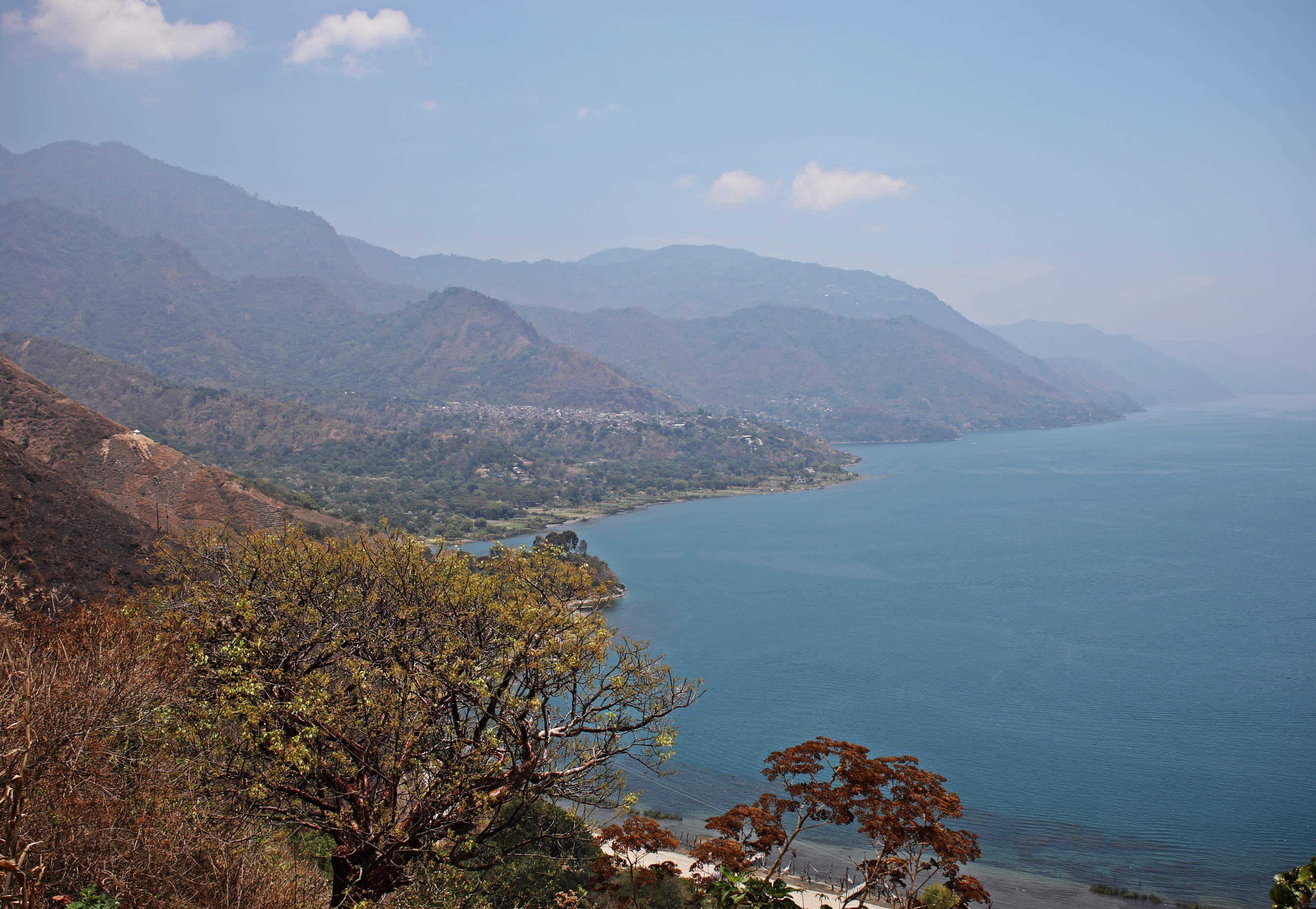
After seeing Lake Atitlán in the distance from our hike on Acatenango Volcano, we were excited to visit it in person. The large crater lake has a unique location, cradled in the basin between three volcanoes. Atitlán, Tolimán and San Pedro Volcanoes and the hilly landscape between them make Lake Atitlán one of the prettiest lakes in the country.

Located at 1,562 m (5,125 ft), the high elevation lake has an interesting beginning. It was formed by a super-volcanic eruption almost 85,000 years ago. Because it is a caldera, the 320 m (1,049 ft) deep lake has no natural drainage.


Many generations ago, Mayans began farming on the rich soil that surrounds Lake Atitlán. They are still there today, farming coffee and cocoa beans, corn, avocados, tomatoes and chiles. In fact of the eleven villages and towns around the lake, many still have large Maya populations.
One of our favourite things to do was explore the lake by boat. Ferries, called lanchas, operate as collectivos and are great way to get around the lake. From the water we could appreciate the fantastic landscape where volcanoes sweep down to the lake shore. Small towns and villages climb up and down the endless hills.


About eight of the eleven towns cater to tourists. Some we only saw from shore, but we did get off the ferry to explore five of them. It was fascinating to see that even though they are in close proximity to each other, each has their own personality.
San Juan La Laguna
As we approached San Juan la Laguna, our ferry maneuvered its way between the rows of colourful fishing boats lined up along the embarcaderos (docks). Above them the rugged, hilly terrain added even more character to this setting. San Juan La Laguna was our favourite lakeside town.


The village is very welcoming. It’s not too busy and has a fun atmosphere with many streets decorated overhead in colourful hats, flowers and ribbons. The streets and markets are filled with artisan shops selling weavings, paintings, and pottery.
Most of the local women dress in tradition attire called traje. It includes colourful woven skirts with matching bright, flowery tops, a wide belt and long scarves.


On a hill on the edge of town is Mirador de San Juan (1,620 m/5,315 ft). From the viewpoint we looked down upon the sapphire blue lake with its undulating shoreline. Looking the other way was the village of San Juan and a little further away, the city of San Pedro la Laguna was spread out below San Pedro Volcano. Beyond the shoulder of the volcano we could even see Atitlán and Tolimán Volcanoes. In addition to these wonderful views, the viewing platform is painted in colourful folk art.


There is a dirt trail that goes higher up the mountain from the viewpoint. We were warned that there may be banditos on this trail that are known to rob tourists. Others say they are farmers that make you pay to cross their land. Either way, it is not recommended to go above the mirador without a guide. Whether this is true or not, it is believable, so we didn’t feel like testing our luck.
The mirador is on the edge of the first ridge on the picture below.

San Pedro La Laguna
Sitting right below San Pedro Volcano (2,995 m) is the second largest city on the lake. With a population of 10,000, San Pedro La Laguna is still not very large, but its main dock was quite busy. There always seemed to be a lot of activity with several ferries, tour boats and fishing boats coming in and out of the port.
As we looked from the docks to the homes above, they looked to us like matchboxes piled one on top of the other. It didn’t have the same appeal from the water as some of the other towns in the area.


Near the main docks, the streets are a little hectic with tuk tuks and cars streaming by. Along the sides of the streets are many bars, restaurants and tourist shops. Their staff were calling out to us to come inside.


At first we wondered why we were staying in this busy city instead of quiet San Juan. Only a short walk away though and we found narrow streets with quiet cafés, guesthouses and small hotels. Some of the cafés had lovely gardens so we started to feel better about our choice.


Our hotel had a resident turtle that came to say hi to us each morning at breakfast. It was a lovely way to start our days.

The city’s character continued to grow on us as we explored the city by foot. Many of the buildings’ outer walls and restaurants’ interiors have wonderful street art displaying their Mayan roots.


The waterfront in most of the towns on the lake is not as idyllic as you may expect, although in many ways their settings are much more picturesque. Along San Pedro’s shoreline we found several small, gravelly areas with wooden boats set between groupings of reeds. In another area we often saw women doing laundry on large, flat rocks in the water. It let us know that tourism hadn’t completely changed their way of life yet.


Near the top of town is San Pedro Catholic Church. Although the church was nothing special it is set in a beautifully manicured garden. As we were leaving the church, we heard music coming from the street so walked toward the sound. We saw a funeral procession following a pick up truck with a four-piece band in the back. The band members were playing maracas, drums and a xylophone and were dressed in traditional attire. Their dress included woven shirts, white cropped pants and a sash around their waist. Apparently it is the custom for Mayan men in this area to wear cropped pants because they are better for wading in the water when fishing or working on their boats.


Santiago
Nestled below Atitlán (3,537 m) and Tolimán (3,158 m) Volcanoes, on a narrow bay is the interesting town of Santiago. The majority of its residents are Tzu’tujil Mayan and they proudly continue some of the traditions of their ancestors.


With only a few hotels and restaurants in Santiago, they don’t really cater to tourists, but were very friendly to us. Maybe it was because it is a less visited so tourists are a bit more of a novelty.

Further in town we visited Parochial Santiago Apostle Church. It was built by Franciscan monks in the 16th century. In this Mayan town the people have fused many Mayan traditions with Christian beliefs. One way we noticed this was inside the large white Spanish church. Instead of typical statues of saints, the ones in this church are dressed in fabric cloaks. Their outfits are apparently changed every year by local women. It is done in the Mayan tradition of showing their respect for the saints by taking care of them.


One of the most interesting displays of this cultural mix is the deity Maximón. Some describe him as a trickster, others as a great grandfather or someone who watches over every generation of Mayans. He is also said to have qualities of Spanish saints. His effigy is taken care of by a different household every year and we were keen to see him.
There are no directions to the house or signs indicating which way to go, but most people in Santiago know where Maximón is staying. We found him by asking a couple of locals who were more than happy to point us in the right direction. After a few blocks, we’d ask someone else, who would get us a little closer. Finally, we were told to go down a narrow back lane in an obviously poor district. As we walked down the lane a voice called out to ask if we were looking for Maximón. When we said we were they invited us in.
We walked inside the smoke filled, low ceilinged room to see one of the most usual sites we’d seen in a while. Right in front of us was a wooden effigy of Maximón with a cigar sticking out of his mouth and a drink of moonshine beside him. He had on at least two cowboy hats, boots and was draped in multiple colourful ties and scarves. Cash was tucked under the scarves and coins were in a bowl on the floor. A few old timers were sitting with him getting drunk, which is apparently the custom on a visit to Maximón. Visitors make offerings of cigarettes before asking Maximón for a favour. The request is usually something considered inappropriate by the Catholic Church. We had no cigarettes so we offered money and it was gladly accepted by the homeowners.


On one side of Maximón was a glass coffin fringed with flashing lights. Inside was a statue of Jesus. At the other end of the small room was another Maximón effigy. This one had a sunglasses and was dressed like a cowboy and reminded us of the movie Weekend at Bernie’s.

It is a bizarre and uniquely Lake Atitlán Mayan custom and we are glad to have witnessed it.
To reach Santiago take a ferry from East Pier in San Pedro. It is much quieter than the main pier.

San Marcos
The last town we visited was our least favourite. We had read that San Marcos is a hippie town filled with dreadlock clad ex-pats trying to find enlightenment. It actually sounded interesting and we were tempted to stay there. What we found though were tight streets bordered by corrugated sheet metal and no sidewalks to keep you safe from the buzzing tuk tuks.


It looked promising at first with a narrow market street, but quickly it felt like more like a construction site than a cute inviting town. The street below is the only nice part we could find in the busy town.
Since Mayans actually invented chocolate we decided to visit a chocolate factory in San Marcos but it was as disappointing as the town. The factory was not a factory at all, but rather was a small shop where the staff was taking chocolate out of molds and wrapping it in tinfoil. Since we were there, we bought a bar, but it wasn’t very good either.

Panajachel
The largest city on Lake Atitlán also has the largest port. It is a busy, working town and doesn’t hold much interest for visitors. We thought we’d spend our first day exploring this city before making our way across the lake, but after walking a short way, we decided to get on a ferry to spend our time in the smaller towns instead.
Since it can be reached by bus or car from Antigua, Panajachel is the main access point to the lake and almost all visitors arrive here first. There are two docks in town, most used the central embarcadero.

Other things to do In Lake Atitlán
- There are quite a few hiking trails in the area. Popular hikes are on San Pedro and Atitlán Volcanoes.
- There are a lot of tours offered in San Pedro to coffee fincas, chocolate factories as well as a Mayan cocoa ceremony.
- Most of the towns have businesses that rent kayaks and SUPs. We did see a few people paddling on the lake and others who were swimming. There are warnings however, about the contamination of the lake water. We were told not to submerge our heads, not to drink the lake water and to shower immediately after getting out of the water. With these warnings we weren’t tempted to swim.
When to visit Lake Atitlán
The best season to visit this beautiful region is dry season which runs from November to April. We visited in the middle of April and as you can see in some of our pictures, the clouds had moved in and we had a little rain. Since it is at a high elevation, the temperatures never get too high averaging 25° C during dry season. Rainy season is officially May to October.
How to get to Lake Atitlán
Shuttles run 3 times a day between Antigua and Panajachal (3 hrs, 150Q/$19 USD). There is also a shuttle that operates twice a day between Antigua and San Pedro la Laguna. We were told that the road to San Pedro is very poor so most people go the Panajachel and then take a ferry to the various towns. This is what we did. Shuttles can be purchased from many travel agents in Antigua.
You could drive yourself because the roads are quite good, but the shuttles are very convenient, inexpensive and well run.

How to get around Lake Atitlán
There are a few roads between towns, but the best way to get between them is to take the public ferry (lancha). Rides range from 20-25Q ($2.50-$3.20 USD) depending on the distance. There are signs with prices posted at each dock. There are a lot of ferries coming and going at the docks, but there are always people there that will direct you to the correct ferry. They operate as collectivos so typically wait to fill up before leaving.

We walked between San Pedro and San Juan and although there was no sidewalk it was perfectly safe. There are rumors of banditos on some of the more remote roads so take care when walking between towns. It’s nicer to go by boat anyway.
Where to stay and eat
The most popular town to stay in is San Pedro because of its numerous hotels, restaurants and pubs. We recommend the hotels that are a few blocks from the main docks as it is much quieter. Another option would be to stay in the nearby community of San Juan. There aren’t as many hotels and restaurants, but it is a very nice community. Some people recommend staying in San Marcos but from we saw, it isn’t pleasant. There are also many isolated hotels around the lake. They are boat-access only and would be very peaceful and quiet. For us they were a little too remote and we thought we’d quickly run out of things to do. The village of Tzununa apparently does not want tourists so we didn’t visit.

To read more of our adventures in Guatemala, click here.
Coming Next – Guatemala City & The Black Beaches
For pictures from other blogs go to Gallery at monkeystale.ca
To read about more of our adventures go to Destinations.
If you like what you read, please comment or share (with credit) using the links below.



We'd love to hear from you, please leave a comment.