
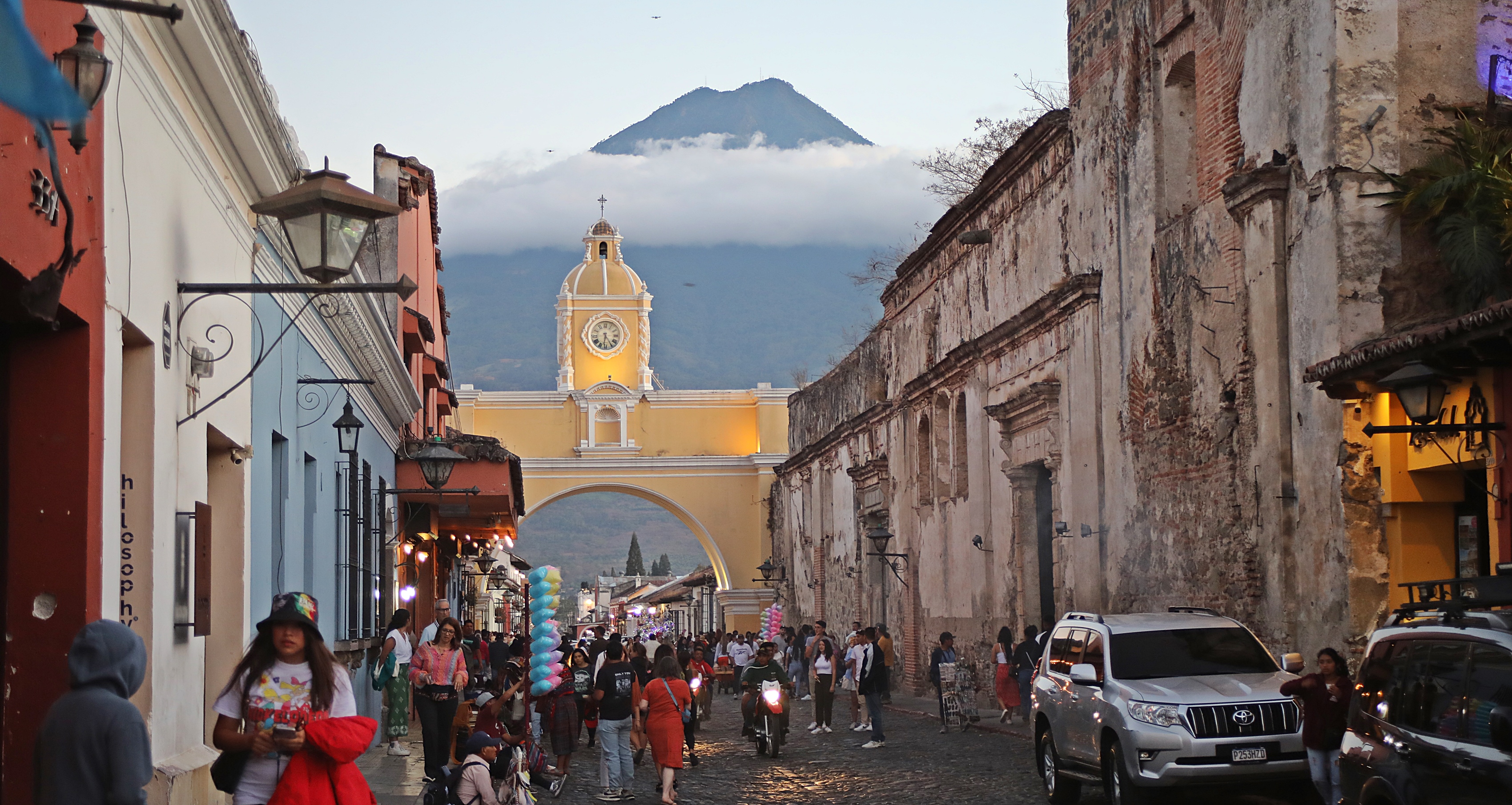
Located in the shadows of Agua Volcano, the colonial city of Antigua has the perfect setting. With its mix of colourful colonial homes and 17th century church ruins under the perfect cone-shaped volcano, it’s no wonder that Antigua is Guatemala’s most visited city. If you like visiting quaint, colonial Old Towns, you will love exploring Antigua, Guatemala.
Antigua was the third capital of Spanish colonial Guatemala. Although it was called Guatemala, it was actually much larger than the country we know today. At the time Guatemala consisted of most of present-day Central America, not including Belize and Panama, as well as the Mexican state of Chiapas. The first two capitals of this early Guatemala were both called Santiago de los Caballeros and were abandoned. One was vacated due to a Mayan uprising and the other when it was damaged by mud flows that came streaming out of Agua Volcano.
In 1543 the capital was moved again to what we now know as Antigua. The Spanish picked what they thought was a safe spot in Panchoy Valley, which was still not far from Agua Volcano. This third capital was also named Santiago de los Caballeros and it remained as the capital for almost 200 years. Using the same name for three capitals must have caused a bit of confusion. This new capital suffered through a several earthquakes, and eventually a large series of earthquakes destroyed the town in 1773. They are called the Santa Marta earthquakes because they began on the Day of Santa Marta.

After the devastation, the capital was moved a fourth time to its current home in Guatemala City, and Santiago de los Caballeros was renamed Antigua Guatemala (Old Guatemala). It is more commonly just referred to as Antigua and is undoubtedly one of the most colourful colonial towns in Central America.
During its 200 years as capital, the Spanish built a gorgeous city and filled it with elegant, baroque palaces and churches. Many of them today stand as shells of their former selves; not being restored or removed after the devastating earthquakes. Other buildings have been restored and it is this mix of ruins and restored buildings underneath Agua Volcano that makes Antigua such a captivating place to explore.


What makes this city great is that every street is lined by heritage buildings painted in a multitude of colours. Charming antique lamps, flower pots and wrought-iron window coverings give them more character. Even if there was nothing else to do in the city, wandering the streets of Antigua would be reason enough to visit. At 1,533 metres (5,029 ft), temperatures are cooler than in most other places we visited in Guatemala, making it even more enjoyable place to spend a few days.


Unlike most other Old Towns, a modern city was not built up around Antigua. Once the capital was moved to Guatemala City, Antigua was mostly abandoned. In the early 1900s locals began moving back to farm in the rich lands in the region and reestablished a city using the old buildings. The result is that, other than the odd gas station and market stalls, almost all of the buildings are heritage.
Since gaining UNESCO World Heritage Status in 1979, the city has slowly transitioned to a tourist destination. Most of the buildings in the centre now are used in the tourism industry as shops, restaurants, hotels, cafes, and tour offices. Branching out from the centre, more and more of the buildings are lived in by locals and most have been restored and look to be in good condition.
Like many heritage cities in this part of the world, there is an approved list of colours that are allowed. As you wander the streets though, it doesn’t feel like there are any restrictions to the colours used.


Volcanoes
The peaks of the surrounding volcanoes add another element to the city’s beauty. Volcán de Agua (3,760 m/12,340 ft) is the closest. Its name translates to Water Volcano but it is usually called Agua Volcano by English speaking tourists. It received this name after an earthquake caused a crack in its crater resulting in the devastating mudflow that covered the second Spanish capital in 1541. It has never erupted, but given this history, it seems remarkably close to Antigua.
Two other volcanoes that can be seen from many parts of town are the dormant Acatenango (3,976 m/13,045 ft) and the very active Fuego (3,763 m/12,346 ft). You can read about our hike to these volcanoes in our post Acatenango and Fuego Hike.


Santa Catalina Arch
The most famous structure in Antigua is Santa Catalina Arch. Built in the late 17th century, the arch survived the massive earthquakes that destroyed most of the city. From either side of the arch, the view is framed by colourful buildings that line the cobblestone street.


On one side of the street was Convent of Santa Catalina and on the other, a convent school. It was run as closed convent so the nuns were not to be seen by anyone outside of the convent. The arch was built with a hidden passageway inside that allowed the nuns to travel back and forth without being seen. Today much of the convent is in ruins and the rest is used as hotels, restaurants and stores. The clock on the arch was added in the 19th century.
For our first few days in Antigua, the skies were cloud covered. We had seen pictures of a volcano behind Santa Catalina Arch, but thought they may be fake pictures because we never saw the volcano. In fact, we hadn’t seen it from any vantage point in the city. Finally, after a couple of days we woke up to a view of Agua Volcano from our hotel room window so we knew the Old Town would look different. Below is how the volcano slowly revealed itself to us behind the arch.


Plaza Mayor
The large, treed Plaza Mayor, in the centre of town, is usually a hub of activity. Locals meet with friends and family on park benches under the shade of large trees. In the centre of the park is a fountain with unusual waterspouts.


Along the edge of the park, women dressed in traditional Mayan outfits called trajes, sell purses, shawls, and bags. Ice cream vendors pass by with their mini chicken bus carts.


Also called Parque Central (Central Park), it is surrounded by grand buildings with long colonnades. On one side is Palace of the Captain-Generals. It was the main seat for the Spanish government for almost 200 years. One of the buildings on the other side of Plaza Mayor houses the Antique Book Museum, unfortunately though, it is temporarily closed.


Taking up one full side of the park is Parish Church of San Jose and the old archbishop’s residence. Originally standing on that site was the massive Santiago Cathedral, but it was destroyed by the Santa Marta earthquakes. In the 19th century one section was restored to house the parish church. You would hardly know by looking at it today, but this church was also damaged several times by earthquakes. Today the church has a grand façade, adorned with many statues of saints.


The original cathedral, built in 1680, must have been quite the ornate building. Its remains can be seen in the museum behind Parish Church of San Jose. The ruins of Santiago Cathedral show not only the devastation but also some of the grandeur this cathedral once had. We could still see fine details of carvings on some of the tall walls.


La Merced Church & Convent
Down the street from Santa Catalina Arch is the bright, yellow La Merced Church and Convent. The design is a bit over the top with white, lacey stucco details covering much of the yellow building.

Antigua is supposedly one of the best places to visit in Central America during Holy Week; the week before Easter. Long processions travel up and down the narrow streets. We were in Antigua shortly after Holy Week and the city was still cleaning up after the big festivities. We saw where a few icons that would have been used in the processions were stored in the convent ruins. Others were being taken into La Merced Church.


Church ruins
As you would expect for a former Spanish colonial capital, there are a lot of churches, convents and monasteries in Antigua. Because of the Santa Marta earthquakes in the 1700s though, most are in ruins. One that was partially rebuilt is San Francisco Monastery. The church’s front still has many of the original details, but at the side you can see the unrestored wall of the monastery.


Most of the rest of the baroque churches are in ruins, but still show some of the grandeur they once possessed.


In addition to visiting these main sites we explored the General Cemetery St. Lazaro. Its large tombs sit under the under the watchful eye of of the surrounding volcanoes.

On the other side of town is the busy market. Its maze of aisles were filled with every fruit, vegetable or meat that you may want to buy. Markets are usually filled with curious tourists, but the main market in Antigua seemed to be just used by locals.


Popular Trips from Antigua, Guatemala
Not only is Antigua a great city to visit, it is also located close to a few other sites.
Lake Atitlan is only a couple of hours away and provides visitors with a mix of culture and nature. (You can read about the lake in our post Visiting The Towns Of Lake Atitlan)
A very popular activity in the area is hiking. There are many agencies offering hikes to some of the volcanoes such as Pacaya, Acatenango or Fuego (You can read about our hike here). People used to be able to hike to the summit of Agua Volcano, but reports of thefts on the trail have put a stop to all hikes.
Both Antigua and Flores are great cities to use as hubs to visit other parts of the country. Tourist shuttles operating in both cities make it easy to reach other tourist sites such as Semuc Champey, Rio Dulce or the beaches such as El Paredon. Local transportation is not the easiest in Guatemala. Even if two sites look close on a map there are not always buses or even chicken buses running directly between therefore these shuttles are very helpful.
Best time to Visit Antigua
Dry Season is usually the best time to visit. In Antigua there is a 6 month long dry season from November to April followed by a 6 month wet season from May to October. We were there in early April and we had a few days of rain.
Where to eat in Antigua
Antigua is known as a foodie’s paradise. In the mornings your stomach will grumble when you inhale the intoxicating smells of fresh baked bread, croissants and cookies. At lunch and dinner it will change to more savory aromas. There are many restaurants in the city and each seemed to be tying to outdo themselves in their offerings of exceptional food. You can have almost any international food you crave in Antigua with many pasta, pizza, Indian or Chinese restaurants. Pubs have an offering of burgers and beer and there are new twists on local fare such as broccoli tacos with a peanut mole sauce. We didn’t have a bad or even average meal, the entire time we spent in the city.
Where to stay in Antigua
There is no shortage of choice for hotels, apartments, and hostels to match any budget in Antigua. Since everything in the city is within walking distance there really is no bad location.
How to get to Antigua
The nearest airport to Antigua is La Aurora International Airport, on the outskirts of Guatemala City, 40km away. If you don’t have a car, the easiest way to reach Antigua from the airport is by tourist shuttle. If you’re travelling from other parts of the country, we suggest taking the tourist shuttles. You can buy shuttle tickets from Tropicana Hostel in Antigua and Green Monkey Hostel in Flores. There are also a few public buses, but most only go to Guatemala City, not Antigua.
Of course another way to travel is on a colourful chicken bus. These suped-up, colorfully painted school buses travel to many cities and towns in the area. We didn’t see them around Flores or Rio Dulce but they are very common around Antigua. They don’t travel long distances, but are great to get between nearby communities.


This article is now featured on GPSmyCity. To download this article for offline reading or create a self-guided walking tour to visit the attractions highlighted in this article, go to Walking Tours and Articles in Antigua.
To read more of our adventures in Guatemala, click here.
Coming Next – Acatenango & Fuego Volcanoes Hike
For pictures from other blogs go to Gallery at monkeystale.ca
To read about more of our adventures go to Destinations.
If you like what you read, please comment or share (with credit) using the links below.




We’d love to hear from you, please leave a comment.