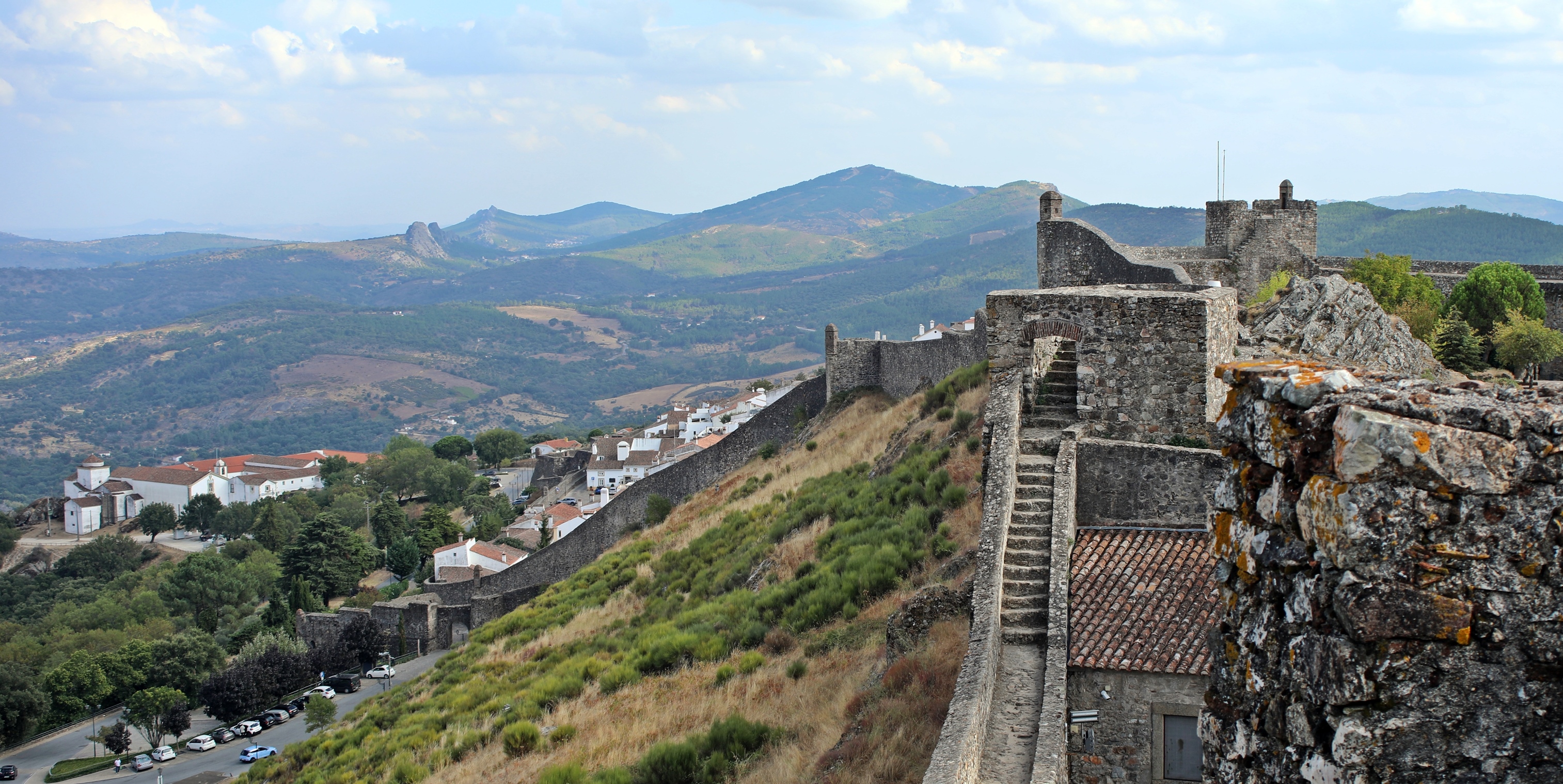
All along the Portuguese-Spanish border, tall castles cling to the steep hills, mountains and crags. Small villages trickle down the slopes below. As we drove thorough this area we wanted to visit each and every castle, but we soon realized that there were far too many. It would take a lifetime to visit each castle in this area.

The next three posts will highlight a few of these magnificent castles and their medieval towns and villages. First we’ll take you to the picture-perfect fortified towns of Monsanto and Marvão.

You can read about the other border cities in our posts: A Journey Through Elvas and Évora’s Rich Heritage; Beja, Mértola and Alcoutim.

As we walked between the homes in this medieval village, we could almost hear the voices from Monsanto’s past seep from their stone walls. The rustic homes on the sides of the cobblestone streets made us think we had stepped back in time.

This prominent hillside has been inhabited for thousands of years. It has been Portuguese since 1165 when King Afonso Henrique I conquered the Moors who were living here.

We wandered along the meandering lanes beside old stone cottages, homes and churches. Most are in excellent condition and have been restored to look their authentic selves. Flowerpots hang from the walls and in gardens which is probably a new, but lovely addition. As you can imagine, these streets are far too narrow for vehicles. This lack of modern traffic makes the village feel even more ancient.

The most unusual quirk of Monsanto is how the massive boulders are incorporated into the design of homes. Some use the boulders as walls, while others as roofs. There’s even a pigpen carved into a granite boulder. We almost expected Fred Flintstone to come walking out of one of the homes. Even if there wasn’t a castle on top of the hill, it would be worth a visit to explore this village.

The Portuguese king granted the land on the top of the hill to the Knights Templar to defend the land from Muslim Moors. The catholic military order of knights built a small castle on the site and part of Monsanto Castle (Castelo de Monsanto) still exists today. When you walk below the castle walls, you can see its improbable location on the edge of the steep mountain wall.

After exploring the castle, don’t return directly to the village, instead walk around the top of the hill to see some of the other ruins in this fascinating landscape. Some may be as old as the Romans, but most are 12th century Portuguese including Capela de São Miguel and its rock-cut graves.

From this vantage point on Monsanto Hill, we looked down to the rooftops of the medieval village.

We saw a lot of roof ornaments, statues and paintings of roosters throughout Portugal. One of those was on the 14th-century Torre de Lucano (Lucan’s Tower) in Monsanto. It was in Monsanto that we finally learned the reason for the abundance of roosters. Legend says that in a Portuguese town near Braga, a man was accused of stealing. He claimed his innocence and said to the magistrate “As certain as I am innocent, a rooster will sing when they hang me!” He was found guilty and sentenced to death on the gallows. The next day as the man was being hung, a rooster began to cock-a-doodle-doo. The judge was startled and rushed to the gallows to save the man. Remarkably, the noose was poorly tied and the man was still alive. The magistrate had him released immediately. Because of this legend, the rooster has become a symbol of good luck in Portugal.

As we said above, there are a lot of hilltop castles and fortified towns in this part of Portugal. Here are a couple that we saw in the area around Monsanto and Marvão, but didn’t have time to visit.

Set atop a long ridge, 800m above Server River, is the impressive Marvão Castle. One side is protected by a sheer wall. The other, by an only mildly less steep side that is home to a wonderful medieval village. From below it was difficult to distinguish the bulwark from the granite boulders; maybe that was part of its strategy.

The origins of this castle are a little different from others in the area. In the 9th century a short-lived dynasty reigned in this region. Ibn-Marúan, was muladi, an Iberian Peninsula native who converted to Islam. He led a few rebellions against Moors in Córdoba. At that time he established a small fortress on top of this quartzite crag. In the 12th century it was partially rebuilt by Portuguese rulers where its proximity to the Spanish border made it an important fortress.

Before visiting the castle you first need to penetrate the 16th century wall that surrounds the town. Today its not difficult as the gates are open, but you can imagine how it once kept invaders at bay. We entered through Porta de Rodão and walked along the cobblestone streets of the village.

The fortified town inside those walls still retains its medieval look. The streets run almost parallel to each other and are lined with old, whitewashed homes. Stairways and alleys link the streets and allow you to make your way up to the castle above.

Most of the homes have been lovingly restored and thankfully, haven’t let much of the modern world inside. As we got higher we could see how its hillside location adds even more charm to the old town.

At the top of the hill we could finally see the castle. In front of it is a lovely, large garden with manicured hedges and flower beds. It was quite unexpected to see such a lush garden on this rocky ridge.

Inside the castle, large open spaces are surrounded by a tall fortification wall. It is in excellent condition and you can walk along the wall to explore the many sentry posts and towers. The exposed narrow stairways and uneven steps make getting up to the top of wall a bit of a challenge though.

From the top of the Keep, main tower, the view of the surrounding Serra de São Mamede mountains is wonderful. We even spotted another castle on a neighbouring peak, not far away.

You can also climb to the top of Flag Tower at the front of the castle grounds. From there we looked down upon the fortified town and we could see how the castle walls are linked to the wall that surrounds the town.

As you can see in the map below, Monsanto & Marvão are located very close to the Spanish border, but rather far from Portugal’s large cities. The easiest way to reach both of these cities is to drive. The highways in the area are usually single lane and travel though rural lands so the drive will take longer than you expect. The countryside is lovely though so take your time and enjoy the drive. If you need to travel to Monsanto by bus you will first need to get to the city of Castelo Branco. Marvão is a little easier to reach by bus as there are buses from Lisbon.

Both cities have bed & breakfasts and apartments located in their medieval villages. Staying in one makes a wonderful and unique experience. Otherwise there are also a few hotels located in the more modern part of Marvão.

Read from another device.
To read more of our adventures in Portugal, click here.

Fediverse reactions

81 responses to “The Fortified Towns of Monsanto & Marvão”

  1. These two towns appear more like what I’ve long imagined medieval settlements should look like. The rough-edged, antique quality is foremost.

    1. They really feel like authentic medieval villages, it was fun to imagine life in the streets so long ago. There are few of them along this border too. Thanks Swabby! Maggie

  2. Great scenes from the old towns! Well described, Maggie!

    1. Thanks Indira, these old medieval towns are so fascinating. Maggie

  3. For 😎 cool . I never knew there was a city. I have disliked the Monsanto corp of the USA ever since seeing there exhibit at the 1961 World Expo in Seattle❗️

    1. The name does have a bad history attached to them don’t they?! But the town is adorable, and has nothing to do with Monsanto Corp. We actually did look it up when we were there. 😊 Maggie

  4. Monsanto was a challenge but Marvao is probably my favourite place in all of Portugal. Don’t quote me, but I totally fell in love with the place. Morning mists from the castle walls are an enduring image. Winter might be a different proposition, of course. Thanks for the memories xx

    1. Marvao is perfect isn’t it. I especially love the castle walls allowing you to look down over the roofs of town. But I also loved the prehistoric look of Monsanto! Hope UK isn’t too cold for you right now 😊Maggie

      1. It’s not warm but I’m in a very nice restaurant at the moment xx

  5. These are beautiful hill towns and one can only imagine what it must be like growing up there. I have never been to Portugal, but have enjoyed the hill towns in Southern France and Norther Italy. Thanks for sharing Maggi. Happy Monday. Allan

    1. Aren’t they fun to explore? There are more to come in Portugal too Allan. Thanks!! Maggie

  6. Wonderful to see places so unaffected by change, many things just how they were long ago. Makes you feel great to wander around such places.

    1. They let you get a glimpse of medieval times don’t they? Thanks! Merry Christmas, Maggie

      1. And to you guys too, have a great one!

  7. Oh I am not going to tell my husband about the boulder architecture, or we will be moving to Monsanto. I’ll bet no one has anything remotely resembling air conditioning there! Cheers!

  8. Both Monsanto and Marvão look wonderful to explore – I’m probably more attracted to the villages than the castles (perhaps because we have lots of castles in England but our villages look very different?) I especially like the look of those boulders in Monsanto!

    1. I loved walking on the castle walls, especially over looking the villages, but then, we don’t have any castles here. The integration of the boulders into the homes in Monsanto is fabulous. It made it feel prehistoric. Thanks Sarah, Maggie

  9. These towns, Marvão and Monsanto, are iconic medieval settlements, especially with their roughly hewn stone walls. The view from the high points of the castle (Marvão Castle) is marvelous.

    Yikes! Those stone stairs look pretty high up there, leading to the keep!

    I love the sudden garden expanse in Marvão Castle; it’s a beautiful setting for a fairy tale.

    I did not see too many roads leading up to the castles. How does one get up to see them?

    This is the kind of tour that would be nicely complemented by a stay at one of the bed and breakfast places you mentioned to get close to the stories of this ancient place.

    I thoroughly enjoyed your share. Great photos; I could really sense the height of the areas as you mentioned so well in your opening description of castles with buildings trickling down the steep hillside. Safe travels always to you both, Maggie.

    1. There aren’t many roads, that’s true. In some villages we parked well below and walked up. In others we could even drive right through the castle gates! Most of them though don’t have car ready roads which is very nice (maybe not for the people who live there). Thanks so much Suzette! Have a wonderful Christmas! Maggie

      1. Thank you Maggie and Richard for your labors to share what you have experienced on your journeys this year. For your fabulous descriptive explanations and generous travel tips. Not to mention the extensive research your work shows you have conducted to bring these places and their ways of living to light. Blessings to you!

        1. Thanks so much 😊😊

  10. It’s all so beautiful and moving. I love that most of the ancient buildings are still being used. What an experience for you, Maggie. You are seeing things most of us only read about.

    1. They are being used as homes, cafes, shops and bed & breakfast. They’re in excellent condition making them both wonderful little towns. Thank sMary, Maggie

  11. happy holidays

    🎄☃️❄️🎁❄️☃️🎄

    1. Happy Holidays Graham! Maggie

  12. Wow, great photos. I love it when natural landscape features (like boulders) are incorporated into towns. I suppose it was way easier than trying to chisel through them!

    1. Yes I guess it is easier. They really the town it’s own personality. Thanks for taking the time to comment. Maggie

  13. Thanks a lot for sharing another gorgeous reportage!

    Wishing you and your family a Merry Christmas 💫

    1. Thanks Luisa, Merry Christmas to you too. 🎅

      1. 🙏💞🙏💞🙏

  14. Marvellous article, Maggie. I’m amazed that your photos are people-less. Were you strategic or were there few people about? The level of preservation in these communities is astonishing. When I lived in Europe I very much learned that there are still some places where the clock ticks slowly, but these towns are probably the best examples of that.

    1. There were very few tourists in either town, which is astonishing given how cute they are. Most of the buildings are very well maintained in all of these border towns that we visited. It’s a not often visited, but fascinating part of Portugal. Thanks Lynette! Maggie

  15. As always, Maggie and Richard, wonderful descriptions and stunning photos!

  16. Monsanto is certainly an amazing ancient city and the Marvão Castle is indeed impressive. As usual your photos are great.

    1. Thank you! They are both so charming and unlike anything in my daily life. 😊 Maggie

  17. I loved the history and the ancient captures. I even shared the lucky cock story with my sons, of course.

    1. Isn’t the lucky cock story fun! We really saw them all over the country.

      1. From memory, Poles like roosters and they feature on lots of souvenirs. Richard could verify probably.

        1. He said he doesn’t know about it, but I just read some of the rooster folklore from Poland. Maybe it’s more in the small towns than the cities. 🐓

  18. These towns are just picture perfect!

    1. They really are. Thanks Anna! Merry Christmas! Maggie

      1. Merry Christmas Maggie! X

  19. So much life and character in those buildings and I love the green doors! 💚

    1. Aren’t they great! Thanks Michele!

  20. I always though Monsanto was only the name of a giant agricultural company often embroiled in controversies. I didn’t know that there’s a village in Portugal having the same name. I love its rustic look, and the incorporation of the boulders into the design of homes really makes it appear atmospheric. Marvão looks equally charming as well with its whitewashed homes. I love how you always include lesser-known places in your travels!

    1. Ha, yes we looke it up and there’s no connection. Both Monsanto and Marvão are very charming. It’s surprising that not more people visit, but they are a little out of the way. Glad you enjoyed them! 😊 Maggie

  21. Another good travelogue, Maggie.

  22. Sitting reading this in the early hours. The amazing photographs came into view far quicker. Usually, due to my rural location, they can take a very long time to upload in the day. So maybe it would be good to be reading your posts more often at this time of day. I always love your marriage of descriptive words alongside the skilfully well taken photographs. Such a pleasure to see and read such synergy. And you always write and give images insightfully and informatively. All the best.

  23. It’s amazing that these two villages are so well maintained. They remind me of the medieval villages in Umbria and Tuscany. Happy holidays!

    1. They are wonderful medieval towns with hardly any tourists, yet anyway. Happy Holidays to you both Tricia! Maggie

  24. Thank you for taking us to Monsanto.
    It reminded us well of the old villages of Tuscany.
    Have a happy holiday
    The Fab Four of Cley
    🙂 🙂 🙂 🙂

    1. It is a wonderful historic town. Thanks for taking the time to comment, Maggie

  25. Monsanto looks like a lovely place to wander around, especially since the streets are too narrow for any vehicles. The views from the top of the hill are impressive. How interesting about how the rooster is a symbol of good luck. The Marvao Castle looks beautiful as well. Thanks for sharing and have a merry Christmas! Linda

    1. They are both very charming and so unlike anything we have here. Merry Christmas to the three of you! Maggie

  26. Ruins & Medieval Village….what could be better!

    Happy Christmas to you both 🙂

    1. Exactly! Thanks June Merry Christmas, Maggie

  27. Oh my gosh Maggie, Monsanto is truly a quaint, medieval place. It is so intriguing with the breath of intimacy meandering through it’s cubbyholes of stone. Love it! 🤗💖🥰📸😎

    1. Monsanto is truly unique and feels as if its still in the Middle Ages. Thanks Kym! Maggie

      1. You’re so very welcome Maggie. I love to revisit these special places, with you as our guide my dear! Hugs my friend. 🤗📸😎

  28. Monsanto has a quaint and intimate atmosphere. The boulders included in the design of its dwellings only add to the sense of a place lost in time. Marvão is also very charming with its rows of whitewashed houses. Merry Christmas to you both.

    1. They are both great historic centres to explore and so different from each other. Portugal just keeps giving 😊 Thanks Leighton, Maggie

  29. […] magnificent castles and their medieval towns and villages. To read about other towns read our posts The Fortified Towns of Monsanto and Marvão. In the coming days we’ll explore Beja, Mértola and […]

  30. Wow, I had no idea there were so many castles and ancient settlements in this area. Monsanto looks incredible, definitely one of those places where you feel you’ve stepped back in time. And Marvão Castle looks majestic – beautifully captured as always 🙂

    1. At first when we were driving, we stopped to take a picture of each of the castles, but the further we drove we kept seeing so many, we could no longer keep stopping! Monsanto is like a pre-historic town. It’s so fascinating how they incorporated the boulders into the buildings, and that they haven’t changed things. Marvão is a completely different kind of fascinating! So much to see in this part of the country. Thanks Han,

  31. Medieval and scenic. You can almost hear the knights galloping through the streets!

    1. You can. Ghosts, knights, they’re still wandering those streets. 😊

  32. I think I recognise myself in the way you exclude people from your views of historic places, as if they were deserted towns. Showing medieval streets with today’s clothes would break the charm. That requires patience though.

    1. Surprisingly, in these towns there weren’t a lot of tourists, but you’re right, we usually prefer to patiently wait for most to move on. 😊

  33. […] three posts. To read about some of the other magnificent castles in this region, read our posts The Fortified Towns of Monsanto and Marvão, and A Journey Through Elvas & Évora’s Rich […]

  34. Lovely collection of towns that seem perfect for walking up and down the streets and taking the day for what you find. Interesting to see the graves cut out of rock- I have never seen anything like that before.

    1. The graves are really interesting aren’t they? It added to the already prehistoric town. Thanks Meg! Maggie

  35. This is stunning! I’ve been to Portugal, but only to the major cites. I see another visit in my future!

    1. Yes, there is so much more to see in the rest of the country- and not as many tourists!!

      1. That’s always good! I think I visited juuuust before Portugal got insanely popular

  36. So funny your remark about Flintstone, but then, I’m sure they had to inspire from one of such places😀

    I’m amazed at how many wonderful areas you stopped by!

    xx

    1. There are so many of these amazing little towns in Portugal!

  37. Wow! More ammunition to persuade my Wife for a Portuagal visit. Those boulders utilised in the building of houses in Monsanto look intriguing and I may have said before but I do love Castles – more for the list, great post Maggie.

    1. You’d love this region in Portugal then. Almost the entire border is home to dozens and dozens of castles. If you have a car, its easy to visit many of them. Monsanto is one of the most unique towns I’ve ever visited. Hope you get there 😊 Maggie

  38. […] more information about these fascinating cities and town, click on the link to the following posts: The Fortified Towns of Monsanto & Marvão; A Journey Through Elvas & Évora’s Rich Heritage, Discover The Medieval Castles of Beja, […]

We'd love to hear from you, please leave a comment.

Destinations

Discover more from Monkey's Tale

Subscribe now to keep reading and get access to the full archive.

Continue reading