
Spread across seven hills on the edge of Tagus River, Lisbon has been a draw for visitors for years. With so many beautiful and historically important sites to see, it’s no wonder that it is now a tourist hot spot. In this post, we’ll show you some of the wonderful sites that you will see when you visit the historic city of Lisbon.
Having been settled as early as 1200 BCE by the Phoenicians, Lisbon is the second oldest capital in Europe. Like many parts of this country, it was consecutively occupied by many civilizations over the millennia. It didn’t become a part of Portugal until 1147 when King Afonso Henriques was triumphant over the Moors and took control of Lisbon, changing the city forever. He had become the first king of Portugal after winning the siege of Guimarães in 1127. Now, he could add Lisbon and parts of southern Portugal to his newly independent kingdom. You can read more about Guimarães here. (Coming Soon)
Another big event that changed the country was the Great Lisbon Earthquake. On November 1, 1755 a massive earthquake devastated the city and surrounding areas. The epicenter was roughly 290 km southwest of Lisbon. Not only did the 8.5-9 earthquake topple buildings, the ensuing tsunami flooded the Tagus estuary nearly destroyed the city. On top of that, the earthquake hit on All Saints Day when many were visiting local churches. Hundreds of candles were lit in the churches in remembrance of loved ones. The shaking from the earthquake toppled the candles, resulting in many fires throughout the city.
These events made King Joseph I paranoid and since that day he wouldn’t sleep inside a building; only in tents or wooden structures. Because of this he had a royal tent city erected in Ajuda. It was only seven kilometers away but since it was not affected by the quake, he felt more safe in Ajuda. Years later his daughter, Marie I built Ajuda Palace. You can read about that palace here. (Coming Soon)
This natural disaster resulted in over 75,000 deaths. The king and Lisbon’s mayor were forward thinking though and are credited for saving many more. In opposition to the church, they ordered that the dead be loaded onto boats and burned at sea. They did this to prevent disease from spreading throughout the city. This earthquake also changed the way Portuguese cities and buildings were built and organized. Previously built haphazardly without much concern for safety or organization, the city was rebuilt in a grid with straight lines. This grid organization is apparent throughout much of the city.

As well as the grid design, new buildings were built of stone on wooden frames to be more flexible. They are the fist known earthquake-resistant buildings in Europe.
Because of the earthquake though, Lisbon does not have as many ancient buildings as its history would make you think, but that doesn’t mean it’s not a great city. Come with us as we explore the sites in this beautiful capital city.
Castelo São Jorge
Taking the highest point in town is St. George Castle (Castelo São Jorge). The best way to reach the castle is to walk up São Jorge Hill through the Alfama district. Cobbled streets take you by pretty heritage buildings with small balconies and tiled exteriors. When you walk along these streets it is easy to imagine living here in18th century Lisbon.


Once inside the castle walls, a large courtyard offers expansive views of the city below. We were able to spot places we planned to visit over the next few days.


There isn’t a lot to see inside the castle, but you can walk on top the old walls as the sentry would have done centuries ago. Today instead of searching for intruders though, you will be treated to amazing city views, making it more than worth it.


Viewpoints
Below the castle, but only part way down São Jorge Hill, are two very popular viewpoints. Named Miradouros Santa Lucia and Portas do Sol, these viewpoints look down to Mouriara, the former Moorish quarters of the city. Not only did we have lovely city views, but Santa Lucia provided us with one of the first displays of azulejos (tiles) we saw in Lisbon.
We returned at night to see the same vistas illuminated by city lights.


There are other lookouts above the castle that were less busy and we think offered more picturesque views. Our favourite was the park in front of Chapel of Our Lady of the Mountain (Capela Nossa Senhora de Monte).

National Tile Museum
Of all of the civilizations who lived in Portugal over the centuries, the Moors likely left the most influence on the architecture. They introduced the Portuguese to glazed tiles. These pretty ceramic details proved useful not only in helping to keep the rooms cool, but they also added a bit of colour to the rather plain Gothic designs that were prevalent at the time. The Portuguese began using tiles as early as the 13th century, calling them azulejo. The word comes from Arabic word azzelij, meaning ‘small polished stone’.
The National Tile Museum (Museu Nacional do Azulejo), is a wonderful museum that takes you through Portugal’s history of azulejos. Initially the Portuguese used the tiles similar to how the Moors did, by applying them in geometric and floral patterns.


With influences from Spain, the Portuguese put their own spin on the tiles. They decorated their interior walls with large panels of tiles and painted them in beautiful blue and white murals. These panels acted as storybooks, depicting different aspects of their lives.


Walking from room to room in the museum and admiring the azulejos throughout their history in Portugal, is a tile lover’s fantasy. I don’t think you’ll get tiled-out here. They are far too beautiful. Our favorites were the older ones from the 16th and 17th century.
The azulejo museum is housed in the 16th century Madre de Deus Convent. By the 17th century churches commissioned panels to decorate church walls with scenes from the Bible, portraits of saints and angels as well as birds. In one area the convent’s church is an eye-catching example of how tiles were used at the time. In this church, like many from this time, large azulejo panels decorate the lower half of the walls. The panels in the convent church depict Franciscan scenes.
We would see more elaborate examples as we travel across the country.

On the top floor of the museum is a long mural depicting Lisbon before the earthquake. It was fun to pick out buildings we had visited in the city to see how they looked in the 1700s. In fact, some of the tiles displayed were salvaged from buildings destroyed in the 1755 earthquake. Glad these treasures could be saved.

When Lisbon was rebuilt after the earthquake the demand for these tiles increased greatly. At this time, designers specifically put tiles on the outside of buildings as an expression of rebirth. So today, not only do we see murals inside buildings, but their exteriors are also decorated in colourful tiles.
Azulejos grew in popularity from the 16th to 18th centuries. As a result, azulejos, with a variety of scenes, can be seen throughout Portugal on fountains, in churches, train stations and on benches. They were very trendy and were taken across the seas to cover buildings in their newly conquered territories. We saw a lot of these tiles in Brazil. (You can see some examples in our post from São Luis)

Nor far away from the National Tile Museum is the large National Pantheon. It was originally a church, but is now the resting place of many prominent Portuguese.

Lisbon Cathedral
The tall stone bell towers of Lisbon Cathedral (Sé de Lisboa) can be seen from many parts of town. The church is set on Praça de Sé (Cathedral Square). Inside, it is a solemn looking place with tall stone pillars and not a lot of decoration. Its best features are the two 18th century organs that are positioned high up on the walls of the nave.


It’s free to enter the church, but there is a small fee to visit the Treasury which takes over the top floors of the church. The Treasury has a display of relics, robes and instruments from the church’s history. The best part of the Treasury was being able to see more of this gorgeous building including the azulejos on the walls and the rose window from the inside.


The Cloisters are usually open as well, but were under renovations when we were there.
Note: Sé comes from Sedes Episcopalis (Bishop’s Seat) and is the name of most of Portugal’s Cathedrals.
Praça do Comércio
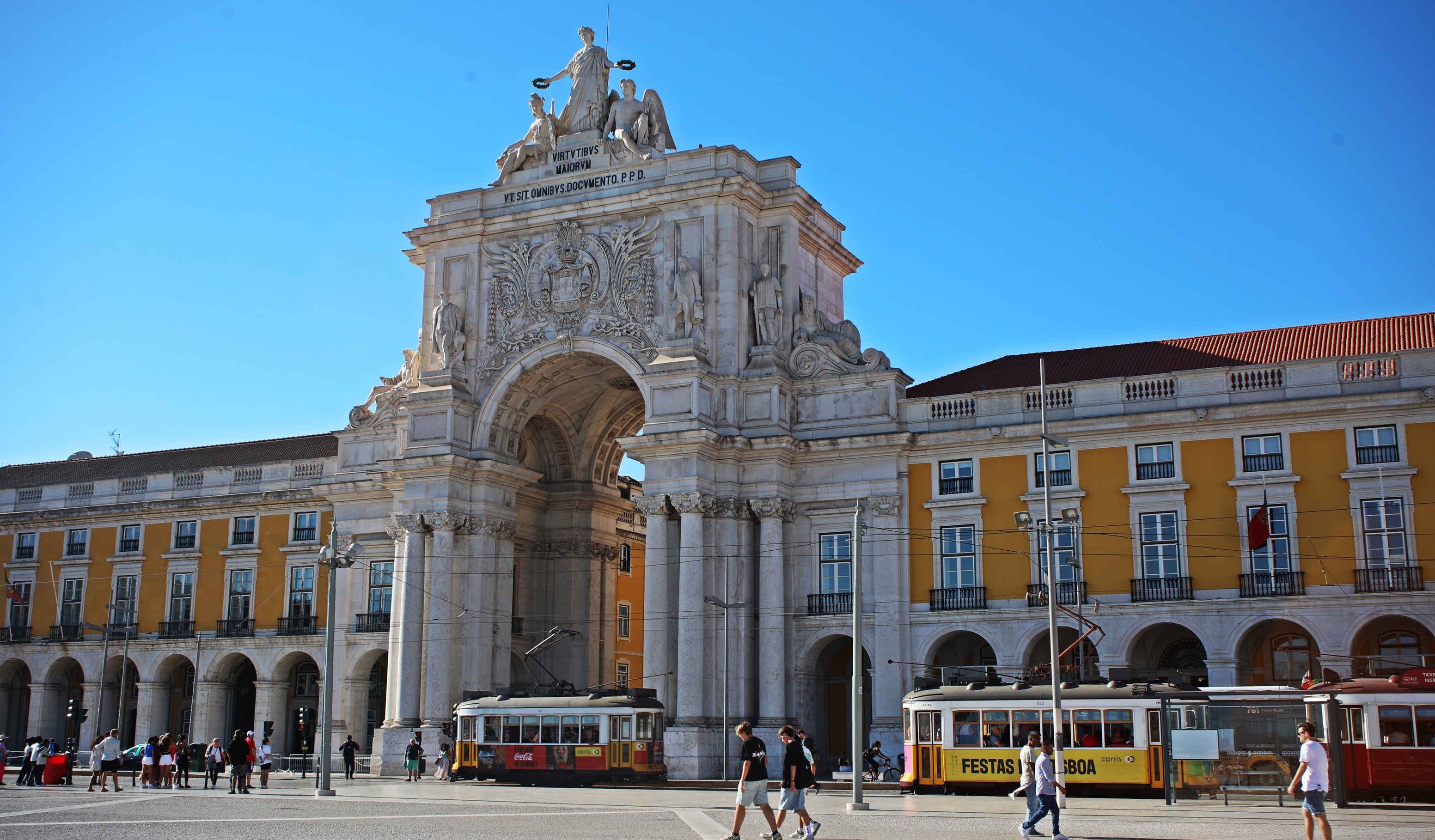
One of the best ways to approach the beautiful Praça do Comércio, is from the pedestrian-only Rua Augusta. At the end of it is the elegant 19th century Rua Augusta Arch (Arco Triunfal da Rua Augusta).

On the other side of the beautiful arch, your view opens up to the stunning Praça do Comércio. Three of its sides showcase elegant, yellow18th century buildings. The third is open to the Tagus River. This used to be the site of the palace for the kings of Portugal, but it was destroyed in the earthquake. As the city rebuilt, a new square for commerce was placed here instead. The square is also called Terreiro do Paço (Royal Courtyard) because of this royal history. In the centre is a statue of King Joseph I, who was king at the time of the earthquake.
We were thrilled to see a few of the historic Tram 28s travel by the square, in front of the historic arch.


Tram 28E
A popular way to travel through Old Town is on a historic tram. These yellow, wooden trams look a little awkward as they slowly amble along the rails. Tram 28E is the historic one, but there are others in the city’s downtown. All tram rides are included in Lisboa Card.
We had initially hoped that we would take at least one ride on the historic tram. In the end we ended up taking them several times. You likely will too, so don’t be too stressed out if there are long line ups. The tram stops at Martim Moniz Square and Miradouro Portas Do Sol often seemed to have long lines, especially around 10 am. In the fall, we only had to walk a block or two along the line to be able to get on a tram. It’s likely much worse in the busy months though, but once you’re on the tram, you can ride it around the route as much as you want.


Praça Dom Pedro IV
A popular square in the historic centre is Praça Dom Pedro IV. This had been the site of markets and meeting places since the city’s early years, but it was mostly demolished in the earthquake. Today the square is encircled by grand 18th century properties that are busy with shops and restaurants.


Explore the Historic Centre on foot
In this large historic city, there are so many more beautiful squares and buildings. After you’ve visited the popular sites, take an afternoon to simply explore the historic area on foot. We often walked between the sites and would stumble across many gorgeous buildings. The historic districts of Barrio Alto, Chiado and Alfama are some of the best neighbourhoods for this aimless walking.


One that we really wanted to see was the oldest bookstore in Lisbon, Livraria Bertrand. To be honest, it wasn’t as nice inside as we had hoped. Not far away is Lisbon’s oldest restaurant Café A Brasileira. It is still a popular spot for a drink or a meal.


Day Trips From Lisbon
If you’re already planning to visit Lisbon, don’t forget to explore the palaces of Sintra, elaborate monuments of Belém and rocky cliffs of Cabo da Roca. You can read what those cities have to offer in our posts A Day in Belém, Palaces of Sintra and Hiking the Trails of Cabo da Roca.
Lisboa Card
If you plan on visiting a few sites in Lisbon as well as Belém and will use public transit, it is worthwhile to consider getting a Lisboa Card. Not only is admission to many sites included, at some sights you don’t have to wait in the long ticket line.
Getting around Lisbon
With narrow streets and winding roads, the best way to get around the city is by using public transit and by walking. If you have a Lisboa Card all public transit is included (trams, metro, buses and trains). We didn’t plan it, but ended up taking the historic Tram 28E a few times to get around the historic district.
The stops and routes for all of Lisbon Transit are on Google Maps and MoovIt. We found MoovIt to be a little more accurate for accurate bus times, but the routes seem to be correct in both. You can also use Uber, but the congestion in the city centre makes it a little cumbersome. If you drive you should probably leave your car at your hotel because there is not much available parking in the large historic centre.
Where to eat in Lisbon
No matter where you end your day of sightseeing in the city, you will be sure to find many patios, called esplanades, and indoor restaurants. Great areas in the city for dining are in Chiado District near the historic Café A Brasileira; or below the castle in Alfama. We stumbled upon a few charming places offering local food for a good price in Alfama. There are also many patios on the pedestrian streets around the Rua Augusta Arch in Baixa district. If you travel a few blocks in any direction beyond the Arch, you will undoubtedly find better restaurants with lower prices.
Where to stay in Lisbon
Public transportation is very efficient so where you stay will be more related to your budget. Generally, the closer you stay to the historic centre, the higher the prices. Trendy neighbourhoods are Baixa, Rossio, Alfama, Bairro Alto and Príncipe Real. Each neighbourhood has a slightly different vibe, but are all safe and easily accessible.
How to get to Lisbon
As the capital of Portugal, Lisbon is easily accessed. It has a large international airport receiving flights from all over the world. If you rent a car, the city is well connected to the rest of the country. There are many toll roads in the country, but there are always alternative, smaller highways travelling between smaller cities. Many of the toll roads do not have pay booths, so if you rent a car, don’t be surprised if you have a few bills to pay in addition to your car rental.
Lisbon is also connected by train to many cities including: Porto, Faro, Braga and Évora. You can also travel by bus to many of the major centres. To reach smaller sites though, trains and buses are difficult options.


This article is now featured on GPSmyCity. To download this article for offline reading or create a self-guided walking tour to visit the attractions highlighted in this article, go to Walking Tours and Articles in Lisbon.
To read more of our adventures in Portugal, click here.
Coming Next – A Day In Belém
For pictures from other blogs go to Gallery at monkeystale.ca
To read about more of our adventures go to Destinations.
If you like what you read, please comment or share (with credit) using the links below.




We’d love to hear from you, please leave a comment.