By taking a journey through the cities of Elvas & Évora, you are sure to find examples from their rich heritage around every corner. Castles and forts were built to protect these cities so that today we can stand in wonder at their historic churches and heritage homes. Located not far from the Portuguese-Spanish border, the cities of Elvas & Évora are waiting for you to visit.

All along this border, castles and fortresses cling to the steep hills, mountains and crags. We will highlight a few of these magnificent castles and their medieval towns and villages. To read about other towns read our posts The Fortified Towns of Monsanto and Marvão. In the coming days we’ll explore Beja, Mértola and Alcoutim.

We were 6 km outside of Elvas when we first saw the 16th century Amoreira Aqueduct. As it neared the city, the aqueduct became more and more elaborate with four levels of arched windows. It became even more picturesque as it rounded a corner to make its way to the castle on the hill above.

It is a remarkable 8.4 km long and brought needed water from the Xévora River. It may have been functional, but it is also beautiful.

After seeing the aqueduct, we were even more excited to see what lies behind the city walls of Elvas. We entered the old town through a set of fancy gates called Corner Gates (Porta das Esquina). We thought the first one was pretty until we saw the inner gate. Its black and white marble base is topped with a cute chapel. It was so pretty that we walked up to see it from the upper level too.

Upon seeing Corner Gates, we understood how the fortified city of Elvas achieved its UNESCO World Heritage Status.

Inside these gates we were surprised to find a fully functioning town, rather than a small space with tourist hotels and shops. Not every building has been restored, but it appears that every single building is historical. With arches built high above the narrow lanes, it feels as if not much has changed in this medieval village.

A secret alley leads from the homes to the castle. Today it is signed but in the day you wouldn’t know how to get through the maze of streets. The Moors originally built a castle on this site on top of an old Roman structure. It was eventually captured by the Portuguese in the 13th century. There’s not a lot to see inside Elvas Castle, but its outer walls still have a prominent position on top of the hill and allowed us to see the walls surrounding the old city below.

From the castle on top of the hill, follow a winding road down to the newer section of the historic town. Still inside the fortified walls is the busy Republic Square (Praça da República). The typical Portuguese black and white tiled flooring in the square is bordered by lovely heritage buildings including the old city hall and Old Cathedral. The fortified church was the city’s cathedral until the late 19th century. The square is a popular meeting place and its patios were filled with locals and tourists enjoying the atmosphere.

The surrounding streets are home to more wonderful buildings. Many of the heritage buildings in this area have been modernized at street level and house shops and services for locals rather than tourists. It is a very nice part of the city.

The wall surrounding this large Old Town is fantastic. Originally built by the Moors in the Middle Ages, it was rebuilt by the Portuguese in the 17th century. We had already seen Corner Gate at the top of the hill. At the base of the hill we found another double gate. Oliveira Gate has two gates with a dry moat and an old drawbridge in between.

Since Elvas is roughly 15 km from the border, the Portuguese King built two forts on either side of the city to protect if from invasions from nearby Spain.

We first saw Graça Fort (Forte de Nossa Senhora da Graça) from the top of the walled city. Now we were standing at its only entrance which also has a double gate. The outer entrance to Dragon Gate, has a dragon sculpture above the entryway. The inner gate is even more elaborate with carvings of two knights.

An old battery was first built on this spot in the 17th century around an even older chapel. In the 18th century, a large bastion fort was built to better protect the city from Spanish invasions. It was built in a pentagon shape to eliminate blind spots.

Inside Dragon Gate is a long corridor that takes you to the many rooms inside of the star shaped Fort.

In the centre of the fort is the two story Governor’s home. It’s a round building with many rooms and offices that all have windows overlooking the fortress grounds and barracks. The best part is the rooftop veranda that lets you see the the land around the fortress and across to Elvas Castle on the hill.

On the other side of the city is the 17th century Fort of Santa Luzia that was built to protect the city from Spanish invasions. Its star shaped walls surround cisterns, barracks and a Governor’s House. Today it is used as a military museum.

As we drove away from the city we looked back for a great view of Elvas and Graça Fort on a hill behind the city.


As we said earlier, there are many castles along the border with Spain. Driving to Elvas and Évora we passed the castles of Portalegre and Estremoz. Further on, the rounded buttresses of Evoramonte Castle enticed us to make a quite stop.  


While driving around the Alentejo region of Portugal, the highway took us by many cork oak forests. Portugal is the number one supplier of cork to the world, and this region is responsible for most of it. In fact 50% of the cork that is sold worldwide, comes from Alentejo.

We had never seen harvested cork trees before, but as soon as we saw the unusual trees, we knew what we were looking at. Thick bark had been stripped from the tree trunks but not from the branches, making them look a little awkward. The trees are numbered with the year the cork was stripped because trees are only harvested every 9 to 12 years.


With a long history of civilizations living in this region, there are still a few remnants of the Roman’s occupation. The first one we saw was Porto do Moinho de Vento (Windmill Gate) where the Roman and medieval walls meet. 

In the middle of Évora you can find the 1st century AD columns of Temple of Diana. These Roman ruins are part of the reason Évora’s historic centre has received UNESCO World Heritage Site status.

The remaining heritage buildings in Évora’s Old Town are mixed in with more modern structures, but there are enough historical ones to still make it a great place to visit.

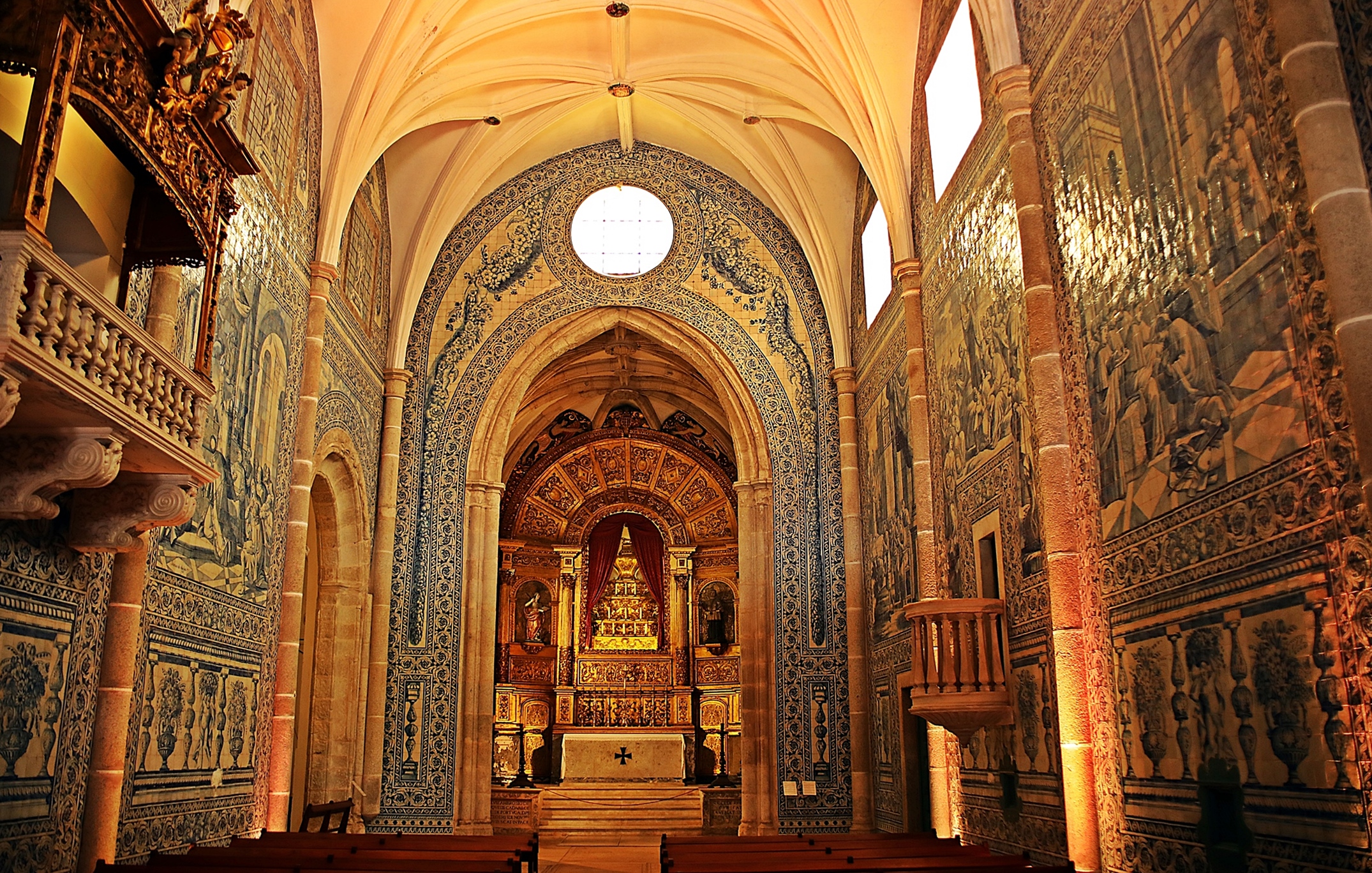
At the side of the Roman temple is the 15th century church of the Convent of Lóios (Convento dos Lóios).  With floor to ceiling azulejos, this church is said to be the prettiest in Portugal, and we have to agree. The church was part of a convent which is now a hotel. It is connected to the 14th century Cadaval Palace, a private residence.

The 13th century castle-like Évora Cathedral (Sé de Évora) is magnificent. Composed of granite, the front entry way has a recessed door decorated with tall statues of the apostles below a stained glass window.

From the back, its crenalated roofline, steeples, rose window and towers add interest to the building.  Our favourite thing to do in Évora was to climb to the top of the tower for a closer look at this great roof.

From the roof you can see that Lantern Tower has turrets that are replicas of the tower itself.

If Évora Cathedral looks massive, that’s because it is. In fact, it is the largest medieval church in Portugal. Because of its size, its tall stone walls and vaulted ceilings make it difficult to photograph, so we searched for small decorations. We found our favourite feature hanging on the wall. An Iberian organ from 1544 is the oldest organ in Portugal that is still operational today.

A little further away is the small, but creepy, Chapel of Bones (Capela dos Ossos). When we walked into the chapel we couldn’t believe our eyes. Almost every square inch of this chapel is covered in bones. Human bones. Having worked in health care for many years, I was easily able to identify the bones that are somewhat artistically arranged on the walls, pillars, and moldings. Hundreds if not thousands of bodies cover these walls. 

Built in the 17th century, it was dedicated to the worshipping of holy souls in purgatory and is a part of a larger Franciscan complex. The belief is that the bones were from the cemeteries of the convent, church, and even the general cemetery. The Franciscan monks and laypeople apparently chose these graveyards knowing the fate of their bones. A St. Francis prayer says that ‘it is by dying that one lives for eternal life’.

Feel free to skip past the pictures if they make you feel queasy.

Not far from Évora are the ancient monoliths Cromlech of the Almendres. These standing stones, or menhirs date back to 6000 BCE and are believed to the be largest collection in the Iberian Peninsula.

The monoliths are at the end of a 3 km gravel road which we thought would be a short side trip. That is until Google Maps told us it would take 30 minutes. We thought the app must be wrong, but unfortunately, the road has more deep potholes than it does drivable road. It did take at least half an hour to the cover 3 km. The sun was getting lower and lower on the horizon and we were a little worried that we may arrive after dark. As it was the low sun gave the standing stones a haunting feel.

Because of the condition of the dirt road, it is not recommended to go if it has recently rained.

Both cities are reasonably easy to access from Lisbon. There are direct buses to both cities. As well you can reach the cities by train, although for Elvas it involves a transfer. From other regions though, they more difficult to reach by public transit. Driving to both cities is usually the easiest. The highways are single lane and wander through the countryside, but allow you to see more of this area’s wonderful landscape.

Map of Southern Portugal
Read from another device.

To read more of our adventures in Portugal, click here.

Fediverse reactions

74 responses to “A Journey Through Elvas and Évora’s Rich Heritage”

  1. Fascinating post, Maggie. Amazing historical sites – I understand why UNESCO has named them. And it looks as if there weren’t too many other visitors around. It must have been great to wander without concern for crowds or crowded conditions. Cheers.

    1. We didn’t find many crowds outside of Lisbon, Porto and Algarve, which was great for us. All of these border towns were great to explore and each offered something different. Thanks Lynette, Maggie

  2. Lovely historic architecture! A fine post!!

    1. Thanks so much Indira, Maggie

  3. An area well worth preserving and exploring. Is there historical significance to so much yellow colour being used on exterior and interior of the buildings. That Chapel of Bones is creepy to the max. That puts a new spin on the real estate saying…that building has good bones. Have a great Friday Maggie. Allan

    1. I couldn’t find anything about all of the yellow in Elvas. Theories are bugs or just tradition, it does make it more cheery. Ha, yes, the chapel has good bones 😊 Maggie

  4. The intersections of ancient Roman architecture with later styles is fascinating. The Amoreira Aqueduct appears to have been inspired by the Roman system of aqueducts.

    1. I imagine the aqueduct was Roman inspired, but they took it to a new level. I love it when the older structures like the Roman walls are still being used and incorporated into the next generation. Thanks Swabby, Maggie

  5. Wow, that first shot is stunning, but then there are so many others to follow it! I love the look of Elvas in particular but everything here looks really worth seeing :)a

    1. There was so much to see between these two cities, and there’s so much history in each. The church is a jaw dropper for sure 😊 Thanks Sarah, Maggie

  6. Convent of Lóios is phenomenal-the Chapel of Bones a stark contrast. It reminds me of the Killing Fields of the Khmer Rouge. It’s just amazing to see so many medieval structures still standing strong-kudos to Portugal! 🙂

    1. It is strange that these two churches with completely opposite decor are in the same city. Portugal has done well to maintain and restore its heritage buildings. You can spend a lifetime visiting them. Thanks Nancy, Maggie

  7. Interesting… as always a great post!!

    1. Thanks Jyothi! Maggie

  8. So much beauty and interesting places to see. The opulence of the Convent of Lóios is breathtaking, and the Chapel of Bones is just….creepy in a super awesome way. I also love the aqueduct, there is just history everywhere – I really need to get to this part of the world!

    1. There was so much more here than we expected. We almost wondered if we should visit, but wow, I’m glad we did. Thanks Hannah! Maggie

  9. Thank you so much for sharing another wonderful post, dear Maggie. I found it fascinating, really informative and supported by fantastic images.

    Even though I have visited Portugal, these are places I did not know at all. 💞

    1. There are so many rarely visited and yet absolutely fascinating places in Portugal. Glad you enjoyed these two. Maggie

      1. It was a real pleasure (and a fascinating discovery) to read your fabulous post, dear Maggie 🌹

  10. You’ve convinced me that I need to go back, Maggie! Evora was one of the first inland cities we visited when we first came here, and Elvas was almost an afterthought because I was smitten with Monsaraz and the Alqueva Dam. We saw the aqueduct but I think the castle was closed and we didn’t go inside. For a small country it doesn’t do badly for great sights, does it? We’ve still got some exploring to do.

    1. We kept having to make our Portugal list longer, and yet, our rental car return date was set! We enjoyed Evora and Elvas a lot more than we expected, there’s so much to see in each. Did you go on the cathedral roof? If not add it to your list, it is a great roof. Maggie

      1. It was cold in the October time when we were there, Maggie, so we didn’t. Will keep it in mind.

  11. Very interesting post, Maggie, and spectacular photography. There’s a bone church in Faro as well. It’s also quite creepy, but interesting too.

    1. Yes, we opted not to go to the one in Faro because this one was more than enough 😊

  12. […] can read about the other border cities in our posts: A Journey Through Elvas and Évora’s Rich Heritage; Beja, Mértola and […]

  13. When it comes to exploring the Alentejo region, you can’t miss the capital of Évora. I’ve been to the wonderful town a few times and would always recommend people visit it as it is such a charming and historic place. We didn’t go on the cathedral roof but loved exploring the Chapel of Bones, seeing Giraldo Square and visiting Evora University. Thanks for sharing, and have a good day 🙂 Aiva xx

    1. It’s a great city, did you also get to Elbas? We loved it too. Thanks Aiva, Maggie

      1. No, I didn’t make it to Elbas.

  14. Another incredible site, Maggie. Fabulous photos and information, as always.

  15. WOW! You really discovered some gems on this trip. I guess that is the joy of having a car to explore wherever you want. Thanks for yet more inspiration. Mel

    1. I know, Portugal just keeps giving 😊

  16. As always your Portugal posts are blowing me away and definitely making me think of pushing it higher on my must visit list! Which is a huge long list btw lol 😝

    1. I’m sure it’s a very long list, but I think you’d love Portugal! Maggie

  17. 👏🏻👏🏻👏🏻👏🏻👏🏻

  18. Wonderful places! I only got the chance to get to a concert of Cesaria Evora, maybe i will get also the chance to see the town that shares the name 🙂

  19. Such beautiful historic sites. It’s pretty neat how it’s a bit of a maze to find the Elvas Castle. I don’t think I’ve ever seen a cork tree before. The tilework in the Convent of Loios is stunning.

    1. The cork trees are very bizarre with baark only on their limbs. But the star was the convent. Those tiles never get old for me. Thanks Linda! Maggie

  20. Wow, great finds. I don’t find the bones creepy, but interesting. I’m amazed at the Roman ruin in the middle of town. You gotta love that part of the world. Cork trees, 500-year-old functioning organs… it’s all just remarkable!

    1. I found the bones interesting too, but also very creepy when it’s an entire room. It is a remarkable part of the world! 😊

  21. Another fine series of impressive architecture. And after all, since the Reconquest, Portugal has never experienced a war that could destroy what was built. Which might explain this abundance, initially based on colonial wealth.

    1. That’s true, and they still have a large number of forts that are in quite good condition. Thanks for your comment, Maggie

  22. Very nice, Maggie! You were able to see so much! I found the cork trees fascinating! Lori

    1. Aren’t they strange looking?! And entire forests of them. Thanks Lori

  23. Wow, so much to see and appreciate! Thank you, Maggie. Love the photo of the two nuns at Elvas Castle and that yellow earthy color throughout. The Chapel of Bones, not so much. Creepy, yes.

    1. Yes, it is quite creepy, so different from other monuments we visited in this area. Thanks for your comment Michele! Maggie

      1. You’re very welcome and happy new year to you!

  24. First I’m wowed by the aqueduct, and then by Elvas, and then the Convent of Loios took my breath away. Loved the Chapel of bones 😁 — Alison

    1. There’s so much to see in this part of Portugal isn’t there?! Glad you enjoyed it Alison, bones and all 😊 Maggie

  25. […] There are so many castles and fortresses along Portugal’s border with Spain, that we’re showing you them over three posts. To read about some of the other magnificent castles in this region, read our posts The Fortified Towns of Monsanto and Marvão, and A Journey Through Elvas & Évora’s Rich Heritage. […]

  26. Fantastic. I love the Portuguese obsession with decorative tiling, it gives places such a distinctive look, and flair. But that wall of bones is something else entirely, isn’t it. Quite unique. Portugal gave you an endless run of great sights, great places and beautiful scenery.

    1. I never got tired of seeing the amazing tiling in Portugal. I still gasped in awe, up to the last day. The wall of bones made me gasp in a different way. I found it fascinating, but it is a little creepy. So much to see in Portugal 😊Thanks guys, Maggie

  27. Stunning architecture. I’m impressed. In fact, more people should visit these cities rather than just Lisbon or Sintra. Thanks for sharing.

    1. I know Arv, there is so much more to the country than Lisbon, in fact it’s not in our top 5 places in the country. Thanks for your comment, Maggie

      1. I love the architecture of these old cities in Portugal and they seem so calm and quiet.

  28. I don’t think I had seen pictures of cork trees before. How interesting! Évora really looks like my kind of place, one where I can easily spend hours just marveling at the old structures. The fact that the Convent of Lóios sits right next to the Temple of Diana shows how much the locals appreciate the beautiful things at the heart of their city. But the cathedral and Capela dos Ossos all together make Évora such an intriguing place. I hope I’ll get to visit one day!

    1. Seeing an entire forest of harvested cork trees feels like a fantasy world. They’re very awkward looking. Évora has such a variety of sites, and all so close together. You would love it! Happy 2025 Bama, Maggie

  29. Another gem you got to explore in Portugal. This area is definitely on our list for a return trip. Excellent post!

    1. This part of Portugal is well worth a visit. Not as many make it to these cities, making them even better.

  30. theres something so intriguing about a chapel full of bones, isnt there? its like you feel you shouldnt, but you WANT to visit!

    1. I know! And it’s creepy and fascinating all at once! 😊

  31. Thanks for reminding me of being in the cathedral in Evora with my school choir when they were giving a concert there. When they were rehearsing I took a quick walk through the town. Magical.

    1. Oh, what a great way to experience it! Glad we could take you back 😊 Maggie

  32. Very interesting tour of this area. I love how yellow is used throughout- not overpowering but very subtle and pretty. The convent is stunning! I am always fascinated by bone chapels and how they can be both beautiful and a little creepy all at once.

    1. They are fascinating and creepy at the same time aren’t they. It seems so opposite to how I think a church would be decorated too! Thanks for catching up on so many posts Meg! Maggie

  33. Ohhhh found your post on Evora. The other city Elvas is so similar in the architecture. I would have mistaken it for Evora if not for the picture tags. Such pretty cities with so much to explore. I found the chapel of the bones fascinating!

    1. It was creepy and fascinating all at once 😊

  34. […] and town, click on the link to the following posts: The Fortified Towns of Monsanto & Marvão; A Journey Through Elvas & Évora’s Rich Heritage, Discover The Medieval Castles of Beja, Mértola & […]

  35. I still remember the first time I saw a chapel of bones in Germany. It’s definitely an impression and a mental image I will never forget. I think people had a different attitude toward death and physical remains when these were “in fashion.”

    1. It is a very bizarre place and I find it very strange that it is a church. But yes, very different times. Thanks Tanja

  36. […] A Journey Through Elvas and Évora’s Rich Heritage (a travel essay with photos by a new visitor here) […]

  37. […] The star shape reminded us of the forts in Elvas, Portugal. You can read about the forts in our post A Journey Through Elvas and Évora’s Rich Herirage. […]

We'd love to hear from you, please leave a comment.

Destinations

Discover more from Monkey's Tale

Subscribe now to keep reading and get access to the full archive.

Continue reading