
Woven through the streets of Córdoba’s historic centre are the legends of its past. Captured inside its old city walls are fabulous buildings that tell these tales. Although most famous for its Mosque-Cathedral, there are many more treasures to find when you explore these historic streets.
Córdoba’s location on the Guadalquivir River, only 145 kilometres (90 miles) upstream from Seville, gave it an ideal position for centuries. Not only was it on an important navigable river, it was also surrounded by fertile land. Only a few remains are left from the Romans and Visigoths, but the city’s next resident left much more. It was the Moors who established it as a major centre in the 8th century. The city’s name may have originally come from the Phoenicians, but the Moors called it Qurṭubah.
The Moors settled throughout the Andalucía and, for a while, Córdoba was its capital. Under their rule, Córdoba was considered one of the most educated cities in Europe. In the 13th century, the Castilian King conquered Córdoba, Seville, Jaén and most of Andalucía. What we see in Córdoba today is a blend of this long history. Some of this mixture works well together, while in other areas, the different styles seem to be at odds.
The Mosque-Cathedral of Córdoba (Mezquita Catedral de Córdoba) is undoubtedly the most popular site in the city. First, we’re going to explore the rest of the city, and present the iconic building in its own post. You can read about the mosque-cathedral here. (Coming Soon)

Come with us as we see what else there is in the fascinating city of Córdoba.
Alcázar of the Christian Monarchs
The name of the fortress, Alcázar of the Christian Monarchs (Alcázar de los Reyes Cristianos), doesn’t even give a hint to its previous owners. In fact, it has a very long history. When the Moors captured Córdoba from the Visigoths, they significantly expanded the former Roman fortress. It became the Moors’ official seat of power in Andalucía and remained so for a couple hundred years. It was mostly abandoned in the 11th century so was in extremely poor condition when the Spanish arrived in the 13th century.
The Spanish restored and expanded the complex, making it the residence of the royal family for awhile. Later, it was a seat in the Spanish inquisition. The outer walls of the alcázar are in very good condition and give it an impenetrable look.

A portion of it is open to visitors including one of the four towers and the extensive gardens. At first, the complex was a little underwhelming. You have to walk through a few plain rooms on the ground floor before reaching the Hall of Mosaics. Here, adjoining rooms display gorgeous Roman mosaics that were discovered in various mansions throughout the city. Today the mosaics hang on the walls, making it easier to appreciate the artwork.


From the Hall of Mosaics, climb up the steps of Lions Tower (Torre de los Leones). It is the oldest of the four towers and has three different levels, each with a small patio. From them you have wonderful vistas of the garden, the other towers and even parts of the old centre. It was the view of the Great Mosque-Cathedral though, that made us excited to see it the next day.
Only a limited number of people are allowed in the tower at once, so there is likely to be a line-up.


Tributes Tower (Torre del Homenaje) also called The Keep, may be open to the public in the spring of 2025.
Another tower that you see from the grounds is the Inquisition Tower. It received this name because it was used to store Inquisition archives. It’s the rounded tower in the picture below.

After exploring Lions Tower, don’t forget to walk through the large garden you saw from above. Even though it’s in the middle of the city, the manicured hedges, flowers and fountains make it a tranquil place.


Royal Stables
Immediately beside the Alcázar are the Royal Stables (Caballerizas Reales). In the 1500s, Spanish King Felipe II’s goal was to breed the perfect horse. These stables were built to help achieve that dream.
Today, Andalusian Horses are considered prize horses, and the historic stables are used for training and competition. We were lucky to arrive on the day of a dressage competition. One event had just ended, and an awards ceremony was taking place. Other riders and horses were warming up for their upcoming competition in a neighbouring room.


Roman Bridge
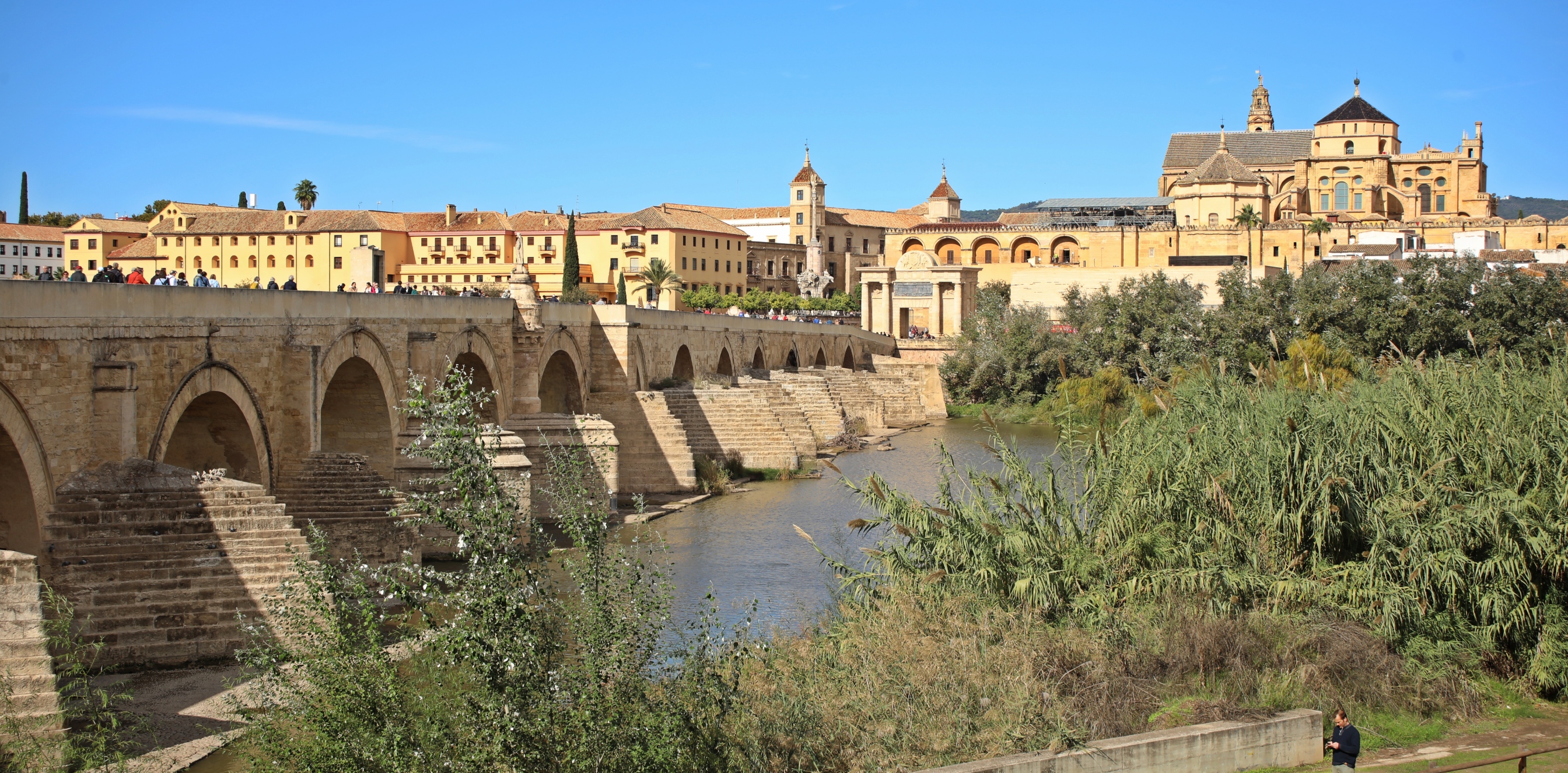
The alcázar and cathedral sit along the edge of the Guadalquivir River. Spanning across it is the picturesque Roman Bridge. While a stone bridge did cross the river in the 1st century BCE, that bridge has been reconstructed many times. The current one is said to be from the Middle Ages, so although not Roman, is is still quite old.


Triumph Square
In front of the bridge is Triumph Square (Plaza del Truinfos). One of its monuments is Puerta del Puente (Bridge Gate) which was part of the original city wall and was remodelled in 16th century. It used to be open to visitors, but is currently closed.

Another occupant on the square is the ornate Triumph of St. Raphael of Bridge Gate (Triunfo de San Rafael de la Puerta del Puente). St. Raphael is said to have saved the city from a plague in the 17th century. Apparently, there are triumph statues and fountains throughout Córdoba, but we didn’t find any others.

On the far side of the Roman Bridge is Calahorra Tower (Torre De Calahorra). The original Moorish structure had two towers on either side of an arched gate. In the 1300s, a new tower was built, resulting in one large building. Much later, it was used as a prison and then a girls school. Today, it houses a museum dedicated to the city’s history.
From the tower, you have a great view of the old city including the Great Mosque-Cathedral looming above.


You can see a few old mills when you walk along the river. The 14th century Albolafia’s Mill (Molino de la Albolafia) is the oldest and sits in front of the alcázar. It was used to bring water to the fortress by way of an aqueduct.

City Walls
After visiting these popular sites, spend some time exploring the city walls. When the Spanish arrived, the original Roman and Moorish-built walls were in disrepair and had to be rebuilt. As you walk between the many gates, you’ll realize how large the walled city was. The wall is 9 km (5 miles) long, so don’t expect to walk the entire perimeter.


Heritage Quarters
Not only does Córdoba have magnificent buildings, but its heritage centre is filled with charming street scenes. Walking between the big sites is half the fun of visiting the city. One of our favourite neighbourhoods was San Basilio. The pretty whitewashed buildings are said to have been homes for the staff of the Alcázar and Royal Stables.


In this same neighbourhood, you’ll find Patios of Córdoba. With temperatures reaching the 40sC in the summer, it is the hottest city in Spain. Because of this, Roman rulers mandated that all buildings have patios with gardens and plants to help keep the temperatures more moderate. That custom continued for centuries and now there still are a few complexes with lovely garden courtyards, called patios.
Some have small artisan shops around the edge of the patios so are free to enter, but others charge a fee. It’s a nice idea, but they aren’t overly elaborate gardens to be worth paying an admission fee.

Not far from San Basilo is the Jewish Quarter. Jews settled in this neighbourhood in the 10th century. They continued to live there for 400 years until the Inquisition when most were forced to leave. The lanes are narrower, and the houses are a little more subdued, but it is a great part of the city to explore on foot.


Further out, the medieval city seamlessly transitions into 17th and 18th century squares. Here we found wider streets, taller heritage buildings and something a little different. One of the only remains from the Romans can be seen in this part of town. Roman columns with Corinthian tops from an old temple stand next to a busy commercial street.


This district spread over many blocks and as we continued to walk we found many lovely streets, but very few tourists.


How to get to Córdoba
Located only 145 km (90 miles) from Seville, Córdoba is quite easy to reach. There is a good freeway between the two cities if you have your own car. Otherwise, trains run frequently between the two. It’s also connected by train and good freeways to Granada (200km/125 miles), Málaga (170 km/105 miles) and Jaén (110 km/70 miles). As well, there is an international airport receiving flights from other parts of Europe.
You can find Córdoba in the middle, near the top of the map below. Click on the map to expand.

Where to stay and eat in Córdoba
There are many options for small, local hotels and apartments in the historic district. Most will not include parking though, so consider this if you have a car. Otherwise, you can find a selection of accommodations in the neighbouring communities and still be only a short walk away.
Córdoba is accustomed to having tourists and there is no shortage of restaurants around the cathedral and alcázar. Because it is the tourist centre, they tend to have more flexible dining hours, but will be more expensive. Even a few blocks away, in Plaza de las Tendillas we were able to find very good, local restaurants with reasonable prices.


This article is now featured on GPSmyCity. To download this article for offline reading or create a self-guided walking tour to visit the attractions highlighted in this article, go to Walking Tours and Articles in Cordoba.
To read more of our adventures in Spain, click here.
Coming Next – Visiting The Mosque-Cathedral of Córdoba
For pictures from other blogs go to Gallery at monkeystale.ca
To read about more of our adventures go to Destinations.
If you like what you read, please comment or share (with credit) using the links below.




We’d love to hear from you, please leave a comment.