
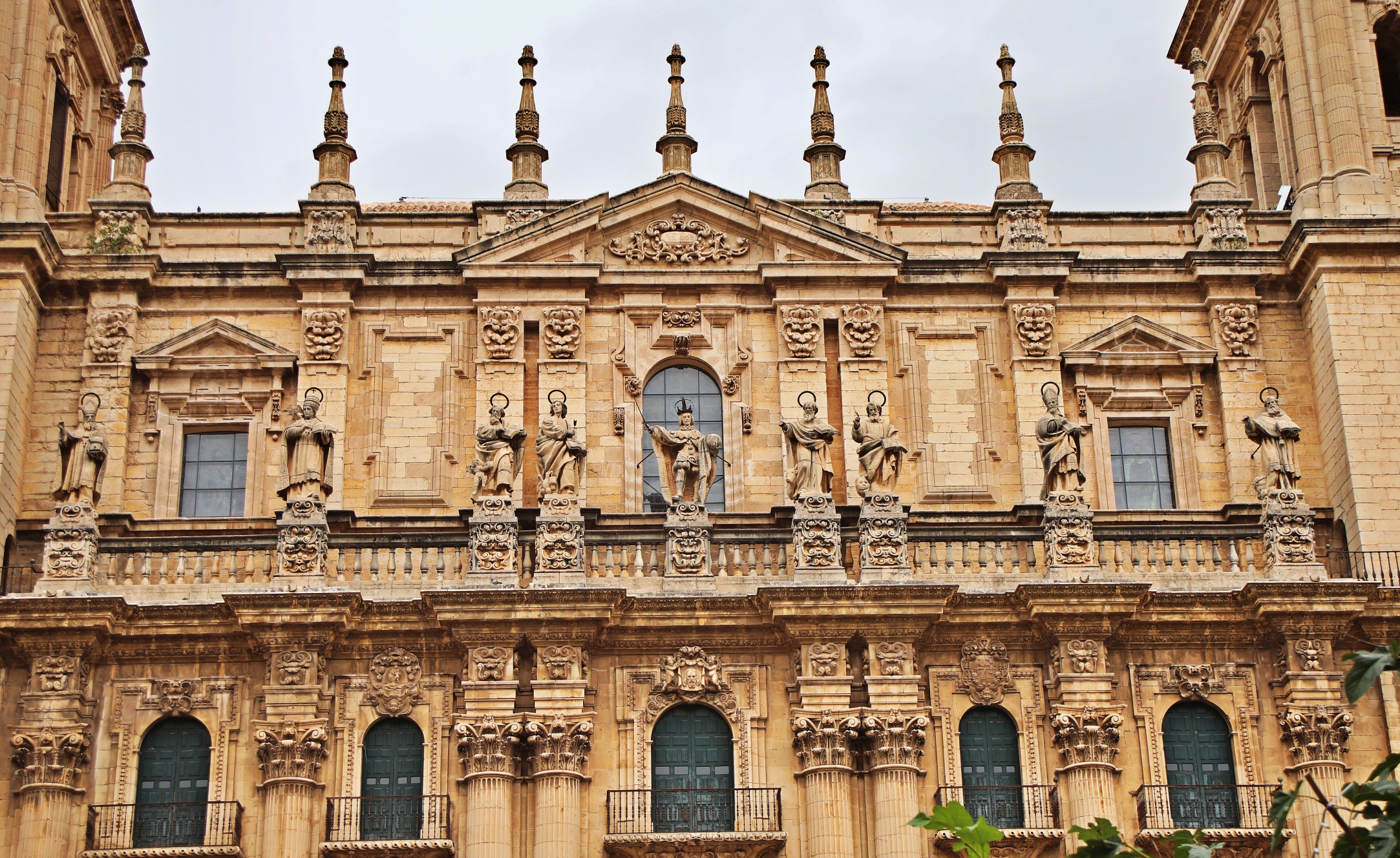
The most famous monument in Jaén is its cathedral. Once you see it, you will understand why it is so celebrated. Calling it ornate is an understatement. From the multiple statues on its façade to the intricate details on its ceiling, Jaén Cathedral will impress anyone who visits.
The capital city is in the middle of olive paradise. The Guadalquivir River meanders its way through Jaén Province creating a fertile valley, perfect for growing olives. There are said to be 65 million olive trees in this small province. Driving through the region, we were never far from large olive groves.


As we approached the city, we were surprised and excited by its unique location in the saddle between two hills. For a capital city, Jaén has a more interesting setting than we expected.


Even though it was occupied by the Moors for hundreds of years, there’s not a lot of Moorish influence left in Jaén. In the 13th century, Christian kings successfully conquered the city. This put Jaén near the border of the Arab and Christian kingdoms for a couple of centuries. The city is not often visited by tourists and doesn’t have as many sites as other Spanish capitals, but we were able to find a few interesting ones in its historic downtown.
Jaén Cathedral
Its main attraction is a showstopper. Jaén Cathedral (Catedral de la Asunción) was first built in the 14th century, but was completely remodeled in the 16th. The rebuilding was led by architect Andrés de Vandelvira, who transformed the Gothic church into a masterpiece. He is the same architect that designed many buildings in nearby Úbeda and Baeza. A statue of him sits outside the cathedral in Santa Maria Square.


The cathedral’s façade looks like it belongs on a theatre rather than a church. Life-sized statues stand atop tall columns above the door. The columns without statues are topped with ornate Corinthian capitals. At the centre, is a statue of King Ferdinand III of Castile holding an orb. These statues were added in the 17th century as a tribute to the man who was king during the Reconquista.


Inside the main chapel the grand designs continue. Tall columns lead your eye up to the spectacular ceiling. Each dome has a different stucco moulded design.


In the centre, the choir has sculpted wooden seating as many of them do, but this one has unusual details. Each chair arm is decorated with a different sculpture. Some are animals, others are saints. Each seems to tell a story.


The cathedral also houses the Veil of Veronica, a religious relic. It is said that the face of Jesus became imprinted on it after he used it to wipe his brow when carrying the cross to his crucifixion. The veil is displayed inside a 3D frame with painted angels that appear to hold up the veil.
There are four other veils in the world attached to the same legend, each claims to be the authentic one.

After viewing the nave, climb to the upper balconies where you are treated to lovely views of the surrounding olive tree-covered hills.

This church is said to have inspired the designs of cathedrals in Mexico (Mexico City, Puebla, Morelia, Guadalajara) and Peru (Lima, Cuzco). Looking back to our pictures from those cathedrals, we can see some similarities.
There are other gorgeous buildings on Santa Maria Square, but they don’t get much attention when competing against the spectacular cathedral. Across from the main entrance of the cathedral are Palacio Episopal and City Hall.

Arab Baths
One of the only reminders of the city’s Moorish roots can be found in the basement of the Palace of the Counts of Villardompardo. This 16th century mansion was built atop 11th century Moorish baths. Although they are called Baños Árabes (Arab Bath House), there were likely Roman baths on this site even earlier. When the Christians arrived, they used the baths as tanneries before abandoning them. They were covered when the mansion was built and only rediscovered in the early 1900s.
There’s not much left, but you can tell they were built by the Moors by the horseshoe-shaped arches. Entry is free.


Santa Catalina Castle
Santa Catalina Castle stands alone on top of the steep prominence above the city. The first fortress was built by the Moors and was expanded by Spanish kings. Unlike most other Spanish sites, the old town did not build homes on the slopes beneath the castle.
Today, the castle is mostly a shell. Only a small section has been rebuilt to house a Parador hotel. Anyone can walk around the newly restored walls, but you can can’t get beyond the hotel’s lobby and restaurant if you’re not a guest.


The castle straddles a rocky ridge on top of the hill. The best part of visiting the castle is to walk to the end of the ridge for sweeping views of the city and hilly landscape.
Note – If you drive, parking is not allowed on site. You must park on the streets below. The parking lot at the top is reserved for hotel guests.


As we wandered through the city we found a few other nice buildings and parks, but not as many as other Spanish capitals we visited.


Where to stay in Jaén
We chose to visit Jaén on a day trip from our Cave House in Pegalajar, but there are many hotel options in the city too. Try to find accommodation within walking distance of the cathedral because that is where the majority of sites and restaurants are located.
How to get to Jaén
The nearest airports to Jaén are in Granada and Málaga. It is not far from the railway line between Almeria and Madrid as well as the one to Córdoba. A change is required to travel to Seville, Cádiz and Málaga. If you have a car, Jaén is easily accessed on good highways. Parking in the city’s downtown is limited, so park before reaching the city centre.
Jaén is in the upper middle of the map below. Click on the map for an enlarged view.


To read more of our adventures in Spain, click here.
Coming Next – Best Day Trips From Jaén – Úbeda and Baeza
For pictures from other blogs go to Gallery at monkeystale.ca
To read about more of our adventures go to Destinations.
If you like what you read, please comment or share (with credit) using the links below.






We’d love to hear from you, please leave a comment.