
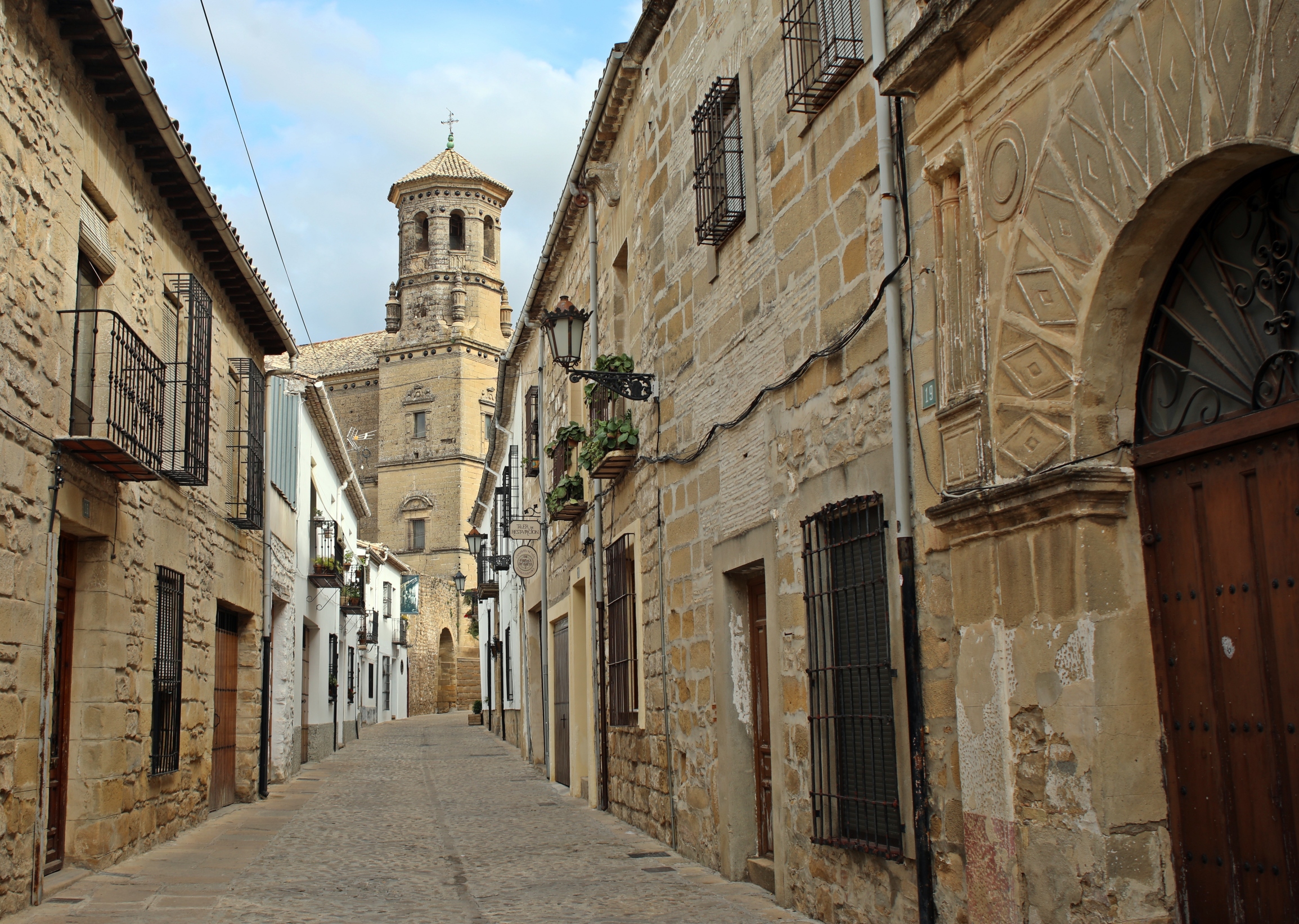
Given their remote locations, these two small cities have much more to see than you would expect. The old quarters in Úbeda and Baeza are filled with extravagant buildings and have interesting histories to match. Once you step inside their magical centres, you’ll know why they are UNESCO World Heritage Sites. Both are only a short drive from Jaén and make great day trips from the city.
Úbeda
Located on a plateau in the Guadalimar Valley, Úbeda was first settled in the 9th century by the Moors but became Spanish in the 13th century. That meant, for a couple of hundred years, Úbeda and the neighbouring town of Baeza, were frontier towns. They sat on the border between Muslim and Christian lands.
Plaza Vázquez de Molina
During the 16th century, the city gained prestige due to its connection to King Carlos V. A boom followed and soon the town centre was filled with elegant buildings. Today, Úbeda is famous for its many Spanish Renaissance-style buildings from that period. A few can be seen in Plaza Vázquez de Molina in the city’s historic district.
On one side of the plaza is its namesake, Vázquez de Molina Palace. Guarded by two stone lions, the palace was home to Juan Vázquez de Molina, privy secretary of King Carlo V. Later, it was converted into a convent for Dominican nuns. Today, it is used for City Hall archives.


Across from the palace is Basilica Church of Santa María of the Royal Alcázares (Basilica Iglesia Santa María de Los Reales Alcázares). The church was built in 1233 over a mosque and part of the Moorish alcázar. Long before that, a Roman temple stood on this spot. The church went through several transformations since the 13th century resulting in a mix of many architectural styles. Unfortunately, the large fortress-like church was closed when we visited.


In the rest of the square, several other extraordinary historical buildings fill the space between orange and cypress trees. One is the striking Holy Chapel of El Salvador (Sacra Capilla del Salvador). Not long after work began on the chapel, the first architect left the project to design Granada’s Cathedral. The job was taken over by his stone mason Vandelveira who went on to design many of the important buildings in Úbeda as well as in Baeza. His masterpiece is Jaén Cathedral.


Vandelveira was obviously influenced by his predecessor. You can see the similarities in the designs by looking at a door from the chapel and one from the cathedral in Granada.


Beside the chapel is Palacio del Deán Ortega. It is now a Parador; luxury hotels operated by a branch of the government. This building and Vázquez de Molina Palace, that you can see in the background, were also designed by Vandelveira.

Úbeda’s location near the region of Castile meant that its buildings were not constructed in the typical whitewashed styles we saw throughout Andalucía. Instead, these Renaissance buildings have stone walls. This detail became obvious as we walked along the cobbled pedestrian streets where stone buildings with wrought iron balconies are the norm. It did give the town a different look and feel from the others we recently visited.


Plaza 1 de Mayo
The pedestrian walkways brought us to another large plaza. May 1st Square (Plaza 1 de Mayo) is surrounded by historical buildings and was the site for markets, festivals and bull fights for years. One of those buildings is Old Town hall.


At the head of the square is San Pablo Church (Iglasia San Pablo) which was built on the site of an old mosque. The front entrance has a gorgeous recessed portal from the 16th century, but the original building is from the 13th. None of the old mosque remains.

Mirador del Salvador
Not only is Úbeda a lovely city, it also has a wonderful setting. From Mirador del Salvador in the city’s downtown, we looked across the Úbeda Hills to see a land blanketed in olive trees. The province of Jaén is the largest olive grower in Spain.

Baeza
Less than 10 km away is another enchanting medieval city. Similar to Úbeda, Baeza was a 9th century Moorish town taken over during the Spanish Reconquista in the 13th century.
City Gates
The main entrance to the historic quarter is through the double-arched Jaén Gate and Arch of Villalar (Puerto Jaén, Arco de Villalar). The original Moorish wall that once stood here was torn down after the Spanish moved in. The gate was built in its place to show that they were now in control of the city. Arch of Villalar was added by Carlos I after defeating Castilian rebels.
On the other side of these arches is Pópulo Square. It is often called Lions Square because the fountain in the centre is surrounded by lion statues. They are not in very good condition anymore, barely looking like lions at all.


If you don’t enter the town through this gate, another option is to go through the less ornate Gate of Úbeda. On the way, you will pass Aliatares Tower (Torre de los Aliatares). It is not only one of the oldest monuments in town, it used to be the primary access to the old city.


Baeza’s historic quarter is very charming. It’s not very large, but because of its quaint streets and well-kept heritage buildings, we liked it a little more than Úbeda.


Baeza Cathedral
A mosque originally stood on this site, but was transformed into a Gothic church when the Christians took control of Baeza. Like many other churches, it went through many updates and transformations. The few accents we see today are from the 16th century when Vandelvira, who designed many of the buildings in Úbeda, was in charge of the church’s remodelling.


Inside, the medley of Gothic and Renaissance styles are easily seen. The church’s Renaissance altar was modified to fit under a pointed Gothic Arch. The newer part of the nave also has tall arches, but they are rounded, as was fashionable in the Renaissance era. In the second picture below you can see rounded arched in the foreground and pointed Gothic arches further back.
Another interesting part of the church is the sacristy that showcases a library of old hymn books.


One of our favourite things to do was walk along the alleys behind the cathedral. Ducking under the old arched gates made if feel as if we had stepped back to Medieval times.


Down the street are two buildings with contrasting styles. One is a church that has retained its medieval look. Santa Cruz has an austere exterior that seems more fitting in this old part of town. It was one of the first churches built in Andalucía during the Reconquista.
Not far away is Jabalquinto Palace. This highly decorated 15th century monument is considered one of the most emblematic buildings in Baeza. It is now a university building.


Baeza Mansions
During the Reconquista, many men from Baeza were financially rewarded for their military successes. They used this money to build large mansions. You can see a few of these on Calle San Palbo. This pedestrian street is just outside of the medieval area and in addition to the mansions is home to lovely historic buildings. Some of the mansions operate today as boutique hotels, and would be a lovely place to stay.


Getting to Úbeda and Baeza
Located less than 10 km apart, if you plan to visit one of these cities, you should try to visit both. Úbeda is 60 km from Jaén on good two lane highways. They are also close to our unique cave house stay in Pegalajar. Getting to either city by bus would be difficult.
We drove to these cities from Murcia. On the way we passed fabulous scenery in the Guadalquivir River Valley, including Negratín Reservoir.


Úbeda and Baeza can be found near the top, centre of the map of Andalucía below. Click on the map for an enlarged version.


This article is now featured on GPSmyCity. To download this article for offline reading or create a self-guided walking tour to visit the attractions highlighted in this article, go to Walking Tours and Articles in Ubeda.
To read more of our adventures in Spain, click here.
Coming Next – Explore The Historic Streets Of Córdoba
For pictures from other blogs go to Gallery at monkeystale.ca
To read about more of our adventures go to Destinations.
If you like what you read, please comment or share (with credit) using the links below.





We'd love to hear from you, please leave a comment.