
In the foothills of Azerbaijan’s Greater Caucasus, you’ll find an adorable mountain community with a long history. Between the stunning views, the elaborate Khan’s Palace, and the city’s wonderful historic centre, we think you’ll love discovering the sites in the mountain city of Sheki.
A Brief History of Sheki
It was originally settled in the 8th century BCE by the Sakas from Persia. After them, the rulers of Sheki changed hands several times. By the 1st century AD, Sheki was one of the largest towns in Caucasian Albanian territory. In the 800s, the Caucasian Albanians were replaced by the Arabs, Mongols and then Shirvanshahs, who we first learned about in Baku. Foreign invaders continued through the Middle Ages and included Amir Temur from Uzbekistan. Sheki came under Persia’s Sheki Khanate in 1747, but in the 1800s, the Khan asked Russia to help protect it from invaders. This led to it being a part of Russia and then eventually, the Soviet Union.
Note – Caucasian Albanian translates in English to either ‘land of the brave’ or ‘white man’, depending on your source. They have nothing to do with the country Albania.
In the 18th century a large mudslide devastated Sheki, and the city had to be rebuilt. As a result, not much of this extensive history can be seen and the old city we see today is primarily 18th-20th century architecture. This relatively newer old town though, has an old soul.
Sheki Castle and Khan’s Palace
The main complex to visit is Sheki Castle, which includes the Khan’s Palace (Xan Sarayi). Built under the Sheki Khan’s reign in the late 1700s, the castle grounds are still surrounded by a tall stone wall. Several watchtowers are in place to keep an eye out for intruders.
Castle
The main entrance to the complex is through Southern Gate, an opening in the crenulated wall. Once inside, you can wander throughout the castle grounds for free. It is usually called Sheki Castle, but is also named Nukh Fortress.

Inside, you’ll only find a few of the original castle structures. Most of the buildings are 19th century Russian Military Barracks. Even though they’re not original, they are nice buildings. They were constructed in the local style, which combines stone and brick and their presence makes the castle grounds quite unique. When we visited, one of the original castle buildings and a few barracks were covered in scaffolding because they were undergoing restorative work.
Also inside the castle walls is the picturesque Round Church, also called Nukha Three Saints Church. It was used by Russian soldiers, but some believe the building was originally built much earlier, by Caucasian Albanians. As of 2025, you can not go inside.


The stained glass windows that are prevalent in this area are made with a technique called Shebeke. Craftsmen build the pretty windows by fitting small pieces of coloured glass into a wooden frame. Instead of being held in place by lead inlays, they use hand-made wooden lattice frames with slots that allow the glass to slide into place.
Examples can be seen in the Shebeke Workshop on the castle grounds. It’s called a workshop, but it is really more of a store, with an example of how they are made.

On the hills above Sheki are the ruins of the 8th century Gelarsan-Gerarsan Fortress. It is not easily accessible and is mostly in ruins. It was a first line of defense in protecting Sheki during many invasions and the fortress itself was never conquered. You can visit the fortress, but we didn’t have time.
Sheki Khan’s Palace
At the far end of the castle grounds is the elegant Sheki Khan’s Palace. In front of the decorated building is a large, walled rose garden and two huge sycamore trees.
The palace has a very pretty exterior adorned with mirrored muqarnas, plasterwork in arabesque patterns and colourful eaves. The walls display several Shebeke stained glass windows. From the outside though, you can only see the lattice work, its colours are muted on this side.

The designs outside pale in comparison to those inside. The entire top floor and one room on the main floor are extremely flamboyant. The walls and ceilings are adorned with delicate frescoes of flowers, animals and geometric patterns which are illuminated by the brightly coloured stained glass. In the late afternoon, the sun shines through the glass, creating sparkling images on the floor. It seems as if not one single inch has been left undecorated. The rooms are stunning, if not a little over the top. There’s is no furniture inside so you can’t tell what the rooms were used for, but you can see that it had an imaginative decorator.
Remarkably, 85% of the palace is original. It has rightly earned its UNESCO World Heritage status.
Unfortunately, pictures are not allowed inside, and a staff member follows you around the entire time to ensure you don’t touch anything or take any pictures. Lucky for you we were able to sneak two pictures from our phone. In the first, you can see the colourful Shebeke glass from the inside. In the second, sunrays are reflecting off the floor and onto the decorated walls.


There is an entrance fee, 9 AZN (€5) to go inside the building, but you can walk in the courtyard and admire the exterior for free.
Upper Caravanserai
In the Middle Ages, Sheki was an important hub on trade routes between Central Asia, Anatolia (Turkey) and the Black Sea. Caravansaries were inns used by merchants travelling on these medieval trade routes. In addition to guest rooms and kitchens, they usually had space for camels and other livestock.
There are two Caravansaries in Sheki. Only Upper Caravansarai has been restored, and it is a showstopper. Its main entrance has castle like doors that allow entry into a domed foyer. The brick ceiling in this first room reminded us of the Trade Domes we saw in Bukhara, Uzbekistan.


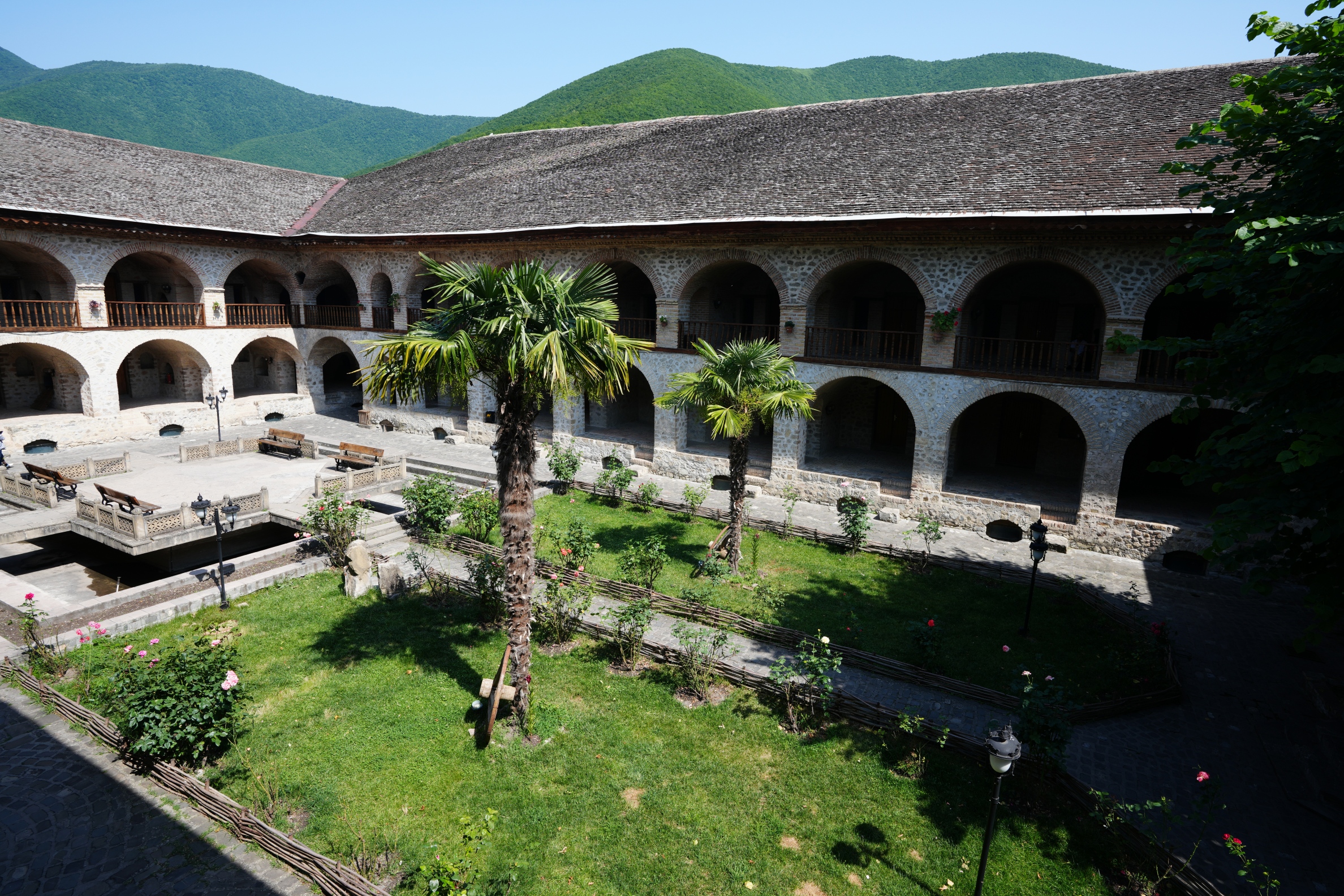
Beyond this, a large garden courtyard is enclosed by the inn portion of the old building. Two stories of rooms surround a picturesque garden courtyard. Rounded arches frame covered passageways on both levels that allow you to walk around the building in the shade.


On the side of the colonnades are rooms that would have been used by travellers on the historic trade routes. Today, it is a hotel and guests stay in the rooms that lead off from these walkways. We stayed in the Caravanserai Hotel, and it was a fantastic experience. The rooms are shaped similar to the arched walkways with brick, barrel vaulted ceilings and stone walls. It is not luxurious, but it is a very unique place to stay. As I tried to fall asleep at night, I couldn’t help but think of the hundreds of travellers on the Silk Road who also stayed in these rooms.
Details on how to stay in the Caravansarai Hotel are at the bottom of the post.


Visitors are welcome to view the main floor courtyard as well as the on-site tea house and garden restaurant, but only between 11am and 7pm. The teahouse reminded us of ones we saw in Turkey.

Hotel guests can roam around as much as they like, and we did. An unfinished section of the caravansarai’s second story leads to even more rooms. Here, the ceilings are lower, and guest rooms are a little smaller. With their unpolished appearance, you could almost feel the ghosts of the past hovering in the halls.


The bottom level of the caravanserai acts much like it would have in the Middle Ages when shops and workshops inhabited the small rooms that open to the street. Sheki artisans were known for their skilled craftwork including pottery, leather and woodworks as well as for their silks and weaving. Instead of selling these items though, today, these stores sell mostly tourist garb.

Lower Caravanserai
A couple blocks away from Upper Caranavsarai is Lower Caranavsarai (Ashaghi Caravanserai). This building is even larger than the other, but it is not open. It appears that it is being renovated, so maybe one day it will be open too.


Shekikhanovs’ House
A few blocks away from the Caravansaries is Shekikhanovs’ House (also called Shekikhanovs’ Palace or Winter Palace). Some reports claim it was the winter palace of the Khan, but information at the palace said it was the residence of Sheki Khan’s relatives. There is a lovely flower garden in front with large maple trees providing shade on the sides.
The house itself is much less ornate than the main palace, but it does have nice Shebeke stained glass and a painted eave. Inside, most of the palace is empty with bare, white walls and no furnishings. Only one room on the upper floor is elaborately decorated with frescoes of deer, lions, pheasants and people in traditional costumes. Most rooms have large stained glass windows and painted doors

Considering it is an empty shell, the entrance fee is quite steep at 9 manat (€5). Photography is not allowed inside, and a staff member follows you around very closely to make sure you don’t sneak one.
Juma Mosque
The 18th century mosque is the oldest in Sheki. Juma Mosque is a rather plain, brick building with a separate minaret. There’s an old madrasa on the complex grounds as well.
We were allowed to go inside the mosque even though Maggie only had a hat to cover her hair, and Richard was in shorts. Most other mosques are usually quite strict with their dress code. The people at Juma Mosque seemed to be happy that we were interested. The prayer room has a lovely tiled mihrab, but the rest of the room is unremarkable.


Yeralti Hamam
Beside Juma Mosque is the interesting looking 19th century Yeralti Hamam (Bath House). Even though you can not go inside, we poked our heads through some of the open windows to see inside the dark rooms.


Old Town
Between Juma Mosque and the Caravansaries, you’ll love to get lost in the labyrinth of streets in the Old Town. Some of the lanes are still cobbled, but many are now paved. The charming part of this district is that many of the old buildings were constructed with a combination of brick and stone. This style gives the city an interesting character.


Most are bordered by tall stone walls that prevent you from seeing the homes, but it is still a great part of the city to explore. In addition to stone walls and homes, there are many mosques in Old Sheki.
The entire Old Town is a UNESCO World Heritage Site.


It’s difficult not to notice the pipes running along the sides of the walls and crossing up and over driveways. They are leftovers from Soviet times and are a very unattractive way to deliver gas to the homes. You can find them in many former Soviet countries. We first saw them in Uzbekistan and Kyrgyzstan, and continued to see them throughout Azerbaijan.

Khan’s Mosque Complex
Built by Muhammad Huseyn Khan in the late 1700s, the mosque and madrasa are made from the same brick and stone patterns seen on many of the buildings in town. The mosque was built on top of the ruins of another mosque. Inside, there are a few sections where you can see the partial walls of that old building. They are under plexiglass though, and difficult to photograph.
In the back of the walled complex is the cemetery for the Khan’s family.

In addition to the mosque and cemetery, the complex has two restored madrasas and a nice green courtyard with lush grass, hedges and flower beds. One of the madrasa buildings is now a small museum with examples of pottery, metalworks, rugs, clothing etc. from the region.


Entrance to the mosque is free, but the museum has a small fee (5AZN/€2.50).
Old Silk Factory
Sheki has the perfect climate to grow mulberry, trees which are the preferred food of silkworms. Silk products were made in small workshops and homes in Sheki for generations. When the Russians arrived, they built large silk factories. Sheki Silk was considered one of the top silk products in Russia. Today, those silk factories are closed, and the buildings are mere skeletons of their former selves.
You can still find a lot of silk for sale on the streets of Sheki, though. The local pattern on many is called Tekelduz and looks a bit like an amoeba.


Getting to Sheki
Buses leave from Baku International Bus Terminal 5 times a day. You can buy bus tickets online on the app BILETIM.AZ. Signs at the bus station say the bus takes 6 hours, but ours only took 4 1/2. You can also travel by marshrutka, but they only leave at 6 am. Marshrutkas travel to/from Ganja 4 times a day, 3 hours.
You can find Sheki in the upper middle section of the map below. Click on the image to be directed to an interactive map.

Getting around Sheki
You can walk to reach most of the sites in Sheki, but when you arrive you will likely want to grab a taxi to Old Town. A taxi to the Upper Caravanserai from the bus station costs 4 AZN (€2). You can also take bus 22, which seem to run frequently from downtown to the castle.
Where to stay in Sheki
Even though the rooms are quite rustic, we loved staying in the authentic Upper Caravansarai. It’s located in the heart of Old Town and is only a short walk from Sheki Castle. The only way to book rooms is by contacting the owner via WhatsApp. (WhatsApp +944 55 712 57 17) He responded to our questions quickly and in English, and gave us a great room. The rooms are basic and only have single (twin) beds, but what an opportunity to stay in a piece of history. If you’d rather book in person that is possible too, but you run the risk of the hotel being booked up, especially on a weekend. We did not receive compensation for this promotion, we just really liked staying in the old inn.
In addition to the Caravanserai, there are many other hotels in Sheki ranging from luxury to budget. You should try to stay with in walking distance of Sheki Castle or the Caravanserai.
Where to eat in Sheki
There are quite a few options to eat in Sheki, both in Old Town and the newer part of the city. Qaqarin Restaurant Terrace has good food at reasonable prices and nice views of Old Town. In the new part of the city we had great meals at Sheki House.
When to visit Sheki
Located at 700 m (2,300 ft), Sheki’s temperatures are usually cooler than other parts of Azerbaijan. The best times to visit are spring and fall when temperatures are comfortable. In the summer it can reach well into the 30°sC, and in winter it can go below freezing.

Click on the link to see our Travel Tips for Azerbaijan
To read more of our adventures in Azerbaijan, click here.
Coming Next – Church of Kish and Other Day Trips From Sheki
For pictures from other blogs go to Gallery at monkeystale.ca
To read about more of our adventures go to Destinations.
If you like what you read, please comment or share (with credit) using the links below.






We'd love to hear from you, please leave a comment.