
There are many sites to keep you busy in the eclectic city of Baku, but don’t forget to save a day to explore some of the wonderful places outside the city. You may enjoy visiting some colourful natural scenes or a historic cliff-side tomb. Maybe you’d prefer a drive through spectacular mountain ranges to find an ancient village. Regardless of your preference, you’re sure to find something of interest. Here are our favourite day trips from Baku
Pink Lake
Not far from the city is a saline lake that received its nickname because of its colour. Lake Masazir’s (Masazirgol) hue ranges from drab brown to vibrant pink, depending on weather conditions. For us, it was a dark pink, so a medium view. Not quite the shocking pink that is in the brochures, but not brown either, which happens often. The pink colour is the result of its shallow depth, the concentration of halophilic algae, as well as high salinity of the water.
Salt has been mined from the lake for over a century by small, family-operated businesses. The government recently built a large salt processing facility on Lake Masazir (Masazirgol), so the view isn’t as nice as it used to be. While it is not as spectacular as the marketing images would have you believe, it’s worth a stop if you’re in Baku.

Candy Cane Mountain
As its name implies, Candy Cane Mountain is a long ridge of red and white striped rocks. The colourful striations are the result of oxidized iron ore that has naturally settled in pretty patterns.

The view we had from the highway was nice, but we wanted to get a closer look at this unique site. As we climbed up the rock, we realized that there is a lot of variety in the colourful designs. Some were swirls, others were jagged, but they all were very photogenic.


It was apparently called Candy Cane Mountain when British Explorer and author Mark Elliot first laid eyes on the ridge. It clearly wasn’t named by an Azerbaijani. Our guide doesn’t know what candy canes are and kept calling them Candy Mountain.
Candy Cane Mountain is 100 km from Baku. Unless you have a car, the only way to see the mountain is on a tour because there is no public transportation.
Greater Caucasus Mountains
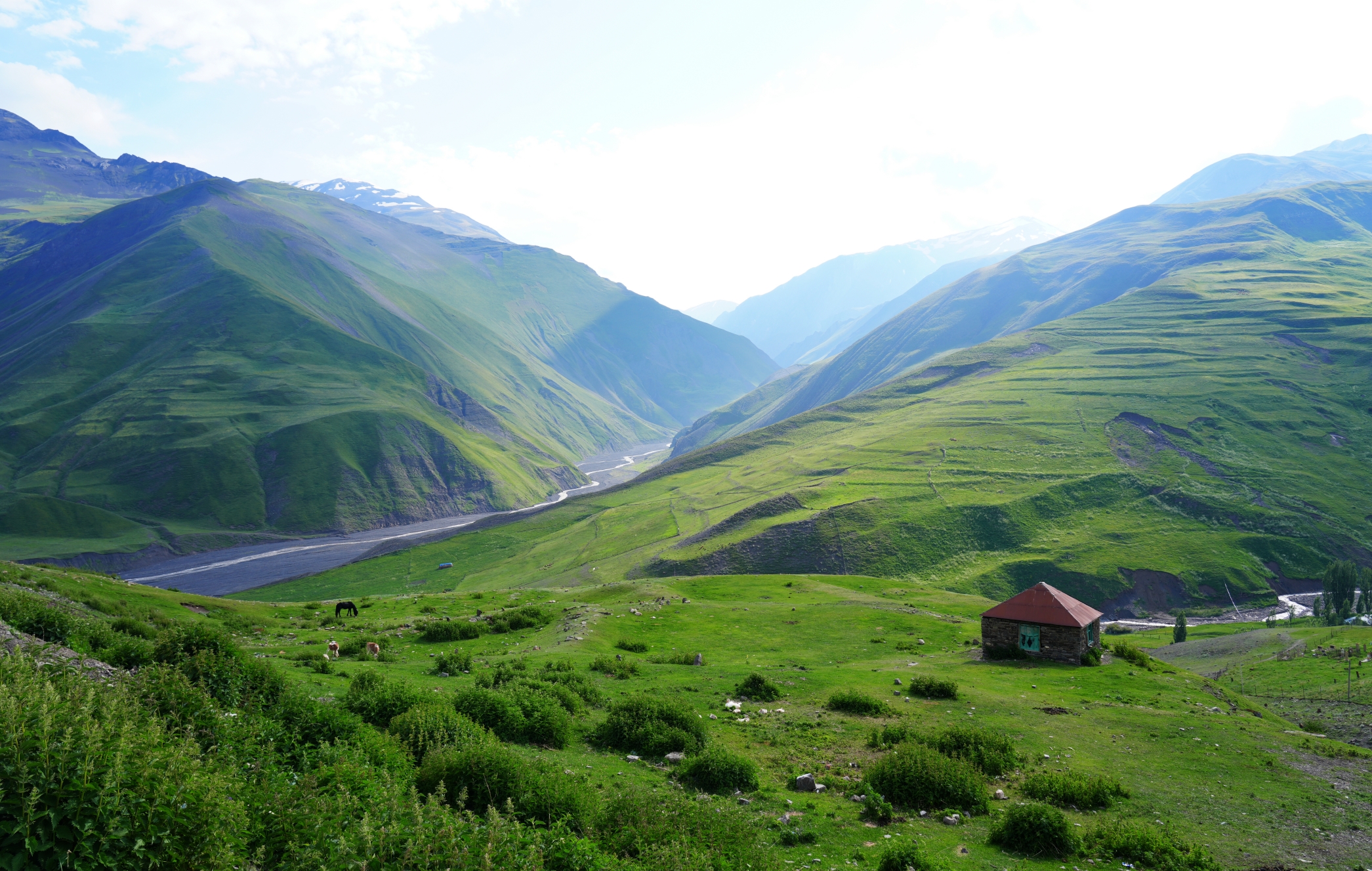
In northern Azerbaijan, the border with Russia is marked by the Greater Caucasus Mountains. As we drove north from Baku, we first travelled through an arid desert, and then through lush forests of walnut, apple, oak and maple trees. Once we began to climb above treeline to reach the High Caucasus Mountains, the landscape changed again. Now we were driving through tight canyons, bordered by sheer cliffs where plants grow in the most unlikely locations. We could see trees and bushes growing in small cracks high up on the rock walls.


Driving further north, the canyons opened up to reveal wide, green meadows broken up by deep rocky gorges. We were in awe of nature once again.


At one of our stops there was a make-shift teahouse where tea was being brewed in samovars. These wood fired kettles are common in this part of the world. A small fire is housed in the base of a metal urn and keeps the tea simmering at the perfect temperature and an attached chimney takes away the smoke. A tap on the bottom allows you to easily pour your cup of tea.

A popular viewpoint in this part of Azerbaijan is Eagle Top (2,010 m/6,600ft). The mountain views here are jaw-dropping. Even though this drive through the mountains was just intended to take us to our next attraction, it ended up being our favourite part of our day. It would have been worth the drive for these views alone.


Khinaliq
The main reason for driving this far north was to visit this ancient village. Khinaliq (also spelled Xinaliq, Khinalug) is the oldest and highest village in Azerbaijan. It has a mystical story that doesn’t quite seem possible, but villagers believe it is true. The community was settled 5,000 years ago by people who claim to be descendants of Noah. According to legend, their ancestors lived on another mountain in the Caucasus before the Biblical flood occurred. After the flood, they were forced to move their village to its current location.
Apparently, they used to practice Zoroastrian, but now are Muslim. It seems strange that Noah’s family would be fire-worshipping Zoroastrians.

Protected by the tall Caucasus, Khinaliq was isolated from the outside world for thousands of years. The people call themselves Kyat and speak a language that has no connection to any other language. Today there are 1,500 residents from only 4 clans. Each clan has their own identity which can be seen in their weaving and needlework patterns. The people we saw though, were mostly in western clothing. Each clan also has their own graveyard, which we did see scattered on different high meadows.

The village was only connected to the outside world in 2006 when a road was built to the village. Since then, locals have learned Azerbaijani and a school was built for the children to learn all subjects, including English. When we were walking around the village a group of kids ran up to practice their English on us.

Built from stones carried up from river in the valley below, the homes are very basic. But the village layout is interesting. It is built on the mountain slope, so many of the homes are built on top of each other like match boxes, where one person’s roof is another’s terrace.


The village was declared a UNESCO Heritage Site in 2023 so although some have metal roofs, they are only allowed to use traditional techniques when repairing the old houses. We saw men repairing a roof with mud and stones.

We were able to walk on a few streets in the tiered town and met some locals who were friendly to say hi, but mostly kept to themselves. Tourism has brought a new revenue source for this remote community, but hopefully, they don’t allow it to change them too much.


Residents are mostly sustenance farmers, raising sheep, goats and cows. They make their own cheese, milk and butter and have gardens to grow cabbage, potatoes, cucumbers and tomatoes.

Being located at 2,180 metres (7,152ft), it gets very cold in the winter and may reach as low as -30°C (-22°F) overnight. Villagers still heat their stone homes by traditional methods. Over the summer, residents make bricks composed of manure and straw. The bricks are laid out to dry until the fall. Piles of them are all over town. During the winter, these cow dung bricks are burned in stoves. We saw similar heating methods in Nepal and Tibet.

Even though they have a humble existence, these villagers spend their days in a gorgeous surrounding.


Tip – For the trip to Khinaliq, Eagle Top, Candy Cane Mountain and Pink Lake, we used My Tour Baku. If you don’t have a car it would be difficult to visit any of these sites on your own. Our experience with them was very positive and we’d recommend them for your tours. You can find them online or at their office in Baku. (We did not receive any compensation for this recommendation.)
We visited another area in Azerbaijan’s mountains, but it’s too far for a day trip. You can read about it in our post Discover Azerbaijan’s Mountain City of Sheki.
Diri Baba Mausoleum
On a separate excursion, we visited the Diri Baba Mausoleum. The cliffside tomb is located not far from Azerbaijan’s first capital, Shamakhi. The name Diri Baba translates in English to Living Grandfather and the mausoleum was built to commemorate an ancient Sufi mystic. There are many legends surrounding this mystic and his death.
Some say he was a Sufi teacher who became so deeply entranced he could not be awakened for 300 years. Other, less fantastical stories recall that he was a muezzin or even a highly regarded sheikh who died on this spot while praying. The legend says his body was found in a meditative pose.
Whatever story you believe, in 1402 a mausoleum was built on the site where he died. Since that happened to be on the side of a cliff, that’s where you’ll find the mausoleum. Caves in the cliff wall were commonly used at the time by Sufi priests to meditate, so parts of the story are possible. Its position on the historical silk road, meant that it was a stopping point for pilgrims and travellers.


In the Middle Ages, this area was under constant invasions from the Mongols, and others. It is said that even Amir Temur of Uzbekistan, was one of them, but upon seeing the body of the praying Sufi, he instead assisted the Shirvanshah in their battle against the Mongols.
Diri Baba Mausoleum is a simple, domed building built into the side of the cliff. By its description, we expected it to be a bit more dramatic than it actually is. Inside, it is also quite plain with only a few carvings on each of its three stories.
Today, it is a pilgrimage site for people of the Shirvan region.


The cliff where the tomb is located is riddled with caves. On either side of the tomb, there are at least nine caves. Some are natural, while others are man-made and have shelves carved into the walls. They were used both as residences and as meditation niches by Sufi mystics. Researchers believe that there was a passageway between the caves, but it was destroyed in a landslide.

While you’re there you can walk through the medieval cemetery located across the canyon. It has several tall gravestones engraved with geometric patterns and prayers.


If you have time, you may want to visit, but it is not a must-see site.
Entry fee – 9 AZN (€4.50); Hours – 10am-8pm
How to get to Diri Baba Mausoleum
This pilgrimage site is not easy to visit if you don’t have a car. It is not included on many group tours. It is located 1.5 km outside the town of Gobustan (Qobustan), on the M4 Hwy. We had intended on taking a bus from Baku to either Gobustan or Shamakhi and then a local taxi, but there is only one bus a day, at 1 pm.
We ended up taking a private taxi for 80AZN (€40) return. If you do this be prepared to haggle. The driver began negotiations as 100 AZN (€51) one way. Our trick was that we were not desperate to go, so walked away with no intentions of seeing the site. Realizing we weren’t bluffing, the taxi driver chased after us and made a much lower offer, which we eventually got down to the final price.
Gobustan Mud Volcanoes and Ancient Petroglyphs
These two phenomenal day trips from Baku are so spectacular that we gave them their own post. In case you missed it, you can read about them here.


For more information on Baku visit our posts A Guide To The Old City of Baku, and Explore The Modern Architecture of Baku.
All of these day trip destinations can be found on the map below. Click on the image to be directed to an interactive map.


Click on the link to read our Travel Tips for Azerbaijan.
To read more of our adventures from Azerbaijan, click here.
Coming Next – Discover The Mountain City of Sheki
For pictures from other blogs go to Gallery at monkeystale.ca
To read about more of our adventures go to Destinations.
If you like what you read, please comment or share (with credit) using the links below.




We'd love to hear from you, please leave a comment.