
Tbilisi’s historic centre boasts a wonderful assortment of buildings that give it a charming personality. Some have been lovingly restored, while others look to be falling apart. Other cities wouldn’t be able to pull off this look; they would feel old and worn. In Tbilisi, however, this mix draws you in, enticing you to explore its old streets. If you can’t already tell, we love Tbilisi.
Not only does Old Tbilisi have historic homes with wooden balconies and a clifftop fortress, you can also find traditional bathhouses and a large collection of heritage churches. There are many reasons to visit Tbilisi. Come with us as we take you to the sites in this eclectic city.
Old Tbilisi
We’ll begin our exploration of this city in our favourite part, Old Tbilisi. When looking from above, it seems as though the historic centre has squeezed into one of the only flat areas on the banks of the Mtkvari River (called Kura River in Turkey). From the river basin, rugged cliffs steeply rise, giving the centre an even more picturesque setting. This district is sometimes referred to as Lower Tbilisi.
Even though there is evidence of people living in this area since the 1st century BCE, the first settlement was established in the 300s AD. By the 5th century, Tbilisi was the capital of the Kingdom of Iberia (referred to as Kartli by Georgians). Before Tbilisi, the capital was in Mtskheta, where we’ll take you in a few days. You can read about this in our post Georgia’s First Capital, Mtskheta and Jvari Monastery
Note – Until the 1930s Tbilisi was called Tiflis in many languages.

During the Middle Ages, the city was frequently under attack, which led to it having many different ruling dynasties, including the Persians, Byzantines, Arabs, Mongols and Turks. Even with this long history, what we see today, are mostly 19th century structures because a Persian invasion in 1795 almost wiped it off the map.
While it may not be very old, these 19th century neighbourhoods have a quirky mix of wonderfully restored heritage buildings and those in much need of TLC. Instead of being a turn-off though, they come across as shabby chic. As with many old towns, the best activity is to wander through the maze of streets and take in the unusual mix of architecture.


One of our favourite activities while roaming along these well-trodden streets was finding little treasures like the adorable wooden balconies that hang from the stone and brick walls.


You can’t spend all your time aimlessly wandering though, because there are many specific places you need to visit. Make sure you have plenty of time in the city to see them all.
Narikala Fortress
Spread along the top of the narrow Sololaki Ridge is the historic Narikala Fortress. It was built in the 4th century, making it the oldest structure in Tbilisi. The fortress was expanded in the 7th and 8th centuries by the Arabs and then again in the 11th century by the Georgian King, David the Builder.
In the 1800s, it all came tumbling down. The Russians were using it as a garrison, which included storing gunpowder. In 1827, a lightning strike hit the stored ammunition, causing a massive explosion that destroyed the fortress. Today, only a few walls are still standing, but you can see them from many parts of the city.


In August 2025, the fortress was being restored, so many of our views of it include a green tarp and scaffolding. It also means that you can’t wander around the grounds too much, but you can walk up to get a closer look at the walls. Hopefully, one day visitors will be able to explore this large castle.
The 13th century St. Nicholas Church, located inside the fortress walls, has already been rebuilt. It is the only building on the grounds that you are allowed to visit. Its freshly painted walls are adorned with frescoes of biblical scenes and stories from Georgian history, and give you an idea of how Georgian heritage churches may have once looked.


Even if there’s not much of a fortress to see right now, its location means you have a bird’s eye view of the city. That alone makes it a worthwhile visit.


Getting to the fortress.
Our preferred way of reaching the fortress is by walking up the hilly streets through the old neighbourhoods. If you don’t want to walk, you can usually take a cable car from Rike Park, but due to restoration work in 2025, the pathway between the cable car top station and fortress is closed.
Tip – On your way walking up or down from the fortress or Mother of Georgia, take the scenic route by way of Betlemi and Gomi Streets. Not only are there more balconies to see, but you will also be treated to more views of the city.


Meidan Bazaar
Below the fortress is where you’ll find the oldest part of the city. Dating back to the times of the Silk Trade, Meidan Bazaar is an underground market bursting with character. Its brick, barrel-shaped ceilings are used to display antique metalware as well as items for sale in one of the many small vendors. In addition to its old world feel, the underground market crosses all the way under Meidan Square. After emerging from the market on the other side of the square, look up for a great view of the fortress.


Abanotubani
Not far from Meidan Square are the old bathhouses of Abanotubani (Bath District). Mineral water flows from natural underground springs in this area and was one of the reasons this location was selected for the new capital. Bathhouses were built along the sulfur springs as early as the 5th century. Over time, the number of bathhouses increased dramatically, and at its peak, there were a total of 65 bathhouses. The 10 that remain today are from the 17th and 18th centuries.
When you’re close to the creek that runs through Abanotubani, you can smell the sulfur, but as soon as you move a block away, the aroma disperses.


Apparently, Tbilisi’s high society women would spend their days at the bathhouses. It was their recreation and entertainment. The ladies would have tea, lunch and even dinner in the bathhouses and adjoining gardens. One of their favourite topics was match-making, determining which families would gain from which marriages.
Even today, relaxing in the baths is a favourite activity for both locals and tourists. Most of the rooms are private; some have baths for 2 people, others fit as many as a dozen. You are meant to bathe naked, but I can’t imagine bathing naked with 11 friends or family. The rooms are rented by the hour, and the larger ones are quite pricey at 600 GEL/hour (€200), You can find a small, two-person bath for 60 GEL/hour (€19).


Old City Wall
Although not much is left, you can find parts of the 11th century city wall on the edge of the historic district. In some areas, you can even distinguish different layers of construction from its continual rebuilding. The most complete section is on the side of Nikoloz Baratashvili Street. A smaller part was only recently discovered when the busy Pushkin Street was being rebuilt in 2012. Both are a short walk from Freedom Square.


Churches
There are thousands of Georgian Orthodox churches in the country, and to us, it felt like most of them are located in the city’s historic centre. We saw quite a few, but there are many more that we missed. The top ones that we think you should see are:
● Anchiskhati Cathedral
Also called Church of the Nativity of the Virgin Mary, this 6th century church is the oldest in Tbilisi. Located in the middle of the historic centre, the city has built up around the church making it difficult to back up far enough to get a good view.

Despite being rebuilt and restored several times, the dark interior of the three-nave church feels every one of its 1,500 years. Part of that comes from the old frescoes that decorate the arches and ceiling. At the front is a simple iconostasis. This is a wall of icons that you will find in most Georgian Orthodox Churches.


● Sioni (Zion) Cathedral of the Assumption of the Blessed Virgin
The church was originally built in the 6th and 7th centuries, but was damaged many times by various invaders of Tbilisi. As a result, it was completely rebuilt in the 12th and then again in the 19th century.
Sioni Cathedral is the caretaker of a sacred relic in Georgian Orthodoxy. The Cross of St. Nino was first set in the ground in the 4th century when St. Nino converted the Georgian king to Christianity. It was moved several times in an effort to keep it away from invaders. Eventually, it found its home in Sioni Cathedral in the 1800s. We’ll give you more information on this cross when we visit Mtskheta.


● Metekhi Church of the Nativity of the Virgin Mary
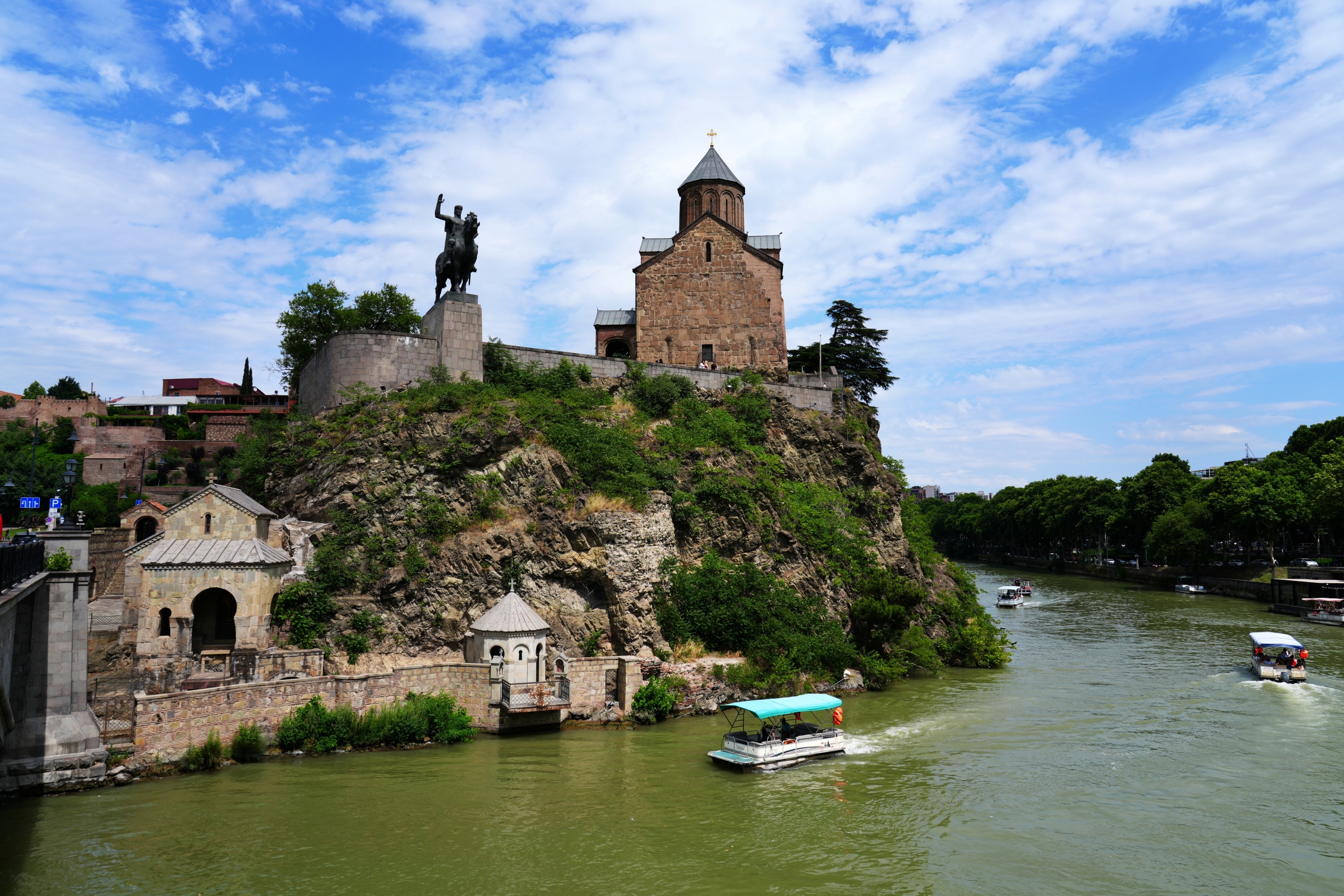
Standing on a picture-perfect position above the river is Metekhi Church. A statue of King Vakhtang Gorgasali on a horse in front, makes it appear even more regal. He is credited with founding the city in the 5th century and built a chapel and castle on this strategic spot.
That original church was demolished and rebuilt several times. The current one is from the 13th century, but it served many different roles. It was used as a prison, armament storage, mosque and theatre over the centuries. It was only reopened as a church in 1988.


We saw the church from many angles during our time in Tbilisi. Our favourite view was at night when it was nicely illuminated.


● St. George Church
St. George is one of two functioning Armenian Apostolic Orthodox Churches in Tbilisi. It was built in the 13th century and restored in the 2000s. A service was taking place when we visited on a Saturday morning. Unlike Georgian Orthodox churches, in Armenian Apostolic churches, parishioners walk backward when exiting the church. We first witnessed this custom in St. George.


● Jvaris Mama Church
A church has been on this spot since the 5th century, but Jvaris Mama Church (St. Cross Church) is from the 16th. Legends say that St. Nino lived in the surrounding yard in the 4th century. Today it is a small, peaceful garden.
In the same yard is the 16th century Armenian Church, St. Virgin Mary Temple of Norashen. It is not currently operating as a church, and people were setting up a craft show inside when we visited. The two churches, although from different denominations, are almost exact replicas of each other.


Tip – To enter all churches in Georgia, women must cover their legs and hair. Often, I had to put a wrap around my pants (trousers) because I was told that pants are for men, not women. Most times, my sunhat was acceptable. Men must cover their legs and not wear a hat. Scarves are usually available at the entrance to cover your legs and hair.
Clock Tower
The whimsical leaning clock tower of Tbilisi is not an old building, but at first glance, you think it is. Built in 2010, the awkward-looking tower is composed of a series of blocks piled on top of each other in such a way that it looks like it may topple over any minute. A metal brace on one side adds to this illusion.


The owners of the attached Gabriadze Puppet Theater built the clock tower. As you would guess, they included a puppet show on it. On the hour, an angel emerges with a hammer to ring the bell. Twice a day, at noon and 7 pm, a drum with different scenes spins below the clock.


In the same block, on Shavteli Street, there are a number of bronze statues. Our favourite was ‘Two Old Friends’ (Dvoye Starykh Druzey).

Juma Mosque
On the streets above Abanotubani is a unique site in this city of churches. Juma Mosque was originally built by the Ottoman Empire in the early 1700s, only to be torn down by the Persians less than a decade later. It was rebuilt in the 19th century by a philanthropist from Baku, Azerbaijan. Today, it is shared by both Sunni and Shiite Muslims, which is not common. Its minaret is what first caught our attention.


When we went inside, we were surprised at how colourful it is. The walls are painted with blue and white designs, and bright blue tiles are on the qibla wall at the front. We haven’t seen such a brightly painted mosque in quite a while.
In the picture you can see two prayer rooms separated by a wall. One is for Sunnis and the other, for Shiites.

Great Synagogue of Tbilisi
In addition to the multitude of churches, there are a couple of synagogues in the historic centre. The Great Synagogue of Tbilisi is a large, brick building. It was closed when we arrived; a thick chain was wrapped around the door. We didn’t expect to get inside, but we must have looked curious because a man came and unlocked it for us. Inside, the Synagogue looks more modern than the exterior. Blue and golden designs are painted on the ceilings and walls.


In addition to the many sites in Old Tbilisi, there are also plenty of things to see in Uptown Tbilisi. We’ll show you those in our post What To See In Uptown Tbilisi.
Getting to Tblisi
Tbilisi International Airport receives flights from across Europe as well as Central Asia and the Middle East. If you’re already in Georgia, the city can easily be reached by marshrutka. There are four marshrutka stations in Tbilisi, so make sure you know which one yours will use. You can also reach Tbilisi by land from Yerevan and Gyumri in Armenia; or Sheki and Ganja in Azerbaijan. See our post from Ganja to read about the Azerbaijan to Georgia border crossing.
You can find Tbilisi in the lower centre of the map below. It is an interactive map, so you can zoom-in, or click on a marker for a link to our post from that region.
Where to eat in Tbilisi
There are many choices for eating and drinking in Old Town. Expect prices to be higher in the centre than outside of downtown, but not by much. We had excellent meals at a few different restaurants. Here are a few locations where you can find a selection of restaurants:
Shardeni and Ekele Il Street are short pedestrian streets with a selection of restaurants, most with patios. Some are good, but others have poor reviews so you’ll probably want to research online before going. Another option nearby is Cotton Street with an interesting curve to the buildings. A little further away, in opposite directions, are G. Antonella Pedestrian Street and Galaktion Tabibze Street. Both are quieter than Shardeni and Ekele II Streets and have a few restaurants to chose from.
For a cheap snack, stop at one of the many bakeries for Lobiani (bread stuffed with kidney bean paste), or khachapuri (cheese bread). We’ll talk about some of the delicious Georgian dishes in an upcoming post.


Blog Buddy Meet Up
You will also find quite a few restaurants in the Abanotubani district. This is where we had a blog buddy meet up with The Travel Architect and The Husband. By a complete coincidence, we were both in Tbilisi at the same time. In addition to Georgia, they also visited Azerbaijan and Armenia on this trip, so be sure to read her posts from their trip. After following The TA for a few years, I felt as if we already knew each other, but it was fun to finally meet in person. We had a great evening, sharing travel stories over Georgian wine.

Where to stay in Tbilisi
Without a doubt, we think you should stay in Old Tbilisi. It is actually quite a large neighbourhood with many options for inexpensive guesthouses, to more luxurious hotels. We stayed in 34 Silver Rooms, and highly recommend it for its comfortable rooms, delicious breakfast and great location. You can find it online. We did not receive compensation for this recommendation.
Tip – Most coffee shops and restaurants in Georgia don’t open until mid morning. If you want breakfast, you should either book a hotel that offers it, or an apartment with a kitchen to prepare your own.

This article is now featured on GPSmyCity. To download this article for offline reading or create a self-guided walking tour to visit the attractions highlighted in this article, go to Walking Tours and Articles in Tbilisi.

Click on the link to read our Travel Tips For Georgia.
To read more of our adventures in Georgia, click here.
Coming Next – What To See In Uptown Tbilisi
For pictures from other blogs go to Gallery at monkeystale.ca
To read about more of our adventures go to Destinations.
If you like what you read, please comment or share (with credit) using the links below.



We'd love to hear from you, please leave a comment.