We first realized how deeply religious Georgians are when riding on public transportation. Almost every person on board our first marshrutka (shared minibus) made the sign of the cross each time we passed a church. We often couldn’t even see a church, but they all seemed to know one was there.

We continued to notice it on every bus, marshrutka and taxi that we took as we travelled throughout the country. An interesting point is that Orthodox Georgians make the sign of the cross right to left, whereas Roman Catholics do it left to right. They also do it 3 times in a row.

Since it is an important part of their culture, we wanted to see where it all began, so we travelled to the country’s first capital, Mtskheta. At the time Georgia was called the Kingdom of Iberia, and Mtskheta was its capital from the 3rd century BCE to the 5th century AD. It was there that the country adopted Christianity as the state religion in the year 326. That’s almost 80 years before Rome, and only 25 years after Armenia. Before this, Georgians were pagans.

You can read about Armenia’s first cathedral in our post How To Visit Etchmiadzin and Zvartnots Cathedrals.

Early in the 4th century, St Nino was a young woman who travelled from Cappadocia to Georgia, intent on bringing Christianity to the region. She carried with her a cross made from grape vines, tied together with her hair. On her way across the country, she preached Christianity and developed quite a following. When St. Nino arrived in Mtskheta, she was able to convert the Georgian Queen to Christianity by healing her illness. Then, St. Nino converted the queen’s husband, King Mirian III, by curing his sudden blindness. Soon after, the king declared the entire kingdom to be Christian.

Today most citizens follow the Georgian Orthodox Church which is a part of the Eastern Orthodox Church.

As you would expect, there are several historic churches and monasteries in Mtskheta that relate to this early history. The historical religious sites we visited in Mtskheta are collectively listed in UNESCO World Heritage Sites which gave us even more incentive to visit them.

The most important site near Mtskheta is Jvari Monastery. Standing on the top of a small hill above the confluence of two rivers is a revered site in Georgian Orthodoxy.  It was on this hill that St. Nino, the missionary, placed a wooden cross over a pagan sanctuary in the 4th century. Jvari translates in English to Cross.

Even though the cross was planted in the 4th century, it wasn’t until the 6th century that a church was built on this site. A few years later, a monastery was established, and a second church was built. This one we constructed around St. Nino’s cross. At the time, the monastery faced many threats from adversaries, so the complex was fortified by a stone wall. The first church and wall are mostly in ruin, but the second church is still standing.

These first two churches were built in the shape of a cross and would set the style for all future Georgian churches. From the outside, Jvari Monastery’s stone walls show its age, but a few decorative elements can still be seen.

Inside the small stone room, there are a few framed pictures and shrines around the edge. The wooden and metal beams holding it up hide most of its historic details, though. It’s also quite dark inside. There are only a few slit windows, so candles provide most of the light. An engraved wooden cross stands in the centre, and is said to be set inside the stone base of the first cross planted by St. Nino.  

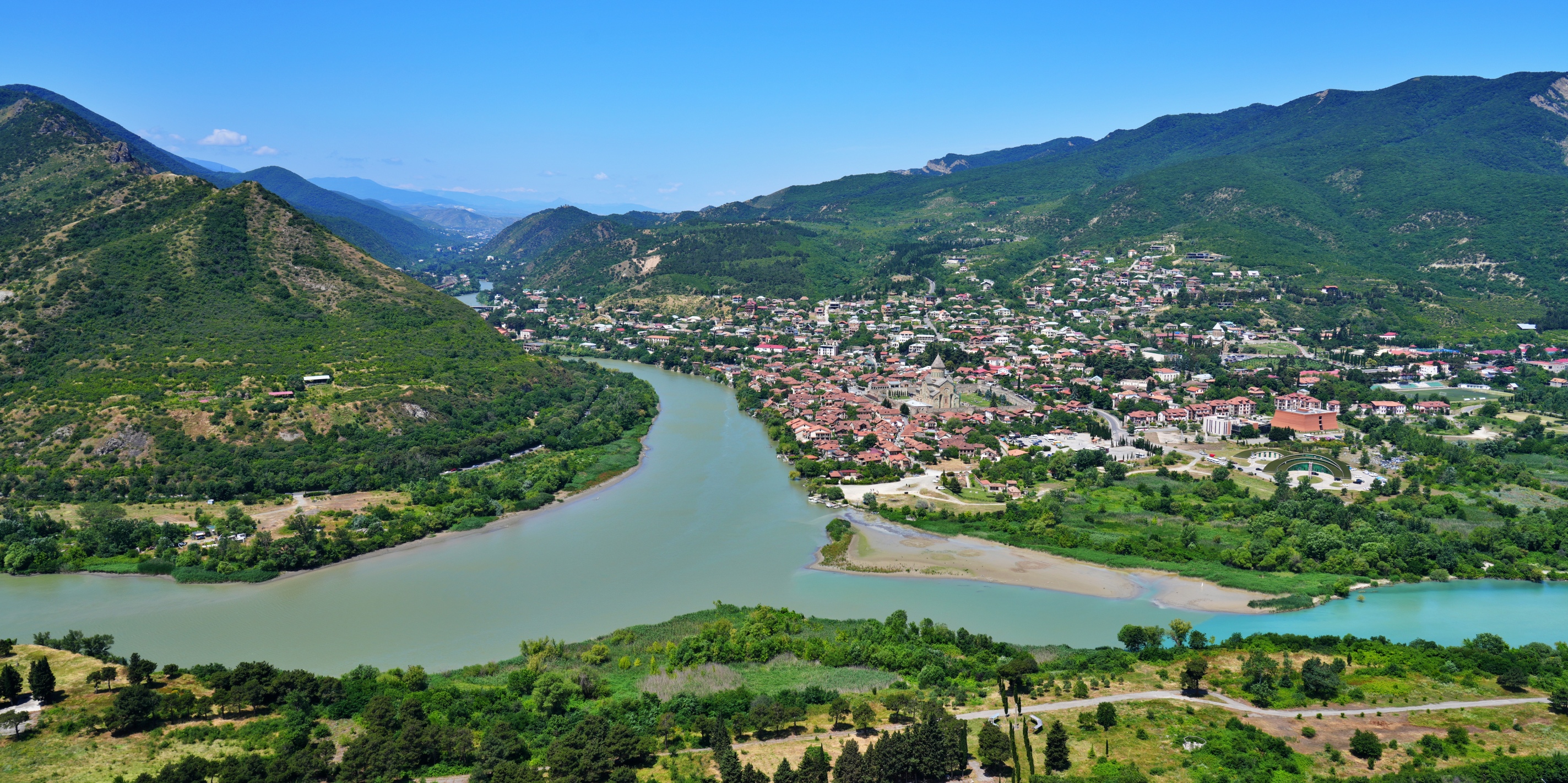
From the ridge beside the church you have a wonderful panorama where you can appreciate Mtskheta’s perfect setting at the confluence of the Aragvi and Mtkvari Rivers. (Mtkvari is known as Kura River in Turkey.)

Entry is free and you are allowed to take pictures inside. It is one of the most visited tourist sites outside Tbilisi, so is very busy.

Most visit the monastery on a tour from Tbilisi. We wanted to explore other places in the area, so we went on our own and took a marshrutka to Mtskheta (see below for details). From the city centre, it’s easy to take a Bolt or taxi up to the monastery. We arranged for our driver to wait for us and return to the city for only 25 GER (€8). Although it is close to Mtskheta, it’s not easy to walk because you have to cross the river and the highway.


Situated in the middle of the city, a large stone wall prevents you from seeing much of this complex from the outside. Once you walk through the gate, however, you can’t help but be impressed by the large stone church in its park like setting.

Surrounding the monastery grounds is a tall wall with bell and watchtowers. In between the wall and cathedral is a peaceful park with a manicured lawn, olive trees and a few rose beds. From the grounds, you can see Jvari Monastery, high up on a hill.

At the centre of the yard is the second largest cathedral in Georgia. Although Svetitskhoveli Cathedral has a lot of plain stone, you can still find a few old accents on the walls and around the windows. Its multileveled roof also gives it a lot of character.

There are two legends related to the church. The first tells the tale of the king cutting off the architect’s hand to ensure he wouldn’t design a more beautiful building. One of those carvings is said to be of that dismembered hand grasping a chisel.

Located in the country’s first capital, Svetitskhoveli Cathedral, had an important place in Georgia’s history. This cathedral was the coronation and burial site of many kings, including King Erkele II. You can see the kings’ grave markers on the cathedral floor. Today, it is the headquarters for the Georgian Orthodox Church.

The original cathedral was built in the 4th century, but the current building is from the early 11th. Inside, the old, tall walls look like they have many stories to tell. You can still see a few remnants of the old frescoes, but most were destroyed over the centuries.

In the centre are two old shrines, covered in weathered frescoes. This is where the second legend comes into play. In the 1st century, a man from Mtskheta travelled to Jerusalem, where he found or purchased a tunic worn by Jesus at his crucifixion. When the man returned to Mtskheta, his sister was gravely ill. He showed her the tunic, she clutched it and passed away soon after. Apparently, even in death, her hands wouldn’t let go of the robe, so she was buried with it. From her grave, a Lebanese cedar tree grew. Three centuries later, when a church was built on this site, they cut down this cedar and cut it into pillars. One of those pillars extruded a sap that is said to have cured various diseases. Therefore, the name of the church, Svetitskhoveli, translates to Living Pillar.

One of these old shrines is said to contain Jesus’ tunic. This makes it a very important pilgrimage site for Orthodox Christians.

There is also a ceramic foot that apparently houses a bone from the foot of St. Andrew the Apostle. Even though St. Nino is credited for making Christianity the country’s official religion, many came before her to spread the word. St. Andrew is considered the first preacher of Christianity in Georgia, making this a very sacred relic.

Entry is free but it is not open to tourists during services which are held Sat and Sun 9am -1pm.

Tip – The dress code is strictly enforced. Women must wear a long skirt/dress and cover their hair. Men must have their legs covered and not wear a hat. Scarves are available to borrow at the entrace. Flash photography is not allowed.


On the edge of the city is another interesting site. While the current buildings are from the 11th century, the convent dates back to the 4th century when St. Nino stayed on these grounds.

It is an active convent so we didn’t explore the grounds too much, but we could see its old wall and bell tower. Near one of the old chapels is a reproduction of the cross that St. Nino carried. It is often called the Georgian Cross.   

Entrance is free, but the dress code is enforced and pictures are not allowed inside.


Located in the hills outside the city is a monastery with a long history. In the 6th century, a hermit monk named Shio was living in a cave in the limestone wall. Shio was one of the 13 Assyrian Fathers who came to Georgia in the 6th century to spread Christianity. Eventually, other monks joined him, and a monastery was founded. You can still see many caves in the canyon walls behind the complex. One is a cave shrine dedicated to Shio, but it is closed to visitors.

We visited other monasteries established by the 13 Assyrian Fathers when we were in Kakheti. You can read about those in our post Touring Kakheti’s Historic Monasteries.

Below the caves are a number of buildings that have been added to the monastery over the centuries. The first church built in the monastery was Church of John the Baptist (6th century). It is closed to visitors.

At the top of the complex is the large St. Mary’s Assumption Cathedral. It was originally built in the 11th century, but rebuilt in the 17th. Its interior is much different than others in the area. The walls and long barrel ceiling are decorated with newly restored frescoes.

We visited on a Sunday and the nave was full of worshippers. As we witnessed in Romania and Bulgaria, parishioners stand during worship rather than sit, as we are accustomed. We listened as the priests read prayers while others sang in response.

The monastery is located 11 km from Mtskheta. It’s a nice drive through the pretty foothills to reach the monastery. If you don’t have a car, the easiest way to visit is by Bolt or taxi from Mtskheta. We ended up hiring the taxi driver who took us to Jvari Monastery. He added another 25 GEL (€8) to continue to Shio Mgvime Monastery and return, which we think was a fair price.


The city of Mtskheta itself is quite cute. The streets closest to the cathedral are quite touristy, but the rest of the city is very pleasant and worth spending a little time exploring. There are several restaurants, some along the river with a view of Jvari Monastery above.

Most people only visit Jvari Monastery, and do so on a tour. But it’s very easy to visit all of these sites on a day trip from Tbilisi on your own. Marshrutkas leave from beside Didube Metro Station in Tbilisi. They run regularly, approximately every 15 minutes.

You could also take a train from Tbilisi Central Train Station. They leave at 9 am, but only travel Mondays, Wednesdays and Fridays.

You can find Mtskheta in the centre of the map near Tbilisi. It is an interactive map, so you can zoom-in, or click on a marker to find a link to our post from that region.

Read from another device.

Click on the link to read our Travel Tips For Georgia.

To read more of our adventures in Georgia, click here.

Fediverse reactions

95 responses to “Georgia’s First Capital, Mtskheta and Jvari Monastery”

  1. A rich and truly fascinating post with great pictures, providing a glimpse into a world I hope to see one day. Thank you for sharing!

    1. Thank you, It’s certainly an important part of Georgia’s history. I hope you get there one day. Maggie

  2. It is getting to be late evening here and I am so cherishing the quiet walk around with you of all the places of faith in the area. The cold, sober Lutheran religion into which I was born is somehow so distant from the Orthodox side of worshipping . . , from childhood on I was magically enchanted by the late evening candlelit ceremonies and Orthodox church music to me is the best sedative when life’s difficulties arrive , . . I follow the Buddhist thinking patterns these days but when I hear Orthodox chorales they bring me such peace . . and, yes, I learnt the way the Russians in Estonia made the cross probably as a 4-year-old . . .

    1. They are different from the churches I grew up in too. I always find it fascinating to see the similarities and differences of the various religions around the world. With the amount that we visit, it may seem like I’m very religious, but I’m not, it’s just that religion is often strongly integrated with the fabric of the people. It certainly is in Georgia. Thanks Eha, Maggie

  3. St. Mary’s is the most appealing to my eyes. Probably because it looks more colorful and alive.

    1. They did a nice job restoring St. Mary’s. I’m not sure why they don’t do they same for their other historic churches. Thanks Swabby

  4. It is definitely a very religious society and the churches display such grandeur. I grew up trying to cross myself from right to left but of course was corrected. I remember asking why the other way was wrong and being told that it was the “right way to do it” which was a very unsatisfactory answer. I eventually found out the symbolism later. Excellent post as usual, Maggie. Cheers.

  5. You can learn a lot about a country and its people from their faith and what they believe in. Funny about the differences between Orthodox and Roman Catholic. Mtskheta has such a beautiful setting on those rivers. Happy Friday Maggie. Allan

    1. Mtskheta has a lovely setting. I feel like I didn’t give it much time in this post, but the churches are so important, they took up all the space! Thanks Allan, Maggie

  6. […] Even though there is evidence of people living in this area since the 1st century BCE, the first settlement was established in the 300s AD. By the 5th century, Tbilisi was the capital of the Kingdom of Iberia (referred to as Kartli by Georgians). Before Tbilisi, the capital was in Mtskheta, where we’ll take you in a few days. You can read about this in our post Georgia’s First Capital, Mtskheta and Jvari Monastery […]

  7. A very interesting day out ams I imagine it deepened your understanding of the importance of their religious beliefs to the Georgian people? I love the interior of the St. Mary’s Assumption Cathedral!

    1. It was a lot of churches in one day, but you’re right, it did help to better understand the culture and history. It’s too bad that they don’t restore the frescoes on the churches like they did in St. Mary’s, but I think many were completely destroyed by the Soviets, so there was likely nothing to go from. Thanks Sarah

  8. ⬻𓂀ღ☆∞♡ 🔺 𝒽𝒶𝓅𝓅𝓎 𝒻𝓇𝒾𝒹𝒶𝓎 🔺 ♡∞☆ღ𓂀⤖

    1. Thank you! The third symbol actually looks like it’s from the Georgian alphabet 😊

        1. It’s the perfect comment then!!

          1. 🙏
            🙇‍♂️

  9. We always find it interesting (to a degree anyway) to learn of differing religions on our travels, trying to grasp what the differences are and precisely what the beliefs are. But it’s a bit of a giant subject and one can only scratch the surface. Both Michaela and I come from a background and upbringing entirely devoid of religion of any kind, which is a double edged sword in that a) we are open minded about learning but b) we are starting from a knowledge base well behind most people. Fascinating post providing exactly the kind of learning we like to embrace.

    1. I grew up as a minister’s daughter, but am not very religious. We do like to visit these places on our travels, because it’s often important to the people. Like you, we are open minded and want to learn about all of them, not just what we’re familiar with. This part of the trip was a bit of a church overload, but we still found it very interesting and nice to connect some of the regions too, such as the cave monasteries in Cappadocia with a missionary in Georgia. Thanks guys, safe travels, Maggie

      1. I can’t believe we haven’t made Cappadocia yet, been our list since ever…

        1. I can’t believe it either! 😊

  10. The churches and cathedrals in Mtskheta are quite incredible due to their rich history, impressive architecture, spiritual significance, and stunning panoramic views. It’s amazing to see that throughout centuries of facing subjugation and pressure from neighbouring empires, Christianity became a powerful symbol of Georgian independence and resilience, distinguishing Georgians from their often Muslim-dominated adversaries. Thanks for sharing, and have a good day 🙂 Aiva xx

    1. Yes, they’re located in a region where being Christian wasn’t easy and yet, they persevered. That’s probably partly why it has such a prominent role in many Georgian’s lives. Thanks Aiva

  11. Some of their churches look more like fortresses.

    1. That’s true, they likely were at some points in their history. Thanks Rosaliene

  12. I love that wonderful story of St. Nino. What faith she must have had to travel to unknown lands to preach.
    Thank you for the great legends and stories you shared about the churches and the important monuments like the stone that houses the cross at Jvari Monastery’s history, the two legends of Svetitskhoveli Cathedral, Jesus’ tunic, and the reliquary of St. Andrew.
    I appreciate you taking the time to explore the city to discern the source of its inhabitants’ faith. Travel is more about the people than the place, I feel. I applaud your pursuit of that truth.
    Great share, truly. Thanks Maggie. Blessings to you both and safe travels.

    1. Travel really is more about the people than the place isn’t it? That’s why I love learning about these old legends and customs. They are a big part of the puzzle of who the locals are. I’m glad you enjoyed reading them 😊 Thanks so much Suzette, have a great weekend!

      1. Thanks again, Maggie. Cheers.

  13. Brings back many memories. Now, thanks to your post, I can remember all those forgotten names. This is one of my great weaknesses. Must take a notebook on next trip, but then, I’d probably forget and leave the notes somewhere in some other beautiful and nameless spot. How do you keep on top of all these interesting details?

    1. Haha, I don’t leave my notebook behind 😊

  14. well, all orthodox make the cross sign right to left … usually three times. I do it once, as i am lazy and skeptical, but i also do not want to stand up from the crowd by not doing anything while the others keep cover themselves with virtual crosses 🙂

  15. Wonderful sharing. very informative. keep sharing

  16. The legend of St. Nino is so interesting and quite remarkable as well, given women’s roles at that time. The monastery and other churches are beautifully ornate. Very interesting post, Maggie.

    1. Yes, I had read about the Saint at a few sites before one of them said she was female. For that time, it must have been even more remarkable. Thanks Tricia

  17. I really enjoyed this interesting history lesson and the story of St Nino. We like to visit churches and learn their history and this has been an excellent way for me to visit with you.

    1. I’m glad you did. St. Nino is a great part of their history, isnt she? Thanks! Maggie

  18. The legends, St. Andrew’s relic, the ancient churches and cathedrals were all remarkable. What revealed who the people were was the way they genuflected whenever they passed a church. 🙂

  19. 😊 we noticed that in Romania and Bulgaria, but I don’t remember seeing the three times before. And certainly not driving past every single church. 😊

    1. Some ladies in their old age develop a special sense of church detection. You may learn that there is a church in the vicinity just by watching someone repeating the sign of cross 🙂 They KNOW the church is there, behind some trees or buildings, especially if hearing some bell toll.

  20. Very interesting history and great photos as usual. It seems a bit much with the strong religiousness but I think that happens with a lot of wars, threats and persecution.

    1. That’s likely part of it, they weren’t able to practice their faith under Soviet rule, so it becomes even more important. We saw that in Kyrgyzstan too, so I’m sure it occurs in other post communist states. Thanks for your observation Thomas. Maggie

  21. I remember researching about Mtskheta and I’m glad to hear about your positive experience in this place. I love the setting, and the views of Jvari Monastery from below, as well as the city from the hilltop monastery. They are stunningly beautiful! It’s great that you also went to some other less touristy sites, like Samtavro Convent and Shio Mgvime Monastery. You went in May, didn’t you? I just love how blue the sky looks in your photos.

    1. We were in Georgia in June, and had almost perfect weather for our entire trip. Mtskheta was a great stop. It was a lot of churches in a day, but their history is quite interesting. And even though it was busy, many of the people there were Georgian pilgrims, so we could really see how important these churches are to them. And the setting as you see, is beautiful. Thanks Bama

  22. I saw the same in Ireland, every time the Irish passed a statue of Mary, they crossed themselves, but that was a long time back (before the reports of abusive priests). I don’t know it it’s still occurs.

    1. Interesting, I’ve never seen it done by such a huge percentage of the population before as in Georgia. I haven’t been to Ireland for years, and don’t remember that at all there.

      1. I saw it when I lived in Dublin, walking by or on the bus, a small number of older people would cross themselves, but this is getting lost with the younger generations.

  23. My guest house was opposite Svetitskhoveli Cathedral, so I was able to visit it in the evening after the tourists had left, when children were playing in the park and locals came to make the sign of the cross several times inside. I also went to Jvari and Shio Mgvime, one so popular with visitors and the other so deserted.

    1. They are wonderful churches and monasteries aren’t they? Jvari was very busy when we were there, but most were Georgian, so we didn’t mind. It would have been nice to stay overnight. Had we known, we would have done the same. Maggie

  24. Georgia is still in my bucket list, and I’ve added these in my wishlist. Thank you for sharing.

    1. Keep it on the list, we loved it!

  25. I only had time for a quick look, Maggie, but it looks beautiful. I’m in Poznan, heading south xx

    1. I saw your IG pictures from a rainy Torun. Poznan is supposed to have a gorgeous centre square. Enjoy!

      1. It does- thanks! We were meeting family close by too. Are you still going to Poland this year?

        1. Yes, but probably not until late winter/early spring. We’ll be there for a while though, so maybe you’ll go back for another visit?!

          1. I don’t think so. For us this has been a big trip. I loved Gdansk and Torun. We’re on our way to Lodz this evening and then to Belchatow and family. A wedding next Friday then south to Kraków. A lot of experiences xx


  26. great little country!

    1. It is, we loved Georgia!

  27. Great read, Maggie! The legend of St. Nino is a fascinating one. We too noticed very quickly this Georgian habit of making the sign of the cross each time they passed a church. Most notable, a young ‘man’s man’ taxi driver who drove aggressively beeping at pedestrians to cross faster at marked crossing sites, ogling every girl that passed by, then crossed himself very piously driving by the church. Twat.

    1. Haha, yes not everyone was a ‘good’ Christian, and yet they all made the sign of the cross! 😊

  28. Every time I read your travel posts, I’m right there at the destination, so vivid and insightful.

    1. Thanks so much, I’m glad you’re enjoying travelling with us. Maggie

  29. I really love the Svetitskhoveli Cathedral with all its many layers and levels. I was unfamiliar with all this history and the relics present in Georgia, so I appreciated learning all of that!

    1. It is a long history that I didn’t know about either. The fun part of travel for me is learning their history and culture. Thanks for coming along Diana! Maggie

  30. Standing up in church would be very useful to avoid nodding off if the sermon went on a bit! Did you find yourselves joining in with the sign of the cross?

    1. Haha no, never tried, but it was a little mesmerizing to watch. 😊

  31. A fascinating post, I enjoyed reading about the history of the monasteries and churches! I love the shape of them, too, they’re so beautiful. Your photo of Mtskheta and the two rivers is stunning 🙂

    1. We’ll show you many churches of the same shape in both Georgia and Armenia. It is a very distinctive look isn’t it. The view from Jvari Monastery is stunning, thanks! Maggie

  32. Maggie, you’ve really brought that area to life. I enjoyed the history, as always, and still wonder at the buildings created so long ago. You took some very picturesque snaps of some.

    1. It’s pretty amazing to think how old these churches are isn’t it. Glad you enjoyed Mtskheta 😊 Maggie

  33. The old churches continue to draw reverence and an awe our modern churches do not. The buildings are incredible, Maggie.

    1. They really do, most have an aura about them. Thanks Mary

  34. It’s neat how the historic churches and monasteries are all a bit different from each other and help explain part of the history and culture of Georgia. Love the shot of the confluence of the two rivers.

    1. Yes, and they’re all so close together, which makes the area a bit overwhelming. The view from Jvari monastery is gorgeous isn’t it? Thanks Linda

  35. […] Read more about these sites in our post, Georgia’s First Capital, Mtskheta and Jvari Monastery. […]

  36. I hadn’t realised Georgia was so religious, and these churches are really beautiful and special. The locations on hills with striking views makes them magical!

    1. We didn’t realize either until our first bus ride. Mtskheta is a very special place with so many places related to their long history. Thanks Hannah

  37. It’s interesting that they are so devout as to cross themselves at every church. I really love the monasteries and chapels up on the hillside- they seem simple yet beautiful and carefully preserved.

    1. We had never seen so many people making the sign of the cross. Every person at every church! The churches are a really interesting part of the history. Thanks Meg

  38. The monastery and cathedral of Mtskheta are beautiful. How interesting about the importance these institutions are historically, and how visiting these places touch the spirit of the visitors so intimately. Thanks once again for another fantastic adventurous share Maggie! 😍💋🤗💖🥂

    1. We feel so fortunate to be able to visit such culturally and historically significant places. Thanks Kym, Maggie

      1. Oh my friend, I am always in awe by the stories of the trips you’ve taken. Keep on sharing my dear Maggie! 🚢📸🚙

  39. […] sacred Cross of St. Nino was stored in the church for safekeeping. The cross originally stood in Jvari Monastery, and is currently in Sioni Church in Tbilisi. This safe sanctuary for important relics, is a large […]

  40. I love the inset decorations on the church and the iconography. The women wearing headscarves reminded me of my family at Catholic Mass.

    1. Do they still wear headscarves to church? Someone else commented that the Irish make the sign of the cross each and every time they pass a church, too. I’ve never seen it done as often and by as many people as in Georgia. Thanks Kerry

      1. I stopped attending circa 1976 and I think the headsquares or hats were dying out then. I had a lovely black lace mantilla that I wore to church. When I go into a church, I make the sign of the cross, but not outside. K x ⛪

  41. It was interesting to read how devout the Georgians are – there are so many churches, and it is completely understandable when one sees how early Christianity was adopted in this country. You took a beautiful photo of Svetitskhoveli Cathedral from the hill (and it was also nice to see it up close).

    1. Yes, and many of those early churches, or at least the grounds the first ones stood on, are still active churches and monasteries. Georgia has an interesting history. Thanks Corna, Maggie

  42. […] Three of the monasteries we visited in Kakheti are related to the 13 Assyrian monks who travelled to Georgia in the 6th century to preach Christianity. These venerated monks are credited with bringing the ideals of monastic life to Georgia by establishing several monasteries and hermitages in the country. While the country had already been declared a Christian state by King Mirian III two hundred years earlier, Christianity was still not widely spread across Georgia. You can read about King Mirian III in our post Georgia’s First Capital Mtskheta and Jvari Monastery. […]

  43. Fantastic photos!

We'd love to hear from you, please leave a comment.

Destinations

Discover more from Monkey's Tale

Subscribe now to keep reading and get access to the full archive.

Continue reading