
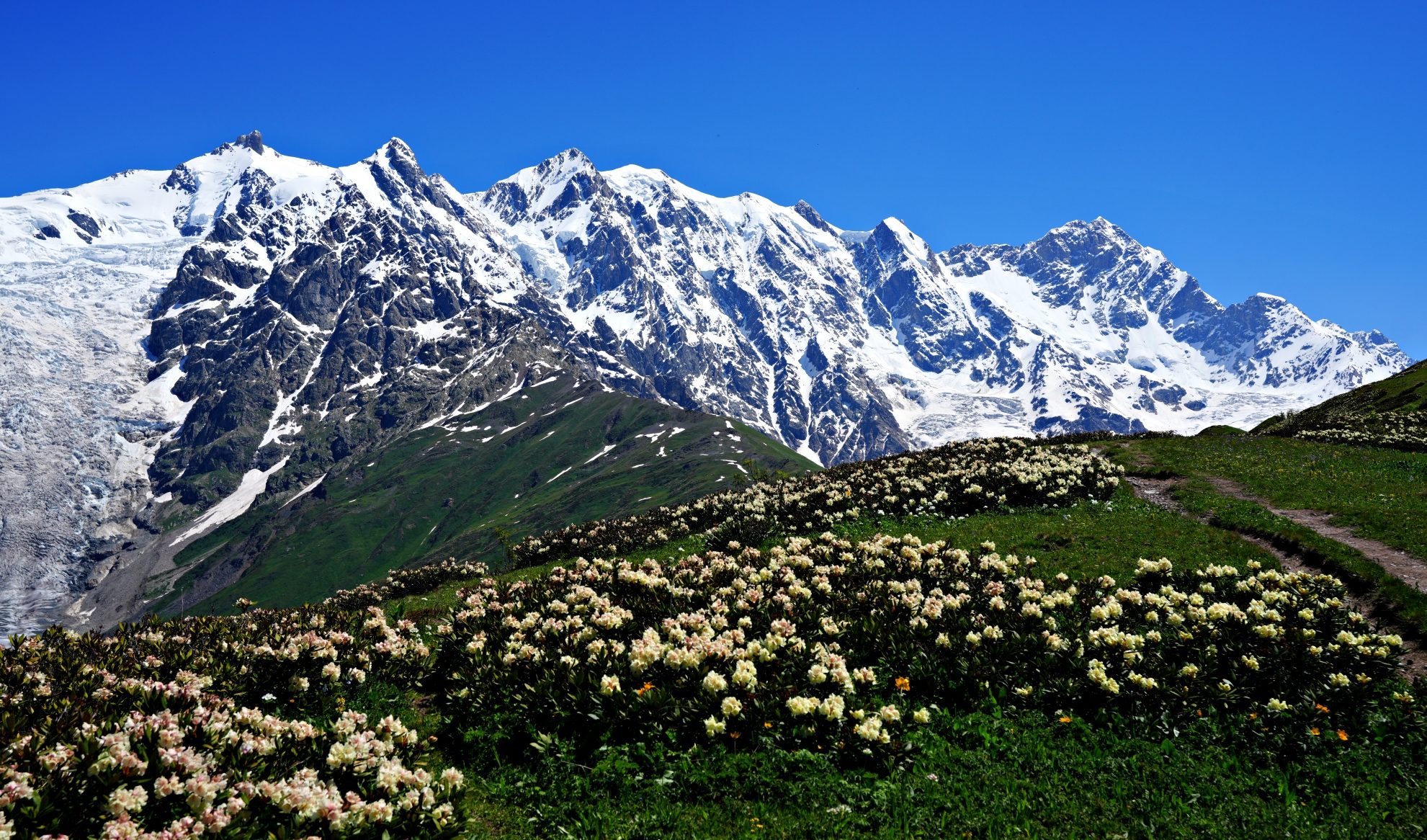
Walking between Svaneti’s medieval villages is an experience you won’t want to miss. Dozens of old stone towers, decorate each village and look as though they were pulled from the pages of a fairytale. Making the walk even better are the constant views of the stunning snow-covered peaks that hover above. But this is more than just a hike, it is an immersion into the culture of the Svan people. With the combination of the epic views and charming villages, it’s easy to see why the Mestia to Ushguli trek is one of the most popular hikes in Georgia.

The Mestia to Ushguli trek in Svaneti, Georgia, is part of the Transcaucasian Trail and can be completed in 3 or 4 days. We had intended to do it in 3, but once we saw how adorable Mestia is, we decided to take 4 days. That would allow us to take our time and enjoy these quaint mountain villages. You can read about the region’s main town in our post Mestia – A Hidden Gem In Svaneti.
In this trekking guide, we’ll show you the breathtaking scenery this area is famous for as well as a brief description of the route each day. Most distances and elevations listed are from our Garmin GPS watches, so they may differ from other sources.
You can find Mestia, Ushguli and the Svaneti hike in the upper corner of the map below and a close-up view of the region in the second map. Click on the first image to be directed to an interactive map.


Day 1 – Mestia to Zhabeshi
Time– 5-7 hours; Distance – 16-17 km (10-10½mi); Elevation Gain – 725m (2,378ft), Elevation Loss – 518m (1,700ft), Max Elevation reached – 1,915m (6,283ft)

After having a rainy day in Mestia the day before, we were so happy to wake up to bright blue skies for our first day of the hike. The route today leaves Mestia and enters one of the less populated valleys in Svaneti. It begins by climbing up an old, gravel road for a while, but there’s not much traffic, so it’s pleasant to walk. You can find the road not far from the Ethnography Museum in Mestia.
As you climb, you won’t be able to take your eyes off Mt. Banguriani as it fills the view in front. Don’t forget to look behind though, at the Lower Svaneti Range and Mestia, far below.


On the way up to the pass, the trail switches back and forth between open meadows, filled with alpine flowers, to tree-covered forests of hazelnut, maple, oak, ash and fir.
Some of the trail in this section is very steep. It had rained for the previous 3 days, so for us, parts of the trail were very muddy. We thought that it would be awful to be on this segment when it is raining.


As you ascend, Mt. Ushba’s distinctive double peaks starts to reveal themselves over your left shoulder. It is a very pretty mountain that we’ll see from many places over the next couple of days.
Richard saw it from the other side when he climbed Mt Elbrus in Russia. His pictures show the amount of snow that was on the mountains when he climbed in May. You can read his story here.


After 7.2 km (4½mi) and 540m (1,770ft) elevation gain, you’ll reach the beautiful, open pass where you are rewarded with stunning views of the Svan towers in the bucolic Mulkhura River Valley ahead. We saw several other trekkers on the trail up to the pass, and many more taking a break when we reached it. Starting the hike with this many people made us hope the trail wouldn’t feel too busy over the next few days.


Just below the pass you have two options to get to your overnight stay. You can take the low trail through the villages, or the high route above them. We chose the high trail and are glad we did. We loved our bird’s eye view of the cute, old towers in the valley. It’s also much less busy because most trekkers take the low route. (High Route Trailhead GPS waypoint N43° 03.351′ E42° 46.924′)
On the way, you’ll be stunned by the landscape. Below the high snow-covered peaks on either side of the valley, the hills are blanketed by green forests. In addition to the greenery, many of the fields have large, fenced fields of daisies, likely grown to feed cattle over the long, snowy winter. They add even more beauty to this already gorgeous landscape.


Soon, we reached Lakhiri. It’s the cutest hamlet in this valley where seventeen medieval towers with attached stone houses are huddled together under the white-capped Tetnuldi Peak. It’s as if they were posing for a picture-postcard. If these views, don’t entice you to stop for a rest in a cafe in Lakhiri, we’re not sure what would.


After passing through Lakhiri, follow the signs to reach the village of Cholashi. If you’re staying in Zhabeshi, you can stay on the same side of the river all the way to Zhabeshi. Those staying in Chvabiani, can go down through Cholashi village and cross the Mulkhra River.
On the other side of the river are the villages of Mulakhi, which include Chvabiani, Tsalda and Zhabeshi. They are all close to the Tetulnadi Ski Resort, and they have many year-round guesthouses. Any of these villages would make great places to stay.


We stayed in Zhabeshi (1,680 m/5,512 ft), near the end of the valley. The quiet community doesn’t have many Svan Towers, but it has a lovely pastoral setting along the river.


On the other side of the Mulkhra River, is a narrow gully with a pretty waterfall. After hiking all day, for some reason, we still wanted to get a closer look at this waterfall. We followed a trail that climbs beside the Tvberi River, but after 130 m (430 ft) of elevation gain, we barely got a glimpse of the waterfall, so we decided to turn around. We realized later that the trail goes up to the toe of the Tviberi Glacier, so it probably doesn’t have any views until you reach the glacier, high above. We don’t recommend this side trip unless you have an extra day.

Day 2 – Zhabeshi to Adishi
Low Route – Time – 3½ -5 hours; Distance – 10 km (6¼mi); Elevation Gain – 840 m (2,755ft), Elevation Loss – 150 m (490ft).
High route – Time – 5-6½ hours ; Distance – 12.5 km (7¾mi); Elevation Gain -1,164 m (5,460ft), Elevation Loss – 676 m (2,220ft) . Max Elevation reached – 2,749 m(9,090ft).

The route today takes you high up into the meadows of Tetnuldi Ski Resort before heading down into another remote valley. Once the trail leaves Zhabeshi, it steadily climbs the ridge, but the jaw dropping views of Ushba, Banguriani and Tetnuldi Mountains will take your mind off the hard work. It hadn’t rained in 2 days, and yet, the trail was still very muddy.
As we climbed, we looked across to the waterfall we tried to hike to yesterday and Mt. Tviberi’s glacier high above.


After walking 4.6 km (2.8mi) and gaining 728 m (2,388ft) of elevation, you will reach the lowest line of Tetnuldi Cable Car at Tetnuldi Ski Resort. It’s above the trees and once again you have 360° views of the Caucasus. Some people suggest taking this lift from Chvabiani instead of trekking. That would avoid 330 m of climbing, but you would also miss many of the views we just showed you.
The lift was not operating when we were there, so if this is your intention, you should check first that it is running. We think many had planned on taking it because we saw large groups walking up the road under the lift. It’s also possible to get a ride to this point, but that would make your walk very short.

From there, follow the signs on the gravel ski resort road for 1 km to reach the trailhead for the Low Route to Adishi. If you take this popular trail, you have about an hour’s walk to Adishi. But, there is another option. Continue on the road for 2 km and 215 m of elevation gain to reach the High Route Trailhead. We decided that since the hiking day is quite short, we’d take this less used trail. Not many take this option, but it offers outstanding vistas of the Caucasus Mountains and the trail is very good. We highly recommend it. (High Route Trailhead GPS waypoint N43° 01.512′ E42° 53.217′)
On the way up to the High Route Trailhead, we walked off-route onto a large meadow in the Tetnuldi Ski Resort. Not only were we treated to unmatched views of the High Caucasus, but the hillside was carpeted in gorgeous alpine flowers, many we had never seen before and couldn’t identify. It made sense when we learned that there are 6,400 species of plants in the High Caucasus, and 25% are endemic.


The resort has 5 lifts and typically receives 6m (20 ft) of snow a year. Skiing is said to be best between late December and late March. We think we may return in the winter to downhill and alpine ski tour (randonnée). Not only will we enjoy skiing, the views are reason enough to return.

From the ski resort, the high route travels through rolling hills covered in flowery meadows for about 45 minutes (2km). The best part was walking under the majestic Mt Tetnuldi and one of its glaciers. Don’t forget to look back from time to time for more unbelievable views of Mt. Ushba.


Around 2 km (1¼mi) from the trailhead, you’ll reach the side trail to Adishi (GPS Waypoint N43° 00.861′ E42° 55.299′). The path is good, but it is quite steep and would be very slippery in the rain. Eventually, it joins the low route, not long before the village.
When you finally approach Adishi (2,040m/6,700ft), it is from above so you can look down onto its dozen towers.

From a distance, Adishi looks adorable. Once you start walking through town, though, it will seem less pristine. Between the cows leaving cow pies on the muddy roads and the shabby homes, it quickly lost its appeal. Adishi is the only hamlet on the trek that is not lived in year-round. At first, we blamed that detail for its lack of cleanliness. After visiting Tusheti, where the summer villages are very clean, we realised that’s not the reason. You can read about Tusheti here.
The other problem with Adishi is that it is the only option for accommodation. The other valleys have several hamlets, so guesthouses are spread out. With trekkers travelling in both directions staying here, it is very busy and that adds to its lack of charm.


As with the other villages, Adishi has a gorgeous setting in the long, tight Adishichala River Valley, so we could ignore the mess for one night.


We sat with a Polish tour group for dinner, and since Richard is Polish, they invited us to join in on the fun. Their guide treated us to his home-made wine and brandy. We didn’t like his sweet wine, but the brandy had a hint of coffee and was our favourite on the trip.
Day 3 – Adishi – Lalkhori
Time – 6 ½ – 8 hours; Distance – 21 km (13mi) including lookout; Elevation Gain – 777m (2,550ft) to lookout; Elevation Loss – 1,182m (3,880ft); Max Elevation reached – 2,829m (9,282ft).

We had heard that day 3 is the highlight of this hike, but after such an amazing day yesterday, we couldn’t imagine it getting any better. Let’s see if it does.
The trail leaves the shabby little hamlet of Adishi and travels up the Adishichala River Valley. Don’t forget to look back for wonderful views of the town and Ushba’s double peaks above. In front, Adishi Glacier was slowly revealing itself to us, enticing us to keep moving forward. Large herds of cattle were grazing along the trail, but better they’re leaving their cow pies here than in Adishi.


After 1½ hours, you’ll reach the crossing point of the Adishichala River. Depending on the time of year, the river may be crossable on foot. It is a very swift river, though, so if you decide to walk, make sure you are experienced in river crossings. Instead of crossing on foot, locals have set up a clever business. For 25GEL (€8), you can cross on horseback. The price is steep for a 2 minute ride, but it adds to the Georgian trekking experience.
We were told that the centuries-old grudges between families were over, but before letting us hire his horse, the cowboy asked us which guesthouse we stayed in Adishi. We’re not sure the reason, but if your guesthouse has horses, you are probably better to hire their horse to cross. As it was for us, we were allowed to ride his horses. The river is very deep in the middle, and even on horseback, our feet got wet.


After the crossing, the trail climbs steeply on muddy trails that wind between tall, flowering bushes. Eventually you’ll reach an open slope that allows more sweeping views of the range, including Ushba and Adishi Glacier. If you look very closely at our pictures, one of the snowy peaks to the right of Ushba is Mt Elbrus, the tallest peak in Europe.


You’ll reach the grassy green Chkhutnieri Pass at 2,655m (8,710ft) after 2 ½-3 ½ hours. If you’re feeling strong, we recommend you continue climbing the grassy ridge to its top. It’s only an extra 90m (300ft) ascent that takes 15 minutes, and is definitely worth it.


From the top of the ridge, you are more than rewarded with panoramic views of the Caucasus and our first glimpse of Mt. Shkhara. At 5193m (1,7037ft), Shkhara is the tallest mountain in Georgia and the 3rd highest in Europe. The views from this pass confirmed to us that day 3 is the most spectacular of the trek.


Walking down from the pass, we couldn’t stop looking back for a continuation of these spectacular views. Once at the valley bottom, we had another great view of Mt. Shkhara that made us excited to see this majestic mountain the next day from Ushguli.


Most people, including us, go all the way to Lalkhori, but there are a couple of other options. Partway down, you will pass a guesthouse at Khalde. Its position on the mountain slope offers spectacular views of the Lower Svaneti Range. Further down, there are 3 or 4 guesthouses at Iprari. Both of these can be accessed by car and some people stop trekking here and hire a 4WD to Ushguli or even Mestia. But, we think this is far too early to stop walking.
Lalkhori is on the banks of the Patara Enguri River and the main highway between Mestia and Ushguli. Both it and Iprari are fine for a night, but neither is a destination on its own.
Day 4 – Lalkhori – Ushguli
Time – 3-4 Hours; Distance – 10.2 km (6 ½mi); Elevation Gain – 585 m (1,9191ft), Elevation Loss – 295 m (970ft). Max Elevation – 2,175 m (4,183ft).

From Lalkhori, the trailhead to Davberi is approximately 320 m up the road toward Ushguli. You’ll recognize it by the sloped pedestrian bridge. From there, follow the long trail that undulates as it crosses over several mountain ridges. There are many ups and downs, but they only gain and lose 50-60m each time. As it travels across the slopes, it passes through fields of alpine flowers and gives a few glimpses of Mt. Shkhara looming above.
Many people skip this part of the trek and take a car directly to Ushguli, making it a 3-day hike. We enjoyed the views from the easy trail, and unless you don’t have time, you should consider doing it.


After 3 or 4 hours, you’ll reach the first of four hamlets that together form Ushguli. The first is Murkmeli. You can continue on the trail if you don’t want to visit this village, but we think it’s worth a walk through. On the other side of Murkmeli, we saw the even cuter community of Chazhashi crowded around a small hill.
If we weren’t already excited to explore Ushguli, we would be after seeing these first two hamlets. Ushguli is such a gem in Svaneti that it deserves its own post. We don’t want to spoil the surprise, so we’ll only give you a glimpse today. You can read our post about Gerogia’s Prettiest Village, Ushguli, here.


To return to Mestia
After you’ve spent a day or two enjoying the views in Ushguli, you will need to return to Mestia before travelling anywhere else. Marshrutkas wait on the bridge between Murkmeli and Chazhashi, beside ChaCha restaurant. There is also a business in Chviniani where you could book one for the next day.
Tips for hiking Mestia to Ushguli


• Hiking Stats: Total Distance – 61.5 km (38¼mi), Max elevation reached on trek – 2,829 m (9,282ft).
• Where to stay – You can find many of the guesthouses on Booking.com. During busy season it’s a good idea to book them in advance. Not all guesthouses have private bathrooms and when shared, there is only one or two bathrooms for several people. Campgrounds are available every day, but it is very easy to stay in guesthouses, so its not necessary to bring a tent.
• Food – Meals provided in guesthouses are excellent, although we always read the reviews online before booking and food reviews were a high priority. In 2025 prices were 20-25GEL each for breakfast and 30-35GEL each for dinner. Many will also have pack lunches for sale, but we found the meals so filling, we only needed a snack mid day. Guesthouses serve Georgian and local Sveneti food such as: chistvari (fried corn bread stuffed with cheese), kachapuri (cheese pizza), soups and salads. Some hamlets have small shops but, prices are high, so you may want to bring your own snacks. A local seasoning is Svan salt. It is a mix of salt, dried garlic, fenugreek, coriander, chili pepper and dill. They tend to use a lot of it, we found a lot of the food a little too salty.
• Water – You can get safe drinking water from your guesthouse. If you take water from streams, you will need to sterilize it before drinking.
• When to trek – Trekking season is mid June until mid October. If you go too early, it will be rainy season and too late you may encounter snow, and many guesthouses may be closed. High season is July to August when there are typically 150 people on the trail every day. We really only noticed it in Adishi because it’s a bottleneck and all trekkers must stay in the small town. Otherwise, people spread out a little more. We also saw far fewer people by hiking the high route options.
• Costs – Our costs for two people were 1,000 GEL (€315) for the 4 day trek in July 2025. We stayed in rooms with private bathrooms in all but one village, so it would be cheaper to have shared bathrooms.
• What to bring – This area does get a high amount of rainfall, so bring rain gear. It also can get cold at night, even in mid summer, so bring a jacket or sweater. In the fall you may need a toque, buff and mittens or gloves. During the day, especially if its sunny, it can get quiet hot. The terrain isn’t too harsh so hiking shoes are good, you don’t need high hiking boots. There are many areas where there is no shade so being sunscreen, a hat and sunglasses.
• Signage – The route is mostly well signed. Most route finding difficulties occur when leaving the villages.
• Money – Bring enough cash for the entire trip as they only accept cash and there is no ATM once you leave Mestia.
• Weather – Check the forecasts daily, but for us, they didn’t seem to be very accurate. Rain was forecasted for every afternoon and if didn’t rain on our entire 4 days. It would not be an enjoyable hike in the rain, because the trail will be very muddy and slick. It hadn’t rained in 4 days and yet we were often dodging large puddles and muddy sections.
• Elevation – This is not a high elevation trek, going only to a maximum of 2,829m (9,280ft).
• Internet – We had pretty good mobile coverage for the entire trek, but not every guesthouse has Wi-Fi, so make sure you have purchased enough data.
• Guide – There is no need for a guide but you do need a map because there are many side trails. Make sure you download maps before leaving Mestia.
You can read about other hikes we did in Georiga in our post Day Hikes From Stepantsminda and Walking Between The Remote Villages of Tusheti. We have also done many hikes around the world. You can find those under Trek-Bike-Ski.

Click on the link to read our Travel Tips For Georgia.
To read more of our adventures in Georgia, click here.
Coming Next – Ushguli – Georgia’s Prettiest Village
For pictures from other blogs go to Gallery at monkeystale.ca.
To read about more of our adventures go to Destinations.
If you like what you read, please comment or share (with credit) using the links below.




We’d love to hear from you, please leave a comment.