
Filled with spectacular mountain scenery, breathtaking waterfalls and varied cultures, Argentina will be a delight to any visitor. The only problem is that there is so much to see and do that trip planning can be difficult. To help you decide how best to spend your time in Argentina, we’ve compiled a list of the top places to visit in the country. Your priorities may not match ours, so while they are ranked in our order of preference, we’re confident that any you choose will result in a vacation to remember.
Since the first three in our list below are equally stunning, they are actually tied for first place.
Click on the link to go directly to our Travel Tips For Argentina.
You can find these cities and more in the map below. It is an interactive map, so you can zoom-in, or click on a marker to read our post from that region.
1. Glacier National Park
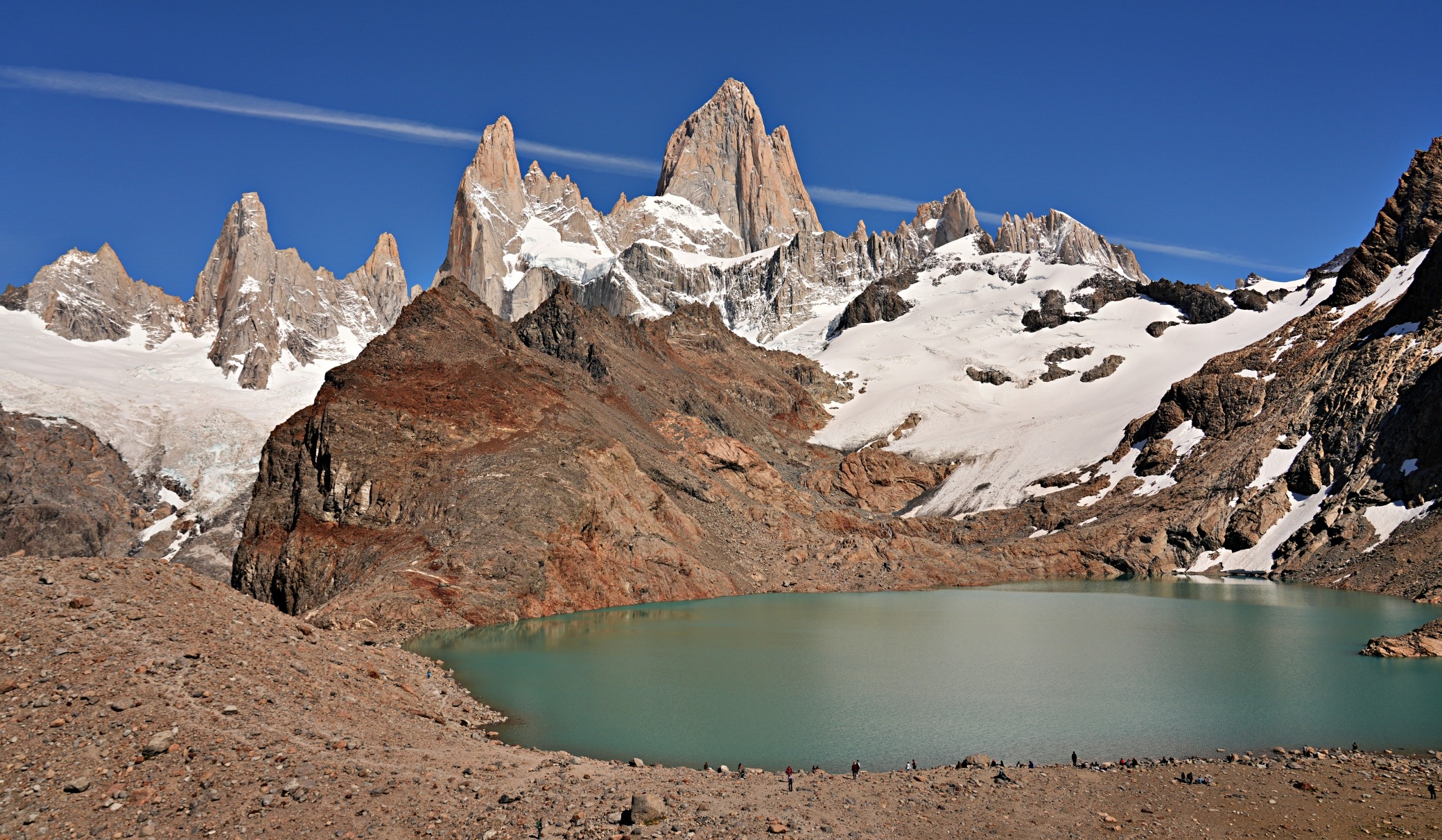
Glacier National Park (Parque Nacional Los Glaciares) is home to both Cerro Torre and Monte Fitz Roy. Hiking to see these iconic peaks in person will be the highlight of your trip to Argentina. It is one of the few places in the world that we have visited more than once and were blown away by the scenery, every single day, on both trips.
Glacier National Park has so much to see, we presented it in two posts. Click on the link to read Hiking Guide For Monte Fitz Roy and Cerro Torre Hiking Guide.

2. Jujuy
In Northern Argentina’s Jujuy Province, the landscapes are saturated with rainbow-coloured mountains, while flat-roofed adobe houses decorate its streets. Its small towns are home to the indigenous Kolla people, who bring their unique culture to their communities. The main towns, Humahuaca, Purmamarca and nearby Iruya in Salta, are bursting with delightful gems that made us fall in love with this region. Make sure you save time to visit these spectacular northern reaches of Argentina.
The northern province of Jujuy has so much to see that we spread it over two posts. Click on the links to read about Purmamarca and the Mountain of Seven Colours and Humahuaca and the Mountain of 14 Colours.

3. Iguazu Falls
It is rare to visit a place so spectacular that you want to see it again. It’s even rarer to be just as impressed the second time as you were on your first visit. Yet, few places in the world are as awe-inspiring as the natural wonder of Iguazu Falls. We think you’ll agree once you see this breathtaking marvel.
To see the pictures and read our post, click Iguazu Falls, Argentina’s Natural Wonder. While you’re there, you should pop over to Brazil to see it from the other side. You can read more about that in our post Visiting Iguaçu Falls in Brazil.

4. Buenos Aires
From the classic monuments in its historic quarter, to the quirky ones in its eclectic neighbourhoods, Buenos Aires has something for everyone. Not only will you find the famous Casa Rosada and Congress Palace, but there are also many lesser known, elegant properties and eclectic neighbourhoods to visit. Come with us as we take you to some of these wonderful sites and neighbourhoods in Buenos Aires.
There is so much to see in Buenos Aires, that we have three posts from the city, A Guide to the Top Sites and Discover the Eclectic Neighbourhoods, and a Day Trip to the Tigre Delta

5. Salta
Mention Salta to any Argentine, and their immediate response is ‘Salta la Linda’, said with a longing sigh. It translates to Salta the Pretty, and once you visit, you will understand why it received this endearing nickname. With its multicoloured churches and elegant heritage buildings, there is much to love about this pretty city. But the colours don’t end in the city. Another place to keep in mind is the nearby Quebrada de las Conchas.
We posted three stories from this northern province. One from the capital, Salta – Argentina’s Prettiest City. Another is from the colourful valley, Day Trip from Salta – Quebrada de las Conchas and Cafayate. The third is from the far north of the province to a remote village, Iruya: Why You Should Visit This Remote Mountain Town.

6. Bariloche and Northern Patagonia
Located in Northern Patagonia, Bariloche offers many opportunities to enjoy the surrounding wilderness. The town itself is nice to visit, but making it even better are the many hikes and scenic drives in the surrounding parks.
Since you have so much to see in Northern Patagonia, we presented it in three blogs. Click on the links to read about Bariloche in Argentina’s Lake District, Hiking to Refugio Frey & Cerro Llao Llao, and Driving the 7 Lakes Route to San Martin de los Andes.

7. Perito Moreno Glacier
On the western end of Lago Argentino, you’ll find a spectacular display of Mother Nature’s brilliance. The massive Perito Moreno Glacier spreads out to fill the long valley as it makes its way to the lake. The highlight of your visit happens at the glacier’s toe, where the tall wall calves into the turquoise water in the most dramatic fashion. Seeing this wonder in person should be on your must-see list when visiting Argentina.
You can read more about this spectacular wonder in our post Perito Moreno Glacier: A Must-See In Argentina.

8. La Rioja
If you do travel to Northern Argentina, it would be worth a quick stop to see one of the three parks near La Rioja: Tampalaya National Park, Ischigualasto Provincial Park and Los Colorados Provincial Reserve. It wasn’t as straightforward as we assumed, so as well as showing you Los Colorados, we offer a few tips on visiting these parks.
To read more about the parks around La Rioja, read our post Explore Los Colorados: A Hidden Gem Near La Rioja.

9. Cordoba
Some of Argentina’s most impressive Jesuit buildings are found in the city of Córdoba. Tucked between the newer buildings of this worn-out city is the Jesuit Block, a UNESCO World Heritage Site. In addition to these distinguished buildings, you can find other elaborate churches, only a few streets away. Although not high on most tourists’ radars, those who love heritage churches will be happy to have visited Córdoba.
To read about this historical city, read our post, Jesuit Monuments in Córdoba.

10. Mendoza
With the tall Andes Mountains on one side and vineyards covering the land on its edge, Mendoza is a mixture of rugged and refined. These two landscapes not only give it a distinct look from other parts of Argentina, but also very different activities. Home to Argentina’s famous wineries, Mendoza is the best spot for wine tours and tasting. Its other popular activity is to go hiking and climbing in the nearby Aconcagua Provincial Park in the Andes Mountains.
You can read more about Argentina’s wine region in our post Wine Tasting in Mendoza, or climbing Aconcagua in our post Seven Summits – Climbing Aconcagua.

Travel Tips For Argentina
Money – Getting cash is more complicated in Argentina than in other countries. Most ATMs charge very high withdrawal fees, usually $10USD or more per transaction, and have a low withdrawal limit equivalent to $80USD. Argentine banks also charge an extremely high fee for credit card purchases, as much as 10% per transaction. Those fees are charged by Argentine banks and are in addition to what your bank may charge.
Another difference to keep in mind is that Argentina has high inflation, and there are two conversion rates. One is the official rate, and one is the blue rate. Most places offer an exchange rate between these two. Because of the high inflation rate, we have listed most prices in USD, but you will pay the equivalent in pesos.
The most cost-effective way to get cash is to send yourself money via Western Union. We were charged just over 2% per transaction. The drawback is that not all cities have Western Union, and smaller branches may not have enough cash on hand, so try to use a Western Union in a large store such as Carrefour.
Accommodations – Foreign tourists are exempt from the 21% VAT (IVA in Spanish) charged on accommodations in Argentina if paid by credit card or bank transfer. In our experience, in tourist areas, the exemption occurs automatically, no matter how you pay. However, in smaller centres and locally run hotels, we had more problems. Some hotels or apartments used several excuses to charge the extra 21% and only gave up when we wouldn’t. Make sure you know the hotel cost, without VAT, in Argentine pesos, before checking in at your accommodation, so they don’t try to sneak the increase past you.
Restaurants – Other than in tourist areas, most restaurants close for mid-afternoon siestas and usually don’t open for dinner until 8 pm. As well, keep in mind that prices are quite high. In many areas, meals are similar to North American prices.
Tipping – In northern Argentina, everyone, and we mean everyone, expects a tip. And they will ask you outright for one. Bus drivers, luggage handlers, taxis/Uber, and wine tasting. It isn’t as bad in other parts of the country, and we didn’t experience it at all in Patagonia.
SIM – Unless you are using an e-SIM, Claro is the only company that offers tourist prepaid SIMs. They are very inexpensive, though, 30 days with 25 GB for $10 USD.
Transportation – Uber is widely available in most cities, but larger cities have good public transportation. In Buenos Aires, Mendoza, Bariloche and San Salvador de Jujuy, they use the SUBE card for public transportation. It can be purchased and reloaded at 25 Hour convenience stores and some private kiosks for a $1 USD fee. You can also reload at the metro stations in Buenos Aires, and they do not charge fees. Recently, most buses and trains have begun to accept credit cards. There is a usage fee, but it is pennies per ride. If you are only using it a few times, it is cheaper than loading the cards at a convenience store.
Bus travel between cities is very comfortable and most depart and arrive on schedule. Conditions of the buses vary, though, so reading reviews is useful. The most comfortable buses were Andesmar. They have good wifi, electrical plug-ins, are clean, hand have comfortable seats. Others may say they offer these features, but they often didn’t work. We also had good rides with CATA. Flecha is one of the worst. Their buses were not clean, plug-ins never worked, and they were often late. An important detail to remember is that long-distance buses generally do not stop for breaks, so make sure to bring whatever food you may want.
We only had two problems with buses breaking down during our three months in South America, and both were in Argentina. One broke down at a bus station, but the other happened in an isolated place, and we had to wait for another bus. The problems were resolved, but did make us several hours late.
Language – Argentina is a Spanish-speaking country. Even if you speak Spanish, the pronunciation throughout Argentina will confuse you. The most noticeable ones are that ll and y are pronounced sh or zh. For example, pollo is posho, and playa is pronounced plasha. Adding to our confusion, in northern Argentina ll is pronounced j, so llama is jama.
Border Crossing – When you arrive in Argentina by plane or on land, you will likely need to show proof of accommodation for the first few days. Ours was booked for 3 nights, and that was fine.
Safety – When travelling in South America, safety is always a concern. We found Argentina to be generally safe, which is an improvement from our visit here over 20 years ago. You should still follow safe practices such as not showing large sums of money or jewelry, keeping your phone in a zipped or concealed place, and taking extra care at night.

To read more of our adventures in Argentina, click here.
Coming Next – What To Do In Banff and Canmore This Summer
For pictures from other blogs go to Gallery at monkeystale.ca.
To read about more of our adventures go to Destinations.
If you like what you read, please comment or share (with credit) using the links below.



We'd love to hear from you, please leave a comment.