
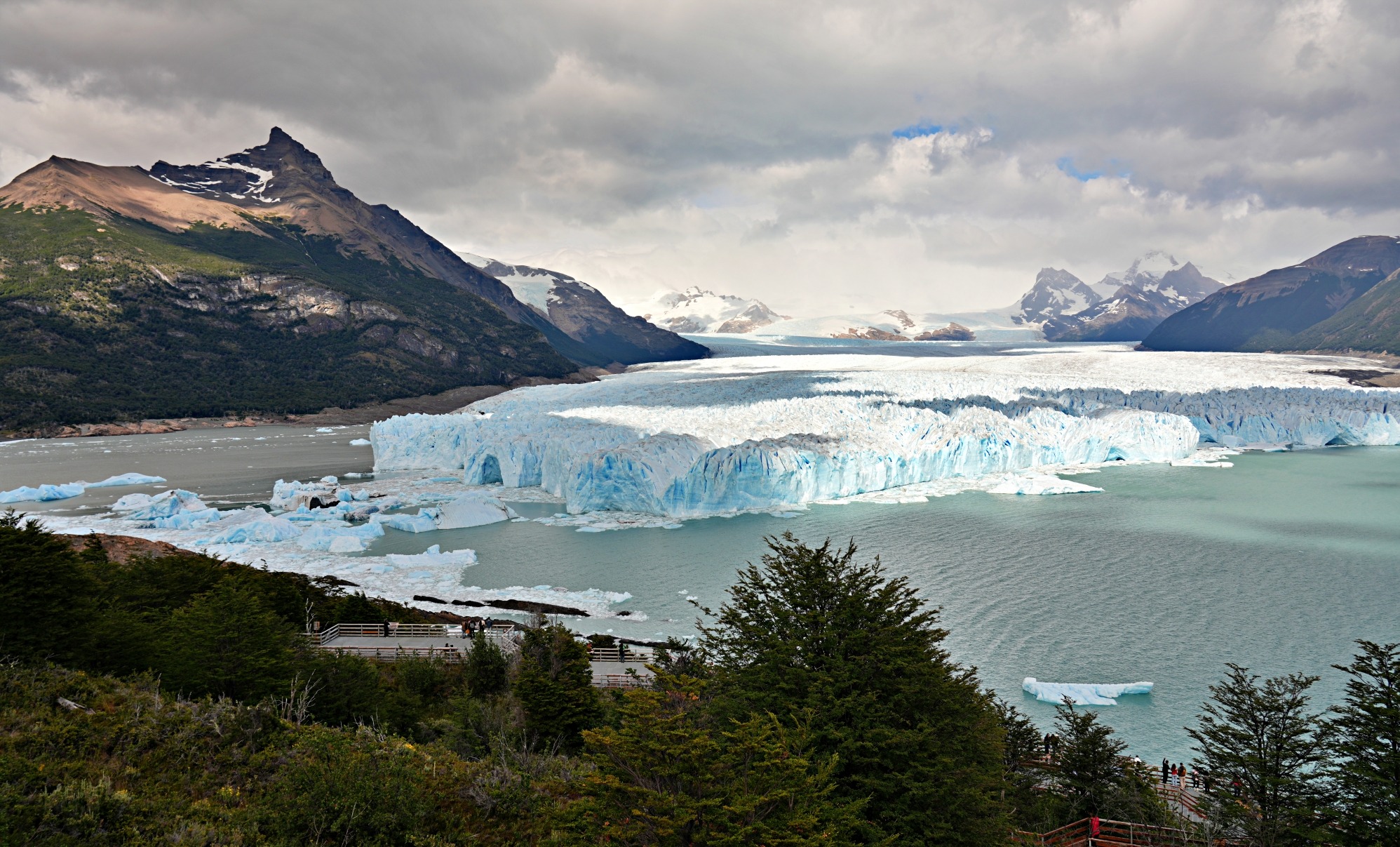
On the western end of Lago Argentino is a spectacular display of Mother Nature’s brilliance. The massive Perito Moreno Glacier spreads out to fill the long valley as it makes its way to the lake. The highlight of your visit happens at the glacier’s toe, where the tall wall calves into the turquoise water in the most dramatic fashion. Seeing this wonder in person should be on your must-see list when visiting Argentina.
Driving to Perito Moreno Glacier
Located 80 km (50 mi) from El Calafate, we didn’t realize the drive would also be part of the beautiful scenery for the day. The road takes you along the shore of the turquoise Argentino Lake, with views of the towering mountains from Glacier National Park in the distance. In addition to Perito Moreno, a few other glaciers terminate on the lake, adding to the collection of icebergs floating on the water.


Perito Moreno Glacier
Our first view of this impressive glacier was from the highway, just before the park gates. From here, it was easy to see how vast the glacier is. At almost 5 km (3 1/4 mi) across and 23.5 km (14 mi) long, it is an impressive sight.

The glacier is named after Francisco Moreno, an Argentine explorer and naturalist. He actually never visited the glacier but is credited with naming Argentino Lake. He was given the nickname Perito, meaning expert, for his many accomplishments in Patagonia, including establishing Nahuel Huapi National Park, near Bariloche, and determining the Patagonian border between Argentina and Chile.
Created 18,000 years ago, for most of its existence, the glacier was slowly advancing. However, things changed in the 20th century. It stopped advancing and instead, remained in a steady state for a while. Since 2020, Perito Moreno has unfortunately followed the path of most other glaciers in the world by retreating. Although we hoped to see the ice wall calve into the lake, we knew that this ice would not be replaced as quickly as it was being lost. As nature lovers, it seems like an awful thing to wish for.

Perito Moreno Walking Trails
There are several ways to see this natural wonder: by boat, kayak, trekking or walking. We chose to walk on the park’s suspended trail system, and will describe the different trails and show you their views.
The interconnected trail system begins at the parking lot. They are rated in difficulty based on the number of stairs, but all the trails have a lot of stairs, and to us, none seemed much easier than the others. All are raised metal platforms, so they aren’t natural trails, but they take you to the best views of the glacier. Only the main viewpoint is wheelchair accessible.
Sendero de la Costa
The trail located closest to the parking lot is Sendero de las Costa (Coastal Trail). It begins away from the glacier and gives you a good look at this breathtaking scenery, without having the glacier as a distraction.


The trail follows the water’s edge with options to climb up and down to a variety of viewpoints, called balconies. In front of you, Perito Moreno Glacier slowly comes into view, and we loved this slow reveal. The trail ends at Sendero Central.

We don’t think you should, but if you want to skip this first trail, there is a free shuttle from the parking lot to Sendero Central.
Sendero Central
This loop trail is considered the easiest, but other than its main balcony, you need to walk down and up stairs to reach the other viewpoints, so it is not much easier than the other trails. From it, we could see the entire glacier and were able to appreciate its vastness.


It was from this trail that we began to see the ice debris in the lake. Some were small, but there were many large icebergs. We also began to see many caves in the glacier wall.


Sendero Inferior
This walkway is said to be the most difficult. It is the longest and has quite a few stairs, but it is definitely worthwhile to walk its entire length because it lets you get very close to the glacier. We were at least as close as the boat tours.
At one point, we were at eye level with the glacier’s pinnacles and could pick out the many disorganized crevases on its surface. We have walked and skied across many glaciers over the years, but Perito Moreno is the most convoluted we’ve seen, including the Khumbu Icefall at the base of Everest. In fact, we didn’t visit the glacier on our first trip to Argentina because we didn’t think it would be much different, but boy, were we wrong.


At 40 to 70 m (130-230ft) tall, the wall of ice looks like a fortress. What we can’t see are the 100 metres of ice below the water’s surface. The total thickness of the glacier is close to 170m (550 ft).

From many of Sendero Inferior’s balconies, we were entertained by the dramatic calving events, some of which happened right in front of us. First, we heard a loud boom and then watched as huge sections of ice peeled off, making a dramatic splash in the water. Many of the cracks we heard took place inside the glacier and don’t lead to calving, but they eventually work their way to the outer edge. Hearing those, we felt like the glacier was teasing us.
Here is a before and after a calving event. It is the same part of the glacier, but taken from a slightly different angle.


This short video lets you see how disruptive they are.
The water had new features after a calving event, too. From debris rings to turning ice blocks, the water was continually changing.


The best time to see the calving is early to mid-afternoon, when the sun has had time to heat up the ice. Don’t go too late, though, because the sun will be in front of you, making it difficult to photograph. We arrived at 10:30 am, and the first cracks began around noon. By 1:30 pm, we witnessed these large sections of the glacier splash into the water.
Sendero del Bosque
Immediately beside this huge glacier is a dense forest. This trail usually lets you walk through the trees, but it was closed because of dangers of tree fall when we were there. It seemed strange to us that a large forest and a glacier can exist side by side. How can both survive in the same conditions? But at 200 m (650ft) of elevation, it is more surprising that such a large glacier exists than the forest. The latitude at Perito Moreno is almost the same distance from the equator as our home in Calgary, Alberta. While we do have large glaciers in the nearby Rocky Mountains, they are at much higher elevations than 200 metres.
How to visit Perito Moreno Glacier
Since Perito Moreno Glacier is inside Glacier National Park, you must purchase a park pass. It is on the same park pass as Monte Fitz Roy and Cerro Torre, so you can buy a multi-day pass to include your time there as well. Multi-day passes are only available online, but single-day tickets can be purchased at the park offices. There is a savings to buy multi-day passes; you can purchase them online here.
If you have a car, there is limited parking at the information centre. If you don’t have a car, the easiest way to visit is by taking a bus from El Calafate. Several companies operate out of the El Calafate Bus Station (Terminal de Omnibus). They offer return trips that give you 4 hours to explore the glacier. We found that to be plenty of time to see everything, including the calving events. Buses stop at the park gates, where you can buy a day pass or show your multiday pass. You need to show your passports.
If you are taking a boat tour, tickets are sold at the information centre where the bus drops you off. If you prefer an organized tour, or want to hike on the glacier or kayak in the lake, you can find many options at the tour companies in El Calafate.
When to visit Perito Moreno
Depending on what you want to see will determine which season is best for you. Summer (December to February) has the warmest weather and the highest chance of seeing calving events, but it will also be the busiest. Spring and fall have cooler temperatures and fewer visitors, but the glacier isn’t as active.
El Calafate
The city of El Calafate provides the best access to visit Perito Moreno Glacier. There’s not a lot to see in the city, but we spent an afternoon exploring its streets and found a few nice spots to recommend.

Argentino Lake
A long promenade on the shore of Lago Argentino lets you stroll along the large lake. From it, you have nice views that are completely different from the glacier located at its other end, 80 km away.


From the promenade, we enjoyed seeing many birds, including black-necked swans and our favourite, black-faced ibis. We had planned to visit a nearby nature reserve on Laguna Nimez, but we saw so many from the lakeshore that we didn’t think it was necessary.


The promenade took us beside Calafate Arroyo (Stream), bordered by Calafate berries, Crowberries and willows. The Calafate berry looks like a small blueberry or Saskatoon, and you can buy calafate jams and syrup in town. The Calfate bush is so common here that it is the reason for the city’s name.


We saw kite surfers in the distance, so we continued our walk to see them up close. The prevailing Patagonian winds make this a great destination for experienced kiteboarders. The best season is October to March. Remember, though, this is the lake that Perito Merino and other glaciers drop into, so the water is very cold at 10-11°C (50°F) in the summer.


Downtown Calafate
The main street, Avenida del Libertador, is a busy tourist street with mountain gear stores, souvenir shops, as well as bars and restaurants. Many of the buildings are in the alpine style, such as log cabins or A-Frames.
It is also where you’ll find the Glacier National Park Office with a statue of Francisco ‘Perito’ Moreno in front.


Mirador de la Ciudad
A small viewpoint above the city gives you a nice view of the lake and the mountains in the distance. It’s not far from the Bus Terminal, so you could stop by on your way back to your hotel after visiting the glacier.

Glacier National Park
The famous Glacier National Park is not far from El Calafate, so after visiting the glacier, you will want to spend a few days exploring its many hiking trails. You can read more about this park and the village of El Chaltén in our posts about hiking to Cerro Torre and Monte Fitz Roy.
Where to stay in El Calafate
The city has many options for short-term rental apartments, hostels and luxury hotels. Maybe you want to stay in one of these adorable A-Frame cottages, as we did. Accommodation prices are very high in Patagonia, so expect to pay more for less quality. If you have a car, you may want to stay in an estancia (ranch) outside the city. Many of them offer homestays.

How to get to El Calafate
The most common option is to fly into El Calafate International Airport. Flights arrive from Buenos Aires, Bariloche, Ushuaia, Mendoza, and Santiago, Chile.
You can also reach El Calafate by bus, but expect long overnight trips. For example, it takes 27 hours to reach Bariloche by bus, and the price is not much less than a flight. If you plan to visit Torres del Pain, buses travel between El Calafate in Puerto Natales, Chile (6 hrs).
Tip – There is a small town in the northern part of Santa Cruz Province called Perito Morino. It has nothing to do with the glacier and is very far away.
You can find El Calafate in the southern end of the map below. It is an interatctive map, so you can zoom-in or click on a marker for a link to our post from that region.
Note – Prices are listed in USD because the rate of inflation in Argentina is so high. As of 2026, any fees listed in pesos would be inaccurate within a few months. Becasue of this, many restaurants don’t list prices on their menus, or if they do, they have been written over many times as the value of the peso drops. Apart from hotels, most business will only accept payment in Argentine pesos.

Click on the link to read our Travel Tips For Argentina.
To read more of our adventures in Argentina, click here.
Coming Next – Top 10 Places to Visit in Argentina
For pictures from other blogs go to Gallery at monkeystale.ca.
To read about more of our adventures go to Destinations.
If you like what you read, please comment or share (with credit) using the links below.




We'd love to hear from you, please leave a comment.