
Located near the middle of the Magellan Strait, Punta Arenas is a common tourist stop in Chile’s Southern Patagonia. While most visitors only have a quick visit as part of an Antarctic cruise, we were here to see the adorable Magallanic Penguins. Having been to the city on previous trips, we had low expectations for Punta Arenas, but on this trip, we discovered a wonderful mix of monuments that highlight both its wealthier days and its illustrious maritime history.
This visit marked Richard’s fourth time in the city. Two of these visits were for his climb of Vinson Massif on Antarctica. You can read about his climb in our post Seven Summits – Climbing Vinson Massif. On this recent South American trip, we returned to this city, to see the thousands of Magellanic Penguins on Isla Magdalena. You can read about visit with those penguins in our post. (Coming Soon)
A Brief History
Founded in 1848, Punta Arenas began as a ragtag town, even serving as a penal colony for a while. By the late 1800s, steam navigation made the route through the 560 km (350 mi) long Magellan Strait a better option for shipping, and the port city quickly transformed. At that time, the strait provided the quickest and safest route to get between the Pacific and Atlantic Oceans. Once the Panama Canal was built, however, the Magellan Strait was much less used, and the port city dropped in importance.
Punta Arenas is located in the far south of the map below. It is an interactive map, so you can zoom-in or click on a marker for a link to our post from the area.
After visiting the penguins, or while spending a few hours before your cruise, you can fill your day by exploring these interesting places in Punta Arenas.
Plaza Muñoz Gamero (Plaza de Armas)
Today, the city’s downtown exhibits signs of its former prosperity, a lot of which can be seen on the historic Muñoz Gamero Square. Surrounding the square are a few elegant mansions, built when the city was filled with wealthy merchants. Today, most are museums, banks and government offices, but their presence makes it easy to imagine the city’s golden days.


In the middle of the square, you’ll find a monument to Magellan, including a bronze statue of the explorer standing above an indigenous Patagonian man. Legend says that if you rub the toe of the seated man, you will one day return to the city. Other versions say it will ward off seasickness or simply that it will give you good luck. The toe is very shiny, so it looks like most visitors comply. Richard rubbed the toe on his previous visit, but on this trip, we avoided the toe because we don’t need to return.

In addition to the mansions, the Sacred Heart Cathedral (Catedral del Sagrado Corazón) and its Romanesque tower add a refined look to the square. In the early 20th century, it was considered the most stylish church in southern Chile.


Those beautifully restored colonial mansions extend beyond the square, so let yourself wander the streets in search of these gems. In between are a few that are still waiting for a touch-up.


On your stroll, make your way toward the water, where you’ll find typical maritime buildings, including warehouses and single-story homes. Many are brightly painted or decorated in street art, but just as many seem to have been forgotten.


Costanera del Estrecho
Once you make it down to the water, take a long walk on the edge of the Strait of Magellan. Costanera del Estrecho (Strait Promenade) not only lets you walk beside the famous strait, but the pedestrian path also displays monuments to important people and the city’s maritime history.


Two notable monuments commemorate their naval history. Monumento al Piloto Pardo celebrates the Chilean Naval Officer who led the expedition to save Shackleton and crew when they were stranded on Elephant Island. Another is a monument for the sailors of the Ancud (Monumento a Tripulantes Goleta Ancud). We’ll tell you more of their story when we visit the Nao Victoria Museum below.


Nao Victoria Museum
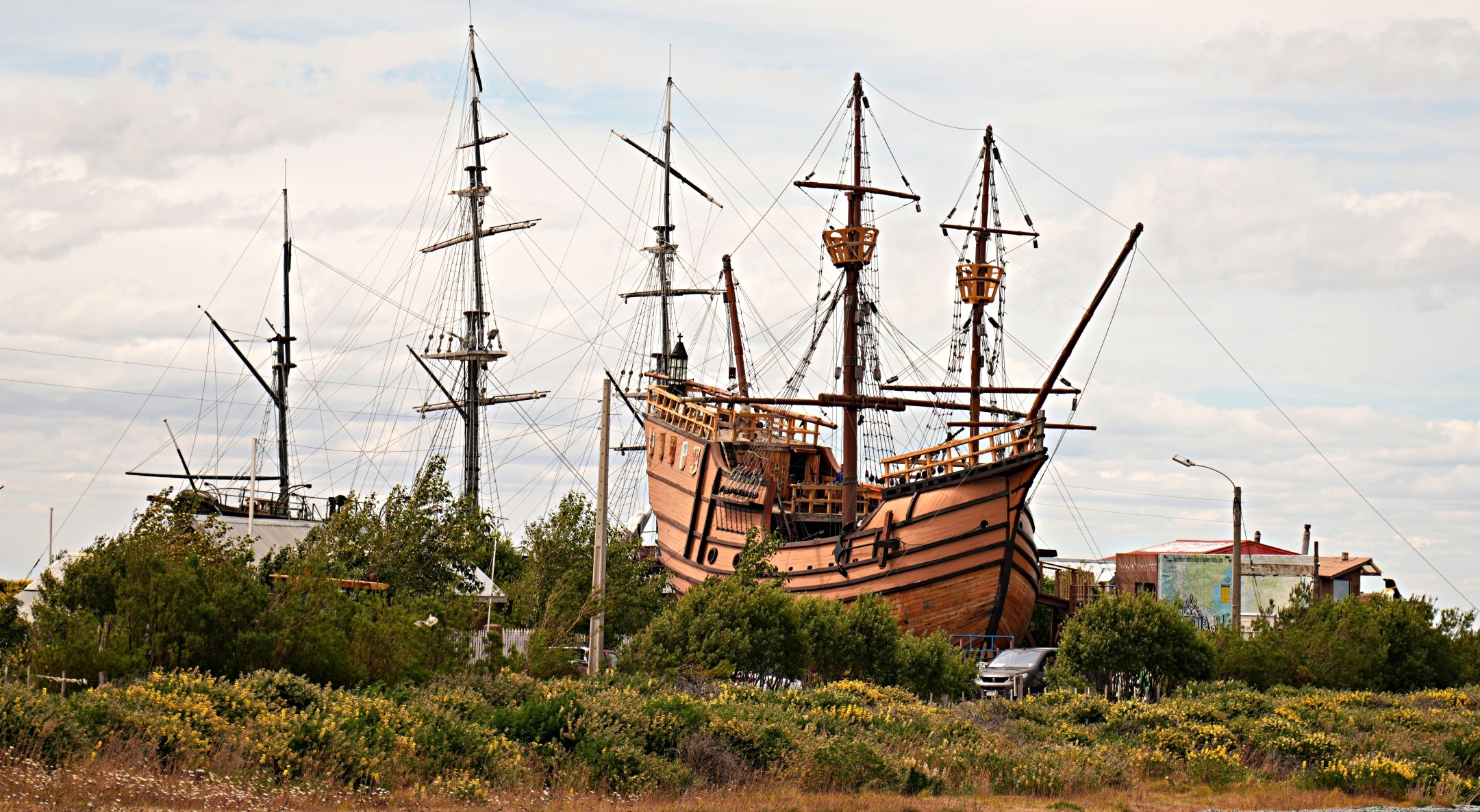
One of the most interesting museums in the city is the Nao Victory Museum. Located 9 km from the city centre, the museum displays full-sized replicas of famous sailing vessels including, Nao Victoria, the Beagle, Ancud and Shackleton’s lifeboat. Since it is close to Terminal Tres Puentes ferry docks, you should plan to visit the museum before or after you visit the penguins.
Nao Victoria
Built in 1518, the Spanish carrack was the first ship to circumnavigate the globe. Magellan, a crew of 265, and his fleet of five ships were tasked with finding a passage between the Pacific and the Atlantic Oceans. All five ships made it to the Patagonian strait that is now named for Magellan. Once there, though, things started to turn sideways for the expedition. While still in the strait, one captain deserted the expedition. Over the next several months, two ships were damaged beyond repair, and the other was deemed unsafe to continue the voyage. Magellan made it as far as the Philippines where he, and several crew, were killed. In the end, only Nao Victoria, captained by Juan Sebastian Elan, was able to complete the mission. He returned to Spain on that ship with a crew of only 18.

In 1522, Captain Elan gave King Carlos I the news that they had found the passage and circumnavigated the earth. Since it was a long, difficult journey, though, it was rarely used as a trade route until steam ships were built.
Once you walk through the replica of Nao Victoria, its success is even more astonishing. Its narrow keel, small rooms and lack of privacy would make an awful journey, even for the heartiest of sailors.


HMS Beagle
Built almost three hundred years after the Nao Victoria, the HMS Beagle’s second voyage is its most famous. It was on this expedition that Charles Darwin’s curiosity led him to propose the Theory of Evolution by Natural Selection.
Darwin wasn’t its only famous sailor. The captain of the Beagle on that voyage was Robert FitzRoy who is credited with mapping large portions of the Patagonia watershed. If you remember, Monte Fitz Roy in Argentina, was named after the captain.


Built in 1820, the Beagle is an impressive-looking boat, but it was the Beagle Figurehead on the ship’s prow that surprised us the most.

Seeing these two re-created boats side by side allows you to appreciate the advancements in shipbuilding that occurred in the 300 years between them. The Beagle is much larger, with spacious rooms, a proper helm and a wider keel, making it look much more seaworthy than the Nao Victoria.
The Ancud
Another ship in the museum is the 19th century schooner, The Ancud. It was built on the Chiloe Islands on Chile’s Pacific Coast. Although we had never heard of The Ancud, it is well known in this region because its mission was to claim Chile’s sovereignty over the Strait of Magellan. We showed you a monument to its crew on the Costanera, above.


Shackleton’s Lifeboat
The final piece at the museum is a replica of one of Shackleton’s Lifeboats used in 1916 when the Endurance sank. He and some of his crew sailed from the Arctic Ocean to Elephant Island on three of these small boats. Imagine going anywhere, never mind the Antarctic Ocean, in this little boat. They were rescued by Luis Pardo, whose monument is also on the Costanera.

Nao Museum Entry – 7,000CLP ($7.50USD); Opening Hours – 9am to 8pm.
Lord Lonsdale Shipwreck
At the opposite end of the waterfront from the museum, an old shipwreck seems to be asking you to take its picture. In 1909, the frigate caught fire and sank near the Falkland Islands, 560 miles away. Someone purchased the boat and was towing it to Puerto Natales when it was abandoned in Punta Arenas. In addition to the Lord Lonsdale Shipwreck, we found a few others along the water’s edge.


Punta Arenas Cemetery
Manicured hedges and flower beds decorate the ornate tombstones in the cemetery. It is the resting places of the city’s early elites and is said to be the most beautiful cemetery in the world. We’re not sure it is the most beautiful, but it does have a peaceful setting surrounded by a lovely garden.
Not far away is a tribute to Pataonia’s shepherds. They were a key driver of Patagonia’s early economy.


India Plaza
We were surprised to learn that there is a large Hindu population in Punta Arenas. Not far from the port, we saw a large temple and plaza with statues of Mother Theresa, Gandhi, and author Rabindranath Tagore.

When to visit Punta Arenas
When you visit Punta Arenas will depend on what you want to see. For the Magellanic Penguins, October to February are the best months to visit. If you’re going on a cruise, most depart Punta Arenas between November and May. In general, Summer (December to February) will be the busiest in Punta Arenas because it has the best weather. Late spring and early autumn will be quieter, but it is likely to be a little cooler.
Getting to Punta Arenas
If you are only planning to visit Punta Arenas, the best option is to fly. Presidente Carlos Ibáñez del Campo Airport is 22 kilometres outside the city. Flights arrive from Santiago, Bariloche, Puerto Montt and other Chilean and Argentine destinations. Otherwise, buses travel several times a day between Puerto Natales and Punta Arenas (3 hours).
Where to stay in Punta Arenas
Many only spend an afternoon in the city before embarking on their cruise, but in order to see the penguins, you will need to stay at least one night. There aren’t a lot of international chain hotels in the city, but there are several locally run hotels and apartment rentals. Try to stay walking distance to Plaza Muñoz Gamero.
Click on the link to read our Travel Tips For Chile.

To read more of our adventures in Chile, click here.
Coming Next – Walking with the Penguins on Magdalena Island
For pictures from other blogs go to Gallery at monkeystale.ca.
To read about more of our adventures go to Destinations.
If you like what you read, please comment or share (with credit) using the links below.





We’d love to hear from you, please leave a comment.