
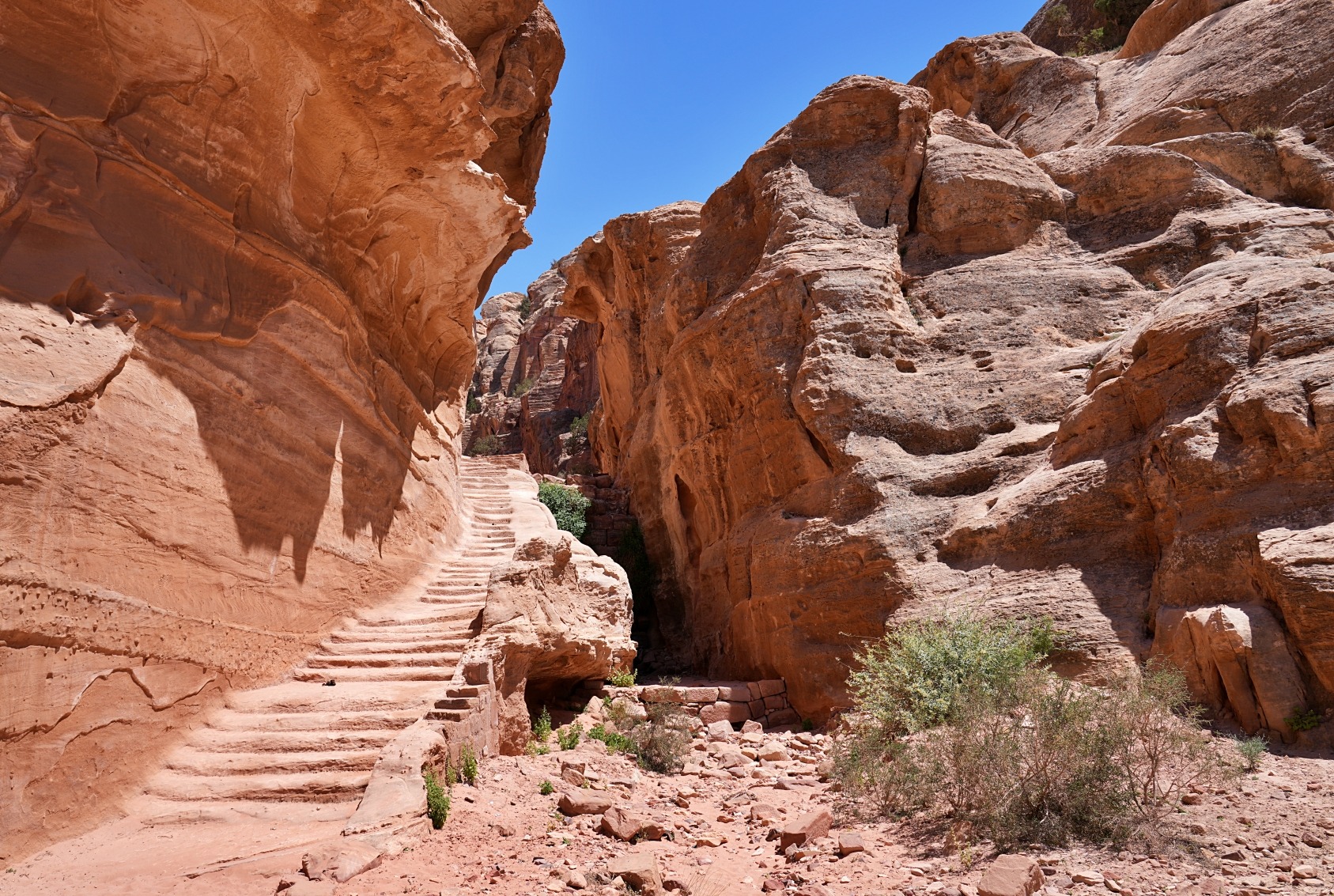
Petra is Jordan’s most popular tourist site, and for good reason. However, did you know that there is also great hiking in the area? We did three hikes in Petra: Little Petra to Petra Trail, including Ad Deir Monastery; Wadi al-Farasa-High Place of Sacrifice Loop Trail; and the Al-Khubtha Trail to a Treasury Lookout. We highly recommend them because they offer a different way to see the alternative parts of fabulous Petra.
In this post, we’ll share the views from the three trails and include hiking details so you can do them too.
To see where Wadi Musa (Petra) is located, please click on the link to view our interactive map of Jordan.
Little Petra to Petra Hike
Follow the footsteps the Nabataeans used thousands of years ago to walk between the villages of Little Petra and Petra. Near the midway point, you can visit the beautiful rock-cut Ad Deir Monastery.
Tip – It is called Addeir Monastery on Mapy.cz. It can also be found on AllTrails as both Little Petra to Petra, and Back Door Petra. Google Maps doesn’t show the hiking trails.
Trailhead: Siq al-Barid (Little Petra entrance) – Distance – 7 km (4.3 mi); Elevation gain – 100m (330 ft), but with ups and downs, the total gain is 247 m (810 ft); Time– 2-3 hours
Alternate Route to the monastery: Ad Deir Monastery Trail from the Basin near Qasr al-Bint in Petra, Distance – 3.2 km (2 mi); Elevation Gain – 208 m (680 ft). This was our descent trail and has approximately 850 stone steps.
Getting to the trailhead
Little Petra is 9.1 km (5.7 mi) from the Petra Museum. The easiest way to reach it is by the free shuttle. It leaves from the parking lot behind the Petra Museum and drops you at the Petra Nabataean Cultural Village. The shuttle operates roughly every 30 minutes from 7:30 am until 3 pm. The cultural village is just shops, so don’t plan to spend much time there. Instead, walk across the highway and follow a dirt road for 1 km to the entrance to Little Petra. If you miss the shuttle, you could take a taxi to Little Petra. We didn’t take one, but were quoted between 6 and 15 JD.
If you don’t want to do the entire hike, you can save about 2 km by taking the government 4×4 to the Back Door entrance of Petra Archaeological Park and hike to the monastery. The cost for the 4×4 is 5 JD; tickets are purchased at the Nabataean Cultural Village.
Little Petra
Before starting the hike, we highly recommend visiting Little Petra (Siq al-Barid). As its name suggests, it is a smaller version of Petra and was a suburb of the larger town.
You’ll pass a few rock-cut tombs outside the village before passing through a very short slot canyon.


Settled in the 1st century BCE, Little Petra was a trading post where wealthy Nabataean merchants lived. As a result, you won’t find tombs in Little Petra; instead, it has several rock-cut houses, meeting halls and temples. It was abandoned in the 7th century, and although Bedouins lived in it for a while, it was not rediscovered until the 1950s.


Little Petra’s main feature is the Painted House. Little remains of this rock-cut cave, but sections of the ceiling still display 1st century BCE frescoes. We expected straight lines or basic shapes, but were astounded by its delicately painted grapevines, leaves, flowers and birds. There are even cherub-like characters. One is playing a flute; another is posed as an archer. What a thrill it was to see this artwork, painted more than 2000 years ago.


At the end of the village, climb up stone steps to reach a cafe with a viewpoint. The rugged mountain scenery made us excited for our hike.

Hike to the monastery
Not long into the hike, we took a short side trip to the 9,000-year-old Neolithic village of al-Bayda (Beidha). The Natufian people inhabited it for 300 years, surviving by cultivating barley and wheat and raising goats and sheep. We found it remarkable that so much of their village remains.


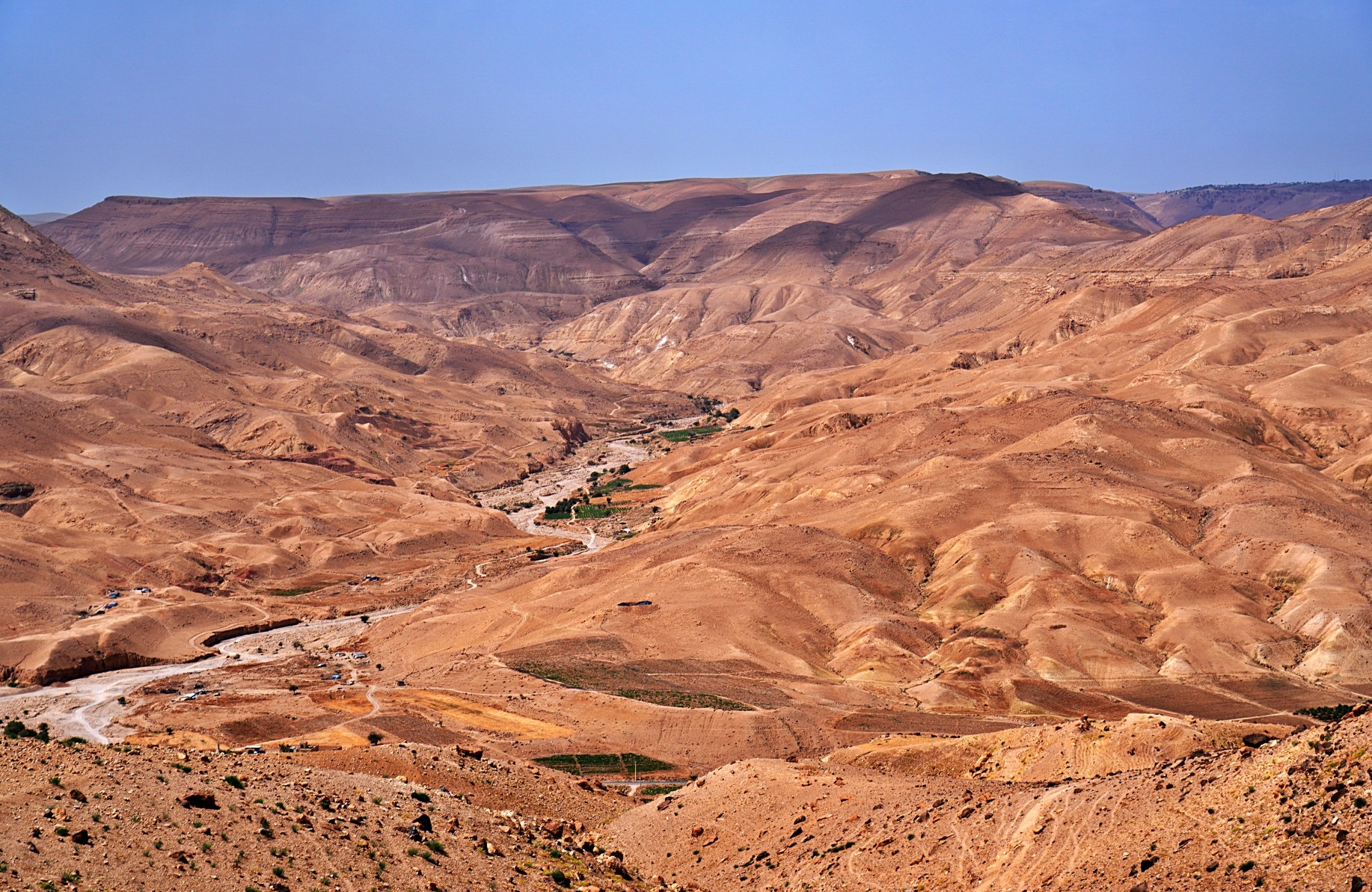
From the Natufian village, the trail crosses a small flat section enclosed by rugged red cliffs. Although it wasn’t very scenic, we still liked it because we walked right through a herd of camels, including two young ones.


After passing between a few ranches, you’ll reach the Back Door entrance to Petra Archaeological Park. You need to show your ticket, and maybe your passport, so bring both. You cannot purchase a ticket or have your Jordan Pass scanned at this entrance; you need to have your Petra entrance ticket. When you first check in to the Petra ticket office, they will give you one ticket valid for as many days as you purchased with your Jordan Pass.
From the park gate, the trail is much more undulating. It climbs up and down stairs and inclines as it winds around Jabal Ad Deir (Monastery Hill). This side of the mountain is riddled with deep and steep gorges.
You’ll pass a few tea shops along the way if you need a break. One is located on the ledge in the last picture below. If you zoom in, you can see benches and a Jordanian flag.


Ad Deir Monastery
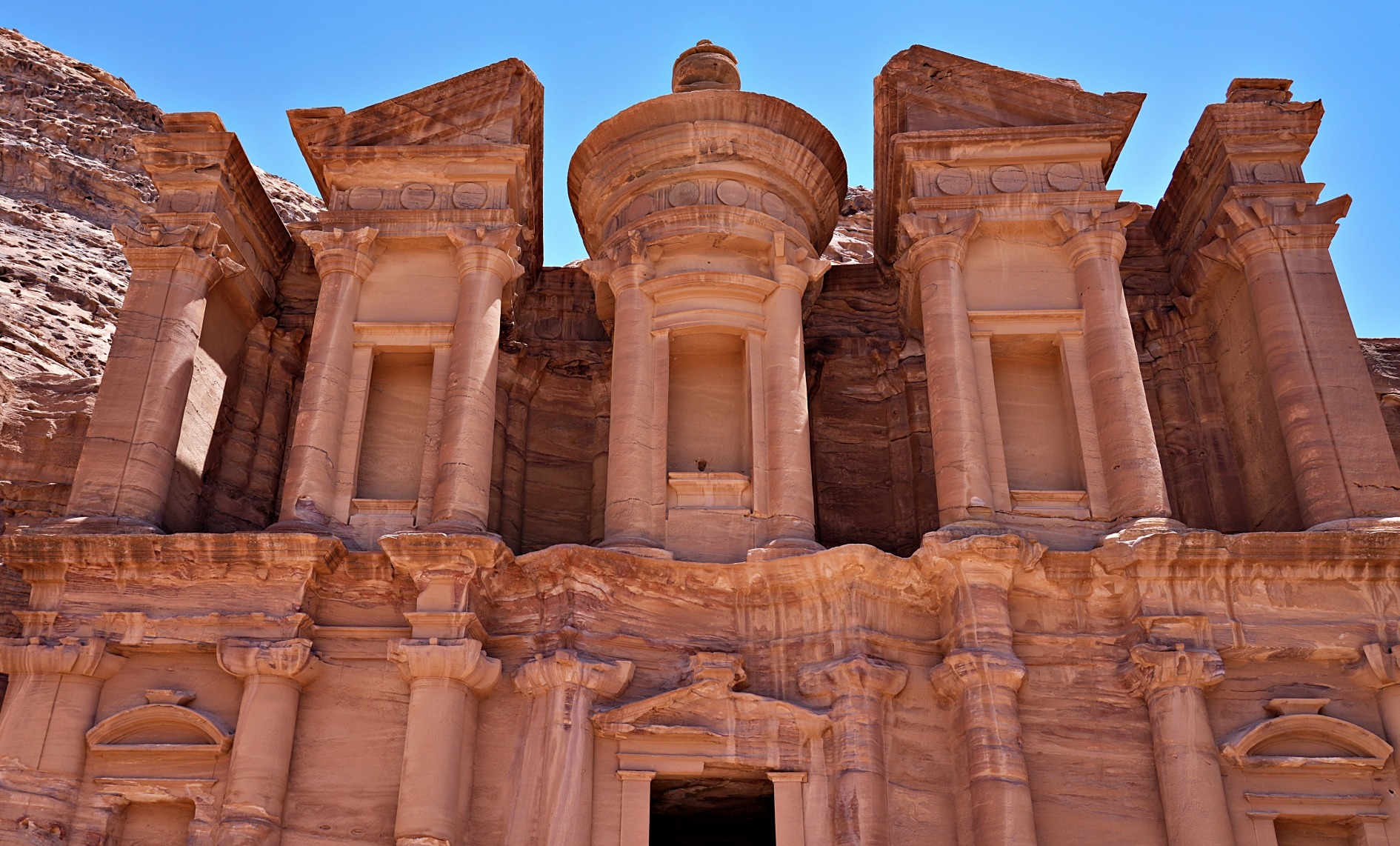
The approach to Ad Deir Monastery (also spelled Ad-Dayr) isn’t as dramatic as the one to the Treasury, but from this trail, you get a peek-a-boo view. Most hides behind the cliff walls until you get right in front, so there is a bit of a buildup.
Nabataeans used the 2nd-century AD building for religious ceremonies. The Byzantines converted it into a church, which is why the Bedouins called it a monastery (Ad Deir).

Once you stand in front, you can fully appreciate this fantastic building. At over 48 m (157 ft) high, it is a taller and wider version of the Treasury. Precisely carved into the mountain wall, the monastery is a piece of art. Like the Treasury, it has pagodas, a broken pediment and an urn. You may notce a few differences, though. For instance, the capitals are only half the height of typical Greek ones. You will see these Corinthian-Nabataean capitals on some of the tombs and temples in Petra.

Other than the size, there are a few other differences between the Treasury and the monastery. One is that its top is three-dimensional, not just a façade like the Treasury. Secondly, instead of carvings of goddesses as we saw on the Treasury, the monastery has deeply cut niches meant to hold statues. Another difference is that the monastery doesn’t have intricately carved details we see in the Treasury. These differences don’t take away from it, but rather give it a distinct personality.


During the winter solstice, the setting sun shines on the altar at the front. The door is the only source of light inside the building, making this detail even more impressive. Other than that time, though, there isn’t much reason to go inside since it is a dark, empty room.
After walking for two hours to reach the monastery, you’ll be happy to have a cold drink in one of the cafes in front and enjoy the view of the monastery.
Tip – It is in the shade until about 12:30 pm, so for pictures, don’t arrive too early.
Returning on the Ad Deir Monastery Trail
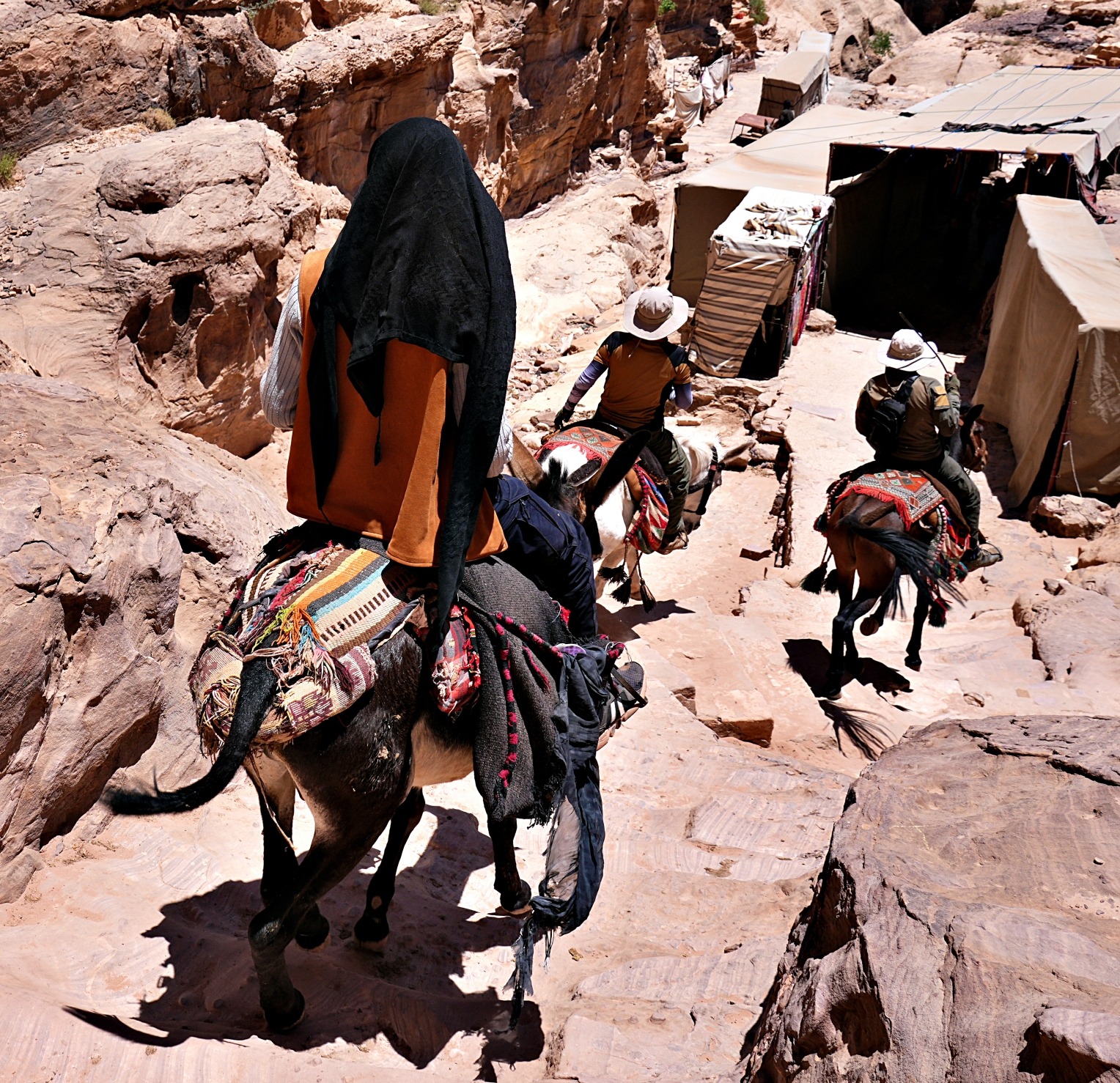
After visiting the monastery, continue your hike down the 800 hand-cut stone steps of the Ad Deir Monastery Trail. They take you all the way down to the Basin at the bottom of the hill. It is much busier than the back side trail, with several kiosks selling various tourist knickknacks, including scarves, fridge magnets, and copper pots.
This is the trail that most will take to reach the monastery, but we preferred our quiter route by walking from Little Petra.


When you’re near the bottom of the stairs, you’ll reach the Lion Triclinium. Its name comes from the lions carved on both sides of the entrance. Tricliniums were halls for formal banquets and religious ceremonies. Unfortunately, this building has suffered over time. For example, its misshapen door is the result of a broken window. As well, many of the original details have weathered and worn. In addition to the lions, a Medusa mask once decorated the façade.


If you are unable to walk up on your own, you can hire a mule in the Basin area. Usually, the mule only takes you up, and you are expected to walk down, but confirm with your muleteer if you want to ride it both ways. It would be pretty scary to go down those steep steps on the back of a mule, though.
2. Wadi al-Farasa – High Place of Sacrifice Trail
Another great hike inside the Petra Archaeological Park is to the High Place of Sacrifice. It is located above the theatre and can be reached from either end. We’ll describe it from the Wadi al-Farasa trailhead near Qasr al-Bint Temple. This CCW direction makes for a slower climb to the sacrificial altar, but in return, it has a steeper descent. The other option is to begin on the High Place of Sacrifice Trail beside the theatre. Both trails are marked on the Tourist Map available at the Visitor’s Centre.
Trailhead – Behind Qasr al-Bint Temple. Distance – Wadi al Farasa Trail is 2.7 km (1¾ mi), High Place of Sacrifice is 1.2 km (¾ mi), done as a loop it is 3.9 km (2.4 mi); Elevation Gain/Loss – 170m (558 ft); Time – 2-3 hours
The trail begins near Qasr al-Bint Temple and wanders through Wadi al Farasa. This rugged canyon runs behind the theatre, parallel to the main street. Since there are several rock-cut tombs and halls in this valley, it was surprising that this trail is much less visited than the main area. Seeing these further increased our understanding of just how large Petra was in its prime.


Three tombs in this valley are quite unique compared to others we saw in Petra. The first is the Soldier’s Tomb. On its front are three deep niches with statues of men dressed in military costume, which gave it the name. One is dressed in Greco-Roman military costume, so it is sometimes called the Roman Soldier’s Tomb. Another is the Garden Triclinium with a wide staircase and three free-standing columns. It was likely used as a meeting hall rather than a tomb. In the surrounding grounds are several cisterns. Some tombs, such as the Broken Pediment Tomb, appeared to still have Bedouin inhabitants.


After passing these notable tombs, it will seem as if you’ve reached a dead end, but this is where the climbing begins. Follow the series of rock-cut steps that take you higher and higher up the mountain.

Halfway up, you’ll come to the highly eroded Lion’s Fountain. Above this, you may think you’ve gone the wrong way because your map application will tell you that you’ve passed the High Places of Sacrifice. Don’t worry, it is high above you on the mountain, and the map thinks you’re at the same level as it. Stay on the trail; it will take you there.
After more climbing, you’ll reach an obelisk marking the point where the two trails meet. Keep climbing up, following the spray-painted arrows until you reach the mountain’s summit. The High Place of Sacrifice spreads across the summit as a large flat area with space for rituals around a central altar.
Although little is known about the rituals, researchers do know that it was here that Nabataeans sacrificed animals such as sheep and goats in reverence to their god Dushara. The round basin pictured below collected rainwater used in ceremonial purifications, while the animal’s blood was collected in a separate recess. Worshippers gathered in the large open space in front of the altar.


From the summit, you can look down upon Petra’s Street of Façades and Qasr al-Bint Temple.

After visiting the sacrificial altar, retrace your steps to the obelisks. Then, you can either return the way you came, or follow the spray-painted arrows to a different staircase and begin your descent down the Place of High Sacrifice Trail. There isn’t much reprieve on this side, and it is a knee-jarring 170m (560 ft) down. At the bottom, you’ll end up at Street of Façades.

Al-Khubtha Trail
The third hike we recommend is to a viewpoint of the Treasury on Al-Khubtha Trail.
Distance – 1.2 km (¾ mi); Elevation Gain – 168m (550 ft); Entry – unlike the other Treasury viewpoints, this one is free
Beside the Palace Tomb in Petra Archaeologial Park, you’ll find the steps that take you up to the best view of the Treasury. Al-Khubtha Trail begins by going up hand-cut Nabataean steps. We were surprised that they even left a thin stone barrier when they carved the steps.
A herd of goats belonging to a Bedouin farmer joined us on our hike. Some Bedouins still live in the area and survive as subsistence farmers, just as their ancestors did.


Partway up, the path changes to modern stairs that are easier to manage. Make sure you stop at the first viewpoint for a great view down to the theatre.


After reaching a Bedouin camp, a hiking trail takes you up and down the rough terrain behind the cliffs until you emerge at an amazing viewpoint of the Treasury. We gasped when we saw this stunning feature from above.
Since the Treasury is typically in shade until 9:30 am, don’t go too early. We arrived just after 10 am, so it was in full sun.

The return route follows the same path. You can find the route on Mapy.cz. It is also marked in green on the tourist map that is available at the Visitor’s Centre.
Petra Museum
No trip to Petra would be complete without a visit to the Petra Museum, located in the same complex as the Visitor’s Centre. It features a selection of artifacts found in the area dating back to the Stone Age. The most interesting to us were the ones found in Petra itself, including the elephant capitals and Goddess of Hayyan Baetyl. The stone face is a baetyl, or sacred stone, also called a stele. The Nabataeans didn’t represent their deities in human form, but rather as decorated stones. Although this one has a face, they usually lacked human features.


For information on where to stay and eat in Wadi Musa, please visit our post Petra: Exploring The Ancient Wonder.
Please note, we visited Jordan in the spring of 2026. At that time, there was a ceasefire in the Iran War due to the signing of the Memorandum of Understanding. Since conditions are changing frequently, please read current news about the area before planning your trip.

Here’s a link where you can read more of our adventures in Jordan, and a link to our interactive map of Jordan.
Coming Next – Wadi Rum: A Visitor’s Guide
For pictures from other blogs go to Gallery at monkeystale.ca.
To read about more of our adventures go to Destinations.
If you like what you read, please comment or share (with credit) using the links below.




We’d love to hear from you, please leave a comment.