
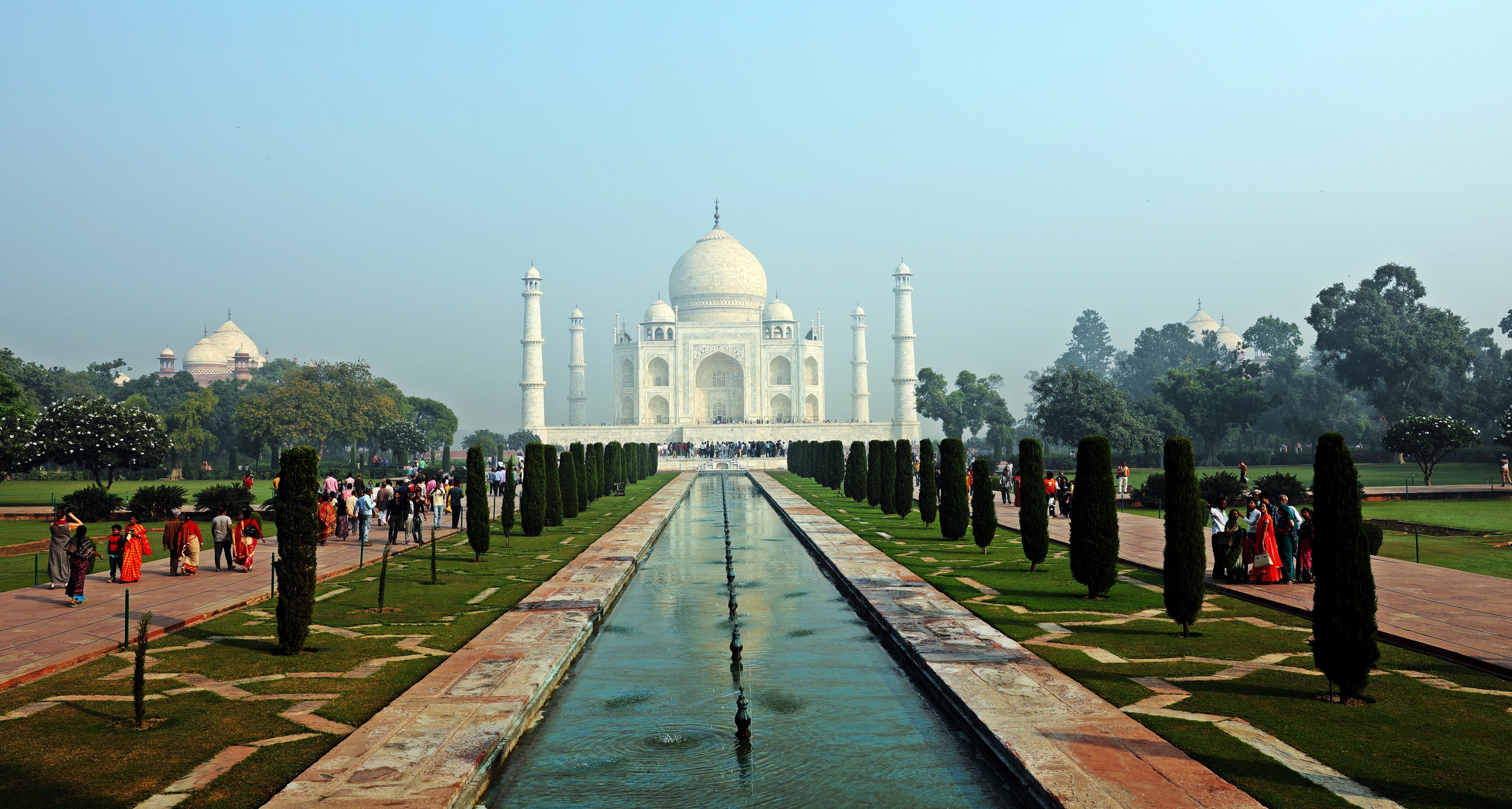
The Taj Mahal is touted as being one of the most beautiful buildings in the world. After seeing it in person, we have to agree. It’s awe-inspiring. Come with us as we show you the beauty of The Taj Mahal as well as other historic buildings in Agra.
Taj Mahal
What makes the Taj Mahal so beautiful? Most likely it’s the combination of its features that work so well together in perfect balance. The building is composed entirely of smooth, white marble, giving it an elegant appearance. The front entryway is a large vaulted, arched doorway with similar smaller ones on either side. All these doorways match the curves of the over-sized, onion-domed roof. The four tall, white minarets at each corner provide a lovely frame for the building. Supposedly the minarets were built with a slight outward lean so that if they fell, they would fall away from the Taj.
There is a long pond leading from the Great Gate to the Taj’s entrance. In the early hours, before they turn on the fountains, the Taj nicely reflects in the pond. Another component that adds to its beauty is that the background is always open sky so there is nothing else to compete with the view. Finally, the symmetry of all these features result in it being one of the most beautiful buildings in the world.


In addition to being gorgeous from afar, when you move closer you can see all its fine details. There are hundreds of marble flowers carved into the walls, bordered by painted flower designs. Around the main arch is beautiful, black calligraphy and inside the arch are carvings matching the arched doorways.


Called simply The Taj by locals, it is set along the Yamuna River in a large, manicured garden surrounded by a large stone wall. We were able to see the Taj at both sunrise and sunset. Because of the air pollution we had red skies for both.


The Great Gate is a beautiful building on its own. Built in red sandstone and marble, with large vaulted, arched doorways that mimic the Taj’s. Across the top of the door are 11 chhatris (domed shaped pavilions) and large ones at each corner. The Gate is a part of the large red sandstone wall that surrounds the Taj and gardens.


On either side of the Taj Mahal are two identical red sandstone and marble buildings with white onion domed roofs and vaulted, arched doorways. One is a mosque. The other may only have been built to complete the symmetry around the Taj.


This UNESCO World Heritage building was built in 1632 by Mughal Shah Jahan. His 3rd wife, Mumtaz Mahal, died during childbirth of their 14th child. Apparently, he was so heartbroken by her death that he created the world’s most beautiful mausoleum in her memory. It took 17 years to build and not long after the building was completed, Jahan was overthrown by his own son and thrown in jail in Agra Fort. The story is that Jahan had a view of the Taj Mahal from his jail cell window. After his death, his body was placed beside Mumtaz’s in the Taj Mahal.


Agra Fort
Agra has many other gorgeous historical buildings in addition to the Taj Mahal. Agra Fort was built by Shah Jahan’s grandfather Shah Akbar. This UNESCO World Heritage site has an imposing red sandstonewall with large turrets and a formidable gate.


Inside are a few Mughal style buildings including the Hall for Public Audience. It’s an open-air building with multiple arches on the ceiling and large columns at the arches’ bases. Further inside is a palace built by his grandson Shah Jahan. The palace was built in Jahan’s favourite white marble. There are several rooms with arched ceilings and carved marble decorations on the walls.


Baby Taj
Down river from the fort is Baby Taj. It’s a mausoleum for the grandfather of Jahan’s wife who was an important Persian businessman. Baby Taj is a small but intricately decorated tomb made of marble. There are small carvings and elaborate paintings on the interior and exterior walls as well as the ceilings.


Shah Akbar’s Mausoleum
Outside of Agra is Shah Akbar’s Mausoleum. South Gate is the main entry to the mausoleum and is made of beautiful red sandstone with intricate inlaid designs in white marble and black slate. The mausoleum is long building with many chhatris on the roof and a grand entryway.


Inside, the ceilings and walls are painted in colourful blue and gold designs. Between the gate and the tomb is a large park where we saw many deer and antelopes grazing on the lawn.


We enjoyed seeing all the Mughal architecture in Agra and are excited for our next week exploring other historical buildings in the area.
To read more of our adventures in India, click here.
Coming up next: Mughal architecture around Agra
For extra pics from this trip go to Gallery/Delhi & Eastern India. For extra pictures from other blogs go to Gallery at monkeystale.ca
To read about more of our adventures go to Destinations.
If you like what you read, please share, with credit, using the links below




We’d love to hear from you, please leave a comment.