
Mughals and Sultans ruled much of northern India in the 16th and 17th centuries and left behind beautiful architecture. Some of these are located a short distance from Agra. They are not often visited by tourists, which makes them even more enjoyable to visit. Let us show you the fabulous historical sites in Fatehpur Sikri, Gwalior, Orchha.
Fatehpur Sikri
Forty km east of Agra is the historical city of Fatehpur Sikri. The capital was located here for 15 years in the late 16th century by Shah Akbar, who also built Agra Fort. His reason for moving the capital to Fatehpur Sikri was because a local sage accurately predicted the birth of his son and heir to his empire. The capital was moved back to Agra after his death.
His fortress is the main site. It doesn’t have a grand entry, but there are many fascinating buildings inside. Your visit begins in a large open courtyard, surrounded by red sandstone buildings and an ornamental pool at one end. Most of the buildings look plain from afar, but on closer inspection you find intricately carved designs on the vaulted ceilings, walls and columns.


The Hall for Private Audience is a very interesting building. It has 4 white-domed chhatris on each corner of the roof. Inside, you’ll find a large engraved pillar in the centre. Unusual raised walkways travel between the pillar’s top and the building’s walls. It is said that Akbar debated with different religious leaders here, each stood in a different corner of these walkways.


In the middle of the grounds is Panch Mahal; a 5-tiered open-air building with many pillars on each level. Akbar spent his evenings on the top tier enjoying the cool breeze and the view accompanied by ladies from his harem. These ladies lived in residence on the edge of the fort. It had room for his harem of 5,000 as well as 250 maids. Apparently, there was once a passage from the harem to the 5-tiered Panch Mahal.


Much of the fortress has been renovated, but behind the renovated area we found a beautiful old, large gate with elephant carvings. The path from this gate led to a tall, strange pillar that looks like a hairbrush with pointy barbs. The barbs are actually stone carvings that are supposed to represent elephant tusks.


Beside the fortress is a large mosque. Jama Masjid was also built by Shah Akbar. The mosque is surrounded by a huge wall of red sandstone brick with an elaborate high arched gate. Inside is a large open courtyard with a few small buildings. One of the buildings is a simple mosque with a long prayer room. Another is a white tomb for the sage that predicted the birth of Akbar’s son.


Gwalior
East of Agra an ancient hill-top fort sits above a run-down town. Gwalior Fort spreads along most of the 3km long plateau on top of the hill. The fort’s first buildings were built under Sultan rule and later ones, by Hindu Maharajahs. There aren’t many buildings still standing inside the fort walls, but the remaining ones are worth a visit.


Aqueduct
Inside the fort walls is an 8th century aqueduct with an interesting legend. Apparently, a hermit used water from the aqueduct to cure a Sultan chieftain of leprosy. The hermit then told the chieftain that as long as his family used the name Pal, they would remain in power. Legend goes that they did and only lost the kingdom when the 84th descendant changed his name.


Man Singh Palace
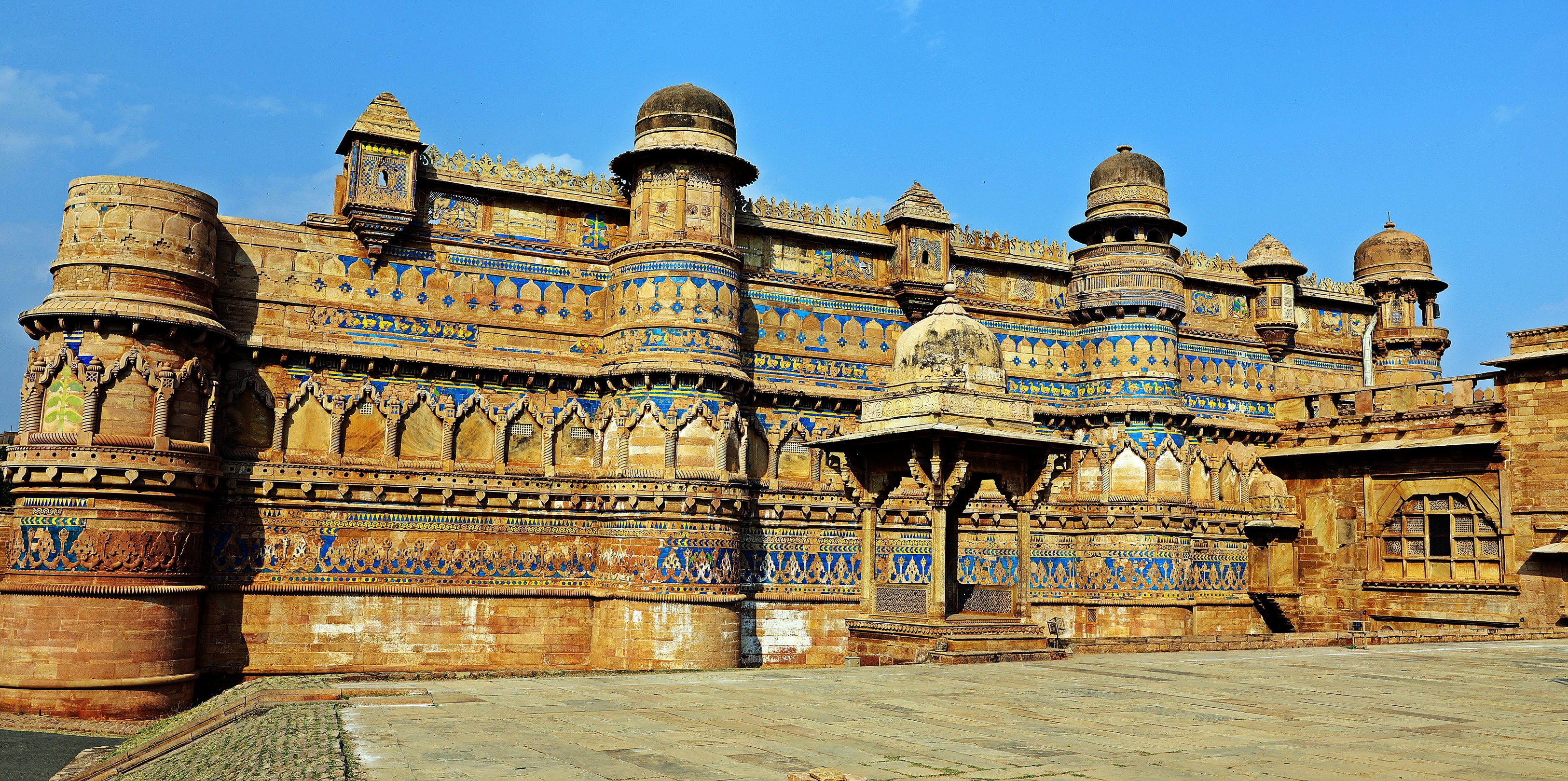
Across from the aqueduct is a colourful 15th century Hindu Palace called Man Singh Palace. The outer walls are painted with blue, yellow and green tiles with depictions of ducks, elephants, crocodiles and lions.


Inside, are two courtyards with remnants of colourful tiles and elaborate carvings on the walls and doorways. There were many small rooms off the courtyards and a few had bats hanging from the ceilings.


The unusual feature of this palace is the two-stories of basements with circular rooms surrounded by large pillars. The basements were used in the summer months to keep cool, but later the Mughals used the basements to hold prisoners. The rooms were quite eerie and it was easy to imagine prisoners being locked up in them for years.

Mother-In-Law and Daughter-In-Law Temples
Further down the road, within the fort walls we found two Hindu temples called Mother-In-Law and Daughter-In-Law Temples. Both temples are decorated inside and out with hundreds of small sculptures on the pillars, walls, doorways. They’re quite beautiful, and reminded us of buildings in Hampi.


Teli Ka Mandir
Teli Ka Mandir is an interesting 8th century temple. It’s a tall, stone building with many carvings on the exterior. What makes it different is the a rounded wagon-style roof. It is the oldest building on the fort grounds. Apparently when the British were in power, they used this temple as a tea house. It would have made an interesting cafe.

Jain Carvings
Down the hill on the backside of the fort and outside the wall is a fascinating Jain site. Huge 15th century carvings, up to 5m tall, have been carved right into the cliff wall. The carvings represent the 24 Jain teachers. Jain is an ancient religion, as old as Buddhism. (You can read more about Jainism in our post from Parasnath.) Many of the carvings are being renovated after years of carnage, but you can still see much of the original detail that went into these.


In Gwalior we went to the iconic Indian Coffee House. The coffee wasn’t very good, but the waiters in their white, safari suits and peacock hats were worth the visit. As usual, there were many cows roaming the streets, including one we saw entering a restaurant.


Orchha
Further east, the town of Orchha has some of the most remarkable buildings in the area. They are from the 16th – 18th centuries and all are within a few minutes’ walk of each other.
Jehangir Mahal
Jehangir Mahal is a huge palace. Its large inner courtyard is surrounded by many rooms on each side. Above the courtyard are three floors of terraces, wrapping around the courtyard. Each terrace looks over the courtyard and the outside to the surrounding buildings. There were dozens of narrow, stone stairwells leading up to them.


At the corners of the top terrace are large domed chhatris with smaller chhatris along each wall. The building has such elaborate architecture and so much character, it was one of the most interesting buildings we’ve seen. Even the monkeys like it. There was a troupe of Hanuman monkeys with very longs tails hanging out on the top tier of the Mahal.


The rear gate of Jehangir Mahal has a very impressive, large wooden door with elaborate carvings on both sides of the door including two large elephants. Behind this gate is a stable for camels with really tall doors. We had read that the palace was set in a lush garden, but it was in a disheveled yard from what we saw.


Raj Mahal
Across from Jehangir Mahal is Raj Mahal. It’s a much plainer looking building from the outside, but the rooms inside are very elaborate. They are decorated with gorgeous frescoes of people, horses, elephants, and the Hindu Gods Rama and Krishna. Many of the frescoes were badly damaged, but we were able to find a few in good condition.


Palki Mahal
Palki Mahal is a small building across the river and is in disrepair, but has an interesting history. The owner was charged with committing adultery with his brother’s wife. To prove his innocence, he committed suicide. Now he is regarded as a hero by local women. There is a memorial for him in a nearby garden (Phool Bagh). Women believe he will grant their wishes if they walk five times around his memorial and tie a string to a fence. The nearby fence was covered in strings!

Chaturbhuj Temple
This is a very impressive structure from the outside. Chaturbhuj Temple has high spires that are elaborately decorated with detailed carvings. The inside however, is quite ordinary with a simple shrine at the front. There are multiple steep stairwells to reach the temple’s roof. Each step is almost knee high, but with a very small area for your foot so we had to climb them sideways. Climbing up was tough, but down was even worse. From the roof though, we had nice views of the river valley and the other buildings of Orchha.


Cenotaphs
Further down the river is a walled area with a well-maintained garden and 12 cenotaphs (monuments) for Mughal leaders from the 17th and 18th centuries. They are still in very good condition with a lovely garden setting. Orchha was a nice surprise as it’s not highly publicized but has such an incredible architecture and history.


To read more of our adventures from India, click here.
Coming up next: Bodhgaya and Parasnath Hills.
For extra pics from this trip go to Gallery/Delhi & Eastern India. For extra pictures from other blogs go to Gallery at monkeystale.ca
To read about more of our adventures go to Destinations.
If you like what you read, please share it using the links below.




We’d love to hear from you, please leave a comment.