
Goa is famous for its white sand beaches, tourist-friendly culture and party atmosphere. We found all of this, but also found great historical neighbourhoods with old buildings from its days as a Portuguese trading centre. Here is an idea of the sites to see in Palolem and Panaji, Goa.
Palolem Beach
Palolem, in south Goa, feels more like a beach town in Sri Lanka than in India. The large cove is lined with sand, and though not the finest sand, the beach was quite clean and has a quiet pace. The waves are gentle which makes it a great area for swimming and kayaking. You can see locals collecting barnacles off the rocks.


The other part that makes this an unusual Indian site are the restaurants and bars that line the beach and offer sunbeds and umbrellas. In the evening, the restaurants set up romantic candle-lit dining on the beach. We haven’t seen anything like this anywhere else in India.
The beach town of Palolem has many great hotels, restaurants and even tolerate women wearing shorts! They are ready for western beach-going tourists. It certainly didn’t feel like India but was a lovely spot to relax for a few days.


At one end of the beach, the shore is very rocky with large boulders forming smaller coves and a cape. On the end of the cape, a coconut grove on a small hill gave us great views of the beach and the rocky shore on the other side.


At the opposite end of the beach, a small estuary cuts off one section of the rugged shore. Many fishing boats were just left on the sand until the water level rose. There’s a rickety bridge to get to the other side when the tide comes in, luckily it was low when we were there so we could hop over the small stream and not test the bridge.


We went kayaking one morning to get a better view of the coast line. Since we were there at the end of dry season, the area was quite brown, but it is still a lovely coast with rocky cliffs and small coves with secret beaches. It’s supposed to be one of the best spots to see dolphins, but they must have been shy on the day we were there because we didn’t see any.


Panaji
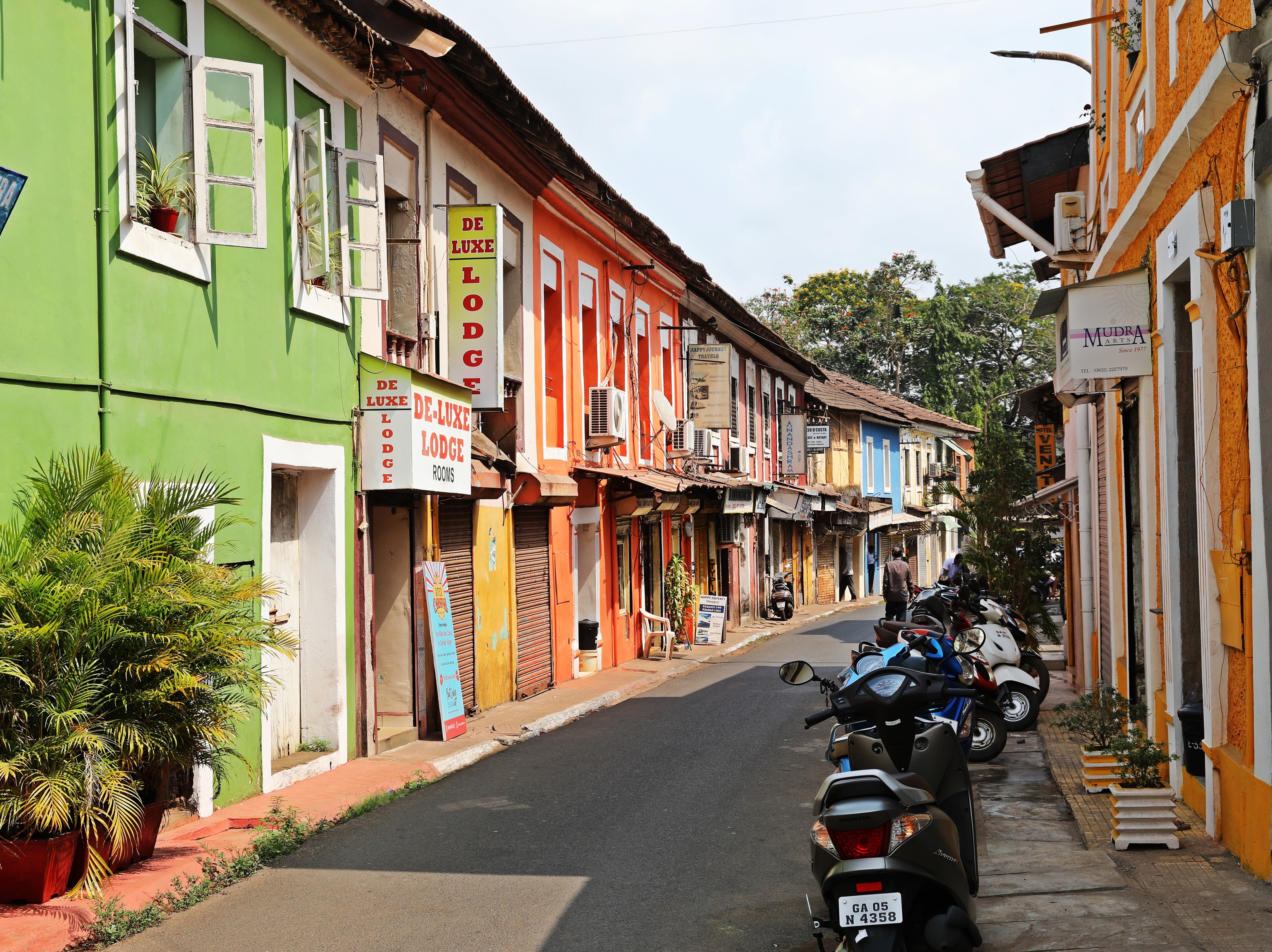
Further north, the capital Panaji is a lovely old city established by the Portuguese. Its architecture and culture have a strong Portuguese influence of which the Goan natives are proud. The neighbourhoods have narrow streets, with renovated small buildings that are now homes, shops, restaurants and hotels. There’s a really nice feel to the town and a laid-back attitude which is unusual for a state capital. We enjoyed wandering the streets, admiring the old buildings.


There are a few hills in town that give Panaji a unique character. It can be seen in the homes, and especially in Maruti Temple and Our Lady of Immaculate Conception church. The staircase in front of Our Lady of Immaculate Conception is similar to a couple we saw in Portugal, one was in Douro Valley. The most famous, Bom Jesus is in Braga. (click on the links for those stories.)


Old Goa
The first settlement in this area is called Old Goa and is only a few kilometres away from Panaji. From the 16th -18th centuries, Old Goa was at its peak and was larger than London. It was abandoned when a plague killed many of the citizens and the city was moved to Panaji. All that is left of Old Goa today are churches, of which there are plenty.
Basilica of Bom Jesus (Baby Jesus) is a 16th century large brick church that has a rather plain baroque-style exterior, but the interior is another story. Its large, ornate golden alter that takes up the entire front wall of the church. To its side is a grand mausoleum for St. Francis Xavier, the first missionary to India.


Within a short walk are several other churches. Across the street is Sé Cathedral, the largest church in Asia. It was built in the Tuscan style with a large, yet simple, white front. Behind it is the Church of St. Francis of Assisi with beautifully carved wood paneling in a long nave with vaulted ceilings. A block away, the Church of St. Cajetan was built by Italians and has large white pillars on its exterior. Inside there are four short naves leading to a lovely wooden centre piece alter. St. Augustine was once a large church and monastery, but when Old Goa was abandoned, it was neglected. Today it is completely in ruins.


Goa State laws are more relaxed than other states, and they have lower taxes, cheap alcohol and a lot of casinos. The popular thing in Panaji seems to be floating casinos. We saw 5 or 6 ships with casinos inside docked just off the shore.

To read more of our adventures in India, click here.
Coming up next: The Rock-Cut Temples of Ajanta and Ellora
For extra pics from this trip go to Gallery/Western India. For extra pictures from other blogs go to Gallery at monkeystale.ca
To read about more of our adventures go to Destinations.
If you like what you read, please comment or share, with credit, using the links below.




We’d love to hear from you, please leave a comment.