
With headlamps providing our only light we waded up the cold river, going deeper and deeper into the dark cave. We were headed toward a gateway to the Maya underworld. Thousands of years ago the land that we now call Belize was a part of the vast Maya Empire. They left behind magnificent sites including flat-roofed pyramids, stone palaces and a sacrificial cave.
Actun Tunichil Muknal (ATM cave)
Note: Cameras and phones are not allowed inside ATM cave. Pictures below are courtesy of our tour company, MayaWalks.
This is one of the best cave tours we’ve ever done. It’s touted as being adventurous and historical all at the same time. The adventure started right away. Soon after the parking lot we had a river crossing in shoulder deep water. A safety rope was strung across the river so we wouldn’t get swept downstream. There were 2 more challenging river crossings during the 45-minute hike so we were already wet when we arrived at the cave entrance. With our headlamps turned on we swam and waded up the river, going deeper and deeper into the dark cave. Led by our guide, we proceeded in single file relaying warnings to each other of obstacles both above and below the water. Squeezing through tight passages, sliding down smooth waterslides, and swimming in the deep river was an exhilarating way to travel in the cave. On the way we shone our headlamps on many beautiful stalactites and stalagmites in many different formations.


The Maya people strongly believed in the underworld. They believed that it is where the gods of agriculture and rain resided. Since the Maya had to carry flaming torches for light, they could not have entered the cave where we did. When we were over 3 km inside the cave, our guide showed us a steep ramp leading up to a hole in the ceiling. Historians believe that this was the entrance the Maya used as their gateway to their underworld. The cave was first used in 300 AD after a few years of drought. The Maya came to the cave to beg for rain and to find a source for water. Soon after passing this Maya entrance, we were on dry ground and started to see Maya artifacts. There were clay urns and pots that had been left for the gods. They would have been filled with food. One pot, called ‘Monkey Pot’ has a small etching of a creature on it and is one of only four Monkey Pots pots found in Central America. Other offerings were stalactites sculpted in the form of animals and people. It was obvious that this cave was very important to the Maya people.


Over the centuries they went further into the cave to get closer to their gods and their offerings intensified. By 600 AD the Maya people became very desperate. We followed their steps by scrambling up a rock that led to an open ledge. Here we saw our first sacrificial human bones. As we walked further we saw several more. The Maya sacrificed their own people as offerings to their gods. Some were young and some were old, and most were from important families. We continued to follow the Maya’s trail and ascended a bamboo ladder to the furthest point in the cave. Here we saw the ‘Crystal Maiden’. A full skeleton, glittering with calcite, lying on the cave floor. The skeleton is dated to 900 AD so is one of the youngest findings in the cave. In all over 1400 human artifacts have been discovered in ATM cave dating from 250 to 909 AD. Adventure and history together made this cave tour one to remember.


Getting to ATM cave
In order to tour the cave, you have to go with a certified guide. Tours leave from the city of San Ignacio. We used MayaWalks Tours and were very pleased with their guides and their service.
Xunantunich
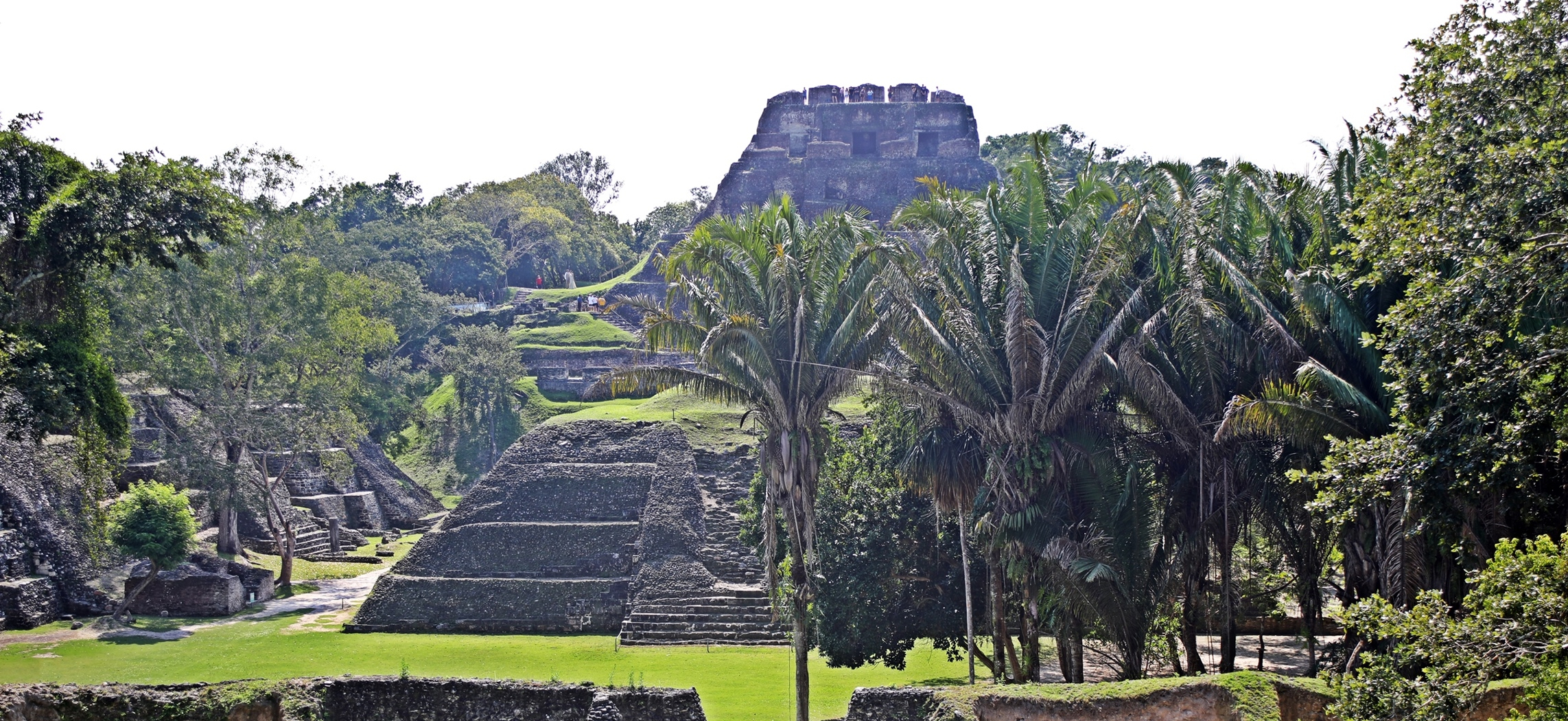
Translated to Stone Woman, Xunantunich was one of the largest Maya cities ever built. There are remnants of temples, ritual sites, palaces, residences and burial chambers. At the centre is the impressive pyramid, El Castillo. At 42m (130 ft) high, El Castillo is the 2nd tallest man-made structure in Belize. It’s a typical Maya pyramid with a series of stairs leading up to a large flat top. Near the top of this structure are large friezes depicting kings, dancing women and astronomical symbols. From the top of El Castillo you can see the entire site with its green courtyards and temple pyramids. Looking the other way you can see the Guatemalan border which is only 1 km west.


At the other end of the city are the remains of a large palace once home to royals and elite Maya families. From its top is a lovely view of green courtyards and the majestic El Castillo.
As we discovered in the ATM cave, Maya people could be very cruel. In Xunantunich are the remnants of the courts for a Maya ball game where the losers were sacrificed to the gods.


Getting to Xunantunich
By Bus – From the San Ignacio bus stop catch any bus heading to Benque and asked to be dropped off at the Xunantunich ferry, 10 km from San Ignacio. The bus driver will know where this is. $2 BZ/person
By Taxi – Take a taxi from San Ignacio, min $20 BZ.
After getting off the bus or taxi, hop on the free hand powered ferry over the Mopan River. It’s a short but relaxing ride. Then walk 1.6 km (1 mile) up a hill on a semi-paved road to reach the site. Cars can go on the ferry, but the fee is $35 to park. If you don’t want to walk up the hill your taxi can drive you, but the fare will include the $35 parking fee. The ferry operates 7:30am to 5pm
Tours – There are many tours offered in San Ignacio which usually combine Xunantunich with Cahal Pech.
Entrance Fee – As of February 2020 entrance fee is a reasonable $10 BZ.


Cahal Pech
Its name translates to ‘Place of Ticks’ but don’t let the name dissuade you from visiting. Cahal Pech is a small Maya site dating back to 1200 BC making it Belize’s oldest Maya ruins. Cahal Pech is perched atop a small hill overlooking the city of San Ignacio and is believed to have been a palace for an elite family. Today the site includes the remains of a large stone temple surrounded by residential buildings and open grassy courtyards. It has a serene peaceful setting in the middle of a jungle. This small site doesn’t get as many visitors as the other sites which further adds to the peaceful setting.


Getting to Cahal Pech
It’s a 20-minute uphill walk from downtown San Ignacio to the entrance of the archaeological site.
Entrance Fee – As of February 2020 entrance fee is a reasonable $10 BZ.
San Ignacio
Located near many of the Maya sites, San Ignacio is the ideal city to use as your base when visiting the ruins. It has a slow Caribbean vibe, friendly locals and many good restaurants and hotels. There’s a great pedestrian mall in the downtown area that houses many cafes restaurants and shops.


Getting to San Ignacio
By Car – San Ignacio is easy to drive to as it is located along the Western Highway, 115 km southwest of Belize City.
By Bus – Buses travel frequently to San Ignacio from the Novelo’s Bus Terminal in Belize City and Belmopan’s Bus Terminal. The buses will say ‘Benque’ as their final destination. We used https://www.belmopanonline.com/belize-bus-schedules and found the information accurate.
By Air – There is an airport in San Ignacio.
Note: We don’t recommend spending time in Belize City. We spent two days in the city and had nothing to do and no sites to see. In addition the city feels unsafe, especially after dark. Nothing happened to us, but we were very cautious. Even Belizians from outside of Belize City said they are afraid to travel there.
Coming Next: Caribbean Cayes in Belize.
For extra pictures from Costa Rica click here. For pictures from other blogs go to Gallery at monkeystale.ca
To read about more of our adventures go to Destinations.
If you like what you read, please comment or share (with credit) using the links below.




We’d love to hear from you, please leave a comment.